“Predicting Accidents in Conditional Autonomous Driving: A Multimodal Approach Integrating Human Misuse, Biometric Indicators, and Spatial Complexity” by Jang, Chang, Kim and Yoon
Conference:
Type(s):
Title:
- Predicting Accidents in Conditional Autonomous Driving: A Multimodal Approach Integrating Human Misuse, Biometric Indicators, and Spatial Complexity
Session/Category Title:
- Interactive Techniques
Presenter(s)/Author(s):
Abstract:
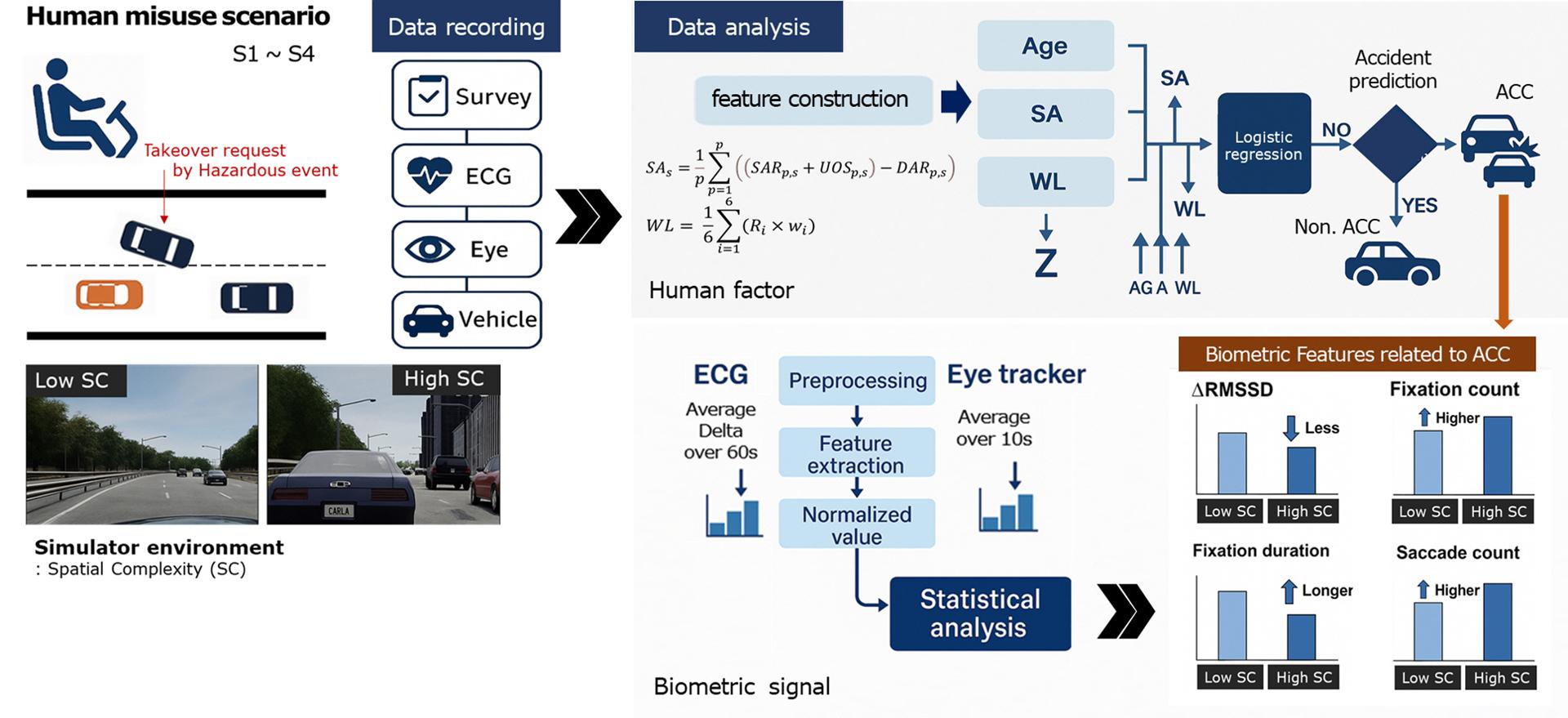
This study presents a multimodal framework integrating human factors(workload, situation awareness), biometrics(heart rate variability, eye-tracking), and spatial complexity to predict Level 2 autonomous driving accidents, achieving 73.7% accuracy via logistic regression, with age and workload as key predictors and elevated cognitive load in complex environments informing real-time adaptive safety interventions.
References:
[1] Oviedo-Trespalacios, O. (2024). Beep, Bleep, Oops! A Discussion on the Misuse of Advanced Driver Assistance Systems (ADAS) and the Path Moving Forward. In Proceedings of the 10th International Conference on Vehicle Technology and Intelligent Transport Systems (VEHITS 2024)
[2] Li, G., Li, Y., Craig, B., & Liu, X. (2022). Investigating the effect of contextual factors on driving: An experimental study. Transportation Research Part F: Traffic Psychology and Behaviour, 88, 69–80.
[3] Ding, S., Abdel-Aty, M., Barbour, N., Wang, D., Wang, Z., & Zheng, O. (2023). Exploratory Analysis of the Crash Severity between Vehicular Automation (SAE L2-5) with Multi-Source Data. Preprint at https://arxiv.org/abs/2303.17788.
[4] Razzaghi, A., Afshari, A., Shahsavarinia, K., Yazdani, M., & Nouri, A. (2024). Distraction and related risk factors among professional and non-professional drivers. Heliyon, 10(11), e31530.
[5] Hart, S. G., & Staveland, L. E. (1988). Development of NASA-TLX (Task Load Index): Results of empirical and theoretical research. In P. A. Hancock & N. Meshkati (Eds.), Human mental workload (pp. 139–183). North-Holland.
[6] Taylor, R. M. (1990). Situation awareness rating technique (SART): The development of a tool for aircrew systems design. In AGARD CP-478 (pp. 3/1–3/17). Neuilly sur-Seine, France: NATO-AGARD.
[7] Healey, J. A., & Picard, R. W. (2005). Detecting stress during real-world driving tasks using physiological sensors. IEEE Transactions on Intelligent Transportation Systems, 6(2), 156–166.
[8] Lin L, Huang C, Ni X, et al. (2015). Driver fatigue detection based on eye state. Technology and Health Care. 23(2_suppl):S453-S463.