“Polarization fields: dynamic light field display using multi-layer LCDs”
Conference:
Type(s):
Title:
- Polarization fields: dynamic light field display using multi-layer LCDs
Session/Category Title:
- Stereo and Light Fields
Presenter(s)/Author(s):
Abstract:
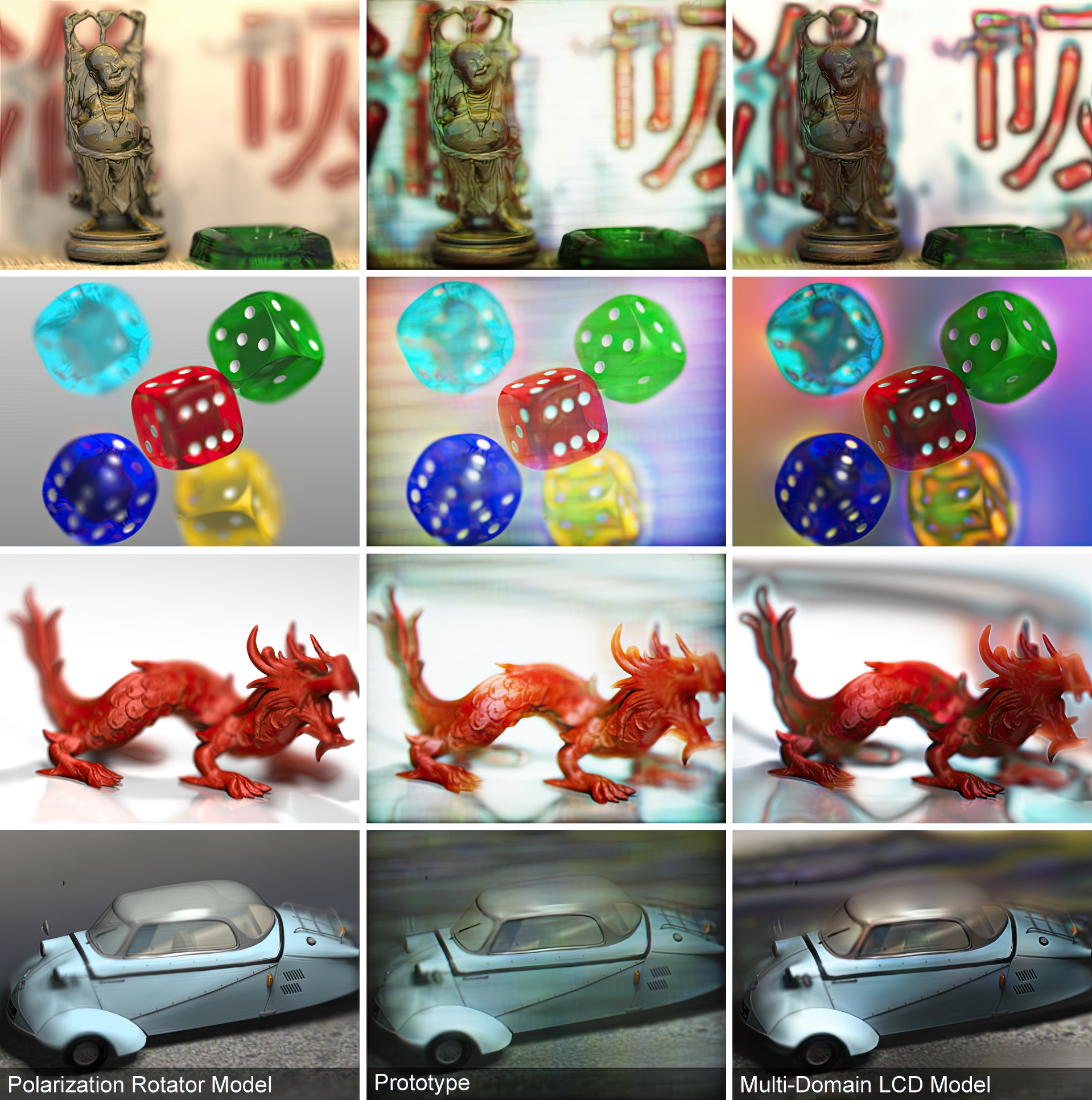
We introduce polarization field displays as an optically-efficient design for dynamic light field display using multi-layered LCDs. Such displays consist of a stacked set of liquid crystal panels with a single pair of crossed linear polarizers. Each layer is modeled as a spatially-controllable polarization rotator, as opposed to a conventional spatial light modulator that directly attenuates light. Color display is achieved using field sequential color illumination with monochromatic LCDs, mitigating severe attenuation and moiré occurring with layered color filter arrays. We demonstrate such displays can be controlled, at interactive refresh rates, by adopting the SART algorithm to tomographically solve for the optimal spatially-varying polarization state rotations applied by each layer. We validate our design by constructing a prototype using modified off-the-shelf panels. We demonstrate interactive display using a GPU-based SART implementation supporting both polarization-based and attenuation-based architectures. Experiments characterize the accuracy of our image formation model, verifying polarization field displays achieve increased brightness, higher resolution, and extended depth of field, as compared to existing automultiscopic display methods for dual-layer and multi-layer LCDs.
References:
1. Akeley, K., Watt, S. J., Girshick, A. R., and Banks, M. S. 2004. A stereo display prototype with multiple focal distances. ACM Trans. Graph. 23, 804–813. Google ScholarDigital Library
2. Andersen, A., and Kak, A. 1984. Simultaneous Algebraic Reconstruction Technique (SART): A superior implementation of the ART algorithm. Ultrasonic Imaging 6, 1, 81–94.Google ScholarCross Ref
3. Bell, G. P., Craig, R., Paxton, R., Wong, G., and Galbraith, D. 2008. Beyond flat panels: multi-layered displays with real depth. SID Digest 39, 1, 352–355.Google ScholarCross Ref
4. Chai, J.-X., Tong, X., Chan, S.-C., and Shum, H.-Y. 2000. Plenoptic sampling. In ACM SIGGRAPH, 307–318. Google ScholarDigital Library
5. Chen, C.-H., Lin, F.-C., Hsu, Y.-T., Huang, Y.-P., and Shieh, H.-P. D. 2009. A field sequential color LCD based on color fields arrangement for color breakup and flicker reduction. Display Technology 5, 1, 34–39.Google ScholarCross Ref
6. Coleman, T., and Li, Y. 1996. A reflective newton method for minimizing a quadratic function subject to bounds on some of the variables. SIAM Journal on Optimization 6, 4, 1040–1058. Google ScholarDigital Library
7. Date, M., Hisaki, T., Takada, H., Suyama, S., and Nakazawa, K. 2005. Luminance addition of a stack of multidomain liquid-crystal displays and capability for depth-fused three-dimensional display application. Applied Optics 44, 6, 898–905.Google ScholarCross Ref
8. Davis, J. A., McNamara, D. E., Cottrell, D. M., and Sonehara, T. 2000. Two-dimensional polarization encoding with a phase-only liquid-crystal spatial light modulator. Applied Optics 39, 10, 1549–1554.Google ScholarCross Ref
9. Dodgson, N. A. 2009. Analysis of the viewing zone of multiview autostereoscopic displays. In SPIE Stereoscopic Displays and Applications XIII, 254–265.Google Scholar
10. Favalora, G. E. 2005. Volumetric 3D displays and application infrastructure. IEEE Computer 38, 37–44. Google ScholarDigital Library
11. Gotoda, H. 2010. A multilayer liquid crystal display for autostereoscopic 3D viewing. In SPIE Stereoscopic Displays and Applications XXI, vol. 7524, 1–8.Google Scholar
12. Gotoda, H. 2011. Reduction of image blurring in an autostereoscopic multilayer liquid crystal display. In SPIE Stereoscopic Displays and Applications XXII, vol. 7863, 1–7.Google Scholar
13. Hart, W. M. 1987. The temporal responsiveness of vision. In Adler’s Physiology of the Eye, R. A. Moses and W. M. Hart, Eds. C. V. Moseby Company.Google Scholar
14. Hecht, E. 2001. Optics. Addison Wesley.Google Scholar
15. Ives, F. E., 1903. Parallax stereogram and process of making same. U. S. Patent 725,567.Google Scholar
16. Jacobs, A., et al. 2003. 2D/3D switchable displays. Sharp Technical Journal, 4, 1–5.Google Scholar
17. Jones, R. C. 1941. A new calculus for the treatment of optical systems. J. Opt. Soc. Am. 31, 7, 488–493.Google ScholarCross Ref
18. Kaczmarz, S. 1937. Angenäherte auflösung von systemen linearer gleichungen. Bull. Acad. Pol. Sci. Lett. A 35, 335–357.Google Scholar
19. Kak, A. C., and Slaney, M. 2001. Principles of Computerized Tomographic Imaging. Society for Industrial Mathematics. Google ScholarDigital Library
20. Keck, B., Hofmann, H., Scherl, H., Kowarschik, M., and Hornegger, J. 2009. GPU-accelerated SART reconstruction using the CUDA programming environment. In SPIE, vol. 7258.Google Scholar
21. Lanman, D., Hirsch, M., Kim, Y., and Raskar, R. 2010. Content-adaptive parallax barriers: optimizing dual-layer 3D displays using low-rank light field factorization. ACM Trans. Graph. 29, 163:1–163:10. Google ScholarDigital Library
22. Levoy, M., and Hanrahan, P. 1996. Light Field Rendering. In ACM SGGRAPH, 31–42. Google ScholarDigital Library
23. Lippmann, G. 1908. Épreuves réversibles donnant la sensation du relief. Journal of Physics 7, 4, 821–825.Google Scholar
24. Loukianitsa, A., and Putilin, A. N. 2002. Stereodisplay with neural network image processing. In SPIE Stereoscopic Displays and Virtual Reality Systems IX, vol. 4660, 207–211.Google ScholarCross Ref
25. Ma, B., Yao, B., Ye, T., and Lei, M. 2010. Prediction of optical modulation properties of twisted-nematic liquid-crystal display by improved measurement of Jones matrix. Applied Physics 107.Google Scholar
26. Moreno, I., Velásquez, P., Fernández-Pousa, C. R., Sánchez-López, M. M., and Mateos, F. 2003. Jones matrix method for predicting and optimizing the optical modulation properties of a liquid-crystal display. Applied Physics 94.Google Scholar
27. Moreno, I., Martínez, J. L., and Davis, J. A. 2007. Two-dimensional polarization rotator using a twisted-nematic liquid-crystal display. Applied Optics 46, 6, 881–887.Google ScholarCross Ref
28. Nayar, S., and Anand, V. 2007. 3D display using passive optical scatterers. IEEE Computer Magazine 40, 7, 54–63. Google ScholarDigital Library
29. Putilin, A. N., and Loukianitsa, A., 2006. Visualization of three dimensional images and multi aspect imaging. U. S. Patent 6,985,290.Google Scholar
30. Stewart, R. G., and Roach, W. R., 1994. Field-sequential display system utilizing a backlit LCD pixel array and method for forming an image. U. S. Patent 5,337,068.Google Scholar
31. Sullivan, A. 2003. A solid-state multi-planar volumetric display. In SID Digest, vol. 32, 207–211.Google Scholar
32. Wetzstein, G., Lanman, D., Heidrich, W., and Raskar, R. 2011. Layered 3D: tomographic image synthesis for attenuation-based light field and high dynamic range displays. ACM Trans. Graph. 30, 4. Google ScholarDigital Library
33. Yeh, P., and Gu, C. 2009. Optics of Liquid Crystal Displays. John Wiley and Sons. Google ScholarDigital Library
34. Zwicker, M., Matusik, W., Durand, F., and Pfister, H. 2006. Antialiasing for automultiscopic 3D displays. In Eurographics Symposium on Rendering. Google ScholarDigital Library