
“Interactive sound propagation with bidirectional path tracing”
Conference:
Type(s):
Title:
- Interactive sound propagation with bidirectional path tracing
Session/Category Title:
- Sound & Pattern Synthesis
Presenter(s)/Author(s):
Abstract:
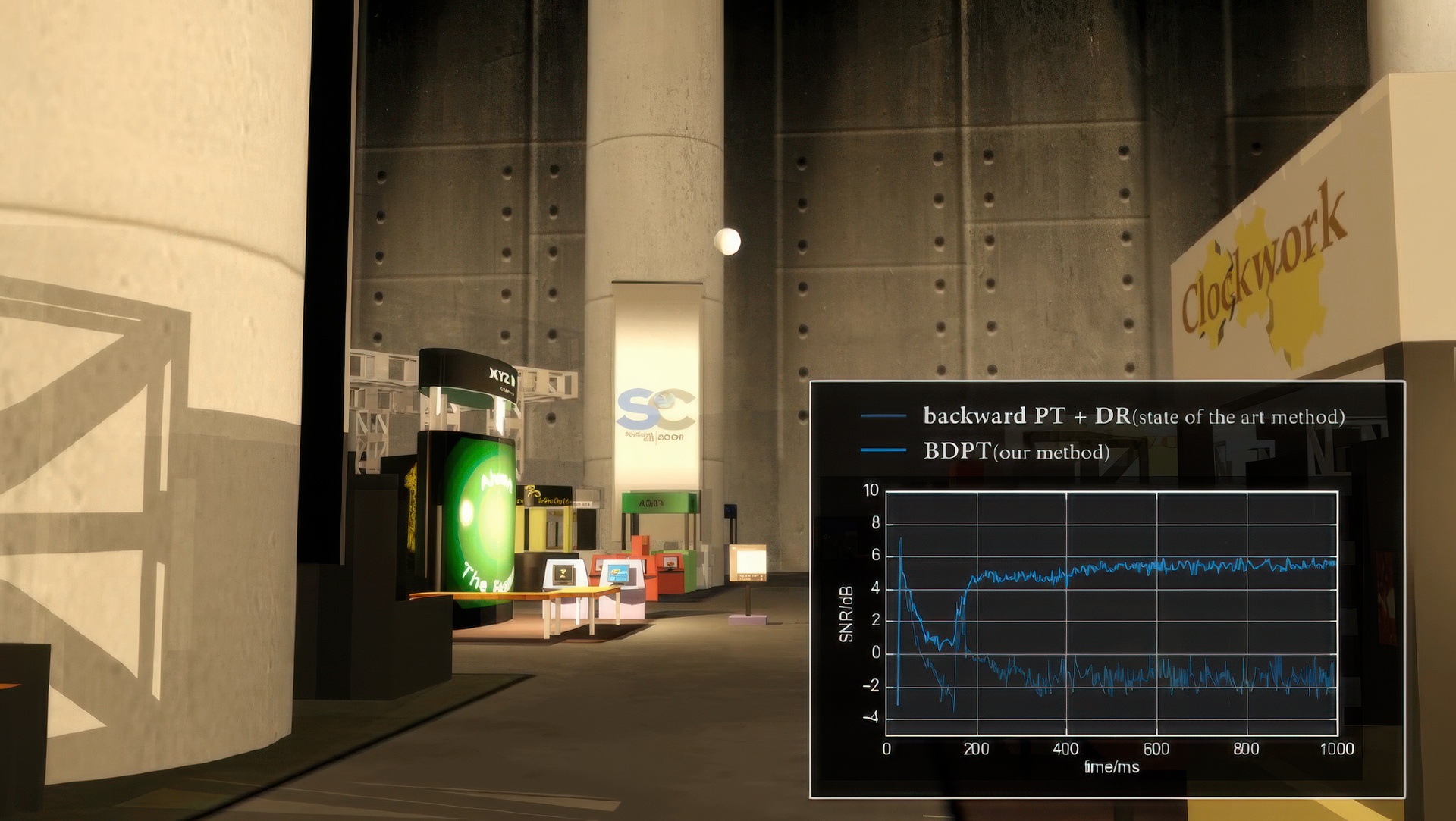
We introduce Bidirectional Sound Transport (BST), a new algorithm that simulates sound propagation by bidirectional path tracing using multiple importance sampling. Our approach can handle multiple sources in large virtual environments with complex occlusion, and can produce plausible acoustic effects at an interactive rate on a desktop PC. We introduce a new metric based on the signal-to-noise ratio (SNR) of the energy response and use this metric to evaluate the performance of ray-tracing-based acoustic simulation methods. Our formulation exploits temporal coherence in terms of using the resulting sample distribution of the previous frame to guide the sample distribution of the current one. We show that our sample redistribution algorithm converges and better balances between early and late reflections. We evaluate our approach on different benchmarks and demonstrate significant speedup over prior geometric acoustic algorithms.
References:
1. Antani, L., and Manocha, D. 2013. Aural proxies and directionally-varying reverberation for interactive sound propagation in virtual environments. Visualization and Computer Graphics, IEEE Transactions on 19, 4, 567–575.
2. Antani, L., Chandak, A., Savioja, L., and Manocha, D. 2012. Interactive sound propagation using compact acoustic transfer operators. ACM Transactions on Graphics (TOG) 31, 1, 7.
3. Bertsekas, D., and Nedic, A. 2003. Convex analysis and optimization (conservative).
4. Blauert, J. 1997. Spatial hearing: the psychophysics of human sound localization. MIT press.
5. Bork, I. 2000. A comparison of room simulation software-the 2nd round robin on room acoustical computer simulation. Acta Acustica united with Acustica 86, 6, 943–956.
6. Brebbia, C. A., and Ciskowski, R. 1991. Boundary element methods in acoustics. Computational mechanics.
7. Dachsbacher, C., Křivánek, J., Hašan, M., Arbree, A., Walter, B., and Novák, J. 2014. Scalable realistic rendering with many-light methods. Computer Graphics Forum 33, 1, 88–104.
8. DeValois, R. L. 1988. Spatial vision. No. 14. Oxford University Press, USA.
9. Keller, A. 1997. Instant radiosity. In Proceedings of SIGGRAPH’97, ACM Press/Addison-Wesley Publishing Co., 49–56.
10. Kreyszig, E. 1978. Introductory Functional Analysis with Applications. Society for Industrial and Applied Mathematics.
11. Křivánek, J., Gautron, P., Pattanaik, S., and Bouatouch, K. 2005. Radiance caching for efficient global illumination computation. Visualization and Computer Graphics, IEEE Transactions on 11, 5, 550–561.
12. Lafortune, E. P., and Willems, Y. D. 1993. Bi-directional path tracing. In Proceedings of Compugraphics, vol. 93, 145–153.
13. Lafortune, E. 1996. Mathematical models and monte carlo algorithms for physically based rendering. Department of Computer Science, Faculty of Engineering, Katholieke Universiteit Leuven, 20–23.
14. Lentz, T., Schröder, D., Vorländer, M., and Assenmacher, I. 2007. Virtual reality system with integrated sound field simulation and reproduction. EURASIP journal on applied signal processing 2007, 1, 187–187.
15. Li, D., Fei, Y., and Zheng, C. 2015. Interactive acoustic transfer approximation for modal sound. ACM Transactions on Graphics (TOG) 35, 1, 2.
16. Mahneke, A. 1957. Flicker-fusion thresholds. Acta ophthalmologica 35, 1, 53–61.
17. Mehra, R., Raghuvanshi, N., Antani, L., Chandak, A., Curtis, S., and Manocha, D. 2013. Wave-based sound propagation in large open scenes using an equivalent source formulation. ACM Transactions on Graphics (TOG) 32, 2, 19.
18. Nicol, R., Gros, L., Colomes, C., Noisternig, M., Warusfel, O., Bahu, H., Katz, B. F., and Simon, L. S. 2014. A roadmap for assessing the quality of experience of 3d audio binaural rendering. In Proc. of the EAA Joint Symposium on Auralization and Ambisonics.
19. Pajot, A., Barthe, L., Paulin, M., and Poulin, P. 2011. Combinatorial bidirectional path-tracing for efficient hybrid cpu/gpu rendering. Computer Graphics Forum 30, 2, 315–324. Cross Ref
20. Pelzer, S., and Vorländer, M. 2010. Frequency-and time-dependent geometry for real-time auralizations. In Proceedings 20th International Congress on Acoustics (ICA 2010), Sydney, Australia, 23–27.
21. Pelzer, S., Aretz, M., and Vorländer, M. 2011. Quality assessment of room acoustic simulation tools by comparing binaural measurements and simulations in an optimized test scenario. In Proc. Forum Acusticum Aalborg.
22. Popov, S., Ramamoorthi, R., Durand, F., and Drettakis, G. 2015. Probabilistic connections for bidirectional path tracing. Computer Graphics Forum 34, 4, 12.
23. Qin, H., Sun, X., Hou, Q., Guo, B., and Zhou, K. 2015. Unbiased photon gathering for light transport simulation. Acm Transactions on Graphics 34, 6, 1–14.
24. Raghuvanshi, N., and Snyder, J. 2014. Parametric wave field coding for precomputed sound propagation. ACM Transactions on Graphics (TOG) 33, 4, 38.
25. Raghuvanshi, N., Snyder, J., Mehra, R., Lin, M., and Govindaraju, N. 2010. Precomputed wave simulation for real-time sound propagation of dynamic sources in complex scenes. In ACM Transactions on Graphics (TOG), vol. 29, ACM, 68.
26. Royden, H. L., and Fitzpatrick, P. 1988. Real analysis, vol. 198. Macmillan New York.
27. Rychtáriková, M., Van den Bogaert, T., Vermeir, G., and Wouters, J. 2011. Perceptual validation of virtual room acoustics: Sound localisation and speech understanding. Applied Acoustics 72, 4, 196–204. Cross Ref
28. Savioja, L., and Svensson, U. P. 2015. Overview of geometrical room acoustic modeling techniques. The Journal of the Acoustical Society of America 138, 2, 708–730. Cross Ref
29. Savioja, L. 2010. Real-time 3d finite-difference time-domain simulation of low-and mid-frequency room acoustics. In 13th Int. Confon Digital Audio Effects, vol. 1, 75.
30. Schissler, C., and Manocha, D. 2014. Interactive sound propagation and rendering for large multi-source scenes. Tech. rep., Department of Computer Science, University of North Carolina. Submitted for publication.
31. Schissler, C., Mehra, R., and Manocha, D. 2014. High-order diffraction and diffuse reflections for interactive sound propagation in large environments. ACM Transactions on Graphics (TOG) 33, 4, 39.
32. Schröder, D. 2011. Physically based real-time auralization of interactive virtual environments, vol. 11. Logos Verlag Berlin GmbH.
33. Siltanen, S., Lokki, T., Kiminki, S., and Savioja, L. 2007. The room acoustic rendering equation. The Journal of the Acoustical Society of America 122, 3, 1624–1635. Cross Ref
34. Taylor, M., Chandak, A., Mo, Q., Lauterbach, C., Schissler, C., and Manocha, D. 2012. Guided multi-view ray tracing for fast auralization. Visualization and Computer Graphics, IEEE Transactions on 18, 11, 1797–1810.
35. Thompson, L. L. 2006. A review of finite-element methods for time-harmonic acoustics. The Journal of the Acoustical Society of America 119, 3, 1315–1330. Cross Ref
36. Tsingos, N., Funkhouser, T., Ngan, A., and Carlbom, I. 2001. Modeling acoustics in virtual environments using the uniform theory of diffraction. In Proceedings of SIGGRAPH’01, ACM, 545–552.
37. Tsingos, N., Gallo, E., and Drettakis, G. 2004. Perceptual audio rendering of complex virtual environments. In ACM Transactions on Graphics (TOG), vol. 23, ACM, 249–258.
38. Veach, E., and Guibas, L. 1995. Bidirectional estimators for light transport. In Photorealistic Rendering Techniques. Springer, 145–167.
39. Vorländer, v. M. 1988. Die genauigkeit von berechnungen mit dem raumakustischen schallteilchenmodell und ihre abhängigkeit von der rechenzeit. Acta Acustica united with Acustica 66, 2, 90–96.
40. Wald, I., Woop, S., Benthin, C, Johnson, G. S., and Ernst, M. 2014. Embree: A kernel framework for efficient cpu ray tracing. ACM Transactions on Graphics (TOG) 33, 4, 143.
41. Ward, G. J., Rubinstein, F. M., and Clear, R. D. 1988. A ray tracing solution for diffuse interreflection. In ACM SIGGRAPH Computer Graphics, vol. 22, ACM, 85–92.



