
“Crowd space: a predictive crowd analysis technique”
Conference:
Type(s):
Title:
- Crowd space: a predictive crowd analysis technique
Session/Category Title:
- How people look and move
Presenter(s)/Author(s):
Moderator(s):
Abstract:
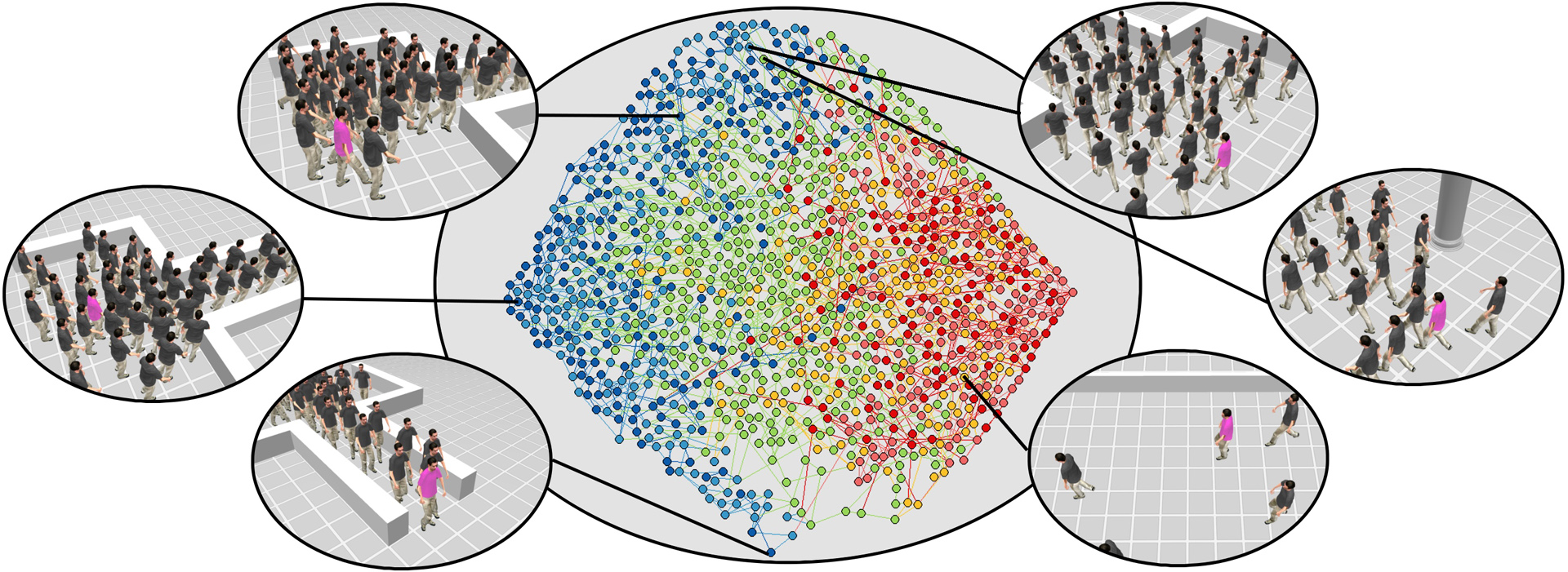
Over the last two decades there has been a proliferation of methods for simulating crowds of humans. As the number of different methods and their complexity increases, it becomes increasingly unrealistic to expect researchers and users to keep up with all the possible options and trade-offs. We therefore see the need for tools that can facilitate both domain experts and non-expert users of crowd simulation in making high-level decisions about the best simulation methods to use in different scenarios. In this paper, we leverage trajectory data from human crowds and machine learning techniques to learn a manifold which captures representative local navigation scenarios that humans encounter in real life. We show the applicability of this manifold in crowd research, including analyzing trends in simulation accuracy, and creating automated systems to assist in choosing an appropriate simulation method for a given scenario.
References:
1. Tunç Ozan Aydin, Martin Čadík, Karol Myszkowski, and Hans-Peter Seidel. 2010. Video Quality Assessment for Computer Graphics Applications. ACM Transactions on Graphics 29, 6, Article 161 (2010), 12 pages. Google ScholarDigital Library
2. Glen Berseth, Mubbasir Kapadia, Brandon Haworth, and Petros Faloutsos. 2014. SteerFit: Automated Parameter Fitting for Steering Algorithms. In ACM SIGGRAPH/Eurographics Symposium on Computer Animation. 113–122. Google ScholarDigital Library
3. Robert Bridson. 2015. Fluid simulation for computer graphics. CRC Press.Google ScholarDigital Library
4. Panayiotis Charalambous and Yiorgos Chrysanthou. 2014. The PAG Crowd: A Graph Based Approach for Efficient Data-Driven Crowd Simulation. Computer Graphics Forum 33, 8 (2014), 95–108. Google ScholarDigital Library
5. Panayiotis Charalambous, Ioannis Karamouzas, Stephen J. Guy, and Yiorgos Chrysanthou. 2014. A Data-Driven Framework for Visual Crowd Analysis. Computer Graphics Forum 33, 7 (2014), 41–50. Google ScholarDigital Library
6. Funda Durupinar, Mubbasir Kapadia, Susan Deutsch, Michael Neff, and Norman I Badler. 2017. Perform: Perceptual approach for adding ocean personality to human motion using laban movement analysis. ACM Transactions on Graphics 36, 1 (2017), 6.Google ScholarCross Ref
7. Teófilo Dutra, Ricardo Marques, Joaquim B. Cavalcante-Neto, Creto Augusto Vidal, and Julien Pettré. 2017. Gradient-based steering for vision-based crowd simulation algorithms. Computer Graphics Forum 36, 2 (2017). Google ScholarDigital Library
8. Geir Evensen. 2003. The ensemble Kalman filter: Theoretical formulation and practical implementation. Ocean dynamics 53, 4 (2003), 343–367.Google Scholar
9. Stephen J. Guy and Ioannis Karamouzas. 2015. A Guide to Anticipatory Collision Avoidance. In Game AI Pro 2: Collected Wisdom of Game AI Professionals, Steve Rabin (Ed.). A K Peters/CRC Press, Chapter 19, 195–208.Google Scholar
10. Stephen J Guy, Jur Van Den Berg, Wenxi Liu, Rynson Lau, Ming C Lin, and Dinesh Manocha. 2012. A statistical similarity measure for aggregate crowd dynamics. ACM Transactions on Graphics (TOG) 31, 6 (2012), 190. Google ScholarDigital Library
11. Dirk Helbing, Illés Farkas, and Tamas Vicsek. 2000. Simulating dynamical features of escape panic. Nature 407, 6803 (2000), 487–490.Google ScholarCross Ref
12. Dirk Helbing and Péter Molnár. 1995. Social Force Model for Pedestrian Dynamics. Physical Review E 51 (1995), 4282–4286.Google ScholarCross Ref
13. Daniel Holden, Taku Komura, and Jun Saito. 2017. Phase-functioned neural networks for character control. ACM Transactions on Graphics 36, 4 (2017), 42. Google ScholarDigital Library
14. Ludovic Hoyet, Kenneth Ryall, Katja Zibrek, Hwangpil Park, Jehee Lee, Jessica Hodgins, and Carol O’sullivan. 2013. Evaluating the distinctiveness and attractiveness of human motions on realistic virtual bodies. ACM Transactions on Graphics 32, 6 (2013), 204. Google ScholarDigital Library
15. Rowan Hughes, Jan Ondrej, and John Dingliana. 2015. DAVIS: density-adaptive synthetic-vision based steering for virtual crowds. In Motion in Games. ACM, 79–84. Google ScholarDigital Library
16. Eunjung Ju, Myung Geol Choi, Minji Park, Jehee Lee, Kang Hoon Lee, and Shigeo Takahashi. 2010. Morphable crowds. ACM Transactions on Graphics 29 (2010), 140:1–140:10. Issue 6. Google ScholarDigital Library
17. Mubbasir Kapadia, Nuria Pelechano, Jan Allbeck, and Norm Badler. 2015. Virtual crowds: Steps toward behavioral realism. Synthesis Lectures on Visual Computing: Computer Graphics, Animation, Computational Photography, and Imaging 7, 4 (2015), 1–270. Google ScholarDigital Library
18. Mubbasir Kapadia, Shawn Singh, Brian Allen, Glenn Reinman, and Petros Faloutsos. 2009. Steerbug: an interactive framework for specifying and detecting steering behaviors. In ACM SIGGRAPH/Eurographics Symposium on Computer Animation. 209–216. Google ScholarDigital Library
19. Mubbasir Kapadia, Shawn Singh, William Hewlett, Glenn Reinman, and Petros Faloutsos. 2012. Parallelized egocentric fields for autonomous navigation. The Visual Computer 28, 12 (2012), 1209–1227.Google ScholarCross Ref
20. Mubbasir Kapadia, Matt Wang, Shawn Singh, Glenn Reinman, and Petros Faloutsos. 2011. Scenario space: characterizing coverage, quality, and failure of steering algorithms. In ACM SIGGRAPH/Eurographics Symposium on Computer Animation. 53–62. Google ScholarDigital Library
21. Ioannis Karamouzas, Peter Heil, Pascal van Beek, and Mark H. Overmars. 2009. A Predictive Collision Avoidance Model for Pedestrian Simulation. In Motion in Games. 41–52. Google ScholarDigital Library
22. Ioannis Karamouzas, Brian Skinner, and Stephen J. Guy. 2014. Universal Power Law Governing Pedestrian Interactions. Physical Review Letters 113 (2014), 238701. Issue 23.Google ScholarCross Ref
23. Ioannis Karamouzas, Nick Sohre, Rahul Narain, and Stephen J. Guy. 2017. Implicit Crowds: Optimization Integrator for Robust Crowd Simulation. ACM Transactions on Graphics 36, 4 (2017). Google ScholarDigital Library
24. Richard Kulpa, Anne-Hélène Olivierxs, Jan Ondřej, and Julien Pettré. 2011. Imperceptible relaxation of collision avoidance constraints in virtual crowds. ACM Transactions on Graphics 30, 6 (2011), 138. Google ScholarDigital Library
25. Gregor Lämmel and Matthias Plaue. 2014. Getting out of the way: Collision-avoiding pedestrian models compared to the realworld. In Pedestrian and Evacuation Dynamics 2012. Springer, 1275–1289.Google Scholar
26. Jehee Lee. 2010. Introduction to Data-driven Animation: Programming with Motion Capture. In ACM SIGGRAPH ASIA 2010 Courses. Article 4, 50 pages. Google ScholarDigital Library
27. Alon Lerner, Yiorgos Chrysanthou, and Dani Lischinski. 2007. Crowds by example. Computer Graphics Forum 26 (2007), 655–664.Google ScholarCross Ref
28. Alon Lerner, Yiorgos Chrysanthou, Ariel Shamir, and Daniel Cohen-Or. 2010. Context-Dependent Crowd Evaluation. Computer Graphics Forum 29, 7 (2010), 2197–2206.Google ScholarCross Ref
29. Pinxin Long, Wenxi Liu, and Jia Pan. 2017. Deep-Learned Collision Avoidance Policy for Distributed Multiagent Navigation. IEEE Robotics and Automation Letters 2, 2 (2017), 656–663.Google ScholarCross Ref
30. Frank J Massey Jr. 1951. The Kolmogorov-Smirnov test for goodness of fit. Journal of the American statistical Association 46, 253 (1951), 68–78.Google ScholarCross Ref
31. Rachel McDonnell, Michéal Larkin, Benjamín Hernández, Isaac Rudomin, and Carol O’Sullivan. 2009. Eye-catching Crowds: Saliency Based Selective Variation. ACM Transactions on Graphics 28, 3, Article 55 (2009), 55:1–55:10 pages. Google ScholarDigital Library
32. Mehdi Moussaïd, Dirk Helbing, and Guy Theraulaz. 2011. How simple rules determine pedestrian behavior and crowd disasters. Proceedings of the National Academy of Sciences 108, 17 (2011), 6884–6888.Google ScholarCross Ref
33. Rahul Narain, Abhinav Golas, Sean Curtis, and Ming C. Lin. 2009. Aggregate Dynamics for Dense Crowd Simulation. ACM Transaction on Graphics 28, 5 (2009), 122:1–122:8. Google ScholarDigital Library
34. Anne-Hélène Olivier, Antoine Marin, Armel Crétual, and Julien Pettré. 2012. Minimal predicted distance: A common metric for collision avoidance during pairwise interactions between walkers. Gait Posture 36, 3 (2012), 399–404.Google ScholarCross Ref
35. Jan Ondřej, Julien Pettré, Anne-Hélène Olivier, and Stéphane Donikian. 2010. A synthetic-vision based steering approach for crowd simulation. ACM Transactions on Graphics 29, 4 (2010), 1–9. Google ScholarDigital Library
36. Nuria Pelechano, Jan M Allbeck, Mubbasir Kapadia, and Norman I Badler. 2016. Simulating Heterogeneous Crowd with Interactive Behaviors. CRC Press. Google ScholarDigital Library
37. Stefano Pellegrini, Andrea Ess, Konrad Schindler, and Luc Van Gool. 2009. You’ll never walk alone: Modeling social behavior for multi-target tracking. In IEEE International Conference on Computer Vision. 261–268.Google ScholarCross Ref
38. Xue Bin Peng, Glen Berseth, KangKang Yin, and Michiel Van De Panne. 2017. Deeploco: Dynamic locomotion skills using hierarchical deep reinforcement learning. ACM Transactions on Graphics 36, 4 (2017), 41. Google ScholarDigital Library
39. Julien Pettré, Jan Ondřej, Anne-Hélène Olivier, Armel Crétual, and Stéphane Donikian. 2009. Experiment-based Modeling, Simulation and Validation of Interactions between Virtual Walkers. In ACM SIGGRAPH/Eurographics Symposium on Computer Animation. 189–198. Google ScholarDigital Library
40. Paul S.A. Reitsma and Nancy S. Pollard. 2007. Evaluating motion graphs for character animation. ACM Transactions on Graphics 26, 4 (2007), 18. Google ScholarDigital Library
41. Zhiguo Ren, Panayiotis Charalambous, Julien Bruneau, Qunsheng Peng, and Julien Pettré. 2017. Group Modeling: A Unified Velocity-Based Approach. In Computer Graphics Forum, Vol. 36. 45–56.Google ScholarCross Ref
42. Craig W. Reynolds. 1987. Flocks, herds, and schools: A distributed behavioral model. Computer Graphics 21, 4 (1987), 24–34. Google ScholarDigital Library
43. Craig W. Reynolds. 1999. Steering Behaviors For Autonomous Characters. In Game Developers Conference. 763–782.Google Scholar
44. Sam T Roweis and Lawrence K Saul. 2000. Nonlinear dimensionality reduction by locally linear embedding. science 290, 5500 (2000), 2323–2326.Google Scholar
45. Armin Seyfried, Oliver Passon, Bernhard Steffen, Maik Boltes, Tobias Rupprecht, and Wolfram Klingsch. 2009. New insights into pedestrian flow through bottlenecks. Transportation Science 43, 3 (2009), 395–406. Google ScholarDigital Library
46. Roger N Shepard. 1980. Multidimensional scaling, tree-fitting, and clustering. Science 210, 4468 (1980), 390–398.Google Scholar
47. Eftychios Sifakis and Jernej Barbic. 2012. FEM Simulation of 3D Deformable Solids: A Practitioner’s Guide to Theory, Discretization and Model Reduction. In ACM SIGGRAPH 2012 Courses. Article 20, 50 pages. Google ScholarDigital Library
48. Shawn Singh, Mubbasir Kapadia, Petros Faloutsos, and Glenn Reinman. 2009. Steer-Bench: a benchmark suite for evaluating steering behaviors. Computer Animation and Virtual Worlds 20, 5–6 (2009), 533–548. Google ScholarDigital Library
49. Shawn Singh, Mubbasir Kapadia, Glenn Reinman, and Petros Faloutsos. 2011. Footstep navigation for dynamic crowds. Computer Animation and Virtual Worlds 22, 2–3 (2011), 151–158. Google ScholarDigital Library
50. Sybren Stuvel, Nadia Magnenat-Thalmann, Daniel Thalmann, A Frank van der Stappen, and Arjan Egges. 2016. Torso Crowds. IEEE Transactions on Visualization and Computer Graphics (2016).Google Scholar
51. Joshua B Tenenbaum, Vin De Silva, and John C Langford. 2000. A global geometric framework for nonlinear dimensionality reduction. science 290, 5500 (2000), 2319–2323.Google Scholar
52. Warren S Torgerson. 1952. Multidimensional scaling: I. Theory and method. Psychometrika 17, 4 (1952), 401–419.Google ScholarCross Ref
53. Adrien Treuille, Seth Cooper, and Zoran Popović. 2006. Continuum crowds. ACM Transactions on Graphics 25, 3 (2006), 1160–1168. Google ScholarDigital Library
54. Grigorios Tsoumakas and Ioannis Katakis. 2006. Multi-label classification: An overview. International Journal of Data Warehousing and Mining 3, 3 (2006).Google Scholar
55. Kiwon Um, Xiangyu Hu, and Nils Thuerey. 2017. Perceptual Evaluation of Liquid Simulation Methods. ACM Transactions on Graphics 36, 4, Article 143 (2017), 143:1–143:12 pages. Google ScholarDigital Library
56. Jur van den Berg, Stephen J. Guy, Ming C. Lin, and Dinesh Manocha. 2011. Reciprocal n-body Collision Avoidance. In International Symposium of Robotics Research. 3–19.Google ScholarCross Ref
57. Jur van den Berg, Ming C. Lin, and Dinesh Manocha. 2008. Reciprocal Velocity Obstacles for real-time multi-agent navigation. In IEEE International Conference on Robotics and Automation. 1928–1935.Google ScholarCross Ref
58. Laurens van Der Maaten, Eric Postma, and Jaap Van den Herik. 2009. Dimensionality reduction: a comparative review. Journal of Machine Learning Research 10 (2009), 66–71.Google Scholar
59. Jarkko Venna, Jaakko Peltonen, Kristian Nybo, Helena Aidos, and Samuel Kaski. 2010. Information retrieval perspective to nonlinear dimensionality reduction for data visualization. Journal of Machine Learning Research 11 (2010), 451–490. Google ScholarDigital Library
60. Pascal Vincent, Hugo Larochelle, Isabelle Lajoie, Yoshua Bengio, and Pierre-Antoine Manzagol. 2010. Stacked denoising autoencoders: Learning useful representations in a deep network with a local denoising criterion. Journal of Machine Learning Research 11, Dec (2010), 3371–3408. Google ScholarDigital Library
61. He Wang, Jan Ondrej, and Carol O’Sullivan. 2017. Trending Paths: A New Semantic-Level Metric for Comparing Simulated and Real Crowd Data. IEEE Transactions on Visualization & Computer Graphics 23, 5 (2017), 1454–1464. Google ScholarDigital Library
62. David Wolinski, Stephen Guy, Anne-Hélène Olivier, Ming Lin, Dinesh Manocha, and Julien Pettré. 2014. Parameter Estimation and Comparative Evaluation of Crowd Simulations. Computer Graphics Forum 33, 2 (2014), 303–312. Google ScholarDigital Library
63. David Wolinski, Ming C. Lin, and Julien Pettré. 2016. WarpDriver: context-aware probabilistic motion prediction for crowd simulation. ACM Transactions on Graphics 35, 6 (2016), 164. Google ScholarDigital Library



