
“BodyOpt 2.0 Advancements in Character Deformations at WetaFX” by Ryan, Mack and Northcott
Conference:
Type(s):
Title:
- BodyOpt 2.0 Advancements in Character Deformations at WetaFX
Session/Category Title:
- Rigging and Character Animation
Presenter(s)/Author(s):
Moderator(s):
Abstract:
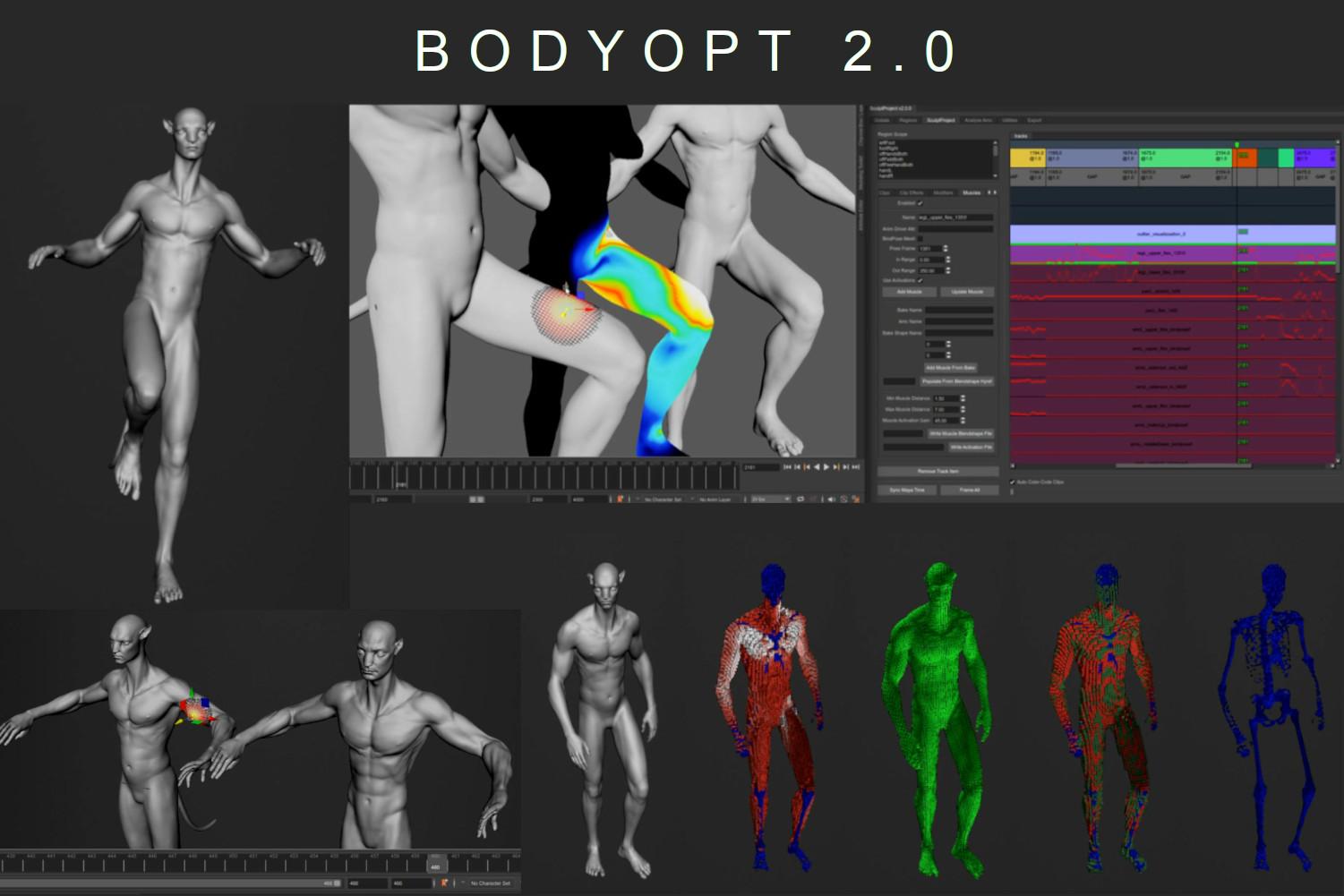
WetaFX has a long-standing history of using advanced anatomical simulation models to create lifelike characters in a variety of productions. However, the limitations of relying solely on anatomical simulations have become apparent, particularly in large-scale productions. BodyOpt is the latest evolution in WetaFX’s character deformation pipeline, integrating advanced simulation techniques with artist-friendly workflows to enable efficient processing of complex deformations across numerous shots and characters. This paper details the technical advancements, production applications, and strategic advantages of BodyOpt, illustrating how it has revolutionized WetaFX’s approach to character animation. The complexity of rigging anatomical movements often leads to suboptimal deformation results, requiring manual fixes for each shot. Given the sheer volume of shots, traditional simulation methods can become extremely costly and time-consuming. BodyOpt addresses these challenges by integrating a learned mesh CNN approach with fast secondary dynamics. This hybrid method enables anatomical simulation models to be applied on a large scale without the need for extensive post-simulation corrections. To allow efficient editing and curation of these datasets, BodyOpt provides artist with a timeline based user interface to handle shape corrections, definition of muscle shape activation states, character to character deformation transfer, visualization and debugging utilities. On top of the mesh encoding, supplementary deformers—such as breathing effects, skin slinding and performance-driven activation shapes that should not be embedded into the training process—can be authored using sculpting tools and instantiated as independent runtime components. Our patch based runtime transfer tool can be enhanced with corrective shapes and is extensively used to generate digital doubles leveraging our pre-trained generic human dataset. This approach significantly reduces the need to generate and train datasets from scratch. By eliminating the need for post-simulation fixes, BodyOpt streamlines the production process, allowing for more efficient management of the extensive data and complex deformations required in blockbuster films.
References:
[1] M. Miles and M. Muller. 2021. A Constraint-based Formulation of Stable Neo-Hookean Materials., Article 12 (2021), 7 pages.
[2] C. Sprenger, T. Mack, A. Stomakhin, and F. Fernandez. 2023. Bodyopt – A Character Deformation Pipeline For Avatar: The Way of Water., Article 60 (2023), 2 pages.
[3] Robert W. Sumner and Jovan Popović. 2004. Deformation transfer for triangle meshes. ACM Trans. Graph. 23, 3 (Aug. 2004), 399–405.
[4] Y. Zhou, C. Wu, Z. Li, C. Cao, Y. Ye, J. Saragih, H. Li, and Y. Sheikh. 2020. Fully convolutional mesh autoencoder using efficient spatially varying kernels., Article 776 (2020), 12 pages.



