
“A general framework for pearlescent materials” by Guillén, Marco, Gutierrez, Jakob and Jarabo
Conference:
Type(s):
Title:
- A general framework for pearlescent materials
Session/Category Title:
- Modeling and Capturing Appearance
Presenter(s)/Author(s):
Abstract:
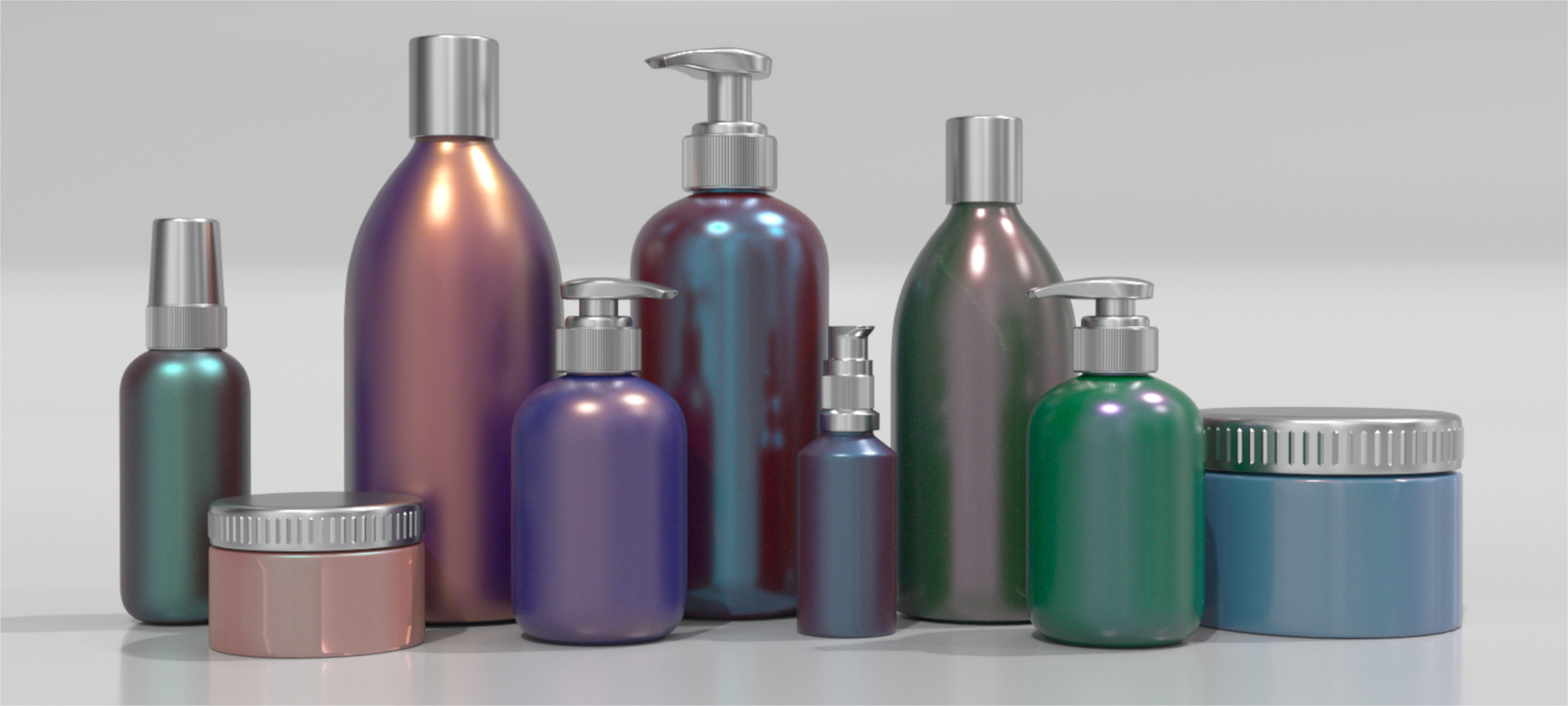
The unique and visually mesmerizing appearance of pearlescent materials has made them an indispensable ingredient in a diverse array of applications including packaging, ceramics, printing, and cosmetics. In contrast to their natural counterparts, such synthetic examples of pearlescence are created by dispersing microscopic interference pigments within a dielectric resin. The resulting space of materials comprises an enormous range of different phenomena ranging from smooth lustrous appearance reminiscent of pearl to highly directional metallic gloss, along with a gradual change in color that depends on the angle of observation and illumination. All of these properties arise due to a complex optical process involving multiple scattering from platelets characterized by wave-optical interference. This article introduces a flexible model for simulating the optics of such pearlescent 3D microstructures. Following a thorough review of the properties of currently used pigments and manufacturing-related effects that influence pearlescence, we propose a new model which expands the range of appearance that can be represented, and closely reproduces the behavior of measured materials, as we show in our comparisons. Using our model, we conduct a systematic study of the parameter space and its relationship to different aspects of pearlescent appearance. We observe that several previously ignored parameters have a substantial impact on the material’s optical behavior, including the multi-layered nature of modern interference pigments, correlations in the orientation of pigment particles, and variability in their properties (e.g. thickness). The utility of a general model for pearlescence extends far beyond computer graphics: inverse and differentiable approaches to rendering are increasingly used to disentangle the physics of scattering from real-world observations. Our approach could inform such reconstructions to enable the predictive design of tailored pearlescent materials.
References:
1. Anita I. Bailey and Susan M. Kay. 1965. Measurement of refractive index and dispersion of mica, employing multiple beam interference techniques. British Journal of Applied Physics 16, 1 (1965).Google ScholarCross Ref
2. Chen Bar, Marina Alterman, Ioannis Gkioulekas, and Anat Levin. 2019. A Monte Carlo Framework for Rendering Speckle Statistics in Scattering Media. ACM Transactions on Graphics 38, 4 (2019).Google ScholarDigital Library
3. Laurent Belcour. 2018. Efficient rendering of layered materials using an atomic decomposition with statistical operators. ACM Transactions on Graphics 37, 4 (2018).Google ScholarDigital Library
4. Laurent Belcour and Pascal Barla. 2017. A practical extension to microfacet theory for the modeling of varying iridescence. ACM Transactions on Graphics 36, 4 (2017).Google ScholarDigital Library
5. Benedikt Bitterli, Srinath Ravichandran, Thomas Müller, Magnus Wrenninge, Jan Novák, Steve Marschner, and Wojciech Jarosz. 2018. A radiative transfer framework for non-exponential media. ACM Transactions on Graphics 37, 6 (2018).Google Scholar
6. Max Born and Emil Wolf. 1999. Principles of optics: electromagnetic theory of propagation, interference and diffraction of light (7 ed.). Cambridge University Press.Google Scholar
7. Brent Burley. 2012. Physically-based shading at Disney. In Practical physically-based shading in film and game production (Proceedings of ACM SIGGRAPH Courses). ACM.Google Scholar
8. Subrahmanyan Chandrasekhar. 2013. Radiative transfer. Dover Publications.Google Scholar
9. Guy Hubert Stephane Sylvain Culeron, Song Shuo, Ping Wang, Liang Yang, and Chunchuan Liang. 2016. Glossy Container. US Patent Application 2016/0375624 A1.Google Scholar
10. Tom Cuypers, Tom Haber, Philippe Bekaert, Se Baek Oh, and Ramesh Raskar. 2012. Reflectance Model for Diffraction. ACM Transactions on Graphics 31, 5 (2012).Google ScholarDigital Library
11. J. R. DeVore. 1951. Refractive Indices of Rutile and Sphalerite. Journal of the Optical Society of America 41, 6 (1951).Google ScholarCross Ref
12. Zhao Dong, Bruce Walter, Steve Marschner, and Donald P Greenberg. 2015. Predicting appearance from measured microgeometry of metal surfaces. ACM Transactions on Graphics 35, 1 (2015).Google ScholarDigital Library
13. Craig Donner and Henrik Wann Jensen. 2005. Light diffusion in multi-layered translucent materials. ACM Transactions on Graphics 24, 3 (2005).Google ScholarDigital Library
14. Serkan Ergun, Sermet Önel, and Aydin Ozturk. 2016. A general micro-flake model for predicting the appearance of car paint. In Proceedings of the Eurographics Symposium on Rendering: Experimental Ideas & Implementations (EGSR ’16). Eurographics Association.Google ScholarDigital Library
15. Sergey Ershov, Konstantin Kolchin, and Karol Myszkowski. 2001. Rendering pearlescent appearance based on paint-composition modelling. Computer Graphics Forum 20, 3 (2001).Google Scholar
16. Viggo Falster, Adrian Jarabo, and Jeppe Revall Frisvad. 2020. Computing the Bidirectional Scattering of a Microstructure UsingScalar Diffraction Theory and Path Tracing. Computer Graphics Forum 39, 7 (2020).Google Scholar
17. Alejandro Ferrero, Berta Bernad, J Campos, Esther Perales, José Luis Velázquez, and Francisco M Martínez-Verdú. 2016. Color characterization of coatings with diffraction pigments. Journal of the Optical Society of America A 33, 10 (2016).Google ScholarCross Ref
18. Alejandro Ferrero, Esther Perales, Ana M Rabal, J Campos, Francisco Miguel Martínez-Verdú, Elizabet Chorro, and A Pons. 2014. Color representation and interpretation of special effect coatings. Journal of the Optical Society of America A 31, 2 (2014).Google ScholarCross Ref
19. Jeppe Revall Frisvad, Niels Jørgen Christensen, and Henrik Wann Jensen. 2007. Computing the scattering properties of participating media using Lorenz-Mie theory. ACM Transactions on Graphics 26, 3 (2007).Google ScholarDigital Library
20. Luis E. Gamboa, Adrien Gruson, and Derek Nowrouzezahrai. 2020. An Efficient Transport Estimator for Complex Layered Materials. Computer Graphics Forum (2020).Google Scholar
21. Jay S. Gondek, Gary W. Meyer, and Jonathan G. Newman. 1994. Wavelength dependent reflectance functions. In Proceedings of the 21st Annual Conference on Computer Graphics and Interactive Techniques (SIGGRAPH ’94). ACM.Google Scholar
22. Xavier Granier and Wolfgang Heidrich. 2003. A simple layered RGB BRDF model. Graphical Models 65, 4 (2003).Google Scholar
23. Jie Guo, Yanjun Chen, Yanwen Guo, and Jingui Pan. 2018a. A Physically-based Appearance Model for Special Effect Pigments. Computer Graphics Forum 37, 4 (2018).Google Scholar
24. Jie Guo, Jinghui Qian, Yanwen Guo, and Jingui Pan. 2016. Rendering thin transparent layers with extended normal distribution functions. IEEE Transactions on Visualization and Computer Graphics 23, 9 (2016).Google Scholar
25. Yu Guo, Miloš Hašan, and Shuang Zhao. 2018b. Position-Free Monte Carlo Simulation for Arbitrary Layered BSDFs. ACM Transactions on Graphics 37, 6 (2018).Google Scholar
26. Pat Hanrahan and Wolfgang Krueger. 1993. Reflection from layered surfaces due to subsurface scattering. In Proceedings of the 20th Annual Conference on Computer Graphics and Interactive Techniques (SIGGRAPH ’93). ACM.Google ScholarDigital Library
27. Eric Heitz, Jonathan Dupuy, Cyril Crassin, and Carsten Dachsbacher. 2015. The SGGX microflake distribution. ACM Transactions on Graphics 34, 4 (2015).Google ScholarDigital Library
28. Hideki Hirayama, Kazufumi Kaneda, Hideo Yamashita, and Yoshimi Monden. 2001. An accurate illumination model for objects coated with multilayer films. Computers & Graphics 25, 3 (2001).Google Scholar
29. Nicolas Holzschuch and Romain Pacanowski. 2017. A two-scale microfacet reflectance model combining reflection and diffraction. ACM Transactions on Graphics 36, 4 (2017).Google ScholarDigital Library
30. Nagaraj Goud Ireni, Ramanuj Narayan, Pratyay Basak, and K.V.S.N. Raju. 2016. Poly(thiourethane-urethane)-urea as anticorrosion coatings with impressive optical properties. Polymer 97 (2016).Google Scholar
31. Wenzel Jakob, Adam Arbree, Jonathan T Moon, Kavita Bala, and Steve Marschner. 2010. A radiative transfer framework for rendering materials with anisotropic structure. ACM Transactions on Graphics 29, 4 (2010).Google ScholarDigital Library
32. Wenzel Jakob, Eugene d’Eon, Otto Jakob, and Steve Marschner. 2014a. A comprehensive framework for rendering layered materials. ACM Transactions on Graphics 33, 4 (2014).Google ScholarDigital Library
33. Wenzel Jakob, Miloš Hašan, Ling-Qi Yan, Jason Lawrence, Ravi Ramamoorthi, and Steve Marschner. 2014b. Discrete stochastic microfacet models. ACM Transactions on Graphics 33, 4 (2014).Google ScholarDigital Library
34. Adrian Jarabo, Carlos Aliaga, and Diego Gutierrez. 2018. A Radiative Transfer Framework for Spatially-Correlated Materials. ACM Transactions on Graphics 37, 4 (2018).Google ScholarDigital Library
35. Adrian Jarabo and Victor Arellano. 2018. Bidirectional Rendering of Vector Light Transport. Computer Graphics Forum 37, 6 (2018).Google Scholar
36. William B. Kerr and Fabio Pellacini. 2010. Toward Evaluating Material Design Interface Paradigms for Novice Users. ACM Transactions on Graphics 29, 4 (2010).Google ScholarDigital Library
37. W. H. Kettler and G. Richter. 1997. Investigation on topology of platelet-like effect-pigments in automotive surface-coatings. Progress in organic coatings 31, 4 (1997).Google Scholar
38. Duck Bong Kim, Myoung Kook Seo, Kang Yeon Kim, and Kwan H Lee. 2010. Acquisition and representation of pearlescent paints using an image-based goniospectrophotometer. Optical engineering 49, 4 (2010).Google Scholar
39. Eric Kirchner. 2009. Film shrinkage and flake orientation. Progress in Organic Coatings 65, 3 (2009).Google Scholar
40. Eric Kirchner and Jacqueline Houweling. 2009. Measuring flake orientation for metallic coatings. Progress in organic coatings 64, 2–3 (2009).Google Scholar
41. Tom Kneiphof, Tim Golla, and Reinhard Klein. 2019. Real-time Image-based Lighting of Microfacet BRDFs with Varying Iridescence. Computer Graphics Forum 38, 4 (2019).Google Scholar
42. Peter Kutz, Ralf Habel, Yining Karl Li, and Jan Novák. 2017. Spectral and Decomposition Tracking for Rendering Heterogeneous Volumes. ACM Transactions on Graphics 36, 4 (2017).Google ScholarDigital Library
43. Manuel Lagunas, Sandra Malpica, Ana Serrano, Elena Garces, Diego Gutierrez, and Belen Masia. 2019. A Similarity Measure for Material Appearance. ACM Transactions on Graphics 38, 4 (2019).Google ScholarDigital Library
44. Boris Mahltig, Jieyang Zhang, Linfei Wu, Daniel Darko, Miriam Wendt, Evelyn Lempa, Maike Rabe, and Hajo Haase. 2017. Effect pigments for textile coating: a review of the broad range of advantageous functionalization. Journal of Coatings Technology and Research 14, 1 (2017).Google ScholarCross Ref
45. Frank J. Maile, Gerhard Pfaff, and Peter Reynders. 2005. Effect pigments—past, present and future. Progress in organic coatings 54, 3 (2005).Google Scholar
46. Frank J. Maile and Peter Reynders. 2003. Substrates for pearlescent pigments. European coatings journal 4 (2003).Google Scholar
47. Irving H. Malitson. 1965. Interspecimen Comparison of the Refractive Index of Fused Silica. Journal of the Optical Society of America 55, 10 (1965).Google ScholarCross Ref
48. Irving H. Malitson and Marilyn J. Dodge. 1972. Refractive-index and birefringence of synthetic sapphire. Journal of the Optical Society of America 62, 11 (1972).Google Scholar
49. José M. Medina. 2008. Linear basis for metallic and iridescent colors. Applied optics 47, 30 (2008).Google Scholar
50. Bailey Miller, Iliyan Georgiev, and Wojciech Jarosz. 2019. A null-scattering path integral formulation of light transport. ACM Transactions on Graphics 38, 4 (2019).Google ScholarDigital Library
51. Satoshi Naganawa and Yuta Suzuki. 2016. Modified polysilazane film and method for producing gas barrier film. US Patent 9,512,334.Google Scholar
52. Merlin Nimier-David, Delio Vicini, Tizian Zeltner, and Wenzel Jakob. 2019. Mitsuba 2: A Retargetable Forward and Inverse Renderer. ACM Transactions on Graphics 38, 6 (2019).Google ScholarDigital Library
53. Fabio Pellacini, James A. Ferwerda, and Donald P. Greenberg. 2000. Toward a Psychophysically-Based Light Reflection Model for Image Synthesis. In Proceedings of the 27th Annual Conference on Computer Graphics and Interactive Techniques (SIGGRAPH ’00). ACM, 55–64.Google ScholarDigital Library
54. Gerhard Pfaff. 2003. Special effect pigments based on silica flakes. Inorganic materials 39, 2 (2003).Google Scholar
55. Gerhard Pfaff and Miriam Becker. 2012. Special effect pigments in cosmetics applications. Household Personal Hold 7, 1 (2012).Google Scholar
56. Gerhard Pfaff and Peter Reynders. 1999. Angle-dependent optical effects deriving from submicron structures of films and pigments. Chemical reviews 99, 7 (1999).Google Scholar
57. Petar Pjanic and Roger D Hersch. 2015. Color changing effects with anisotropic halftone prints on metal. ACM Transactions on Graphics 34, 6 (2015).Google ScholarDigital Library
58. Mikhail N. Polyanskiy. 2020. Refractive index database. Retrieved January 1, 2020 from https://refractiveindex.infoGoogle Scholar
59. Marvin R. Querry. 1985. Optical constants. Technical Report CRDC-CR-85034. Missouri University, Kansas City, MO.Google Scholar
60. Aleksandar D. Rakić. 1995. Algorithm for the determination of intrinsic optical constants of metal films: application to aluminum. Applied Optics 34, 22 (1995).Google Scholar
61. Michael Rösler, Frank J. Maile, and Adalbert Huber. 2008. The macroscopic appearance of effect coatings and its relationship to the local spatial and angular distribution of reflected light. In Proceedings of American Coating Conference 2008.Google Scholar
62. Martin Rump, Gero Müller, Ralf Sarlette, Dirk Koch, and Reinhard Klein. 2008. Photorealistic rendering of metallic car paint from image-based measurements. Computer Graphics Forum 27, 2 (2008).Google Scholar
63. Szymon M. Rusinkiewicz. 1998. A new change of variables for efficient BRDF representation. In Rendering techniques’ 98. Springer.Google Scholar
64. Iman Sadeghi, Adolfo Munoz, Philip Laven, Wojciech Jarosz, Francisco Seron, Diego Gutierrez, and Henrik Wann Jensen. 2012. Physically-based simulation of rainbows. ACM Transactions on Graphics 31, 1 (2012).Google ScholarDigital Library
65. Ana Serrano, Diego Gutierrez, Karol Myszkowski, Hans-Peter Seidel, and Belen Masia. 2016. An Intuitive Control Space for Material Appearance. ACM Transactions on Graphics 35, 6 (2016).Google ScholarDigital Library
66. Christopher M. Seubert, Mark E. Nichols, J. Frey, Max Shtein, and Michael D. Thouless. 2016. The characterization and effects of microstructure on the appearance of platelet-polymer composite coatings. Journal of Materials Science 51, 5 (2016).Google ScholarCross Ref
67. Hiroyuki Shiomi, Eiichirou Misaki, Maoya Adachi, and Fukuji Suzuki. 2008. High chroma pearlescent pigments designed by optical simulation. Journal of Coatings Technology and Research 5, 4 (2008).Google ScholarCross Ref
68. Brian E. Smits and Gary W. Meyer. 1992. Newton’s colors: simulating interference phenomena in realistic image synthesis. In Photorealism in Computer Graphics. Springer.Google Scholar
69. James Speight. 2005. Lange’s Handbook of Chemistry, Sixteenth Edition. McGraw-Hill Education.Google Scholar
70. Jos Stam. 1999. Diffraction Shaders. In Proceedings of the 26th Annual Conference on Computer Graphics and Interactive Techniques (SIGGRAPH ’99). ACM.Google Scholar
71. Jos Stam. 2001. An illumination model for a skin layer bounded by rough surfaces. In Rendering Techniques 2001. Springer.Google ScholarDigital Library
72. Katrin Steinbach and Ulrich Schmidt. 2010. Borosilicate Pigments-Transparency Meets Brilliance and Sparkle. Cosmetic Science Technology 2010 (2010).Google Scholar
73. Shlomi Steinberg. 2019. Analytic Spectral Integration of Birefringence-Induced Iridescence. Computer Graphics Forum 38, 4 (2019).Google Scholar
74. Yinlong Sun. 2006. Rendering Biological Iridescences with RGB-Based Renderers. ACM Transactions on Graphics 25, 1 (2006).Google ScholarDigital Library
75. Yinlong Sun and Qiqi Wang. 2008. Interference shaders of thin films. Computer Graphics Forum 27, 6 (2008).Google Scholar
76. Antoine Toisoul and Abhijeet Ghosh. 2017. Practical acquisition and rendering of diffraction effects in surface reflectance. ACM Transactions on Graphics 36, 5 (2017).Google ScholarDigital Library
77. Ping Wang, Liang Yang, John Andrew McDaniel, Gian Armand Juliana DeBelder, and Gaoyang Wang. 2014. Pearlescent container. US Patent 8,859,067 B2.Google Scholar
78. Andrea Weidlich and Alexander Wilkie. 2007. Arbitrarily layered micro-facet surfaces. In Proceedings of the 5th international conference on Computer graphics and interactive techniques in Australia and Southeast Asia (GRAPHITE ’07). ACM.Google ScholarDigital Library
79. Philippe Weier and Laurent Belcour. 2020. Rendering Layered Materials with Anisotropic Interfaces. Journal of Computer Graphics Techniques (JCGT) 9, 2 (2020), 37–57.Google Scholar
80. Sebastian Werner, Zdravko Velinov, Wenzel Jakob, and Matthias B. Hullin. 2017. Scratch Iridescence: Wave-optical Rendering of Diffractive Surface Structure. ACM Transactions on Graphics 36, 6 (2017).Google ScholarDigital Library
81. Alexander Wilkie, Sehara Nawaz, Marc Droske, Andrea Weidlich, and Johannes Hanika. 2014. Hero Wavelength Spectral Sampling. Computer Graphics Forum 33, 4 (2014).Google Scholar
82. Josh Wills, Sameer Agarwal, David Kriegman, and Serge Belongie. 2009. Toward a Perceptual Space for Gloss. ACM Transactions on Graphics 28, 4 (2009).Google ScholarDigital Library
83. Mengqi Xia, Bruce Walter, Christophe Hery, and Steve Marschner. 2020. Gaussian Product Sampling for Rendering Layered Materials. Computer Graphics Forum 39, 1 (2020).Google Scholar
84. Tomoya Yamaguchi, Tatsuya Yatagawa, Yusuke Tokuyoshi, and Shigeo Morishima. 2019. Real-time Rendering of Layered Materials with Anisotropic Normal Distributions. In SIGGRAPH Asia 2019, Technical Briefs. ACM.Google ScholarDigital Library
85. Ling-Qi Yan, Miloš Hašan, Bruce Walter, Steve Marschner, and Ravi Ramamoorthi. 2018. Rendering specular microgeometry with wave optics. ACM Transactions on Graphics 37, 4 (2018).Google ScholarDigital Library
86. Pochi Yeh. 1988. Optical waves in layered media. John Wiley & Sons, Ltd.Google Scholar
87. Tizian Zeltner and Wenzel Jakob. 2018. The layer laboratory: a calculus for additive and subtractive composition of anisotropic surface reflectance. ACM Transactions on Graphics 37, 4 (2018).Google ScholarDigital Library
88. Shuang Zhao, Wenzel Jakob, Steve Marschner, and Kavita Bala. 2011. Building volumetric appearance models of fabric using micro CT imaging. ACM Transactions on Graphics 30, 4 (2011).Google ScholarDigital Library



