“Modeling Soot Oxidation of Flames as Level Set Erosion” by Nielsen and Bridson
Conference:
Type(s):
Title:
- Modeling Soot Oxidation of Flames as Level Set Erosion
Session/Category Title:
- Fueling Fluids Production and Tools
Presenter(s)/Author(s):
Moderator(s):
Abstract:
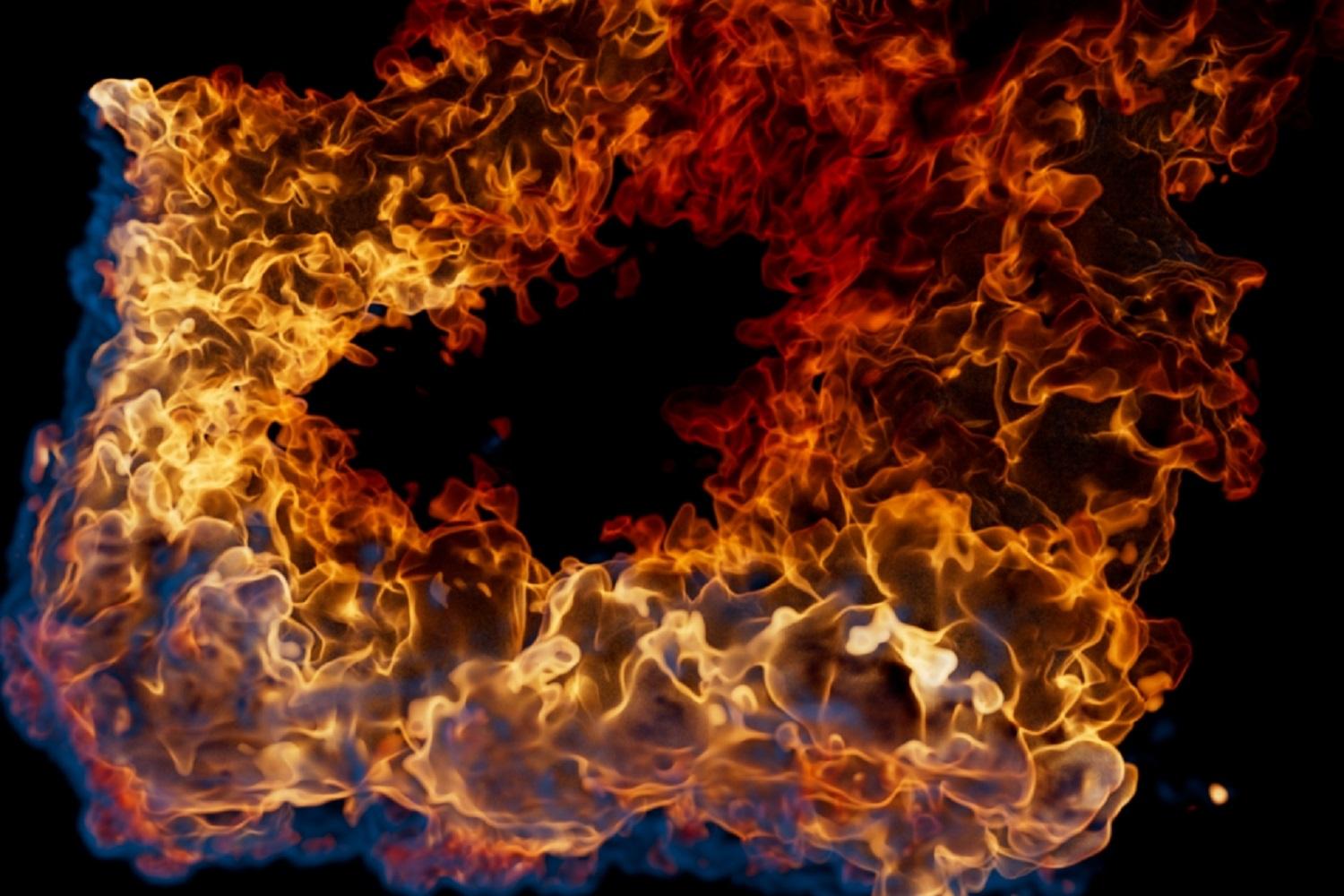
Flickering luminous flames are a key component to the appearance of fire, and the physics governing their behavior is fascinating. For a diffusion flame, soot particles are formed on the fuel rich side of the reaction zone and then abruptly oxidized in a thin band at the edge of the flame. This often results in a sharp boundary to the luminous region, and as shown in the accompanying video, the flame appears to erode visually. Motivated by this observation, we propose to model soot oxidation as an erosion of a level set defined from an isocontour of the soot in conjunction with a dissipation of soot outside of the level set. In our model, we combine (a) a physics-based term to facilitate naturalistic results by default, with (b) a procedural term (in the simplest case a constant) to facilitate enhanced user-control over properties like flame thickness and height beyond what the true physics prescribes. To this end, we leverage previous work and additionally contribute a novel formulation of soot oxidation in the level set framework allowing for the improved explicit user-control over oxidation speed. Furthermore, we contribute a new method that – contrary to previous work – allows the oxidation to be run as a post-process. The post-process facilitates faster iteration on the look of the flames without the risk of introducing a change in behavior into the overall simulation. We demonstrate, verify and discuss the capabilities of our method by several examples ranging from small-scale diffusion flames to large-scale turbulent fire.
References:
[1] John Edholm, Alexey Stomakhin, Rahul Deshprabhu, David Caeiro Cebrian, Florian Hu, and Caitlin Pope. 2023. Fire and Explosions in Avatar: The Way of Water. In ACM SIGGRAPH 2023 Talks (Los Angeles, CA, USA) (SIGGRAPH ’23). Association for Computing Machinery, New York, NY, USA, Article 59, 2 pages.
[2] Jeong-Mo Hong, Tamar Shinar, and Ronald Fedkiw. 2007. Wrinkled Flames and Cellular Patterns. In ACM SIGGRAPH 2007 Papers (San Diego, California) (SIGGRAPH ’07). ACM, New York, NY, USA, Article 47.
[3] B.F. Magnussen and Bjørn Hjertager. 1977. On Mathematical Modeling of Turbulent Combustion With Special Emphasis on Soot Formation and Combustion. Symposium (International) on Combustion 16 (12 1977), 719–729.
[4] Michael B. Nielsen, Morten Bojsen-Hansen, Konstantinos Stamatelos, and Robert Bridson. 2022. Physics-Based Combustion Simulation. ACM Trans. Graph. 41, 5, Article 176 (May 2022), 21 pages.