
“Imaginary Joints and Muscles: Torque-based Proprioceptive Illusions for Extended Body Parts via Skin Stretch Feedback” by Takashita, Steimle and Inami
Conference:
Experience Type(s):
Title:
- Imaginary Joints and Muscles: Torque-based Proprioceptive Illusions for Extended Body Parts via Skin Stretch Feedback
Organizer(s)/Presenter(s):
Interest Areas(s):
- Gaming & Entertainment
- New Technologies
- Research / Education
Description:
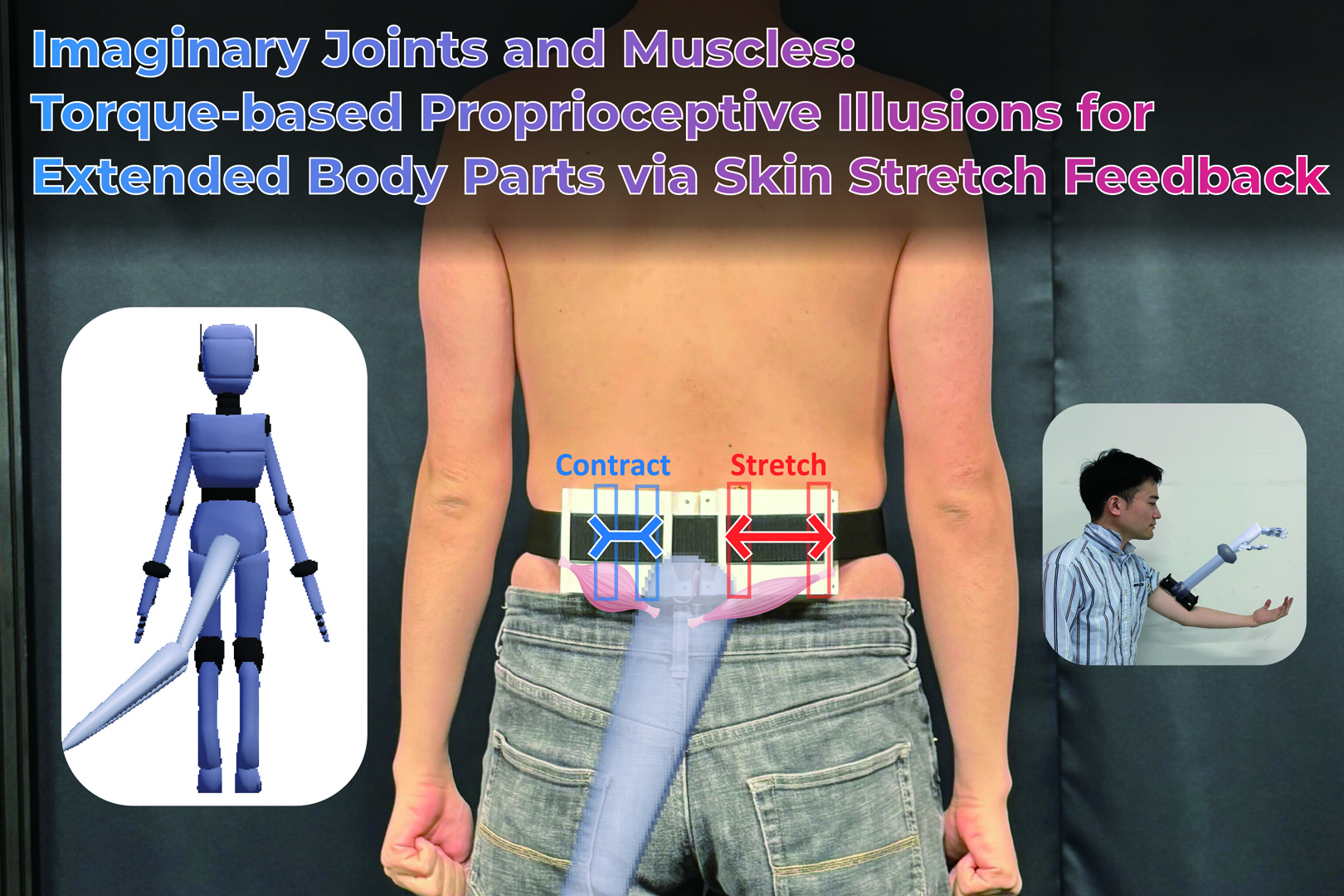
Extended body parts such as a third arm or tail have the potential to offer users new bodily experiences and capabilities. In this paper, we propose a method to enable users to intuitively perceive the posture and motion of such extended body parts without relying on vision, by introducing the concept of ”Imaginary Joints and Muscles”. Our approach provides proprioceptive feedback based on torque information via skin stretch. Specifically, we place an ”Imaginary Joint” at the interface between the user’s body and the extended body part, and the skin around the joint is stretched or compressed in accordance with the motion of the extended body. This allows the user to recognize the movement, in a modality close to innate proprioceptive sensation. The system calculates the torque required for the movement of the extended part and feeds it back to the user, making it applicable to a wide range of scenarios—including physics-based simulations, animations, externally induced movements and mapped manipulations. Through our demonstration, we show that multiple extended parts and various scenarios can be intuitively felt, highlighting the broad potential and versatility of our approach.
References:
[1] Yukiko Iwasaki, Kozo Ando, Shuhei Iizuka, Michiteru Kitazaki, and Hiroyasu Iwata. 2020. Detachable Body: The Impact of Binocular Disparity and Vibrotactile Feedback in Co-Presence Tasks. IEEE Robotics and Automation Letters 5, 2 (2020), 3477–3484. https://doi.org/10.1109/LRA.2020.2977320
[2] MHD Yamen Saraiji, Tomoya Sasaki, Kai Kunze, Kouta Minamizawa, and Masahiko Inami. 2018. MetaArms: Body Remapping Using Feet-Controlled Artificial Arms. In Proc. of UIST 2018 (Berlin, Germany). 65–74. https://doi.org/10.1145/3242587.3242665
[3] Emir Trujillo-Trujillo, Kevin Acuna-Condori, and Marina Gabriela S. P. Paredes. 2022. Evaluation of the Skin Fixation Method of a Haptic Device to Provide Proprioceptive Information for a Sensory Feedback Prosthesis. In 2022 IEEE ANDESCON. 1–6. https://doi.org/10.1109/ANDESCON56260.2022.9989931
[4] Suzanne Wendelken, David M. Page, Tyler Davis, H. A. Christie Wark, Daniel T. Kluger, Cody Duncan, Derek J. Warren, David T. Hutchinson, and Gregory A. Clark. 2017. Restoration of motor control and proprioceptive and cutaneous sensation in humans with prior upper-limb amputation via multiple Utah Slanted Electrode Arrays (USEAs) implanted in residual peripheral arm nerves. Journal of NeuroEngineering and Rehabilitation 14, 1 (Nov 25 2017), 121. https://doi.org/10.1186/s12984-017-0320-4



