“A practical appearance model for dynamic facial color”
Conference:
Type(s):
Title:
- A practical appearance model for dynamic facial color
Session/Category Title:
- Rendering
Presenter(s)/Author(s):
- Jorge Jimenez
- Timothy Scully
- Nuno Barbosa
- Craig Donner
- Xenxo Alvarez
- Teresa Brandao Vieira
- Paul Matts
- Verónica Orvalho
- Diego Gutierrez
- Tim Weyrich
Moderator(s):
Abstract:
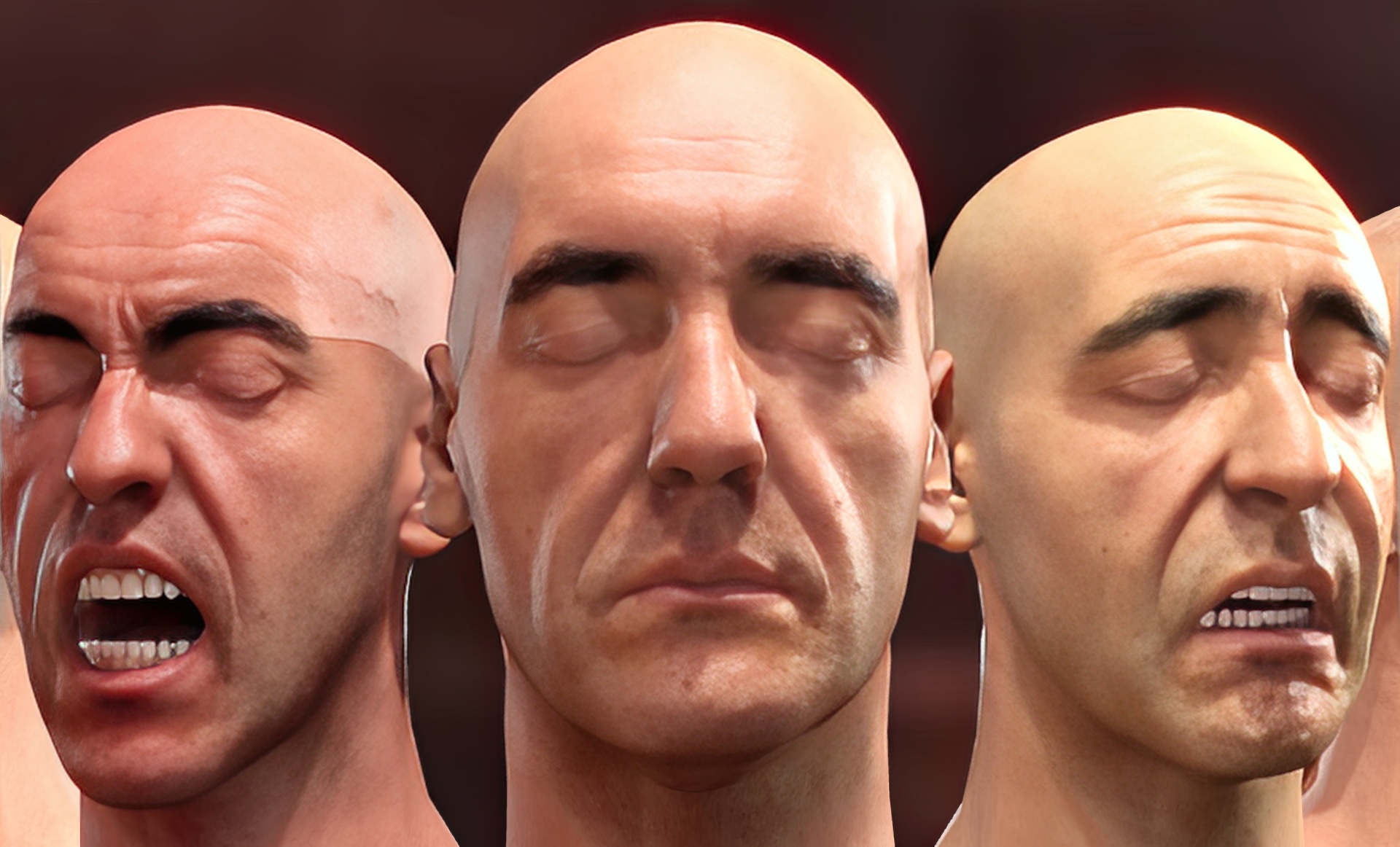
Facial appearance depends on both the physical and physiological state of the skin. As people move, talk, undergo stress, and change expression, skin appearance is in constant flux. One of the key indicators of these changes is the color of skin. Skin color is determined by scattering and absorption of light within the skin layers, caused mostly by concentrations of two chromophores, melanin and hemoglobin. In this paper we present a real-time dynamic appearance model of skin built from in vivo measurements of melanin and hemoglobin concentrations. We demonstrate an efficient implementation of our method, and show that it adds negligible overhead to existing animation and rendering pipelines. Additionally, we develop a realistic, intuitive, and automatic control for skin color, which we term a skin appearance rig. This rig can easily be coupled with a traditional geometric facial animation rig. We demonstrate our method by augmenting digital facial performance with realistic appearance changes.
References:
1. Anderson, R. R., and Parrish, J. A. 1981. The optics of human skin. Investigative Dermatology 77, 13–19.Google ScholarCross Ref
2. Bradley, D., Heidrich, W., Popa, T., and Sheffer, A. 2010. High resolution passive facial performance capture. ACM Trans. on Graphics (Proc. SIGGRAPH) 29, 3. Google ScholarDigital Library
3. Cotton, S. D., and Claridge, E. 1996. Developing a predictive model of human skin colouring. In Proceedings of the SPIE Medical Imaging 1996, vol. 2708, 814–825.Google Scholar
4. Cotton, S. D., Claridge, E., and Hall, P. N. 1999. A skin imaging method based on a colour formation model and its application to the diagnosis of pigmented skin lesions. In Proceedings of Medical Image Understanding and Analysis ’99, 49–52.Google Scholar
5. Cula, O., Dana, K., Murphy, F., and Rao, B. 2004. Bidirectional imaging and modeling of skin texture. IEEE Trans. on Biomedical Engineering 51, 12 (Dec.), 2148–2159.Google ScholarCross Ref
6. Cula, O., Dana, K., Murphy, F., and Rao, B. 2005. Skin texture modeling. International Journal of Computer Vision 62, 1–2 (April-May), 97–119. Google ScholarDigital Library
7. Deng, Z., Chiang, P., Fox, P., and Neumann, U. 2006. Animating blendshape faces by cross-mapping motion capture data. In I3D ’06: Proceedings of the 2006 symposium on Interactive 3D graphics and games, ACM, New York, NY, USA, 43–48. Google ScholarDigital Library
8. d’Eon, E., Luebke, D., and Enderton, E. 2007. Efficient rendering of human skin. In Rendering Techniques (Proc. EGSR), 147–157. Google ScholarDigital Library
9. Donner, C., and Jensen, H. W. 2006. A spectral BSSRDF for shading human skin. In Rendering Techniques (Proc. EGSR), 409–417. Google ScholarDigital Library
10. Donner, C., Weyrich, T., d’Eon, E., Ramamoorthi, R., and Rusinkiewicz, S. 2008. A layered, heterogeneous reflectance model for acquiring and rendering human skin. In Trans. on Graphics (Proc. SIGGRAPH Asia) 27, 10:1–10:12. Google ScholarDigital Library
11. Ekman, P. 1972. Universal and cultural differences in facial expression of emotion. Proc. Nebraska Symposium on Motivation 1971 19, 207–282.Google Scholar
12. Ersotelos, N., and Dong, F. 2008. Building highly realistic facial modelling and animation: a survey. The Visual Computer 24, 1, 13–30. Google ScholarDigital Library
13. Ghosh, A., Hawkins, T., Peers, P., Frederiksen, S., and Debevec, P. 2008. Practical modeling and acquisition of layered facial reflectance. In Transactions on Graphics (Proc. SIGGRAPH Asia) 27, 9:1–9:10. Google ScholarDigital Library
14. Goldstein, D. 2006. Adrenaline and the Inner World: an Introduction to Scientific Integrative Medicine. The John Hopkins University Press.Google Scholar
15. Guo, D., and Sim, T. 2009. Digital face makeup by example. In IEEE Computer Vision and Pattern Recognition, IEEE Computer Society, Los Alamitos, CA, USA, 73–79.Google Scholar
16. Heeger, D. J., and Bergen, J. R. 1995. Pyramid-based texture analysis/synthesis. In Proc. SIGGRAPH, Computer Graphics Proceedings, Annual Conference Series, 229–238. Google ScholarDigital Library
17. Igarashi, T., Nishino, K., and Nayar, S. K. 2007. The appearance of human skin: A survey. Foundations and Trends in Computer Graphics and Vision 3, 1, 1–95. Google ScholarDigital Library
18. Jimenez, J., Sundstedt, V., and Gutierrez, D. 2009. Screen-space perceptual rendering of human skin. ACM Trans. Appl. Percept. 6, 4, 1–15. Google ScholarDigital Library
19. Jimenez, J., Whelan, D., Sundstedt, V., and Gutierrez, D. 2010. Real-time realistic skin translucency. IEEE Computer Graphics & Applications 30, 4, 50–59. Google ScholarDigital Library
20. Jimenez, J., Echevarria, J. I., Oat, C., and Gutierrez, D. 2011. To appear in GPU Pro 2. AK Peters Ltd., ch. Practical and Realistic Facial Wrinkles Animation.Google Scholar
21. Jung, and Knöpfle. 2006. Dynamic aspects of real-time face-rendering. In Proc. ACM Symposium on Virtual Reality Software and Technology (VRST), 1–4. Google ScholarDigital Library
22. Jung, Y., Weber, C., Keil, J., and Franke, T. 2009. Real-time rendering of skin changes caused by emotions. In Proc. of the 9th International Conference on Intelligent Virtual Agents (IVA), Springer-Verlag, Berlin, Heidelberg, 504–505. Google ScholarDigital Library
23. Kalra, P., and Magnenat-Thalmann, N. 1994. Modelling of vascular expressions in facial animation. In Proc. of Computer Animation, 50–58.Google Scholar
24. Kelemen, C., and Szirmay-Kalos, L. 2001. A microfacet based coupled specular-matte brdf model with importance sampling. In Eurographics ’01 (short presentations), 1–11.Google Scholar
25. Lorach, T. 2007. Directx 10 blend shapes: Breaking the limits. In GPU Gems 3, H. Nguyen, Ed. Addison Wesley, ch. 3, 53–67.Google Scholar
26. Matts, P. J., Dykes, P. J., and Marks, R. 2007. The distribution of melanin in skin determined in vivo. British Journal of Dermatology 156, 4, 620–628.Google ScholarCross Ref
27. Matts, P. J. 2008. New insights into skin appearance and measurement. J. Investig. Dermatol. Symp. Proc. 13, 6–9.Google ScholarCross Ref
28. Matusik, W., Zwicker, M., and Durand, F. 2005. Texture design using a simplicial complex of morphable textures. ACM Trans. Graph. (Proc. SIGGRAPH) 24, 3, 787–794. Google ScholarDigital Library
29. Melo, C., and Gratch, J. 2009. Expression of emotions using wrinkles, blushing, sweating and tears. In Intelligent Virtual Agents: 9th International Conference, Springer, Ed., 188–200. Google ScholarDigital Library
30. Moretti, G., Ellis, R., and Mescon, H. 1959. Vascular patterns in the skin of the face. The Journal of Investigative Dermatology 33 (Sep), 103–112.Google ScholarCross Ref
31. Park, S.-B., Huh, C.-H., Choe, Y.-B., and Youn, J.-I. 2002. Time course of ultraviolet-induced skin reactions evaluated by two different reflectance spectrophotometers: Dermaspectrophotometer® and minolta spectrophotometer cm-2002®. Photodermatology, Photoimmunology & Photomedicine 18, 23–28.Google Scholar
32. Plutchik, R. 1980. A general psychoevolutionary theory of emotion. Emotion Theory, Research, And Experience 1.Google Scholar
33. Richie, K., Alexander, O., and Biri, K. 2005. The Art of Rigging. CG Toolkit.Google Scholar
34. Ryan, T. 1995. Mechanical resilience of skin: A function for blood supply and lymphatic drainage. Clinics in Dermatology 13, 5, 429–342.Google ScholarCross Ref
35. Sagar, M. 2006. Facial performance capture and expressive translation for king kong. In SIGGRAPH ’06: ACM SIGGRAPH 2006 Courses, ACM, New York, NY, USA, 26:1–26:1. Google ScholarDigital Library
36. Tsumura, N., Haneishi, H., and Miyake, Y. 1999. Independent-component analysis of skin color image. J. Opt. Soc. Am. A 16, 9, 2169–2176.Google ScholarCross Ref
37. Tsumura, N., Ojima, N., Sato, K., Shiraishi, M., Shimizu, H., Nabeshima, H., Akazaki, S., Hori, K., and Miyake, Y. 2003. Image-based skin color and texture analysis synthesis by extracting hemoglobin and melanin information in the skin. Trans. on Graphics (Proc. SIGGRAPH) 22, 3, 770–779. Google ScholarDigital Library
38. Ward, A. 2004. Game Character Development with Maya. New Riders Publishing. Google ScholarDigital Library
39. Weyrich, T., Matusik, W., Pfister, H., Bickel, B., Donner, C., Tu, C., McAndless, J., Lee, J., Ngan, A., Jensen, H. W., and Gross, M. 2006. Analysis of human faces using a measurement-based skin reflectance model. Trans. on Graphics (Proc. SIGGRAPH) 25, 1013–1024. Google ScholarDigital Library
40. Xu, Y., and Aliaga, D. G. 2007. Dense depth and color acquisition of repetitive motions. In Proc. of International Conference on 3-D Digital Imaging and Modeling (3DIM), 141–148. Google ScholarDigital Library
41. Yamada, T., and Watanabe, T. 2007. Virtual facial image synthesis with facial color enhancement and expression under emotional change of anger. In 16th IEEE International Conference on Robot & Human Interactive Communication, 49–54.Google Scholar