“Yarn-level simulation of woven cloth” by Cirio, Lopez-Moreno, Miraut and Otaduy
Conference:
Type(s):
Title:
- Yarn-level simulation of woven cloth
Session/Category Title:
- Newton's Garden
Presenter(s)/Author(s):
Abstract:
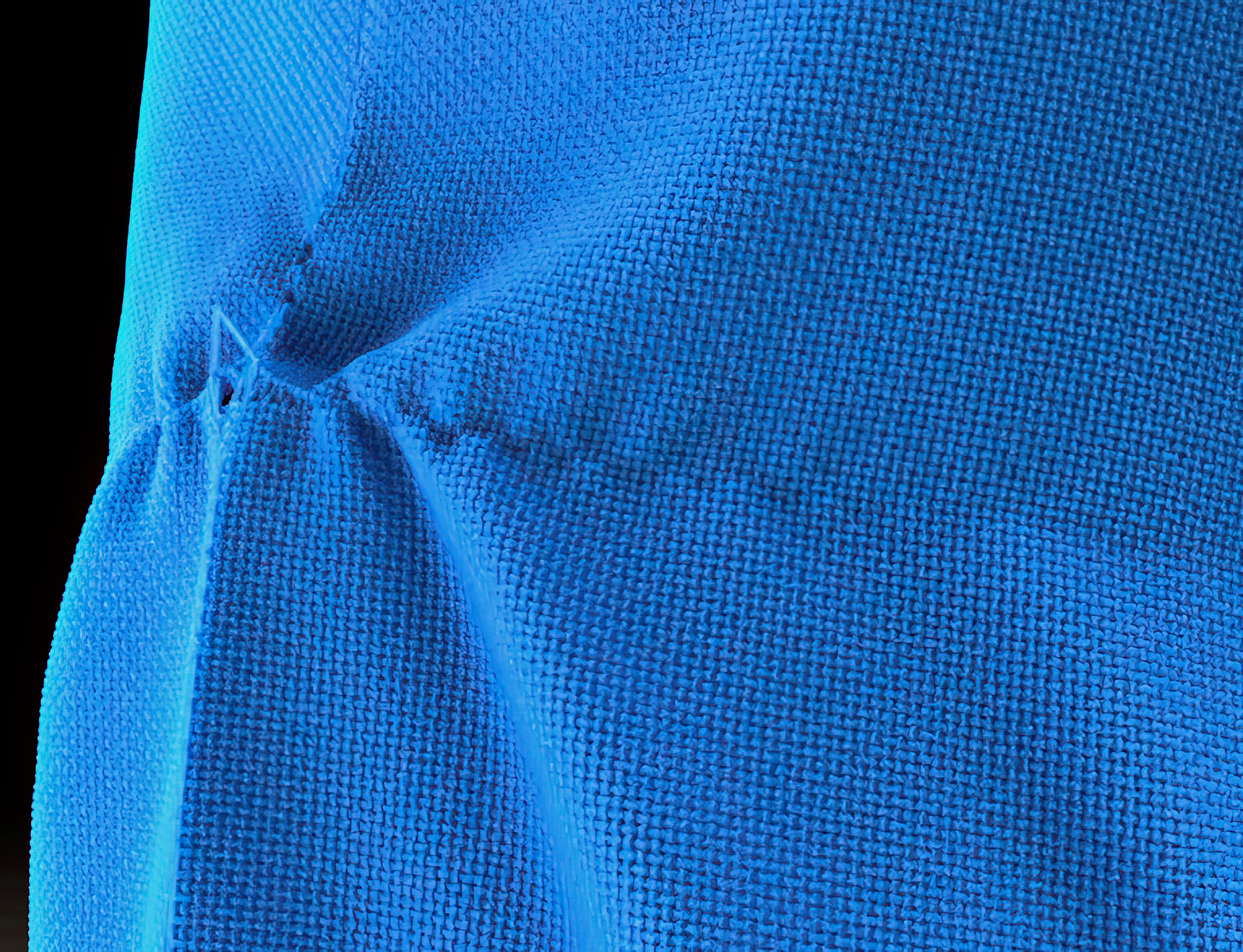
The large-scale mechanical behavior of woven cloth is determined by the mechanical properties of the yarns, the weave pattern, and frictional contact between yarns. Using standard simulation methods for elastic rod models and yarn-yarn contact handling, the simulation of woven garments at realistic yarn densities is deemed intractable. This paper introduces an efficient solution for simulating woven cloth at the yarn level. Central to our solution is a novel discretization of interlaced yarns based on yarn crossings and yarn sliding, which allows modeling yarn-yarn contact implicitly, avoiding contact handling at yarn crossings altogether. Combined with models for internal yarn forces and inter-yarn frictional contact, as well as a massively parallel solver, we are able to simulate garments with hundreds of thousands of yarn crossings at practical frame-rates on a desktop machine, showing combinations of large-scale and fine-scale effects induced by yarn-level mechanics.
References:
1. Baraff, D., and Witkin, A. 1998. Large steps in cloth simulation. In Proceedings of ACM SIGGRAPH 98, 4354.
2. Bell, N., and Garland, M., 2012. Cusp: Generic parallel algorithms for sparse matrix and graph computations. Version 0.3.0.
3. Bergou, M., Wardetzky, M., Robinson, S., Audoly, B., and Grinspun, E. 2008. Discrete elastic rods. ACM Trans. Graph. 27, 3, 63:163:12.
4. Berthouzoz, F., Garg, A., Kaufman, D. M., Grinspun, E., and Agrawala, M. 2013. Parsing sewing patterns into 3D garments. ACM Trans. Graph. 32, 4, 85:1–85:12.
5. Boisse, P., Borr, M., Buet, K., and Cherouat, A. 1997. Finite element simulations of textile composite forming including the biaxial fabric behaviour. Composites Part B: Engineering 28, 4, 453–464.Cross Ref
6. Breen, D. E., House, D. H., and Wozny, M. J. 1994. Predicting the drape of woven cloth using interacting particles. In Proceedings of ACM SIGGRAPH 94, 365–372.
7. Bridson, R., Marino, S., and Fedkiw, R. 2003. Simulation of clothing with folds and wrinkles. In Proceedings of ACM SIGGRAPH/Eurographics Symposium on Computer animation 2003, 2836.
8. Casati, R., and Bertails-Descoubes, F. 2013. Super space clothoids. ACM Trans. Graph. 32, 4, 48.
9. Chen, Y., Lin, S., Zhong, H., Xu, Y.-Q., Guo, B., and Shum, H.-Y. 2003. Realistic rendering and animation of knitwear. IEEE Transactions on Visualization and Computer Graphics 9, 1 (Jan.), 43–55.
10. Choi, K.-J., and Ko, H.-S. 2002. Stable but responsive cloth. ACM Trans. Graph. 21, 3, 604–611.
11. Daviet, G., Bertails-Descoubes, F., and Boissieux, L. 2011. A hybrid iterative solver for robustly capturing coulomb friction in hair dynamics. ACM Trans. Graph. 30, 6, 139:1–139:12.
12. de Joya, J. M., Narain, R., O’Brien, J., Samii, A., and Zordan, V. Berkeley garment library. http://graphics.berkeley.edu/resources/GarmentLibrary/.
13. Duan, Y., Keefe, M., Bogetti, T. A., and Powers, B. 2006. Finite element modeling of transverse impact on a ballistic fabric. International Journal of Mechanical Sciences 48, 1, 33–43.Cross Ref
14. Etzmuss, O., Keckeisen, M., and Strasser, W. 2003. A fast finite element solution for cloth modelling. In Proceedings of Pacific Graphics 2003, 244–251.
15. Goldenthal, R., Harmon, D., Fattal, R., Bercovier, M., and Grinspun, E. 2007. Efficient simulation of inextensible cloth. ACM Trans. Graph. 26, 3, 49.
16. Goldstein, H., Poole, C. P., and Safko, J. L. 2001. Classical Mechanics (3rd Edition), 3 ed. Addison-Wesley.
17. Grinspun, E., Hirani, A. N., Desbrun, M., and Schröder, P. 2003. Discrete shells. In Proceedings of ACM SIGGRAPH/Eurographics Symposium on Computer animation 2003, 6267.
18. Harmon, D., Vouga, E., Smith, B., Tamstorf, R., and Grinspun, E. 2009. Asynchronous contact mechanics. ACM Trans. Graph. 28, 3, 97.
19. Hearle, J. W. S., Grosberg, P., and Backer, S. 1969. Structural Mechanics of Fibers, Yarns, and Fabrics, vol. 1. JohnWiley & Sons Inc., New York.
20. Jakob, W., 2010. Mitsuba renderer. http://www.mitsuba-renderer.org.
21. Kaldor, J. M., James, D. L., and Marschner, S. 2008. Simulating knitted cloth at the yarn level. ACM Trans. Graph. 27, 3, 65:165:9.
22. Kaldor, J. M., James, D. L., and Marschner, S. 2010. Efficient yarn-based cloth with adaptive contact linearization. ACM Trans. Graph. 29, 4, 105:1–105:10.
23. Kawabata, S., Niwa, M., and Kawai, H. 1973. The finite-deformation theory of plain-weave fabrics part i: The biaxial-deformation theory. Journal of the Textile Institute 64, 1, 21–46.Cross Ref
24. King, M. J., Jearanaisilawong, P., and Socrate, S. 2005. A continuum constitutive model for the mechanical behavior of woven fabrics. International Journal of Solids and Structures 42, 13, 3867–3896.Cross Ref
25. Lopez-Moreno, J., Cirio, G., Miraut, D., and Otaduy, M. A. 2014. GPU Visualization and Voxelization of Yarn-Level Cloth. Proceedings of the Spanish Computer Graphics Conference.
26. McGlockton, M. A., Cox, B. N., and McMeeking, R. M. 2003. A binary model of textile composites: III high failure strain and work of fracture in 3D weaves. Journal of the Mechanics and Physics of Solids 51, 8, 1573–1600.Cross Ref
27. Metaaphanon, N., Bando, Y., Chen, B.-Y., and Nishita, T. 2009. Simulation of tearing cloth with frayed edges. Comput. Graph. Forum 7, 1837–1844.Cross Ref
28. Miguel, E., Bradley, D., Thomaszewski, B., Bickel, B., Matusik, W., Otaduy, M. A., and Marschner, S. 2012. Data-driven estimation of cloth simulation models. Comp. Graph. Forum 31, 519–528.
29. Miguel, E., Tamstorf, R., Bradley, D., Schvartzman, S. C., Thomaszewski, B., Bickel, B., Matusik, W., Marschner, S., and Otaduy, M. A. 2013. Modeling and estimation of internal friction in cloth. ACM Trans. Graph. 32, 6, 212:1–212:10.
30. Nadler, B., Papadopoulos, P., and Steigmann, D. J. 2006. Multiscale constitutive modeling and numerical simulation of fabric material. International Journal of Solids and Structures 43, 2, 206–221.Cross Ref
31. Narain, R., Samii, A., and O’Brien, J. F. 2012. Adaptive anisotropic remeshing for cloth simulation. ACM Trans. Graph. 31, 6, 152:1–152:10.
32. Ng, S.-P., Tse, P.-C., and Lau, K.-J. 1998. Numerical and experimental determination of in-plane elastic properties of 2/2 twill weave fabric composites. Composites Part B: Engineering 29, 6, 735–744.Cross Ref
33. O’Brien, J. F., and Hodgins, J. K. 1999. Graphical modeling and animation of brittle fracture. In Proceedings of ACM SIGGRAPH 99, 137146.
34. Page, J., and Wang, J. 2000. Prediction of shear force and an analysis of yarn slippage for a plain-weave carbon fabric in a bias extension state. Composites Science and Technology 60, 7, 977–986.Cross Ref
35. Pai, D. K. 2002. Strands: Interactive simulation of thin solids using cosserat models. Comput. Graph. Forum 21, 3, 347–352.Cross Ref
36. Parsons, E. M., Weerasooriya, T., Sarva, S., and Socrate, S. 2010. Impact of woven fabric: Experiments and mesostructure-based continuum-level simulations. Journal of the Mechanics and Physics of Solids 58, 11, 1995–2021.Cross Ref
37. Parsons, E. M., King, M. J., and Socrate, S. 2013. Modeling yarn slip in woven fabric at the continuum level: Simulations of ballistic impact. Journal of the Mechanics and Physics of Solids 61, 1, 265–292.Cross Ref
38. Peirce, F. T. 1937. The geometry of cloth structure. Journal of the Textile Institute Transactions 28, 3, T45–T96.Cross Ref
39. Pfaff, T., Narain, R., de Joya, J. M., and O’Brien, J. F. 2014. Adaptive tearing and cracking of thin sheets. ACM Trans. Graph. 33, 4, 110:1–9.
40. Provot, X. 1995. Deformation constraints in a mass-spring model to describe rigid cloth behavior. In In Graphics Interface, 147–154.
41. Reese, S. 2003. Anisotropic elastoplastic material behavior in fabric structures. In IUTAM Symposium on Computational Mechanics of Solid Materials at Large Strains, 201–210.Cross Ref
42. Spillmann, J., and Teschner, M. 2007. CoRdE: cosserat rod elements for the dynamic simulation of one-dimensional elastic objects. In Proceedings of ACM SIGGRAPH/Eurographics Symposium on Computer Animation 2007, 6372.
43. Spillmann, J., and Teschner, M. 2009. Cosserat nets. IEEE Transactions on Visualization and Computer Graphics 15, 2, 325–338.
44. Sueda, S., Jones, G. L., Levin, D. I. W., and Pai, D. K. 2011. Large-scale dynamic simulation of highly constrained strands. ACM Trans. Graph. 30, 4, 39:1–10.
45. Sullivan, J. M. 2008. Curves of finite total curvature. In Discrete Differential Geometry, A. I. Bobenko, J. M. Sullivan, P. Schröder, and G. M. Ziegler, Eds., vol. 38 of Oberwolfach Seminars. Birkhäuser, Basel, 137–161.
46. Tang, M., Tong, R., Narain, R., Meng, C., and Manocha, D. 2013. A GPU-based streaming algorithm for high-resolution cloth simulation. Computer Graphics Forum 32, 7, 21–30.Cross Ref
47. Terzopoulos, D., Platt, J., Barr, A., and Fleischer, K. 1987. Elastically deformable models. In Proceedings of ACM SIGGRAPH 87, 205–214.
48. Teschner, M., Heidelberger, B., Mueller, M., Pomeranets, D., and Gross, M. 2003. Optimized spatial hashing for collision detection of deformable objects. 47–54.
49. Volino, P., Courchesne, M., and Magnenat Thalmann, N. 1995. Versatile and efficient techniques for simulating cloth and other deformable objects. In Proceedings of ACM SIGGRAPH 95, 137–144.
50. Volino, P., Magnenat-Thalmann, N., and Faure, F. 2009. A simple approach to nonlinear tensile stiffness for accurate cloth simulation. ACM Trans. Graph. 28, 4, 105:1–105:16.
51. Wang, H., O’Brien, J. F., and Ramamoorthi, R. 2011. Data-driven elastic models for cloth: modeling and measurement. ACM Trans. Graph. 30, 4, 71:1–71:12.
52. Xia, W., and Nadler, B. 2011. Three-scale modeling and numerical simulations of fabric materials. International Journal of Engineering Science 49, 3, 229–239.Cross Ref
53. Yamane, K., and Nakamura, Y. 2006. Stable penalty-based model of frictional contacts. In Proceedings of IEEE International Conference on Robotics and Automation 2006, 1904–1909.