“wave2weave: A Procedural Weave Data Generation” by Hayama and Uchibe
Conference:
Type(s):
Title:
- wave2weave: A Procedural Weave Data Generation
Session/Category Title:
- Craft and Creativity
Presenter(s)/Author(s):
Moderator(s):
Abstract:
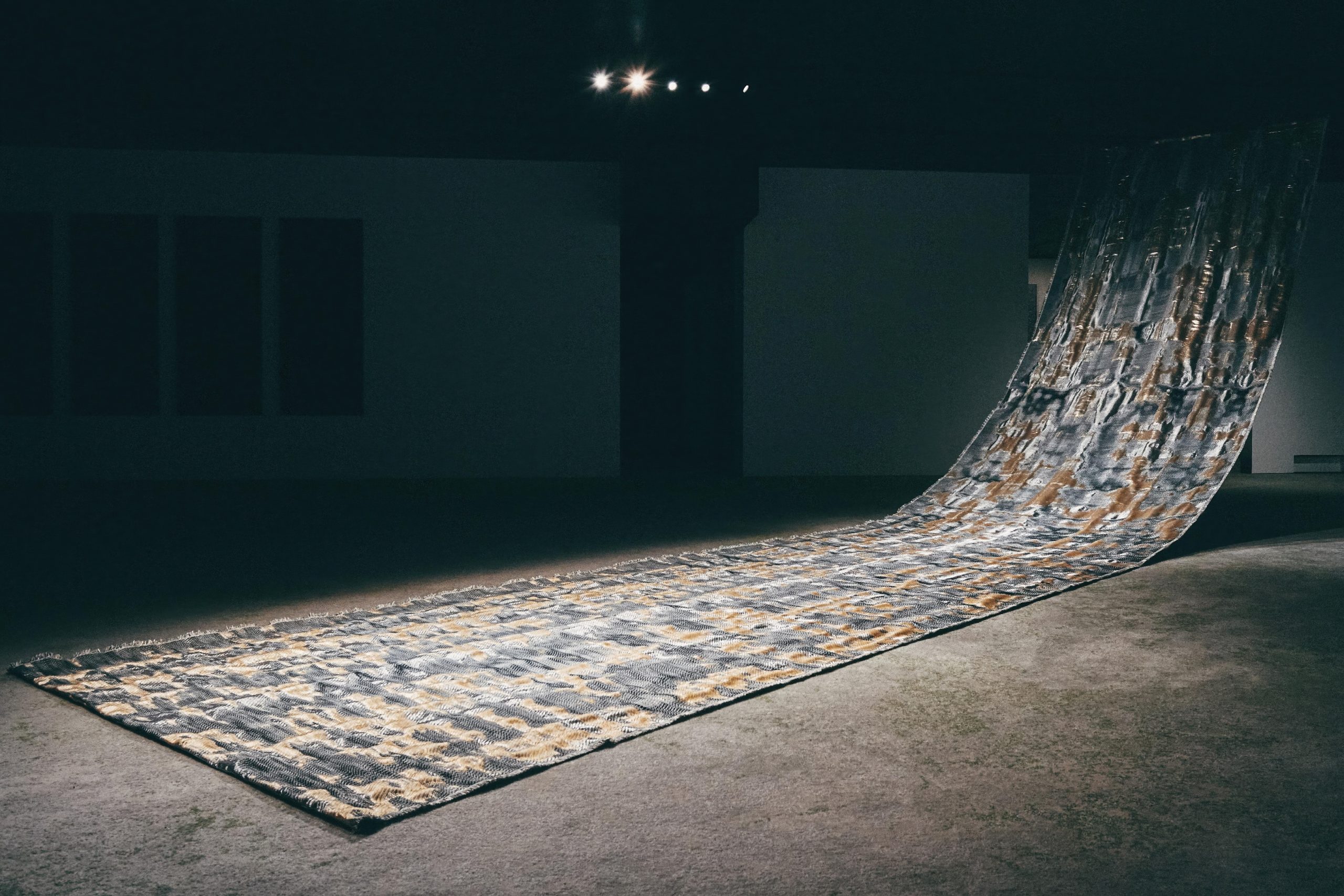
This paper introduces wave2weave, a novel data generation system for Jacquard weaving, and presents a project to create textile artworks with this system. wave2weave procedurally produces weave data through matrix computation, enabling fabrics with complex shaded patterns and a triple-layer structure. The underlying pattern generator adapts network drafting, a handweaving method that creates weave patterns using waveform design. Applying it to Jacquard weaving enables high-resolution waveform designs that are difficult to achieve with hand weaving. Furthermore, executing the matrix computations on a GPU enables efficient and rapid processing of the weaving data. The artistic contribution of their work is associated with a creative coding approach based on noise functions and Nishijin textile techniques. While noise functions are commonly used for procedural texturing in computer graphics, the creative coding community has developed them as a creative medium. Through wave2weave, textile design is reduced to the manipulation of noise functions, generating both the pattern and structure. The authors collaborated with a Nishijin textile company to produce an art piece. Nishijin textiles are traditional Japanese textiles whose defining feature lies in their distinctive use of materials. Rich textile textures that highlight the unique properties of these materials have traditionally been used in luxury woven fabrics. The authors extend a Nishijin double-weave technique to a triple-weave structure using wave2weave, incorporating computational aesthetics. Therefore, they present a new possibility for textile art that emerges from the fusion of traditional craftsmanship and contemporary computational techniques.
References:
[1] Lea Albaugh. 2018. “It’s Just Matrix Multiplication”: Notation for Weaving. http://lea.zone/blog/weaving-notation-at-strange-loop/
[2] Anni Albers. 1965. On Weaving. Wesleyan Univ. Press, Middletown, Conn.
[3] Michael F. Barnsley, Robert L. Devaney, Benoit B. Mandelbrot, Heinz-Otto Peitgen, Dietmar Saupe, and Richard F. Voss. 1988. The Science of Fractal Images. Springer New York, New York, NY.
[4] Laura Devendorf, Sasha de Koninck, and Etta Sandry. 2022. An Introduction to Weave Structure for HCI: A How-to and Reflection on Modes of Exchange. In Designing Interactive Systems Conference. ACM, Virtual Event Australia, 629–642.
[5] Philip Galanter. 2003. What Is Generative Art? Complexity Theory as a Context for Art Theory. Proceedings of the International Conference on Generative Art, Milan, Italy. Generative Design Lab, Milan Polytechnic: City. (2003).
[6] Bonnie Inouye. 2009. Flowing Curves: Network Drafted Twill. https://weavezine.com/content/flowing-curves-network-drafted-twill.html
[7] Isaac Karth. 2019. Preliminary Poetics of Procedural Generation in Games. ToDIGRA 4, 3 (Oct. 2019).
[8] Cadence Kinsey. 2024. In-Formation: Weaving as Code in Beryl Korot’s Text and Commentary (1976–77). Grey Room96 (July 2024), 52–73.
[9] Ken Perlin. 1985. An Image Synthesizer. SIGGRAPH Comput. Graph. 19, 3 (July 1985), 287–296.
[10] Inigo Quilez. 2019. fBM. https://www.iquilezles.org/www/articles/fbm/fbm.htm
[11] Alice Schlein. 1994. Network Drafting: An Introduction. Bridgewater Press, Greenville, SC.
[12] Theo Wright. 2017. When Waves Collide. Complex Weavers Journal 113 (2017), 6–9.
[13] Rundong Wu, Joy Xiaoji Zhang, Jonathan Leaf, Xinru Hua, Ante Qu, Claire Harvey, Emily Holtzman, Joy Ko, Brooks Hagan, Doug James, François Guimbretière, and Steve Marschner. 2020. Weavecraft: An Interactive Design and Simulation Tool for 3D Weaving. ACM Trans. Graph. 39, 6 (Nov. 2020), 1–16.