“ViCMA: Visual Control of Multibody Animations” by James and Levin
Conference:
Type(s):
Title:
- ViCMA: Visual Control of Multibody Animations
Session/Category Title:
- Character and Rigid Body Control
Presenter(s)/Author(s):
Abstract:
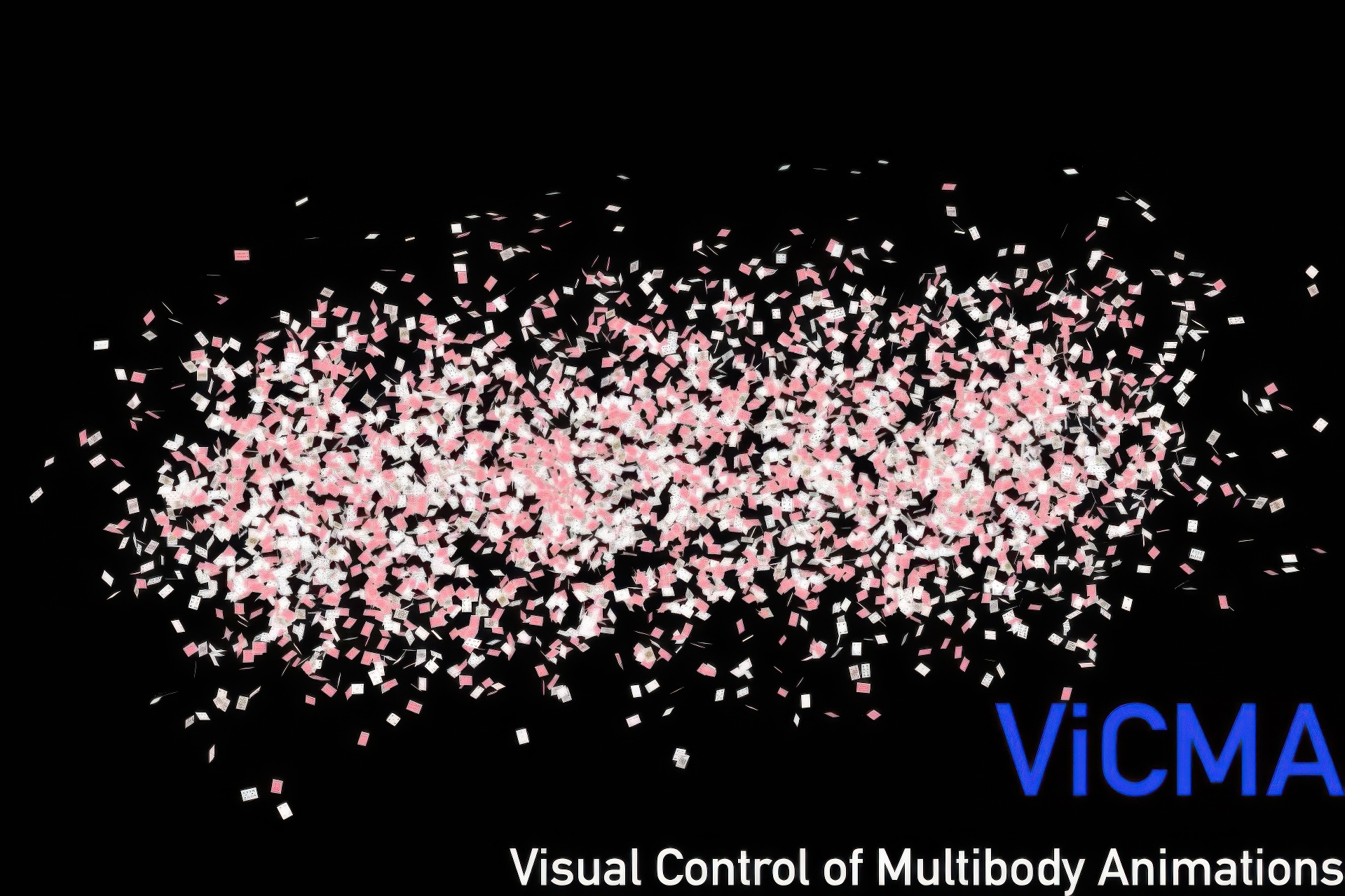
Motion control of large-scale, multibody physics animations with contact is difficult. Existing approaches, such as those based on optimization, are computationally daunting, and, as the number of interacting objects increases, can fail to find satisfactory solutions. We present a new, complementary method for the visual control of multibody animations that expoits object motion and visibility, and has overall cost comparable to a single simulation. Our method is highly practical, and is demonstrated on numerous large-scale, contact-rich examples involving both rigid and deformable bodies.
References:
[1]
Richard A. Abrams and Shawn E. Christ. 2003. Motion Onset Captures Attention. Psychological Science 14, 5 (2003), 427–432. https://doi.org/10.1111/1467-9280.01458 arXiv:https://doi.org/10.1111/1467-9280.01458PMID: 12930472.
[2]
Jonathan E Attwood, Christopher Kennard, Jim Harris, Glyn Humphreys, and Chrystalina A Antoniades. 2018. A comparison of change blindness in real-world and on-screen viewing of museum artefacts. Frontiers in Psychology 9 (2018), 151.
[3]
Jernej Barbič and Jovan Popović. 2008. Real-Time Control of Physically Based Simulations Using Gentle Forces. ACM Trans. Graph. 27, 5, Article 163 (dec 2008), 10 pages. https://doi.org/10.1145/1409060.1409116
[4]
Ronen Barzel, John R Hughes, and Daniel N Wood. 1996. Plausible motion simulation for computer graphics animation. In Computer Animation and Simulation’96. Springer, 183–197.
[5]
Miklós Bergou, Saurabh Mathur, Max Wardetzky, and Eitan Grinspun. 2007. TRACKS: Toward Directable Thin Shells. ACM Trans. Graph. 26, 3 (jul 2007), 50–es. https://doi.org/10.1145/1276377.1276439
[6]
Blender. 2023. Blender – a 3D modelling and rendering package. Blender Foundation, Stichting Blender Foundation, Amsterdam. http://www.blender.org
[7]
Stephen Chenney and D. A. Forsyth. 2000. Sampling Plausible Solutions to Multi-Body Constraint Problems. In Proceedings of the 27th Annual Conference on Computer Graphics and Interactive Techniques(SIGGRAPH ’00). ACM Press/Addison-Wesley Publishing Co., USA, 219–228. https://doi.org/10.1145/344779.344882
[8]
Michael F. Cohen. 1992. Interactive Spacetime Control for Animation. In Proceedings of the 19th Annual Conference on Computer Graphics and Interactive Techniques(SIGGRAPH ’92). Association for Computing Machinery, New York, NY, USA, 293–302. https://doi.org/10.1145/133994.134083
[9]
Emily M Crowe, Christina J Howard, Iain D Gilchrist, and Christopher Kent. 2021. Motion disrupts dynamic visual search for an orientation change. Cognitive research: principles and implications 6, 1 (2021), 1–9.
[10]
Signe Dean. 2018. This Machine “Quantum” Sorting Marbles Into a Rainbow Actually Has a Dirty Secret. Science Alert. https://www.sciencealert.com/coloured-balls-sorted-machine-quantum-resonance-fake-computer-simulation-galton-board
[11]
Raanan Fattal and Dani Lischinski. 2004. Target-driven Smoke Animation. In ACM SIGGRAPH 2004 Papers. 441–448.
[12]
Zahra Forootaninia and Rahul Narain. 2020. Frequency-Domain Smoke Guiding. ACM Trans. Graph. 39, 6, Article 172 (nov 2020), 10 pages. https://doi.org/10.1145/3414685.3417842
[13]
Purvi Goel and Doug L. James. 2022. Unified Many-Worlds Browsing of Arbitrary Physics-Based Animations. ACM Trans. Graph. 41, 4, Article 156 (jul 2022), 15 pages. https://doi.org/10.1145/3528223.3530082
[14]
Donghui Han, Shu-wei Hsu, Ann McNamara, and John Keyser. 2013. Believability in Simplifications of Large Scale Physically Based Simulation. In Proceedings of the ACM Symposium on Applied Perception (Dublin, Ireland) (SAP ’13). Association for Computing Machinery, New York, NY, USA, 99–106. https://doi.org/10.1145/2492494.2492504
[15]
Charles R. Harris, K. Jarrod Millman, Stéfan J. van der Walt, Ralf Gommers, Pauli Virtanen, David Cournapeau, Eric Wieser, Julian Taylor, Sebastian Berg, Nathaniel J. Smith, Robert Kern, Matti Picus, Stephan Hoyer, Marten H. van Kerkwijk, Matthew Brett, Allan Haldane, Jaime Fernández del Río, Mark Wiebe, Pearu Peterson, Pierre Gérard-Marchant, Kevin Sheppard, Tyler Reddy, Warren Weckesser, Hameer Abbasi, Christoph Gohlke, and Travis E. Oliphant. 2020a. Array programming with NumPy. Nature 585, 7825 (Sept. 2020), 357–362.
[16]
David J Harris, Mark R Wilson, Emily M Crowe, and Samuel J Vine. 2020b. Examining the roles of working memory and visual attention in multiple object tracking expertise. Cognitive processing 21 (2020), 209–222.
[17]
Christina J Howard and Alex O Holcombe. 2010. Unexpected changes in direction of motion attract attention. Attention, Perception, & Psychophysics 72, 8 (2010), 2087–2095.
[18]
Shu-Wei Hsu and John Keyser. 2009. Statistical Simulation of Rigid Bodies. In Proceedings of the 2009 ACM SIGGRAPH/Eurographics Symposium on Computer Animation (New Orleans, Louisiana) (SCA ’09). Association for Computing Machinery, New York, NY, USA, 139–148. https://doi.org/10.1145/1599470.1599489
[19]
Shu-Wei Hsu and John Keyser. 2010. Piles of Objects. ACM Trans. Graph. 29, 6, Article 155 (dec 2010), 6 pages. https://doi.org/10.1145/1882261.1866181
[20]
Shu-Wei Hsu and John Keyser. 2012. Automated Constraint Placement to Maintain Pile Shape. ACM Trans. Graph. 31, 6, Article 150 (nov 2012), 6 pages. https://doi.org/10.1145/2366145.2366169
[21]
Doug L James, Christopher D Twigg, Andrew Cove, and Robert Y Wang. 2007. Mesh Ensemble Motion Graphs: Data-driven mesh animation with constraints. ACM Transactions on Graphics (TOG) 26, 4 (2007), 17–es.
[22]
Timothy R. Langlois and Doug L. James. 2014. Inverse-Foley Animation: Synchronizing rigid-body motions to sound. ACM Transactions on Graphics (Proceedings of SIGGRAPH 2014) 33, 4 (Aug. 2014). https://doi.org/10.1145/2601097.2601178
[23]
Pingchuan Ma, Yunsheng Tian, Zherong Pan, Bo Ren, and Dinesh Manocha. 2018. Fluid Directed Rigid Body Control Using Deep Reinforcement Learning. ACM Trans. Graph. 37, 4, Article 96 (July 2018), 11 pages. https://doi.org/10.1145/3197517.3201334
[24]
J. Marks, B. Andalman, P. A. Beardsley, W. Freeman, S. Gibson, J. Hodgins, T. Kang, B. Mirtich, H. Pfister, W. Ruml, K. Ryall, J. Seims, and S. Shieber. 1997. Design Galleries: A General Approach to Setting Parameters for Computer Graphics and Animation. In Proceedings of the 24th Annual Conference on Computer Graphics and Interactive Techniques(SIGGRAPH ’97). ACM Press/Addison-Wesley Publishing Co., USA, 389–400. https://doi.org/10.1145/258734.258887
[25]
Antoine McNamara, Adrien Treuille, Zoran Popović, and Jos Stam. 2004. Fluid Control Using the Adjoint Method. ACM Trans. Graph. 23, 3 (Aug. 2004), 449–456. https://doi.org/10.1145/1015706.1015744
[26]
Michael B. Nielsen and Robert Bridson. 2011. Guide Shapes for High Resolution Naturalistic Liquid Simulation. In ACM SIGGRAPH 2011 Papers (Vancouver, British Columbia, Canada) (SIGGRAPH ’11). Association for Computing Machinery, New York, NY, USA, Article 83, 8 pages. https://doi.org/10.1145/1964921.1964978
[27]
Carol O’Sullivan. 2005. Collisions and Attention. ACM Trans. Appl. Percept. 2, 3 (jul 2005), 309–321. https://doi.org/10.1145/1077399.1077407
[28]
Carol O’Sullivan and John Dingliana. 2001. Collisions and Perception. ACM Trans. Graph. 20, 3 (jul 2001), 151–168. https://doi.org/10.1145/501786.501788
[29]
Carol O’Sullivan, John Dingliana, Thanh Giang, and Mary K. Kaiser. 2003. Evaluating the Visual Fidelity of Physically Based Animations. In ACM SIGGRAPH 2003 Papers (San Diego, California) (SIGGRAPH ’03). Association for Computing Machinery, New York, NY, USA, 527–536. https://doi.org/10.1145/1201775.882303
[30]
Zherong Pan, Jin Huang, Yiying Tong, Changxi Zheng, and Hujun Bao. 2013. Interactive Localized Liquid Motion Editing. ACM Trans. Graph. 32, 6, Article 184 (Nov. 2013), 10 pages. https://doi.org/10.1145/2508363.2508429
[31]
F. Pedregosa, G. Varoquaux, A. Gramfort, V. Michel, B. Thirion, O. Grisel, M. Blondel, P. Prettenhofer, R. Weiss, V. Dubourg, J. Vanderplas, A. Passos, D. Cournapeau, M. Brucher, M. Perrot, and E. Duchesnay. 2011. Scikit-learn: Machine Learning in Python. Journal of Machine Learning Research 12 (2011), 2825–2830.
[32]
Umberto Pesavento and Z Jane Wang. 2004. Falling Paper: Navier-Stokes solutions, model of fluid forces, and center of mass elevation. Physical review letters 93, 14 (2004), 144501.
[33]
Jovan Popović, Steven M Seitz, and Michael Erdmann. 2003. Motion sketching for control of rigid-body simulations. ACM Transactions on Graphics (TOG) 22, 4 (2003), 1034–1054.
[34]
Jovan Popović, Steven M. Seitz, Michael Erdmann, Zoran Popović, and Andrew Witkin. 2000. Interactive Manipulation of Rigid Body Simulations. In Proceedings of the 27th Annual Conference on Computer Graphics and Interactive Techniques(SIGGRAPH ’00). ACM Press/Addison-Wesley Publishing Co., USA, 209–217. https://doi.org/10.1145/344779.344880
[35]
Ganesh Ramanarayanan, Kavita Bala, and James A Ferwerda. 2008. Perception of complex aggregates. In ACM SIGGRAPH 2008 papers. 1–10.
[36]
Paul S. A. Reitsma and Carol O’Sullivan. 2008. Effect of Scenario on Perceptual Sensitivity to Errors in Animation. In Proceedings of the 5th Symposium on Applied Perception in Graphics and Visualization (Los Angeles, California) (APGV ’08). Association for Computing Machinery, New York, NY, USA, 115–121. https://doi.org/10.1145/1394281.1394302
[37]
Paul S. A. Reitsma and Carol O’Sullivan. 2009. Effect of Scenario on Perceptual Sensitivity to Errors in Animation. ACM Trans. Appl. Percept. 6, 3, Article 15 (sep 2009), 16 pages. https://doi.org/10.1145/1577755.1577758
[38]
Syuhei Sato, Yoshinori Dobashi, and Theodore Kim. 2021. Stream-Guided Smoke Simulations. ACM Trans. Graph. 40, 4, Article 161 (July 2021), 7 pages. https://doi.org/10.1145/3450626.3459846
[39]
Arnaud Schoentgen, Pierre Poulin, Emmanuelle Darles, and Philippe Meseure. 2020. Particle-Based Liquid Control Using Animation Templates. Eurographics Association, Goslar, DEU. https://doi.org/10.1111/cgf.14103
[40]
Lin Shi and Yizhou Yu. 2005. Controllable Smoke Animation with Guiding Objects. ACM Transactions on Graphics 24 (01 2005). https://doi.org/10.1145/1037957.1037965
[41]
SideFX. 2023. Houdini Engine. http://www.sidefx.com.
[42]
Jordan W Suchow and George A Alvarez. 2011. Motion silences awareness of visual change. Current Biology 21, 2 (2011), 140–143.
[43]
Diane Tang, J Thomas Ngo, and Joe Marks. 1995. N-body Spacetime Constraints. The Journal of Visualization and Computer Animation 6, 3 (1995), 143–154.
[44]
N. Thürey, R. Keiser, M. Pauly, and U. Rüde. 2006. Detail-Preserving Fluid Control. In Proceedings of the 2006 ACM SIGGRAPH/Eurographics Symposium on Computer Animation (Vienna, Austria) (SCA ’06). Eurographics Association, Goslar, DEU, 7–12.
[45]
Adrien Treuille, Antoine McNamara, Zoran Popović, and Jos Stam. 2003. Keyframe Control of Smoke Simulations. ACM Trans. Graph. 22, 3 (jul 2003), 716–723. https://doi.org/10.1145/882262.882337
[46]
Christopher D. Twigg and Doug L. James. 2007. Many-Worlds Browsing for Control of Multibody Dynamics. ACM Trans. Graph. 26, 3 (July 2007), 14–es. https://doi.org/10.1145/1276377.1276395
[47]
Christopher D Twigg and Doug L James. 2008. Backward steps in rigid body simulation. In ACM SIGGRAPH 2008 papers. 1–10.
[48]
MK Vijaymeena and K Kavitha. 2016. A survey on similarity measures in text mining. Machine Learning and Applications: An International Journal 3, 2 (2016), 19–28.
[49]
Wikipedia. 2004. Shell Game — Wikipedia, The Free Encyclopedia. https://en.wikipedia.org/wiki/Shell_game [Online; accessed 22-August-2023].
[50]
Andrew Witkin and Michael Kass. 1988. Spacetime Constraints. In Proceedings of the 15th Annual Conference on Computer Graphics and Interactive Techniques(SIGGRAPH ’88). Association for Computing Machinery, New York, NY, USA, 159–168. https://doi.org/10.1145/54852.378507
[51]
Chris Wojtan, Peter J Mucha, and Greg Turk. 2006. Keyframe control of complex particle systems using the adjoint method. In Proceedings of the 2006 ACM SIGGRAPH/Eurographics Symposium on Computer Animation. 15–23.
[52]
Guowei Yan, Zhili Chen, Jimei Yang, and Huamin Wang. 2020. Interactive Liquid Splash Modeling by User Sketches. ACM Trans. Graph. 39, 6, Article 165 (Nov. 2020), 13 pages. https://doi.org/10.1145/3414685.3417832
[53]
Thomas Y. Yeh, Glenn Reinman, Sanjay J. Patel, and Petros Faloutsos. 2009. Fool Me Twice: Exploring and Exploiting Error Tolerance in Physics-Based Animation. ACM Trans. Graph. 29, 1, Article 5 (dec 2009), 11 pages. https://doi.org/10.1145/1640443.1640448