“OSCAM – optimized stereoscopic camera control for interactive 3D”
Conference:
Type(s):
Title:
- OSCAM - optimized stereoscopic camera control for interactive 3D
Session/Category Title:
- Stereo and Light Fields
Presenter(s)/Author(s):
Abstract:
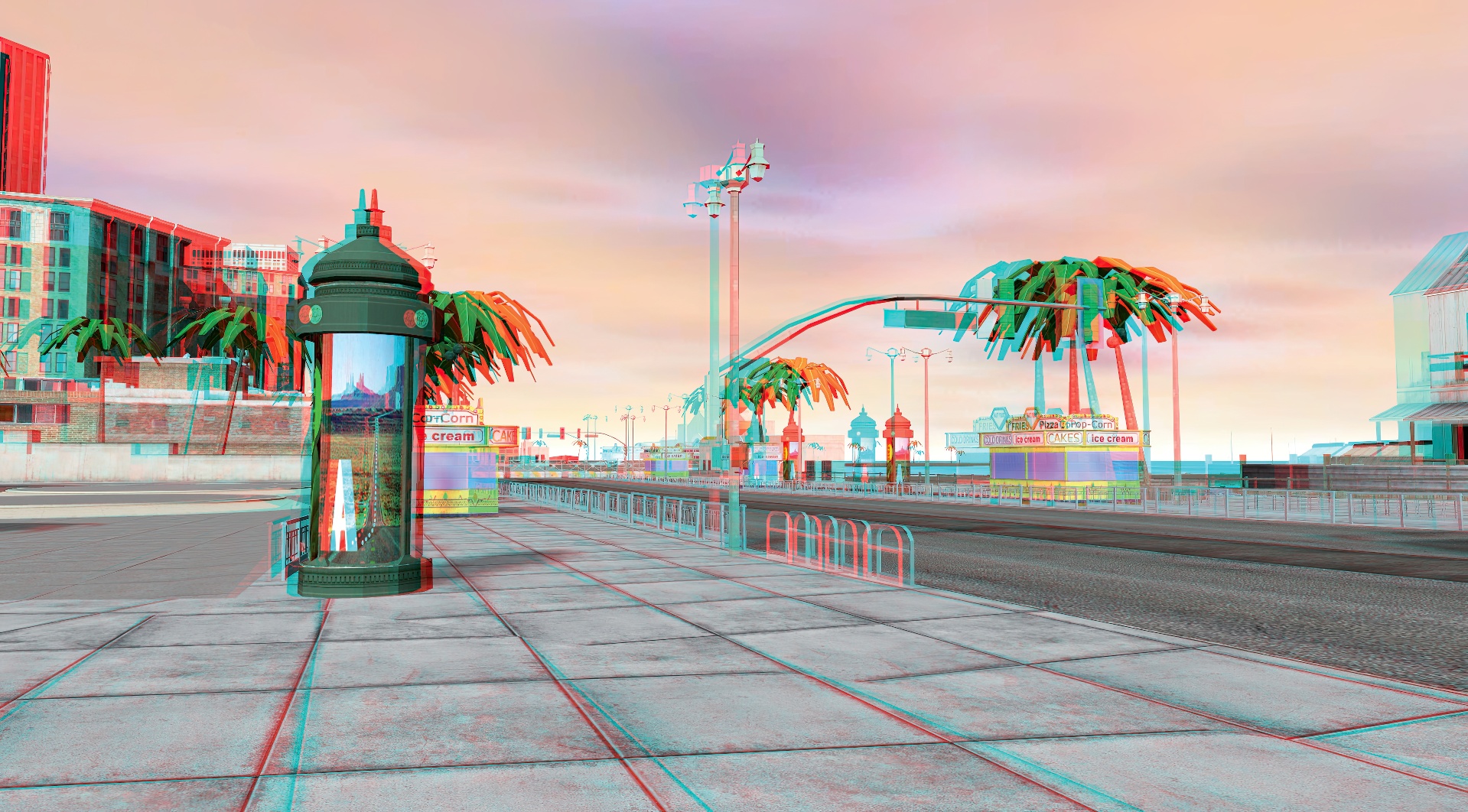
This paper presents a controller for camera convergence and interaxial separation that specifically addresses challenges in interactive stereoscopic applications like games. In such applications, unpredictable viewer- or object-motion often compromises stereopsis due to excessive binocular disparities. We derive constraints on the camera separation and convergence that enable our controller to automatically adapt to any given viewing situation and 3D scene, providing an exact mapping of the virtual content into a comfortable depth range around the display. Moreover, we introduce an interpolation function that linearizes the transformation of stereoscopic depth over time, minimizing nonlinear visual distortions. We describe how to implement the complete control mechanism on the GPU to achieve running times below 0.2ms for full HD. This provides a practical solution even for demanding real-time applications. Results of a user study show a significant increase of stereoscopic comfort, without compromising perceived realism. Our controller enables ‘fail-safe’ stereopsis, provides intuitive control to accommodate to personal preferences, and allows to properly display stereoscopic content on differently sized output devices.
References:
1. Backus, B., Banks, M. S., van Ee, R., and Crowell, J. A. 1999. Horizontal and vertical disparity, eye position, and stereoscopic slant perception. Vision Research 39, 6, 1143–1170.Google ScholarCross Ref
2. Bares, W. H., Gregoire, J. P., and Lester, J. C. 1998. Realtime constraint-based cinematography for complex interactive 3D worlds. In In Tenth National Conference on Innovative Applications of Artificial Intelligence, 1101–1106. Google ScholarDigital Library
3. Broberg, D. 2011. Infrastructures for home delivery, interfacing, captioning, and viewing of 3-d content. Proceedings of the IEEE 99, 4 (april), 684–693.Google ScholarCross Ref
4. Chan, H. P., Goodsitt, M. M., Helvie, M. A., Hadjiiski, L. M., Lydick, J. T., Roubidoux, M. A., Bailey, J. E., Nees, A., Blane, C. E., and Sahiner, B. 2005. Roc study of the effect of stereoscopic imaging on assessment of breast lesions. Medical Physics 32, 4, 1001–1009.Google ScholarCross Ref
5. Christie, M., Olivier, P., and Normand, J.-M. 2008. Camera control in computer graphics. Comput. Graph. Forum 27, 8, 2197–2218.Google ScholarCross Ref
6. David, H. A. 1963. The Method of Paired Comparisons. Charles Griffin & Company.Google Scholar
7. Didyk, P., Ritschel, T., Eisemann, E., Myszkowski, K., and Seidel, H.-P. 2011. A perceptual model for disparity. ACM Trans. Graph. 30, 4, 96. Google ScholarDigital Library
8. Fröhlich, B., Barrass, S., Zehner, B., Plate, J., and Göbel, M. 1999. Exploring geo-scientific data in virtual environments. In IEEE Visualization, 169–173. Google ScholarDigital Library
9. Gateau, S., and Neuman, R. 2010. Stereoscopy from xy to z. In SIGGRAPH ASIA Courses.Google Scholar
10. Gleicher, M., and Witkin, A. 1992. Through-the-lens camera control. SIGGRAPH Comput. Graph. 26 (July), 331–340. Google ScholarDigital Library
11. Gress, A., Guthe, M., and Klein, R. 2006. Gpu-based collision detection for deformable parameterized surfaces. Comput. Graph. Forum 25, 3, 497–506.Google ScholarCross Ref
12. Grinberg, V. S., Podnar, G., and Siegel, M. 1994. Geometry of binocular imaging. In Stereoscopic Displays and Virtual Reality Systems, vol. 2177, 56–65.Google ScholarCross Ref
13. Haigh-Hutchinson, M. 2009. Real-time cameras. A guide for game designers and developers. Morgan Kaufmann. Google ScholarDigital Library
14. He, L., Cohen, M. F., and Salesin, D. 1996. The virtual cinematographer: A paradigm for automatic real-time camera control and directing. In SIGGRAPH, 217–224. Google ScholarDigital Library
15. Heinzle, S., Greisen, P., Gallup, D., Chen, C., Saner, D., Smolic, A., Burg, A., Matusik, W., and Gross, M. H. 2011. Computational stereo camera system with programmable control loop. ACM Trans. Graph. 30, 4, 94. Google ScholarDigital Library
16. Held, R. T., and Banks, M. S. 2008. Misperceptions in stereoscopic displays: a vision science perspective. In APGV, 23–32. Google ScholarDigital Library
17. Jones, G., Lee, D., Holliman, N., and Ezra, D. 2001. Controlling perceived depth in stereoscopic images. In Stereoscopic Displays And Virtual Reality Systems VIII, 200–1.Google Scholar
18. Kim, H. J., Choi, J. W., Chaing, A.-J., and Yu, K. Y. 2008. Reconstruction of stereoscopic imagery for visual comfort. In Stereoscopic Displays and Virtual Reality Systems XIV, SPIE Vol. 6803.Google Scholar
19. Koppal, S. J., Zitnick, C. L., Cohen, M. F., Kang, S. B., Ressler, B., and Colburn, A. 2011. A viewer-centric editor for 3D movies. IEEE Computer Graphics and Applications 31, 1, 20–35. Google ScholarDigital Library
20. Lang, M., Hornung, A., Wang, O., Poulakos, S., Smolic, A., and Gross, M. H. 2010. Nonlinear disparity mapping for stereoscopic 3D. ACM Trans. Graph. 29, 4. Google ScholarDigital Library
21. Lipton, L. 1982. Foundations of the Stereoscopic Cinema: A Study in Depth. Van Nostrand Reinhold Inc., U. S.Google Scholar
22. Masaoka, K., Hanazato, A., Emoto, M., Yamanoue, H., Nojiri, Y., and Okano, F. 2006. Spatial distortion prediction system for stereoscopic images. Electronic Imaging 15, 1.Google ScholarCross Ref
23. Meesters, L. M. J., IJsselsteijn, W. A., and Seuntiens, P. J. H. 2004. A survey of perceptual evaluations and requirements of three-dimensional TV. IEEE Trans. Circuits Syst. Video Techn. 14, 3, 381–391. Google ScholarDigital Library
24. Oskam, T., Sumner, R. W., Thürey, N., and Gross, M. H. 2009. Visibility transition planning for dynamic camera control. In Symposium on Computer Animation, 55–65. Google ScholarDigital Library
25. Pan, H., Yuan, C., and Daly, S. 2011. 3D video disparity scaling for preference and prevention of discomfort. In Stereoscopic Displays and Applications XXII, SPIE Vol. 7863.Google Scholar
26. Shibata, T., Kim, J., Hoffman, D. M., and Banks, M. S. 2011. The zone of comfort: Predicting visual discomfort with stereo displays. Journal of Vision 11, 8.Google ScholarCross Ref
27. Smolic, A., Kauff, P., Knorr, S., Hornung, A., Kunter, M., Müller, M., and Lang, M. 2011. Three-dimensional video postproduction and processing. Proceedings of the IEEE 99, 4 (april), 607–625.Google ScholarCross Ref
28. Stelmach, L. B., Tam, W. J., Speranza, F., Renaud, R., and Martin, T. 2003. Improving the visual comfort of stereoscopic images. In Proc. SPIE 5006, 269.Google Scholar
29. Tekalp, A. M., Smolic, A., Vetro, A., and Onural, L., Eds. 2011. Special issue on 3-D Media and Displays, vol. 99, 4. Proceedings of the IEEE.Google Scholar
30. Wang, C., and Sawchuk, A. A. 2008. Disparity manipulation for stereo images and video. In Stereoscopic Displays and Applications XIX, SPIE Vol. 6803.Google Scholar
31. Watt, S. J., Akeley, K., Ernst, M. O., and Banks, M. S. 2005. Focus cues affect perceived depth. Journal of Vision 5, 10.Google ScholarCross Ref
32. Woods, A., Docherty, T., and Koch, R. 1993. Image distortions in stereoscopic video systems. In Stereoscopic Displays and Applications IV, Proceedings of the SPIE, vol. 1915.Google Scholar
33. Zilly, F., Kluger, J., and Kauff, P. 2011. Production rules for stereo acquisition. Proceedings of the IEEE 99, 4 (april), 590–606.Google ScholarCross Ref