“Opening and closing surfaces” by Sellán, Kesten, Sheng and Jacobson
Conference:
Type(s):
Title:
- Opening and closing surfaces
Session/Category Title:
- Digital Geometry Processing
Presenter(s)/Author(s):
Abstract:
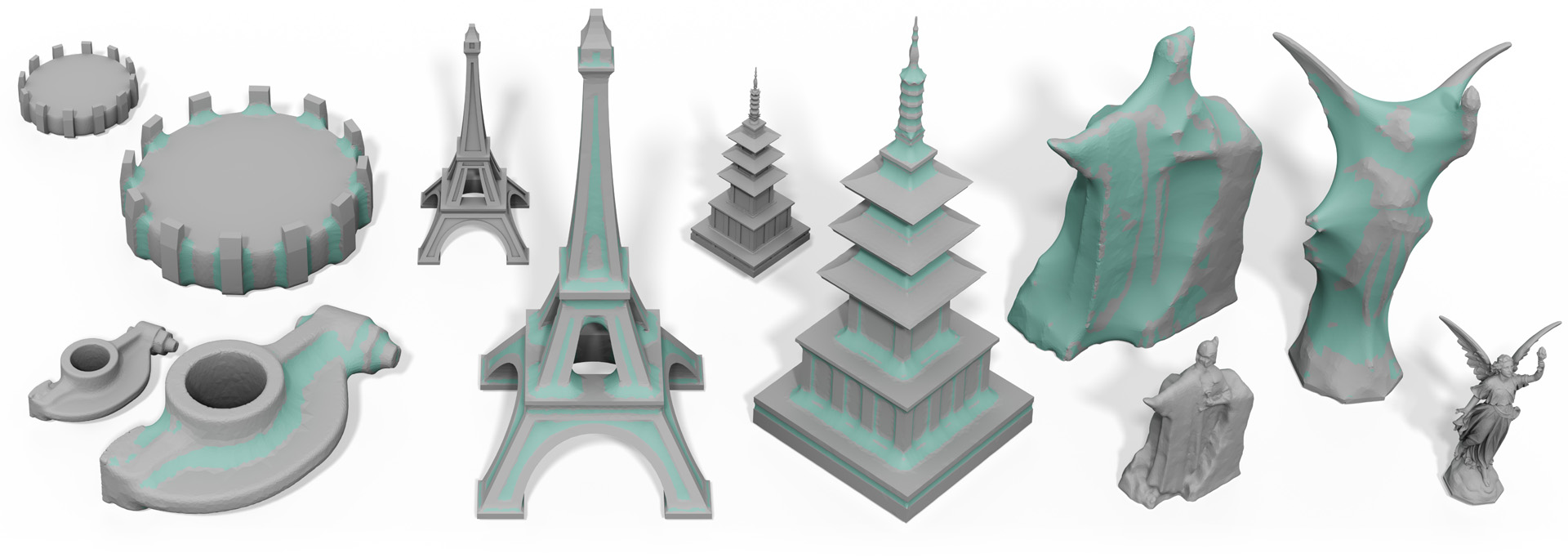
We propose a new type of curvature flow for curves in 2D and surfaces in 3D. The flow is inspired by the mathematical morphology opening and closing operations. These operations are classically defined by composition of dilation and erosion operations. In practice, existing methods implemented this way will result in re-discretizing the entire shape, even if some parts of the surface do not change. Instead, our surface-only curvature-based flow moves the surface selectively in areas that should be repositioned. In our triangle mesh discretization, vertices in regions unaffected by the opening or closing will remain exactly in place and do not affect our method’s complexity, which is output-sensitive.
References:
1. Oscar Kin-Chung Au, Chiew-Lan Tai, Hung-Kuo Chu, Daniel Cohen-Or, and Tong-Yee Lee. 2008. Skeleton extraction by mesh contraction. ACM Trans. Graph. 27, 3 (2008).Google Scholar
2. Hichem Barki, Florence Denis, and Florent Dupont. 2009. Contributing vertices-based Minkowski sum of a non-convex polyhedron without fold and a convex polyhedron. In IEEE Intl. Conference on Shape Modeling and Applications. IEEE, 73–80.Google ScholarCross Ref
3. Alexander I Bobenko and Peter Schröder. 2005. Discrete Willmore flow. In ACM SIGGRAPH 2005 Courses. 5-es.Google ScholarDigital Library
4. Mario Botsch, Leif Kobbelt, Mark Pauly, Pierre Alliez, and Bruno Lévy. 2010. Polygon mesh processing. CRC press.Google Scholar
5. Kenneth A Brakke. 1992. The surface evolver. Experimental mathematics 1, 2 (1992).Google Scholar
6. Tyson Brochu and Robert Bridson. 2009. Robust topological operations for dynamic explicit surfaces. SIAM Journal on Scientific Computing 31, 4 (2009), 2472–2493.Google ScholarDigital Library
7. Stéphane Calderon and Tamy Boubekeur. 2014. Point morphology. ACM Trans. Graph. 33, 4 (2014), 1–13.Google ScholarDigital Library
8. Stéphane Calderon and Tamy Boubekeur. 2017. Bounding proxies for shape approximation. ACM Trans. Graph. 36, 4 (2017), 1–13.Google ScholarDigital Library
9. Marcel Campen and Leif Kobbelt. 2010. Polygonal boundary evaluation of minkowski sums and swept volumes. In Computer Graphics Forum, Vol. 29. 1613–1622.Google ScholarCross Ref
10. Frédéric Cazals and Marc Pouget. 2005. Estimating differential quantities using polynomial fitting of osculating jets. Computer Aided Geometric Design 22, 2 (2005).Google Scholar
11. Zhen Chen, Daniele Panozzo, and Jeremie Dumas. 2018. Half-space power diagrams and discrete surface offsets. arXiv preprint arXiv:1804.08968 (2018).Google Scholar
12. Ulrich Clarenz, Udo Diewald, and Martin Rumpf. 2000. Anisotropic geometric diffusion in surface processing. IEEE.Google ScholarCross Ref
13. Keenan Crane, Fernando De Goes, Mathieu Desbrun, and Peter Schröder. 2013a. Digital geometry processing with discrete exterior calculus. In ACM SIGGRAPH Courses.Google Scholar
14. Keenan Crane, Ulrich Pinkall, and Peter Schröder. 2013b. Robust fairing via conformal curvature flow. ACM Tran. on Graph. 32, 4 (2013), 1–10.Google ScholarDigital Library
15. Fang Da, Christopher Batty, and Eitan Grinspun. 2014. Multimaterial mesh-based surface tracking. ACM Trans. Graph. 33, 4 (2014), 112–1.Google ScholarDigital Library
16. Mathieu Desbrun, Mark Meyer, Peter Schröder, and Alan H Barr. 1999. Implicit fairing of irregular meshes using diffusion and curvature flow. In Proceedings of the 26th annual conference on Computer graphics and interactive techniques. 317–324.Google ScholarDigital Library
17. Michael Eigensatz, Robert W Sumner, and Mark Pauly. 2008. Curvature-domain shape processing. In Computer Graphics Forum, Vol. 27. Wiley Online Library, 241–250.Google Scholar
18. Frederic Guichard, Petros Maragos, and Jean-Michel Morel. 2005. Partial differential equations for morphological operators. In Space, Structure and Randomness.Google Scholar
19. George W Hart. 2008. Sculptural forms from hyperbolic tessellations. In 2008 IEEE International Conference on Shape Modeling and Applications. IEEE, 155–161.Google ScholarCross Ref
20. Lei He and Scott Schaefer. 2013. Mesh denoising via L0 minimization. ACM Trans. on Graph. 32, 4 (2013), 1–8.Google ScholarDigital Library
21. Klaus Hildebrandt and Konrad Polthier. 2004. Anisotropic filtering of non-linear surface features. In Computer Graphics Forum, Vol. 23. Wiley Online Library, 391–400.Google Scholar
22. Samuel Hornus and Sylvain Lefebvre. 2017. Iterative carving for self-supporting 3D printed cavities. (2017).Google Scholar
23. Alec Jacobson et al. 2016. gptoolbox: Geometry Processing Toolbox. http://github.com/alecjacobson/gptoolbox.Google Scholar
24. Alec Jacobson, Daniele Panozzo, et al. 2018. libigl: A simple C++ geometry processing library. http://libigl.github.io/libigl/.Google Scholar
25. Mark W Jones and Richard Satherley. 2001. Using distance fields for object representation and rendering. In Proc. 19th Ann. Conf. of Eurographics (UK Chapter).Google Scholar
26. Daniel M Kaufman. 2009. Coupled principles for computational frictional contact mechanics. Citeseer.Google Scholar
27. Michael Kazhdan, Jake Solomon, and Mirela Ben-Chen. 2012. Can mean-curvature flow be modified to be non-singular?. In Computer Graphics Forum, Vol. 31. 1745–1754.Google ScholarDigital Library
28. Markus Kunze. 2000. Non-smooth dynamical systems. Vol. 1744. Springer Science & Business Media.Google ScholarCross Ref
29. Aaron WF Lee, Wim Sweldens, Peter Schröder, Lawrence Cowsar, and David Dobkin. 1998. MAPS: Multiresolution adaptive parameterization of surfaces. In Proceedings of the 25th annual conference on Computer graphics and interactive techniques. 95–104.Google ScholarDigital Library
30. Hsueh-Ti Derek Liu and Alec Jacobson. 2019. Cubic Stylization. 38, 6, Article 197 (2019).Google Scholar
31. Petros Maragos and Corinne Vachier. 2008. A PDE formulation for viscous morphological operators with extensions to intensity-adaptive operators. In 2008 15th IEEE International Conference on Image Processing. IEEE, 2200–2203.Google ScholarCross Ref
32. Mark Meyer, Mathieu Desbrun, Peter Schröder, and Alan H Barr. 2003. Discrete differential-geometry operators for triangulated 2-manifolds. In Visualization and mathematics III. Springer, 35–57.Google Scholar
33. Ken Museth. 2013. VDB: High-resolution sparse volumes with dynamic topology. ACM Trans. Graph. 32, 3 (2013), 1–22.Google ScholarDigital Library
34. Ken Museth, David E Breen, Ross T Whitaker, and Alan H Barr. 2002. Level set surface editing operators. In Proceedings of the 29th annual conference on Computer graphics and interactive techniques. 330–338.Google ScholarDigital Library
35. Fakir S. Nooruddin and Greg Turk. 2003. Simplification and repair of polygonal models using volumetric techniques. IEEE TVCG 9, 2 (2003).Google Scholar
36. Barrett O’Neill. 1966. Elementary differential geometry. Academic Press.Google Scholar
37. Guillermo Sapiro, Ron Kimmel, Doron Shaked, Benjamin B Kimia, and Alfred M Bruckstein. 1993. Implementing continuous-scale morphology via curve evolution. Pattern recognition 26, 9 (1993), 1363–1372.Google Scholar
38. Jean Serra. 1969. Introduction la Morphologie Mathématique.Google Scholar
39. Oded Stein, Eitan Grinspun, and Keenan Crane. 2018a. Developability of triangle meshes. ACM Trans. Graph. 37, 4 (2018), 1–14.Google ScholarDigital Library
40. Oded Stein, Eitan Grinspun, Max Wardetzky, and Alec Jacobson. 2018b. Natural boundary conditions for smoothing in geometry processing. ACM Trans. Graph. 37, 2 (2018), 1–13.Google ScholarDigital Library
41. Stanley R Sternberg. 1986. Grayscale morphology. Computer vision, graphics, and image processing 35, 3 (1986), 333–355.Google Scholar
42. David E Stewart. 2011. Dynamics with Inequalities: impacts and hard constraints. SIAM.Google Scholar
43. John M Sullivan. 2008. Curvatures of smooth and discrete surfaces. In Discrete differential geometry. Springer, 175–188.Google Scholar
44. Andrea Tagliasacchi, Thomas Delame, Michela Spagnuolo, Nina Amenta, and Alexandru Telea. 2016. 3d skeletons: A state-of-the-art report. In Computer Graphics Forum, Vol. 35. Wiley Online Library, 573–597.Google Scholar
45. Gabriel Taubin. 1995. A signal processing approach to fair surface design. In Proc. of the 22nd annual conference on Computer graphics and interactive techniques.Google ScholarDigital Library
46. Alexandru Telea and Andrei Jalba. 2011. Voxel-based assessment of printability of 3D shapes. In International symposium on mathematical morphology and its applications to signal and image processing. Springer, 393–404.Google ScholarCross Ref
47. Charlie CL Wang and Dinesh Manocha. 2013. GPU-based offset surface computation using point samples. Computer-Aided Design 45, 2 (2013), 321–330.Google ScholarDigital Library
48. Yajie Yan, David Letscher, and Tao Ju. 2018. Voxel Cores: Efficient, robust, and provably good approximation of 3D medial axes. ACM Trans. Graph. 37, 4 (2018), 1–13.Google ScholarDigital Library
49. Juyong Zhang, Bailin Deng, Yang Hong, Yue Peng, Wenjie Qin, and Ligang Liu. 2018. Static/dynamic filtering for mesh geometry. IEEE TVCG 25, 4 (2018), 1774–1787.Google Scholar
50. Qingnan Zhou, Eitan Grinspun, Denis Zorin, and Alec Jacobson. 2016. Mesh arrangements for solid geometry. ACM Trans. Graph. 35, 4 (2016), 1–15.Google ScholarDigital Library