
“MeshWalker: deep mesh understanding by random walks” by Lahav and Tal
Conference:
Type(s):
Title:
- MeshWalker: deep mesh understanding by random walks
Session/Category Title:
- Shape Analysis
Presenter(s)/Author(s):
Abstract:
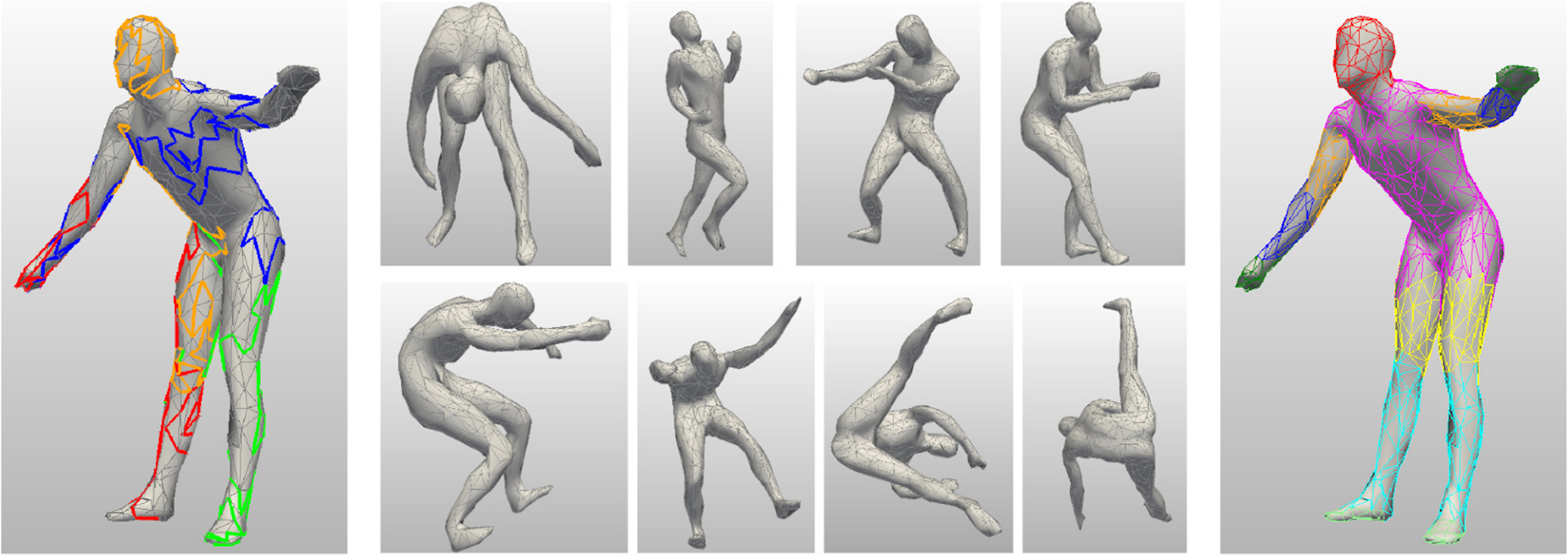
Most attempts to represent 3D shapes for deep learning have focused on volumetric grids, multi-view images and point clouds. In this paper we look at the most popular representation of 3D shapes in computer graphics—a triangular mesh—and ask how it can be utilized within deep learning. The few attempts to answer this question propose to adapt convolutions & pooling to suit Convolutional Neural Networks (CNNs). This paper proposes a very different approach, termed MeshWalker to learn the shape directly from a given mesh. The key idea is to represent the mesh by random walks along the surface, which “explore” the mesh’s geometry and topology. Each walk is organized as a list of vertices, which in some manner imposes regularity on the mesh. The walk is fed into a Recurrent Neural Network (RNN) that “remembers” the history of the walk. We show that our approach achieves state-of-the-art results for two fundamental shape analysis tasks: shape classification and semantic segmentation. Furthermore, even a very small number of examples suffices for learning. This is highly important, since large datasets of meshes are difficult to acquire.
References:
1. Adobe. 2016. Adobe Fuse 3D Characters. https://www.mixamo.com.Google Scholar
2. Charles J Alpert and So-Zen Yao. 1995. Spectral partitioning: the more eigenvectors, the better. In Proceedings of the 32nd annual ACM/IEEE Design Automation Conference. 195–200.Google ScholarDigital Library
3. Dragomir Anguelov, Praveen Srinivasan, Daphne Koller, Sebastian Thrun, Jim Rodgers, and James Davis. 2005. SCAPE: shape completion and animation of people. In ACM SIGGRAPH 2005 Papers. 408–416.Google ScholarDigital Library
4. Marco Attene, Bianca Falcidieno, and Michela Spagnuolo. 2006. Hierarchical mesh segmentation based on fitting primitives. The Visual Computer 22, 3 (2006), 181–193.Google ScholarDigital Library
5. M. Attene, S. Katz, M. Mortara, G. Patane, M. Spagnuolo, and A. Tal. 2006. Mesh Segmentation – A Comparative Study. In IEEE International Conference on Shape Modeling and Applications 2006 (SMI’06). 7–7.Google Scholar
6. Matan Atzmon, Haggai Maron, and Yaron Lipman. 2018. Point convolutional neural networks by extension operators. arXiv preprint arXiv:1803.10091 (2018).Google Scholar
7. Song Bai, Xiang Bai, Zhichao Zhou, Zhaoxiang Zhang, and Longin Jan Latecki. 2016. Gift: A real-time and scalable 3d shape search engine. In Proceedings of the IEEE conference on computer vision and pattern recognition. 5023–5032.Google ScholarCross Ref
8. Yizhak Ben-Shabat, Michael Lindenbaum, and Anath Fischer. 2018. 3dmfv: Three-dimensional point cloud classification in real-time using convolutional neural networks. IEEE Robotics and Automation Letters 3, 4 (2018), 3145–3152.Google ScholarCross Ref
9. Federica Bogo, Javier Romero, Matthew Loper, and Michael J Black. 2014. FAUST: Dataset and evaluation for 3D mesh registration. In Proceedings of the IEEE Conference on Computer Vision and Pattern Recognition. 3794–3801.Google ScholarDigital Library
10. Davide Boscaini, Jonathan Masci, Emanuele Rodolà, and Michael Bronstein. 2016. Learning shape correspondence with anisotropic convolutional neural networks. In Advances in neural information processing systems. 3189–3197.Google Scholar
11. Alexandre Boulch, Bertrand Le Saux, and Nicolas Audebert. 2017. Unstructured Point Cloud Semantic Labeling Using Deep Segmentation Networks. 3DOR 2 (2017), 7.Google Scholar
12. Andrew Brock, Theodore Lim, James M Ritchie, and Nick Weston. 2016. Generative and discriminative voxel modeling with convolutional neural networks. arXiv preprint arXiv:1608.04236 (2016).Google Scholar
13. Alexander M Bronstein, Michael M Bronstein, Leonidas J Guibas, and Maks Ovsjanikov. 2011. Shape google: Geometric words and expressions for invariant shape retrieval. ACM Transactions on Graphics (TOG) 30, 1 (2011), 1–20.Google ScholarDigital Library
14. Alexander M Bronstein, Michael M Bronstein, and Ron Kimmel. 2006. Efficient computation of isometry-invariant distances between surfaces. SIAM Journal on Scientific Computing 28, 5 (2006), 1812–1836.Google ScholarDigital Library
15. Bernard Chazelle, David P Dobkin, Nadia Shouraboura, and Ayellet Tal. 1997. Strategies for polyhedral surface decomposition: an experimental study. Computational Geometry 7, 5–6 (1997), 327–342.Google ScholarDigital Library
16. Kyunghyun Cho, Bart Van Merriënboer, Caglar Gulcehre, Dzmitry Bahdanau, Fethi Bougares, Holger Schwenk, and Yoshua Bengio. 2014. Learning phrase representations using RNN encoder-decoder for statistical machine translation. arXiv preprint arXiv:1406.1078 (2014).Google Scholar
17. Asi Elad and Ron Kimmel. 2003. On bending invariant signatures for surfaces. IEEE Transactions on pattern analysis and machine intelligence 25, 10 (2003), 1285–1295.Google ScholarDigital Library
18. Danielle Ezuz, Justin Solomon, Vladimir G Kim, and Mirela Ben-Chen. 2017. GWCNN: A metric alignment layer for deep shape analysis. In Computer Graphics Forum, Vol. 36. Wiley Online Library, 49–57.Google Scholar
19. Gabriele Fanelli, Thibaut Weise, Juergen Gall, and Luc Van Gool. 2011. Real time head pose estimation from consumer depth cameras. In Joint pattern recognition symposium. Springer, 101–110.Google Scholar
20. Yutong Feng, Yifan Feng, Haoxuan You, Xibin Zhao, and Yue Gao. 2019. MeshNet: mesh neural network for 3D shape representation. In Proceedings of the AAAI Conference on Artificial Intelligence, Vol. 33. 8279–8286.Google ScholarDigital Library
21. Yifan Feng, Zizhao Zhang, Xibin Zhao, Rongrong Ji, and Yue Gao. 2018a. GVCNN: Group-View Convolutional Neural Networks for 3D Shape Recognition. In The IEEE Conference on Computer Vision and Pattern Recognition (CVPR).Google ScholarCross Ref
22. Yifan Feng, Zizhao Zhang, Xibin Zhao, Rongrong Ji, and Yue Gao. 2018b. GVCNN: Group-view convolutional neural networks for 3D shape recognition. In Proceedings of the IEEE Conference on Computer Vision and Pattern Recognition. 264–272.Google ScholarCross Ref
23. Michael Garland and Paul S Heckbert. 1997. Surface simplification using quadric error metrics. In Proceedings of the 24th annual conference on Computer graphics and interactive techniques. 209–216.Google ScholarDigital Library
24. Natasha Gelfand and Leonidas J Guibas. 2004. Shape segmentation using local slippage analysis. In Proceedings of the 2004 Eurographics/ACM SIGGRAPH symposium on Geometry processing. 214–223.Google ScholarDigital Library
25. Abubakar Sulaiman Gezawa, Yan Zhang, Qicong Wang, and Lei Yunqi. 2020. A Review on Deep Learning Approaches for 3D Data Representations in Retrieval and Classifications. IEEE Access 8 (2020), 57566–57593.Google ScholarCross Ref
26. Daniela Giorgi, Silvia Biasotti, and Laura Paraboschi. 2007. Shape retrieval contest 2007: Watertight models track. SHREC competition 8, 7 (2007).Google Scholar
27. Francisco Gomez-Donoso, Alberto Garcia-Garcia, J Garcia-Rodriguez, Sergio Orts-Escolano, and Miguel Cazorla. 2017. Lonchanet: A sliced-based cnn architecture for real-time 3d object recognition. In 2017 International Joint Conference on Neural Networks (IJCNN). IEEE, 412–418.Google ScholarCross Ref
28. Shunwang Gong, Lei Chen, Michael Bronstein, and Stefanos Zafeiriou. 2019. Spiralnet+ +: A fast and highly efficient mesh convolution operator. In Proceedings of the IEEE International Conference on Computer Vision Workshops. 0–0.Google ScholarCross Ref
29. Craig Gotsman. 2003. On graph partitioning, spectral analysis, and digital mesh processing. In 2003 Shape Modeling International. IEEE, 165–171.Google Scholar
30. Leo Grady. 2006. Random walks for image segmentation. IEEE transactions on pattern analysis and machine intelligence 28, 11 (2006), 1768–1783.Google ScholarDigital Library
31. Alex Graves, Marcus Liwicki, Santiago Fernández, Roman Bertolami, Horst Bunke, and Jürgen Schmidhuber. 2008. A novel connectionist system for unconstrained handwriting recognition. IEEE transactions on pattern analysis and machine intelligence 31, 5 (2008), 855–868.Google Scholar
32. Paul Guerrero, Yanir Kleiman, Maks Ovsjanikov, and Niloy J Mitra. 2018. PCPNet learning local shape properties from raw point clouds. In Computer Graphics Forum, Vol. 37. Wiley Online Library, 75–85.Google Scholar
33. Kan Guo, Dongqing Zou, and Xiaowu Chen. 2015. 3d mesh labeling via deep convolutional neural networks. ACM Transactions on Graphics (TOG) 35, 1 (2015), 1–12.Google ScholarDigital Library
34. Niv Haim, Nimrod Segol, Heli Ben-Hamu, Haggai Maron, and Yaron Lipman. 2019. Surface Networks via General Covers. In Proceedings of the IEEE International Conference on Computer Vision. 632–641.Google ScholarCross Ref
35. Zhizhong Han, Honglei Lu, Zhenbao Liu, Chi-Man Vong, Yu-Shen Liu, Matthias Zwicker, Junwei Han, and CL Philip Chen. 2019. 3d2seqviews: Aggregating sequential views for 3d global feature learning by cnn with hierarchical attention aggregation. IEEE Transactions on Image Processing 28, 8 (2019), 3986–3999.Google ScholarCross Ref
36. Rana Hanocka, Noa Fish, Zhenhua Wang, Raja Giryes, Shachar Fleishman, and Daniel Cohen-Or. 2018. Alignet: Partial-shape agnostic alignment via unsupervised learning. ACM Transactions on Graphics (TOG) 38, 1 (2018), 1–14.Google Scholar
37. Rana Hanocka, Amir Hertz, Noa Fish, Raja Giryes, Shachar Fleishman, and Daniel Cohen-Or. 2019. MeshCNN: a network with an edge. ACM Transactions on Graphics (TOG) 38, 4 (2019), 1–12.Google ScholarDigital Library
38. Xinwei He, Yang Zhou, Zhichao Zhou, Song Bai, and Xiang Bai. 2018. Triplet-center loss for multi-view 3d object retrieval. In Proceedings of the IEEE Conference on Computer Vision and Pattern Recognition. 1945–1954.Google ScholarCross Ref
39. Mikael Henaff, Joan Bruna, and Yann LeCun. 2015. Deep convolutional networks on graph-structured data. arXiv preprint arXiv:1506.05163 (2015).Google Scholar
40. Masaki Hilaga, Yoshihisa Shinagawa, Taku Kohmura, and Tosiyasu L Kunii. 2001. Topology matching for fully automatic similarity estimation of 3D shapes. In Proceedings of the 28th annual conference on Computer graphics and interactive techniques. 203–212.Google ScholarDigital Library
41. Sepp Hochreiter and Jürgen Schmidhuber. 1997. Long short-term memory. Neural computation 9, 8 (1997), 1735–1780.Google Scholar
42. Hugues Hoppe. 1997. View-dependent refinement of progressive meshes. In Proceedings of the 24th annual conference on Computer graphics and interactive techniques. 189–198.Google ScholarDigital Library
43. Binh-Son Hua, Minh-Khoi Tran, and Sai-Kit Yeung. 2018. Pointwise convolutional neural networks. In Proceedings of the IEEE Conference on Computer Vision and Pattern Recognition. 984–993.Google ScholarCross Ref
44. Varun Jain and Hao Zhang. 2007. A spectral approach to shape-based retrieval of articulated 3D models. Computer-Aided Design 39, 5 (2007), 398–407.Google ScholarDigital Library
45. Edward Johns, Stefan Leutenegger, and Andrew J Davison. 2016. Pairwise decomposition of image sequences for active multi-view recognition. In Proceedings of the IEEE Conference on Computer Vision and Pattern Recognition. 3813–3822.Google ScholarCross Ref
46. Andrew E. Johnson and Martial Hebert. 1999. Using spin images for efficient object recognition in cluttered 3D scenes. IEEE Transactions on pattern analysis and machine intelligence 21, 5 (1999), 433–449.Google ScholarDigital Library
47. Evangelos Kalogerakis, Melinos Averkiou, Subhransu Maji, and Siddhartha Chaudhuri. 2017. 3D shape segmentation with projective convolutional networks. In Proceedings of the IEEE Conference on Computer Vision and Pattern Recognition. 3779–3788.Google ScholarCross Ref
48. Evangelos Kalogerakis, Aaron Hertzmann, and Karan Singh. 2010. Learning 3D mesh segmentation and labeling. In ACM SIGGRAPH 2010 papers. 1–12.Google ScholarDigital Library
49. Asako Kanezaki, Yasuyuki Matsushita, and Yoshifumi Nishida. 2018. Rotationnet: Joint object categorization and pose estimation using multiviews from unsupervised viewpoints. In Proceedings of the IEEE Conference on Computer Vision and Pattern Recognition. 5010–5019.Google ScholarCross Ref
50. Sagi Katz, George Leifman, and Ayellet Tal. 2005. Mesh segmentation using feature point and core extraction. The Visual Computer 21, 8–10 (2005), 649–658.Google ScholarCross Ref
51. Sagi Katz and Ayellet Tal. 2003. Hierarchical mesh decomposition using fuzzy clustering and cuts. ACM transactions on graphics (TOG) 22, 3 (2003), 954–961.Google Scholar
52. Diederik P Kingma and Jimmy Ba. 2014. Adam: A method for stochastic optimization. arXiv preprint arXiv:1412.6980 (2014).Google Scholar
53. Thomas N Kipf and Max Welling. 2016. Semi-supervised classification with graph convolutional networks. arXiv preprint arXiv:1609.02907 (2016).Google Scholar
54. AF Koschan. 2003. Perception-based 3D triangle mesh segmentation using fast marching watersheds. In 2003 IEEE Computer Society Conference on Computer Vision and Pattern Recognition, 2003. Proceedings., Vol. 2. IEEE, II-II.Google ScholarCross Ref
55. Yu-Kun Lai, Shi-Min Hu, Ralph R. Martin, and Paul L. Rosin. 2008. Fast Mesh Segmentation Using Random Walks. In Proceedings of the 2008 ACM Symposium on Solid and Physical Modeling (SPM ’08). ACM, New York, NY, USA, 183–191. Google ScholarDigital Library
56. Guillaume Lavoué, Florent Dupont, and Atilla Baskurt. 2005. A new CAD mesh segmentation method, based on curvature tensor analysis. Computer-Aided Design 37, 10 (2005), 975–987.Google ScholarDigital Library
57. Yangyan Li, Rui Bu, Mingchao Sun, Wei Wu, Xinhan Di, and Baoquan Chen. 2018. Pointcnn: Convolution on x-transformed points. In Advances in neural information processing systems. 820–830.Google Scholar
58. Z Lian, A Godil, B Bustos, M Daoudi, J Hermans, S Kawamura, Y Kurita, G Lavoua, and P Dp Suetens. 2011. Shape retrieval on non-rigid 3D watertight meshes. In Eurographics workshop on 3d object retrieval (3DOR). Citeseer.Google Scholar
59. Zhouhui Lian, Afzal Godil, Benjamin Bustos, Mohamed Daoudi, Jeroen Hermans, Shun Kawamura, Yukinori Kurita, Guillaume Lavoué, Hien Van Nguyen, Ryutarou Ohbuchi, et al. 2013. A comparison of methods for non-rigid 3D shape retrieval. Pattern Recognition 46, 1 (2013), 449–461.Google ScholarDigital Library
60. Isaak Lim, Alexander Dielen, Marcel Campen, and Leif Kobbelt. 2018. A simple approach to intrinsic correspondence learning on unstructured 3d meshes. In Proceedings of the European Conference on Computer Vision (ECCV). 0–0.Google Scholar
61. Rong Liu and Hao Zhang. 2004. Segmentation of 3D meshes through spectral clustering. In 12th Pacific Conference on Computer Graphics and Applications, 2004. PG 2004. Proceedings. IEEE, 298–305.Google Scholar
62. Yongcheng Liu, Bin Fan, Shiming Xiang, and Chunhong Pan. 2019. Relation-shape convolutional neural network for point cloud analysis. In Proceedings of the IEEE Conference on Computer Vision and Pattern Recognition. 8895–8904.Google ScholarCross Ref
63. Yi Liu, Hongbin Zha, and Hong Qin. 2006. Shape topics: A compact representation and new algorithms for 3d partial shape retrieval. In 2006 IEEE Computer Society Conference on Computer Vision and Pattern Recognition (CVPR’06), Vol. 2. IEEE, 2025–2032.Google Scholar
64. László Lovász et al. 1993. Random walks on graphs: A survey. Combinatorics, Paul erdos is eighty 2, 1 (1993), 1–46.Google Scholar
65. David G Lowe. 2004. Distinctive image features from scale-invariant keypoints. International journal of computer vision 60, 2 (2004), 91–110.Google ScholarDigital Library
66. Mona Mahmoudi and Guillermo Sapiro. 2009. Three-dimensional point cloud recognition via distributions of geometric distances. Graphical Models 71, 1 (2009), 22–31.Google ScholarDigital Library
67. Haggai Maron, Meirav Galun, Noam Aigerman, Miri Trope, Nadav Dym, Ersin Yumer, Vladimir G Kim, and Yaron Lipman. 2017. Convolutional neural networks on surfaces via seamless toric covers. ACM Trans. Graph. 36, 4 (2017), 71–1.Google ScholarDigital Library
68. Jonathan Masci, Davide Boscaini, Michael Bronstein, and Pierre Vandergheynst. 2015. Geodesic convolutional neural networks on riemannian manifolds. In Proceedings of the IEEE international conference on computer vision workshops. 37–45.Google ScholarDigital Library
69. Daniel Maturana and Sebastian Scherer. 2015. Voxnet: A 3d convolutional neural network for real-time object recognition. In 2015 IEEE/RSJ International Conference on Intelligent Robots and Systems (IROS). IEEE, 922–928.Google ScholarDigital Library
70. Facundo Mémoli. 2007. On the use of Gromov-Hausdorff distances for shape comparison. (2007).Google Scholar
71. Facundo Mémoli and Guillermo Sapiro. 2005. A theoretical and computational framework for isometry invariant recognition of point cloud data. Foundations of Computational Mathematics 5, 3 (2005), 313–347.Google ScholarDigital Library
72. Jae Dong Noh and Heiko Rieger. 2004. Random walks on complex networks. Physical review letters 92, 11 (2004), 118701.Google Scholar
73. Maks Ovsjanikov, Alexander M Bronstein, Michael M Bronstein, and Leonidas J Guibas. 2009. Shape google: a computer vision approach to isometry invariant shape retrieval. In 2009 IEEE 12th International Conference on Computer Vision Workshops, ICCV Workshops. IEEE, 320–327.Google ScholarCross Ref
74. Bryan Perozzi, Rami Al-Rfou, and Steven Skiena. 2014. Deepwalk: Online learning of social representations. In Proceedings of the 20th ACM SIGKDD international conference on Knowledge discovery and data mining. 701–710.Google ScholarDigital Library
75. Adrien Poulenard and Maks Ovsjanikov. 2018. Multi-directional geodesic neural networks via equivariant convolution. ACM Transactions on Graphics (TOG) 37, 6 (2018), 1–14.Google ScholarDigital Library
76. Charles R Qi, Hao Su, Kaichun Mo, and Leonidas J Guibas. 2017a. Pointnet: Deep learning on point sets for 3d classification and segmentation. In Proceedings of the IEEE conference on computer vision and pattern recognition. 652–660.Google Scholar
77. Charles R Qi, Hao Su, Matthias Nießner, Angela Dai, Mengyuan Yan, and Leonidas J Guibas. 2016. Volumetric and multi-view cnns for object classification on 3d data. In Proceedings of the IEEE conference on computer vision and pattern recognition. 5648–5656.Google ScholarCross Ref
78. Charles Ruizhongtai Qi, Li Yi, Hao Su, and Leonidas J Guibas. 2017b. Pointnet++: Deep hierarchical feature learning on point sets in a metric space. In Advances in neural information processing systems. 5099–5108.Google Scholar
79. Martin Reuter, Franz-Erich Wolter, and Niklas Peinecke. 2005. Laplace-spectra as fingerprints for shape matching. In Proceedings of the 2005 ACM symposium on Solid and physical modeling. 101–106.Google ScholarDigital Library
80. Rui SV Rodrigues, José FM Morgado, and Abel JP Gomes. 2018. Part-based mesh segmentation: a survey. In Computer Graphics Forum, Vol. 37. Wiley Online Library, 235–274.Google Scholar
81. Xavier Roynard, Jean-Emmanuel Deschaud, and François Goulette. 2018. Classification of point cloud scenes with multiscale voxel deep network. arXiv preprint arXiv:1804.03583 (2018).Google Scholar
82. Kripasindhu Sarkar, Basavaraj Hampiholi, Kiran Varanasi, and Didier Stricker. 2018. Learning 3d shapes as multi-layered height-maps using 2d convolutional networks. In Proceedings of the European Conference on Computer Vision (ECCV). 71–86.Google ScholarCross Ref
83. Nima Sedaghat, Mohammadreza Zolfaghari, Ehsan Amiri, and Thomas Brox. 2016a. Orientation-boosted voxel nets for 3d object recognition. arXiv preprint arXiv:1604.03351 (2016).Google Scholar
84. Nima Sedaghat, Mohammadreza Zolfaghari, and Thomas Brox. 2016b. Orientation-boosted Voxel Nets for 3D Object Recognition. CoRR abs/1604.03351 (2016). arXiv:1604.03351 http://arxiv.org/abs/1604.03351Google Scholar
85. Ariel Shamir. 2008. A survey on mesh segmentation techniques. In Computer graphics forum, Vol. 27. Wiley Online Library, 1539–1556.Google Scholar
86. Shymon Shlafman, Ayellet Tal, and Sagi Katz. 2002. Metamorphosis of polyhedral surfaces using decomposition. In Computer graphics forum, Vol. 21. Wiley Online Library, 219–228.Google Scholar
87. Ayan Sinha, Jing Bai, and Karthik Ramani. 2016. Deep learning 3D shape surfaces using geometry images. In European Conference on Computer Vision. Springer, 223–240.Google ScholarCross Ref
88. Leslie N Smith. 2017. Cyclical learning rates for training neural networks. In 2017 IEEE Winter Conference on Applications of Computer Vision (WACV). IEEE, 464–472.Google ScholarCross Ref
89. Hang Su, Subhransu Maji, Evangelos Kalogerakis, and Erik Learned-Miller. 2015. Multiview convolutional neural networks for 3d shape recognition. In Proceedings of the IEEE international conference on computer vision. 945–953.Google ScholarDigital Library
90. Jian Sun, Maks Ovsjanikov, and Leonidas Guibas. 2009. A concise and provably informative multi-scale signature based on heat diffusion. In Computer graphics forum, Vol. 28. Wiley Online Library, 1383–1392.Google Scholar
91. Yiyong Sun, David Lon Page, Joon Ki Paik, Andreas Koschan, and Mongi A Abidi. 2002. Triangle mesh-based edge detection and its application to surface segmentation and adaptive surface smoothing. In Proceedings. International Conference on Image Processing, Vol. 3. IEEE, 825–828.Google ScholarCross Ref
92. Hari Sundar, Deborah Silver, Nikhil Gagvani, and Sven Dickinson. 2003. Skeleton based shape matching and retrieval. In 2003 Shape Modeling International. IEEE, 130–139.Google Scholar
93. G Tam and R Lau. 2007. Deformable model retrieval based on topological and geometric signatures. IEEE transactions on visualization and computer graphics. 13, 3 (2007), 470–482.Google ScholarDigital Library
94. Lyne Tchapmi, Christopher Choy, Iro Armeni, JunYoung Gwak, and Silvio Savarese. 2017. Segcloud: Semantic segmentation of 3d point clouds. In 2017 international conference on 3D vision (3DV). IEEE, 537–547.Google ScholarCross Ref
95. Hugues Thomas, Charles R Qi, Jean-Emmanuel Deschaud, Beatriz Marcotegui, François Goulette, and Leonidas J Guibas. 2019. Kpconv: Flexible and deformable convolution for point clouds. In Proceedings of the IEEE International Conference on Computer Vision. 6411–6420.Google ScholarCross Ref
96. Dmitry Ulyanov, Andrea Vedaldi, and Victor Lempitsky. 2016. Instance normalization: The missing ingredient for fast stylization. arXiv preprint arXiv:1607.08022 (2016).Google Scholar
97. Petar Veličković, Guillem Cucurull, Arantxa Casanova, Adriana Romero, Pietro Lio, and Yoshua Bengio. 2017. Graph attention networks. arXiv preprint arXiv:1710.10903 (2017).Google Scholar
98. Nitika Verma, Edmond Boyer, and Jakob Verbeek. 2018. Feastnet: Feature-steered graph convolutions for 3d shape analysis. In Proceedings of the IEEE conference on computer vision and pattern recognition. 2598–2606.Google ScholarCross Ref
99. Daniel Vlasic, Ilya Baran, Wojciech Matusik, and Jovan Popović. 2008. Articulated mesh animation from multi-view silhouettes. In ACM SIGGRAPH 2008 papers. 1–9.Google ScholarDigital Library
100. Cheng Wang, Ming Cheng, Ferdous Sohel, Mohammed Bennamoun, and Jonathan Li. 2019a. NormalNet: A voxel-based CNN for 3D object classification and retrieval. Neurocomputing 323 (2019), 139–147.Google ScholarCross Ref
101. Chu Wang, Marcello Pelillo, and Kaleem Siddiqi. 2019c. Dominant set clustering and pooling for multi-view 3d object recognition. arXiv preprint arXiv:1906.01592 (2019).Google Scholar
102. Lei Wang, Yuchun Huang, Yaolin Hou, Shenman Zhang, and Jie Shan. 2019b. Graph attention convolution for point cloud semantic segmentation. In Proceedings of the IEEE Conference on Computer Vision and Pattern Recognition. 10296–10305.Google ScholarCross Ref
103. Yunhai Wang, Shmulik Asafi, Oliver Van Kaick, Hao Zhang, Daniel Cohen-Or, and Baoquan Chen. 2012. Active co-analysis of a set of shapes. ACM Transactions on Graphics (TOG) 31, 6 (2012), 1–10.Google ScholarDigital Library
104. Yue Wang, Yongbin Sun, Ziwei Liu, Sanjay E Sarma, Michael M Bronstein, and Justin M Solomon. 2019d. Dynamic graph cnn for learning on point clouds. ACM Transactions on Graphics (TOG) 38, 5 (2019), 1–12.Google ScholarDigital Library
105. Francis Williams, Teseo Schneider, Claudio Silva, Denis Zorin, Joan Bruna, and Daniele Panozzo. 2019. Deep geometric prior for surface reconstruction. In Proceedings of the IEEE Conference on Computer Vision and Pattern Recognition. 10130–10139.Google ScholarCross Ref
106. Zhirong Wu, Shuran Song, Aditya Khosla, Fisher Yu, Linguang Zhang, Xiaoou Tang, and Jianxiong Xiao. 2015. 3d shapenets: A deep representation for volumetric shapes. In Proceedings of the IEEE conference on computer vision and pattern recognition. 1912–1920.Google Scholar
107. Mingye Xu, Zhipeng Zhou, and Yu Qiao. 2019. Geometry Sharing Network for 3D Point Cloud Classification and Segmentation. arXiv preprint arXiv:1912.10644 (2019).Google Scholar
108. Yifan Xu, Tianqi Fan, Mingye Xu, Long Zeng, and Yu Qiao. 2018. Spidercnn: Deep learning on point sets with parameterized convolutional filters. In Proceedings of the European Conference on Computer Vision (ECCV). 87–102.Google ScholarCross Ref
109. Zhangsihao Yang, Or Litany, Tolga Birdal, Srinath Sridhar, and Leonidas Guibas. 2020. Continuous Geodesic Convolutions for Learning on 3D Shapes. arXiv preprint arXiv:2002.02506 (2020).Google Scholar
110. Mohsen Yavartanoo, Euyoung Kim, and Kyoung Mu Lee. 2018. SPNet: Deep 3D Object Classification and Retrieval using Stereographic Projection. CoRR abs/1811.01571 (2018). arXiv:1811.01571 http://arxiv.org/abs/1811.01571Google Scholar
111. Pietro Zanuttigh and Ludovico Minto. 2017. Deep learning for 3d shape classification from multiple depth maps. In 2017 IEEE International Conference on Image Processing (ICIP). IEEE, 3615–3619.Google ScholarCross Ref
112. Hao Zhang, Rong Liu, et al. 2005. Mesh segmentation via recursive and visually salient spectral cuts. In Proc. of vision, modeling, and visualization. 429–436.Google Scholar
113. Shuaifeng Zhi, Yongxiang Liu, Xiang Li, and Yulan Guo. 2018. Toward real-time 3D object recognition: A lightweight volumetric CNN framework using multitask learning. Computers & Graphics 71 (2018), 199–207.Google ScholarCross Ref
114. Yinan Zhou and Zhiyong Huang. 2004. Decomposing polygon meshes by means of critical points. In 10th International Multimedia Modelling Conference, 2004. Proceedings. IEEE, 187–195.Google ScholarCross Ref
115. Lei Zhu, Weinan Chen, Xubin Lin, Li He, Yisheng Guan, and Hong Zhang. 2019. Random Walk Network for 3D Point Cloud Classification and Segmentation. In 2019 IEEE International Conference on Robotics and Biomimetics (ROBIO). IEEE, 1921–1926.Google ScholarDigital Library



