
“Learning a shared shape space for multimodal garment design”
Conference:
Type(s):
Title:
- Learning a shared shape space for multimodal garment design
Session/Category Title:
- Fabulously computed fashion
Presenter(s)/Author(s):
Moderator(s):
Abstract:
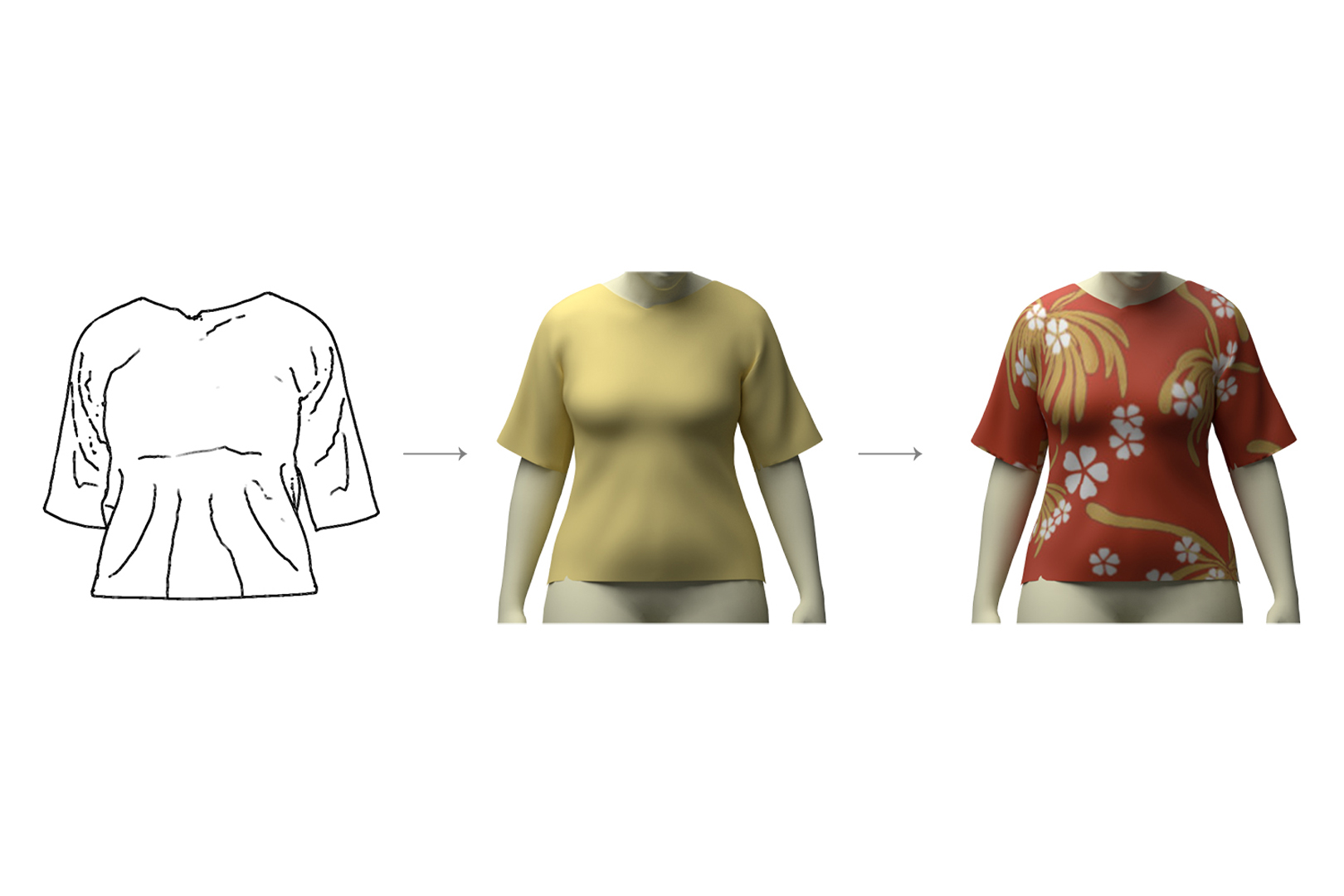
Designing real and virtual garments is becoming extremely demanding with rapidly changing fashion trends and increasing need for synthesizing realisticly dressed digital humans for various applications. This necessitates creating simple and effective workflows to facilitate authoring sewing patterns customized to garment and target body shapes to achieve desired looks. Traditional workflow involves a trial-and-error procedure wherein a mannequin is draped to judge the resultant folds and the sewing pattern iteratively adjusted until the desired look is achieved. This requires time and experience. Instead, we present a data-driven approach wherein the user directly indicates desired fold patterns simply by sketching while our system estimates corresponding garment and body shape parameters at interactive rates. The recovered parameters can then be further edited and the updated draped garment previewed. Technically, we achieve this via a novel shared shape space that allows the user to seamlessly specify desired characteristics across multimodal input without requiring to run garment simulation at design time. We evaluate our approach qualitatively via a user study and quantitatively against test datasets, and demonstrate how our system can generate a rich quality of on-body garments targeted for a range of body shapes while achieving desired fold characteristics. Code and data are available at our project webpage.
References:
1. 2018. Marvelous Designer. https://www.marvelousdesigner.com. (2018). Accessed: 2018-03-30.Google Scholar
2. 2018. NVIDIA Flex. https://developer.nvidia.com/flex. (2018). Accessed: 2018-03-30.Google Scholar
3. 2018. Optitext Fashion Design Software. https://optitex.com/. (2018). Accessed: 2018-03-30.Google Scholar
4. 2018. torchvision. https://pytorch.org/docs/master/torchvision/. (2018). Accessed: 2018-03-30.Google Scholar
5. Aric Bartle, Alla Sheffer, Vladimir G. Kim, Danny M. Kaufman, Nicholas Vining, and Floraine Berthouzoz. 2016. Physics-driven Pattern Adjustment for Direct 3D Garment Editing. ACM SIGGRAPH 35, 4, Article 50 (July 2016), 11 pages. Google ScholarDigital Library
6. Floraine Berthouzoz, Akash Garg, Danny M. Kaufman, Eitan Grinspun, and Maneesh Agrawala. 2013. Parsing Sewing Patterns into 3D Garments. ACM SIGGRAPH 32, 4, Article 85 (July 2013), 12 pages. Google ScholarDigital Library
7. Derek Bradley, Tiberiu Popa, Alla Sheffer, Wolfgang Heidrich, and Tamy Boubekeur. 2008. Markerless Garment Capture. ACM SIGGRAPH 27, 3, Article 99 (Aug. 2008), 9 pages. Google ScholarDigital Library
8. Remi Brouet, Alla Sheffer, Laurence Boissieux, and Marie-Paule Cani. 2012. Design Preserving Garment Transfer. ACM TOG 31, 4, Article 36 (July 2012), 11 pages. Google ScholarDigital Library
9. Xiaowu Chen, Bin Zhou, Feixiang Lu, Lin Wang, Lang Bi, and Ping Tan. 2015. Garment Modeling with a Depth Camera. ACM SIGGRAPH Asia 34, 6, Article 203 (Oct. 2015), 12 pages. Google ScholarDigital Library
10. R. Daněřek, E. Dibra, C. Öztireli, R. Ziegler, and M. Gross. 2017. DeepGarment: 3D Garment Shape Estimation from a Single Image. CGF Eurographics 36, 2 (May 2017), 269–280. Google ScholarDigital Library
11. Doug DeCarlo, Adam Finkelstein, Szymon Rusinkiewicz, and Anthony Santella. 2003. Suggestive Contours for Conveying Shape. ACM Transactions on Graphics (Proc. SIGGRAPH) 22, 3 (July 2003), 848–855. Google ScholarDigital Library
12. Philippe Decaudin, Dan Julius, Jamie Wither, Laurence Boissieux, Alla Sheffer, and Marie-Paule Cani. 2006. Virtual Garments: A Fully Geometric Approach for Clothing Design. CGF (2006).Google Scholar
13. P. Guan, L. Reiss, D. Hirshberg, A. Weiss, and M. J. Black. 2012. DRAPE: DRessing Any PErson. ACM SIGGRAPH 31, 4 (July 2012), 35:1–35:10. Google ScholarDigital Library
14. Xiaoguang Han, Chang Gao, and Yizhou Yu. 2017. DeepSketch2Face: a deep learning based sketching system for 3D face and caricature modeling. ACM Transactions on Graphics (TOG) 36, 4 (2017), 126. Google ScholarDigital Library
15. Kaiming He, Xiangyu Zhang, Shaoqing Ren, and Jian Sun. 2016. Deep residual learning for image recognition. In Proceedings of the IEEE conference on computer vision and pattern recognition. 770–778.Google ScholarCross Ref
16. Charles Hecklinger. 1891. The Keystone System: A Text-Book on Cutting and Designing Ladies Garments. The West Publishing Co., New York.Google Scholar
17. Gao Huang, Zhuang Liu, Laurens van der Maaten, and Kilian Q Weinberger. 2017. Densely connected convolutional networks. In Proceedings of the IEEE Conference on Computer Vision and Pattern Recognition.Google Scholar
18. Moon-Hwan Jeong, Dong-Hoon Han, and Hyeong-Seok Ko. 2015. Garment Capture from a Photograph. Comput. Animat. Virtual Worlds 26, 3–4 (May 2015), 291–300. Google ScholarDigital Library
19. Amaury Jung, Stefanie Hahmann, Damien Rohmer, Antoine Begault, Laurence Boissieux, and Marie-Paule Cani. 2015. Sketching Folds: Developable Surfaces from Non-Planar Silhouettes. ACM TOG 34, 5, Article 155 (Nov. 2015), 12 pages. Google ScholarDigital Library
20. Tsz-Ho Kwok, Yan-Qiu Zhang, Charlie CL Wang, Yong-Jin Liu, and Kai Tang. 2016. Styling evolution for tight-fitting garments. IEEE transactions on visualization and computer graphics 22, 5 (2016), 1580–1591. Google ScholarDigital Library
21. Christoph Lassner, Javier Romero, Martin Kiefel, Federica Bogo, Michael J. Black, and Peter V. Gehler. 2017. Unite the People: Closing the Loop Between 3D and 2D Human Representations. In IEEE CVPR. http://up.is.tuebingen.mpg.deGoogle Scholar
22. Changjian Li, Hao Pan, Yang Liu, Xin Tong, Alla Sheffer, and Wenping Wang. 2017. BendSketch: Modeling Freeform Surfaces Through 2D Sketching. ACM TOG 36, 4, Article 125 (July 2017), 14 pages. Google ScholarDigital Library
23. Minchen Li, Alla Sheffer, Eitan Grinspun, and Nicholas Vining. 2018. FoldSketch: Enriching Garments with Physically Reproducible Folds. ACM TOG 37, 4 (2018). Google ScholarDigital Library
24. Matthew Loper, Naureen Mahmood, Javier Romero, Gerard Pons-Moll, and Michael J. Black. 2015. SMPL: A Skinned Multi-Person Linear Model. ACM SIGGRAPH Asia 34, 6 (Oct. 2015), 248:1–248:16. Google ScholarDigital Library
25. Yuwei Meng, Charlie CL Wang, and Xiaogang Jin. 2012. Flexible shape control for automatic resizing of apparel products. CAD 44, 1 (2012), 68–76. Google ScholarDigital Library
26. A. Neophytou and A. Hilton. 2014. A Layered Model of Human Body and Garment Deformation. In Int. Conf. on 3D Vision, Vol. 1. 171–178. Google ScholarDigital Library
27. Gerard Pons-Moll, Sergi Pujades, Sonny Hu, and Michael Black. 2017. ClothCap: Seamless 4D Clothing Capture and Retargeting. ACM SIGGRAPH 36, 4 (2017). Google ScholarDigital Library
28. Tiberiu Popa, Qingnan Zhou, Derek Bradley, Vladislav Kraevoy, Hongbo Fu, Alla Sheffer, and Wolfgang Heidrich. 2009. Wrinkling Captured Garments Using Space-Time Data-Driven Deformation. CGF Eurographics 28, 2 (2009), 427–435.Google ScholarCross Ref
29. D. Pritchard and W. Heidrich. 2003. Cloth Motion Capture. CGF Eurographics 22, 3 (2003), 263–271.Google ScholarCross Ref
30. C. Robson, R. Maharik, A. Sheffer, and N. Carr. 2011. Context-Aware Garment Modeling from Sketches. Computers and Graphics (Proc. SMI 2011) (2011), 604–613. Google ScholarDigital Library
31. Damien Rohmer, Marie-Paule Cani, Stefanie Hahmann, and Boris Thibert. 2011. Folded Paper Geometry from 2D Pattern and 3D Contour. In Eurographics 2011 (short paper), Sylvain Lefebvre Nick Avis (Ed.). 21–24. https://hal.inria.fr/inria-00567408Google Scholar
32. Volker Scholz, Timo Stich, Michael Keckeisen, Markus Wacker, and Marcus Magnor. 2005. Garment Motion Capture Using Color-Coded Patterns. CGF Eurographics 24, 3 (2005), 439–447.Google ScholarCross Ref
33. Karen Simonyan and Andrew Zisserman. 2014. Very deep convolutional networks for large-scale image recognition. arXiv preprint arXiv:1409.1556 (2014).Google Scholar
34. Emmanuel Turquin, Marie-Paule Cani, and John F. Hughes. 2004. Sketching Garments for Virtual Characters .. In EG SBIM. 175–182. Google ScholarDigital Library
35. Nobuyuki Umetani. 2017. Exploring generative 3D shapes using autoencoder networks. In SIGGRAPH Asia 2017 Technical Briefs. ACM, 24. Google ScholarDigital Library
36. Nobuyuki Umetani, Danny M. Kaufman, Takeo Igarashi, and Eitan Grinspun. 2011. Sensitive Couture for Interactive Garment Modeling and Editing. ACM TOG 30, 4, Article 90 (July 2011), 12 pages. Google ScholarDigital Library
37. L.J.P. van der Maaten and G.E. Hinton. 2008. Visualizing High-Dimensional Data Using t-SNE. Journal of Machine Learning Research (2008).Google Scholar
38. Huamin Wang. 2018. Rule-free sewing pattern adjustment with precision and efficiency. ACM Transactions on Graphics (TOG) 37, 4 (2018), 53. Google ScholarDigital Library
39. Huamin Wang, Florian Hecht, Ravi Ramamoorthi, and James F. O’Brien. 2010. Example-based Wrinkle Synthesis for Clothing Animation. ACM Trans. Graph. 29, 4, Article 107 (July 2010), 8 pages. Google ScholarDigital Library
40. Ryan White, Keenan Crane, and D. A. Forsyth. 2007. Capturing and Animating Occluded Cloth. ACM SIGGRAPH 26, 3, Article 34 (July 2007). Google ScholarDigital Library
41. Weiwei Xu, Nobuyuki Umentani, Qianwen Chao, Jie Mao, Xiaogang Jin, and Xin Tong. 2014. Sensitivity-optimized Rigging for Example-based Real-time Clothing Synthesis. ACM TOG 33, 4, Article 107 (July 2014), 11 pages. Google ScholarDigital Library
42. Shan Yang, Tanya Ambert, Zherong Pan, Ke Wang, Licheng Yu, Tamara Berg, and Ming C. Lin. 2016. Detailed Garment Recovery from a Single-View Image. CoRR (2016).Google Scholar
43. Bin Zhou, Xiaowu Chen, Qiang Fu, Kan Guo, and Ping Tan. 2013. Garment Modeling from a Single Image. CGF 32, 7 (2013).Google Scholar



