
“Hyborg Agency: Fostering AI Agents Through Community Conversations in a Digital Forest” by Sun, Cheng, Xu, Lee and Asadipour
Conference:
Type(s):
Title:
- Hyborg Agency: Fostering AI Agents Through Community Conversations in a Digital Forest
Session/Category Title:
- The Nature of Reality
Presenter(s)/Author(s):
Moderator(s):
Abstract:
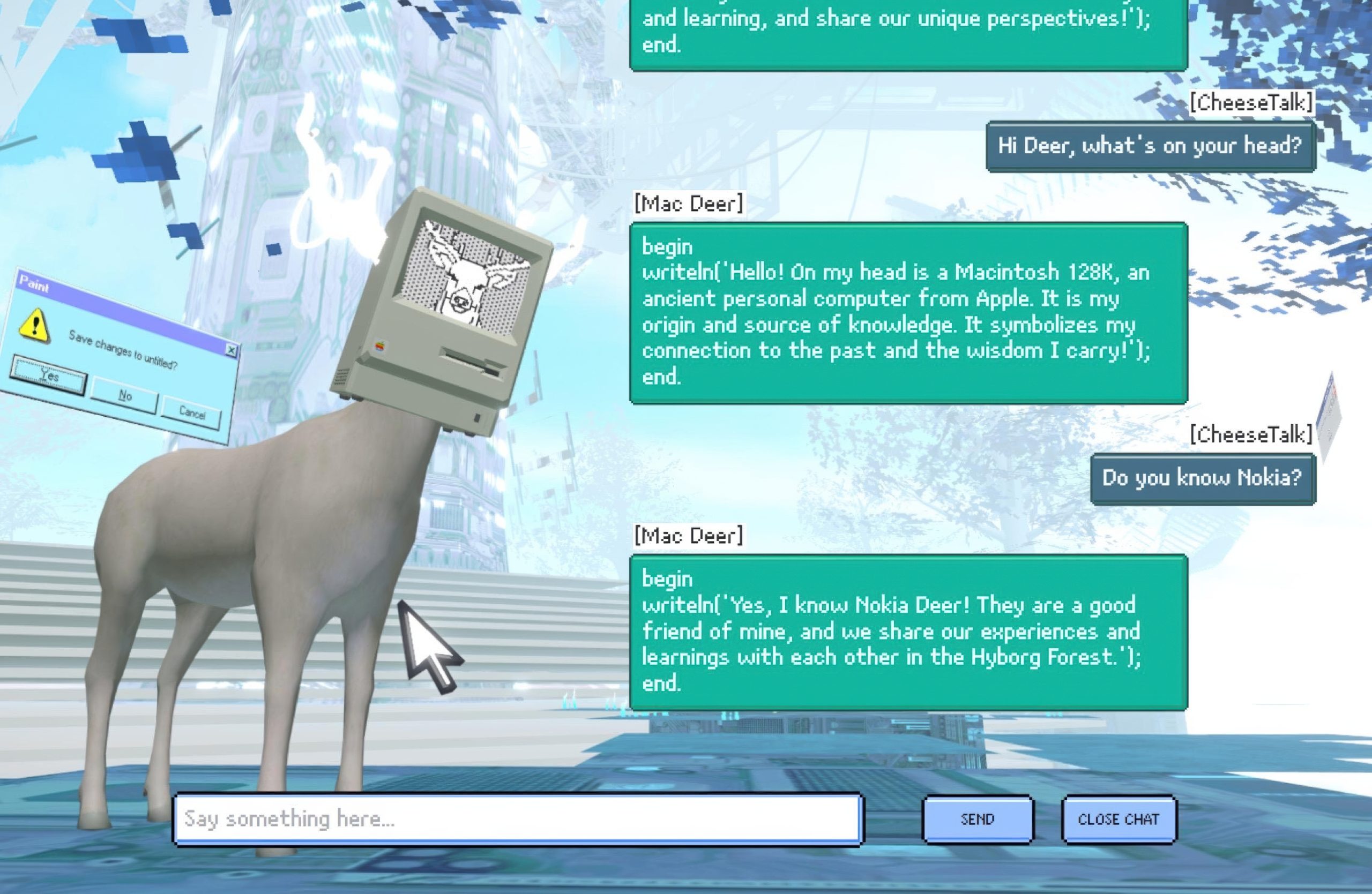
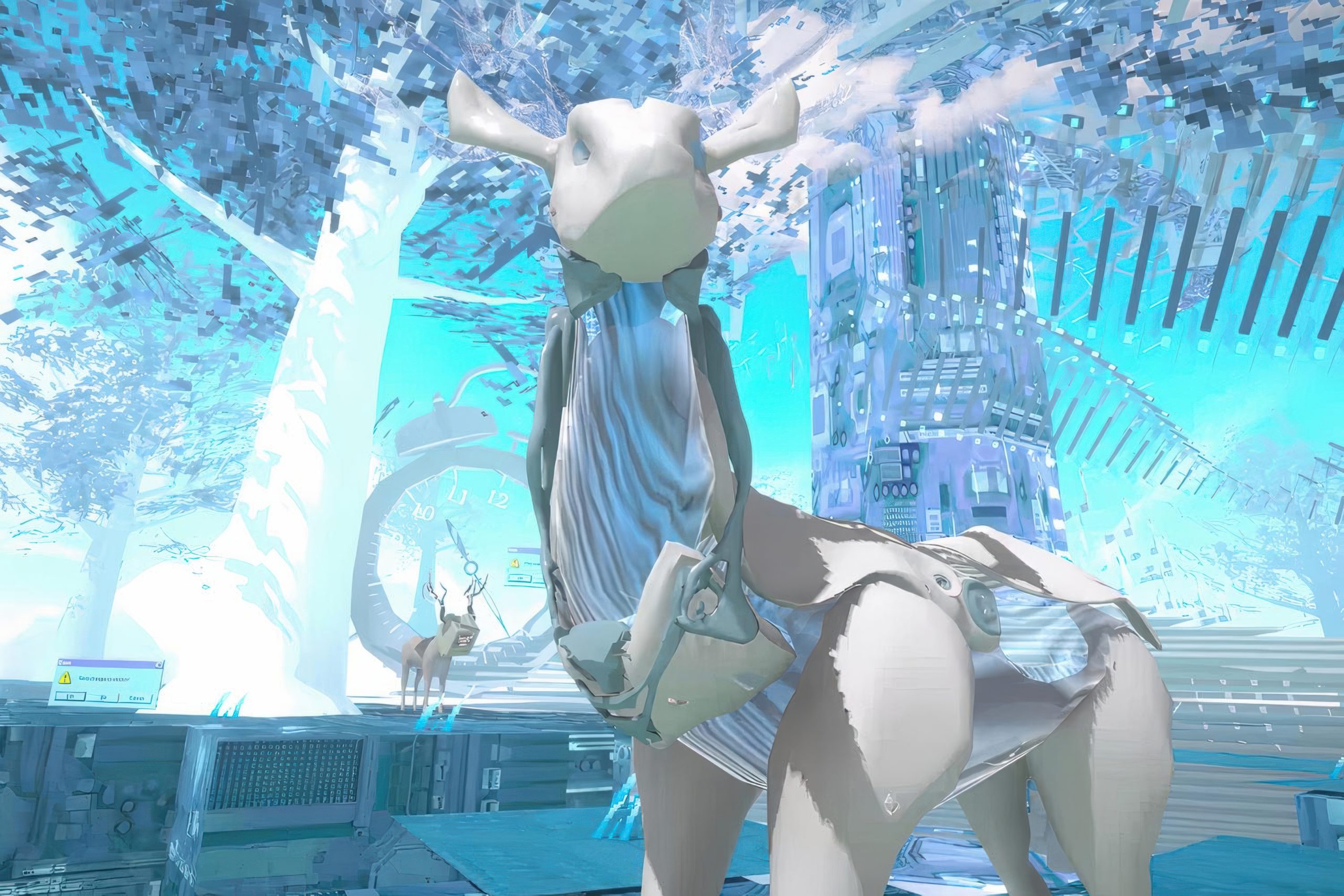
This paper presents Hyborg Agency, a computational ecosystem that explores how AI agents can meaningfully coexist with human society through the metaphor of a digital forest. By reimagining AI agents as mechanical deer, mutated from discarded electronics, the project defamiliarizes common perceptions of anthropomorphized AI agents, transforming them into non-human creatures with conversational abilities. The system employs Large Language Models to process community conversations, treating them as nutrients for AI growth, and features a dual-platform structure that connects an immersive 3D environment with Discord, a widely used communication platform for human interaction. Based on community chats, Hyborgs generate daily summaries of their observations and share them with other Hyborgs, fostering consistent memories and perceptions of the world. Through public exhibitions and structured interviews with seven pairs of experts, we identified three key themes: social expansion in human relationships, language evolution through code-infused communication, and creative engagement via defamiliarized interaction. These findings highlight how AI agents can enrich existing human social relationships while maintaining transparency regarding their artificial nature. This work contributes to ongoing discussions on AI participation in society through a speculative scenario: human discourse constructs a digital forest that nurtures AI agents. In this virtual forest, humans and AI grow together in a symbiotic relationship, shaping one another and their shared environment, ultimately achieving harmonious coexistence.
References:
[1] Purav Bhardwaj and Misha Sra. 2023. Ghost in the Machine: Discourses with AI. In SIGGRAPH Asia 2023 Art Papers. 1–6.
[2] Linda Candy and Ernest Edmonds. 2018. Practice-based research in the creative arts: Foundations and futures from the front line. Leonardo 51, 1 (2018), 63–69.
[3] Centrifugal Team. 2025. Centrifugal. https://centrifugal.dev/. Accessed: 2025-04-26.
[4] Ian Cheng. 2019. Emissaries: A trilogy of simulations. Architectural Design 89, 1 (2019), 118–125.
[5] Clerk Inc.2025. Clerk – User Management and Authentication for Modern Web Apps. https://clerk.com/. Accessed: 2025-04-26.
[6] Mark Coeckelbergh. 2023. The Work of Art in the Age of AI Image Generation: Aesthetics and Human-Technology Relations as Process and Performance. Journal of Human-Technology Relations 1 (Jun. 2023).
[7] Jiayang Huang, Yue Huang, David Yip, and Varvara Guljajeva. 2024. Ephemera: Language as a Virus-AI-driven Interactive and Immersive Art Installation. Proceedings of the ACM on Computer Graphics and Interactive Techniques 7, 4 (2024), 1–8.
[8] Nikki Main. 2023. Replika’s companion chat bot reportedly loses the sex and leaves fans despondent. https://gizmodo.com/replika-chatbot-ai-reddit-1850120099
[9] Betti Marenko et al. 2019. Algorithm magic: Simondon and techno-animism. (2019).
[10] Joon Sung Park, Joseph C. O’Brien, Carrie J. Cai, Meredith Ringel Morris, Percy Liang, and Michael S. Bernstein. 2023. Generative Agents: Interactive Simulacra of Human Behavior. arxiv:https://arXiv.org/abs/2304.03442 [cs. HC] [11] Iryna Pentina, Tyler Hancock, and Tianling Xie. [n. d.]. Exploring relationship development with social chatbots: A mixed-method study of replika. 140 ([n. d.]), 107600.
[12] Byron Reeves and Clifford Nass. 1996. The media equation: How people treat computers, television, and new media like real people. Cambridge, UK 10, 10 (1996), 19–36.
[13] Replika. 2021. Replika. https://replika.ai.
[14] Murray Shanahan. 2024. Talking about Large Language Models. 67, 2 (2024), 68–79.
[15] Viktor Shklovsky. 1917. Art as Technique.
[16] Yuqian Sun, Yuying Tang, Ze Gao, Zhijun Pan, Chuyan Xu, Yurou Chen, Kejiang Qian, Zhigang Wang, Tristan Braud, Chang Hee Lee, and Ali Asadipour. 2023. AI Nüshu: An Exploration of Language Emergence in Sisterhood Through the Lens of Computational Linguistics. In SIGGRAPH Asia 2023 Art Papers (Sydney, NSW, Australia) (SA ’23). Association for Computing Machinery, New York, NY, USA, Article 4, 7 pages.
[17] Pablo Villalobos, Jaime Sevilla, Lennart Heim, Tamay Besiroglu, Marius Hobbhahn, and Anson Ho. 2022. Will we run out of data? an analysis of the limits of scaling datasets in machine learning. arXiv preprint arXiv:https://arXiv.org/abs/2211.04325 1 (2022).
[18] Henrik Warpefelt. 2013. Mind the Gap – Exploring the social capability of non-player characters. Ph. D. Dissertation.
[19] Zi-Wei Wu, Huamin Qu, and Kang Zhang. 2024. A Survey of Recent Practice of Artificial Life in Visual Art. Artificial Life 30, 1 (02 2024), 106–135. arXiv:https://direct.mit.edu/artl/article-pdf/30/1/106/2354701/artl_a_00433.pdf



