“How to Break Crowd Simulation Algorithms” by Chen and Weiss
Conference:
Type(s):
Title:
- How to Break Crowd Simulation Algorithms
Session/Category Title:
- Crowds (and Songs!)
Presenter(s)/Author(s):
Moderator(s):
Abstract:
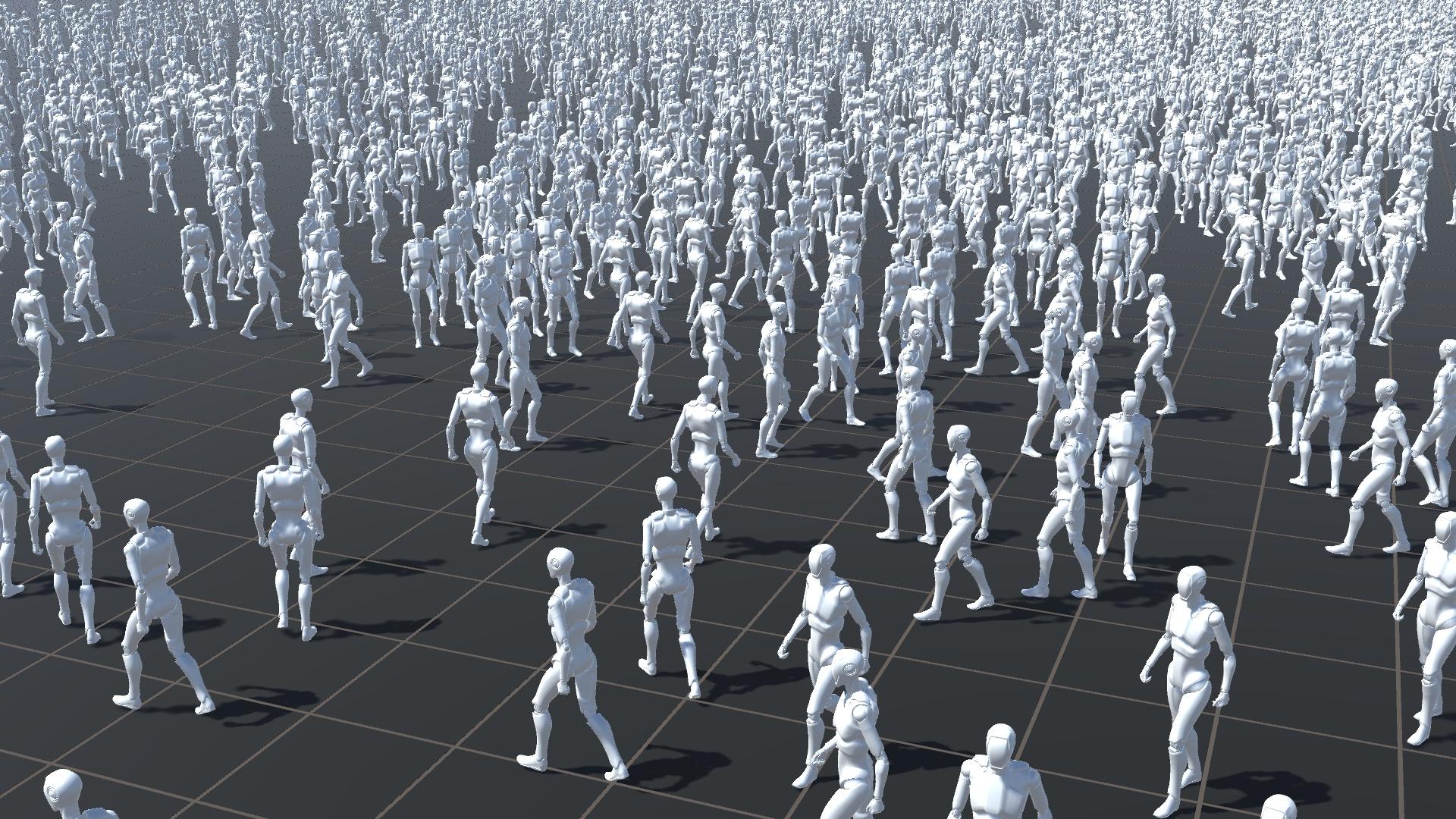
Virtual crowds are prevalent in entertainment media, including movies, games, and educational or training experiences. In this work, we analyze algorithms for simulating such crowds. Specifically, we demonstrate that widely popular state-of-the-art algorithms fail in several basic benchmark cases. With the goal of designing more robust algorithms, we discuss potential solutions, which can be easily integrated into specific crowd simulation algorithms.
References:
[1] Panayiotis Charalambous, Julien Pettre, Vassilis Vassiliades, Yiorgos Chrysanthou, and Nuria Pelechano. 2023. GREIL-crowds: crowd simulation with deep reinforcement learning and examples. ACM Trans Graph 42, 4 (2023), 1–15.
[2] Dirk Helbing, Illés Farkas, and Tamas Vicsek. 2000. Simulating dynamical features of escape panic. Nature 407, 6803 (2000), 487–490.
[3] Mubbasir Kapadia, Nuria Pelechano, Jan M Allbeck, Norman I Badler, and Norm Badler. 2016. Virtual crowds: Steps toward behavioral realism. Springer.
[4] Mubbasir Kapadia, Shawn Singh, Brian Allen, Glenn Reinman, and Petros Faloutsos. 2009. Steerbug: an interactive framework for specifying and detecting steering behaviors. In Symp Comp Anim. 209–216.
[5] Ioannis Karamouzas, Peter Heil, Pascal Van Beek, and Mark H Overmars. 2009. A predictive collision avoidance model for pedestrian simulation. In Motion in Games: Second International Workshop. Springer, 41–52.
[6] Ioannis Karamouzas, Brian Skinner, and Stephen J Guy. 2014. Universal power law governing pedestrian interactions. Physical Review Letters 113, 23 (2014), 238701.
[7] Mehdi Moussaïd, Dirk Helbing, and Guy Theraulaz. 2011. How simple rules determine pedestrian behavior and crowd disasters. PNAS 108, 17 (2011), 6884–6888.
[8] Bilas Talukdar, Yunhao Zhang, and Tomer Weiss. 2024. Learning Crowd Motion Dynamics with Crowds. ACM Comp Graph and Interactive Techniques 7, 1 (2024), 1–17.
[9] Wouter Van Toll and Julien Pettré. 2021. Algorithms for microscopic crowd simulation: Advancements in the 2010s. In Comp Graph Forum, Vol. 40. Wiley Online Library, 731–754.