“Geometry-aware metropolis light transport”
Conference:
Type(s):
Title:
- Geometry-aware metropolis light transport
Session/Category Title:
- Rendering & reflectance
Presenter(s)/Author(s):
Moderator(s):
Abstract:
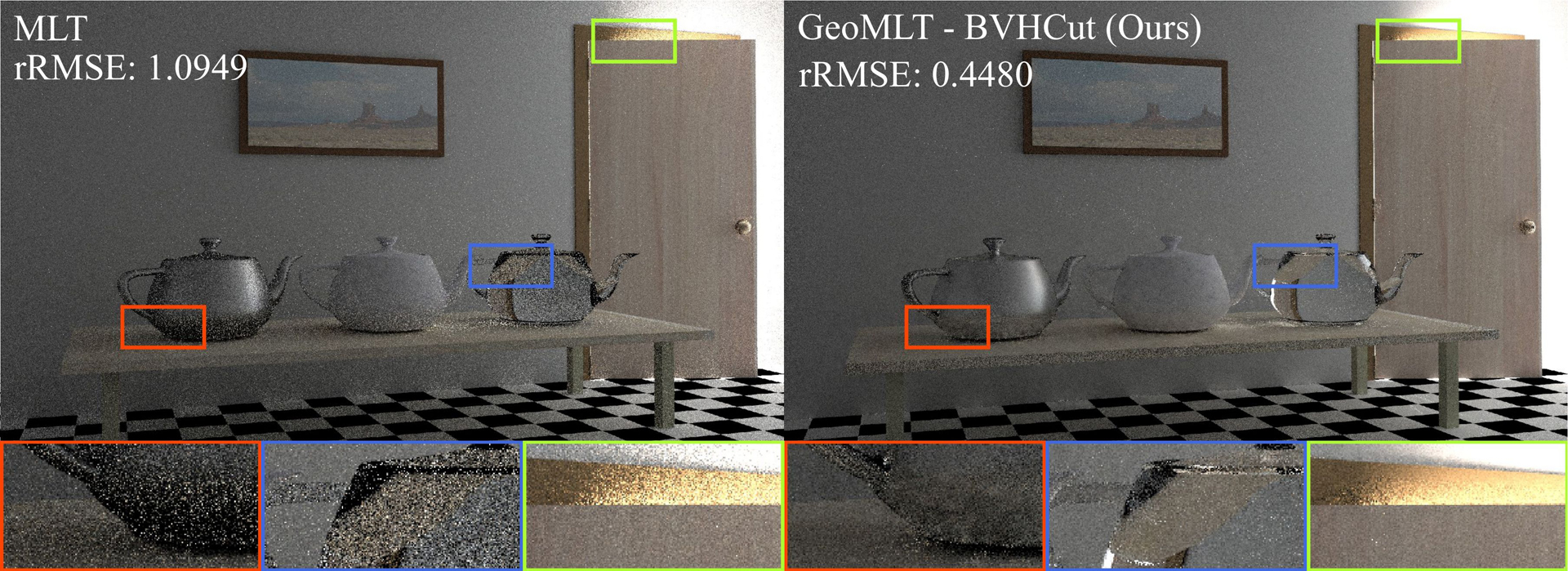
Markov chain Monte Carlo (MCMC) rendering utilizes a sequence of correlated path samples which is obtained by iteratively mutating the current state to the next. The efficiency of MCMC rendering depends on how well the mutation strategy is designed to adapt to the local structure of the state space. We present a novel MCMC rendering method that automatically adapts the step sizes of the mutations to the geometry of the rendered scene. Our geometry-aware path space perturbation largely avoids tentative samples with zero contribution due to occlusion. Our method limits the mutation step size by estimating the maximum opening angle of a cone, centered around a segment of a light transport path, where no geometry obstructs visibility. This geometry-aware mutation increases the acceptance rates, while not degrading the sampling quality. As this cone estimation introduces a considerable overhead if done naively, to make our approach efficient, we discuss and analyze fast approximate methods for cone angle estimation which utilize the acceleration structure already present for the ray-geometry intersection. Our new approach, integrated into the framework of Metropolis light transport, can achieve results with lower error and less artifact in equal time compared to current path space mutation techniques.
References:
1. John Amanatides. 1984. Ray Tracing with Cones. Computer Graphics (Proc. SIGGRAPH) 18, 3 (1984), 129–135. Google ScholarDigital Library
2. James Arvo. 1986. Backward ray tracing. In Developments in Ray Tracing, ACM SIGGRAPH Course Notes. 259–263.Google Scholar
3. Michel Betancourt. 2017. A Conceptual Introduction to Hamiltonian Monte Carlo. ArXiv e-prints (Jan. 2017). arXiv:stat.ME/1701.02434Google Scholar
4. Benedikt Bitterli, Wenzel Jakob, Jan Novák, and Wojciech Jarosz. 2017. Reversible Jump Metropolis Light Transport Using Inverse Mappings. ACM Transactions on Graphics (Proc. SIGGRAPH) 37, 1, Article 1 (2017), 12 pages. Google ScholarDigital Library
5. Cyril Crassin, Fabrice Neyret, Miguel Sainz, Simon Green, and Elmar Eisemann. 2011. Interactive Indirect Illumination Using Voxel Cone Tracing. Computer Graphics Forum (Proc. Pacific Graphics) 30, 7 (2011). Google ScholarDigital Library
6. Simon Duane, A.D. Kennedy, Brian J. Pendleton, and Duncan Roweth. 1987. Hybrid Monte Carlo. Physics Letters B 195, 2 (1987), 216 — 222.Google ScholarCross Ref
7. Charles J. Geyer. 1992. Practical Markov Chain Monte Carlo. Statist. Sci. 7, 4 (11 1992), 473–483.Google Scholar
8. Toshiya Hachisuka, Anton S. Kaplanyan, and Carsten Dachsbacher. 2014. Multiplexed Metropolis Light Transport. ACM Transactions on Graphics (Proc. SIGGRAPH) 33, 4, Article 100 (2014). Google ScholarDigital Library
9. Johannes Hanika, Anton S. Kaplanyan, and Carsten Dachsbacher. 2015. Improved Half Vector Space Light Transport. Computer Graphics Forum (Proc. Eurographics Symposium on Rendering) 34, 4 (2015), 65–74.Google Scholar
10. Wilfred K. Hastings. 1970. Monte Carlo sampling methods using Markov chains and their applications. Biometrika 57, 1 (1970), 97–109.Google ScholarCross Ref
11. Wenzel Jakob and Stephen Marschner. 2012. Manifold exploration: a Markov chain Monte Carlo technique for rendering scenes with difficult specular transport. ACM Transactions on Graphics (Proc. SIGGRAPH) 31, 4, Article 58 (2012). Google ScholarDigital Library
12. James T. Kajiya. 1986. The rendering equation. Computer Graphics (Proceedings of SIGGRAPH ’86) 20, 4 (1986), 143–150. Google ScholarDigital Library
13. Anton Kaplanyan, Johannes Hanika, and Carsten Dachsbacher. 2014. The Natural-Constraint Representation of the Path Space for Efficient Light Transport Simulation. ACM Transactions on Graphics (Proc. SIGGRAPH) 33, 4 (2014), 1–13. Google ScholarDigital Library
14. Csaba Kelemen, László Szirmay-Kalos, György Antal, and Ferenc Csonka. 2002. A simple and robust mutation strategy for the Metropolis light transport algorithm. Computer Graphics Forum 21, 3 (2002), 531–540.Google ScholarCross Ref
15. Eric P. Lafortune and Yves D. Willems. 1993. Bi-Directional Path Tracing. In Compugraphics ’93. 145–153.Google Scholar
16. Tzu-Mao Li, Jaakko Lehtinen, Ravi Ramamoorthi, Wenzel Jakob, and Frédo Durand. 2015. Anisotropic Gaussian Mutations for Metropolis Light Transport Through Hessian-Hamiltonian Dynamics. ACM Transactions on Graphics (Proc. SIGGRAPH Asia) 34, 6 (2015), 209:1–209:13. Google ScholarDigital Library
17. Nicholas Metropolis, Arianna W Rosenbluth, Marshall N Rosenbluth, Augusta H Teller, and Edward Teller. 1953. Equation of state calculations by fast computing machines. 21, 6 (1953), 1087–1092.Google ScholarCross Ref
18. Benjamin Mora. 2011. Naive Ray-tracing: A Divide-and-conquer Approach. ACM Transactions on Graphics 30, 5, Article 117 (2011), 12 pages. Google ScholarDigital Library
19. Hisanari Otsu, Anton S. Kaplanyan, Johannes Hanika, Carsten Dachsbacher, and Toshiya Hachisuka. 2017. Fusing State Spaces for Markov Chain Monte Carlo Rendering. ACM Transactions on Graphics (Proc. SIGGRAPH) 36, 4, Article 74 (2017), 10 pages. Google ScholarDigital Library
20. Jacopo Pantaleoni. 2017. Charted Metropolis Light Transport. ACM Transactions on Graphics (Proc. SIGGRAPH) 36, 4, Article 75 (2017), 14 pages. Google ScholarDigital Library
21. David Roger, Ulf Assarsson, and Nicolas Holzschuch. 2007. Whitted Ray-tracing for Dynamic Scenes Using a Ray-space Hierarchy on the GPU. In Proc. Eurographics Symposium on Rendering. 99–110. Google ScholarDigital Library
22. Eric Veach and Leonidas J. Guibas. 1994. Bidirectional Estimators for Light Transport. In Proc. Eurographics Workshop on Rendering. 147–162.Google Scholar
23. Eric Veach and Leonidas J. Guibas. 1995. Optimally combining sampling techniques for Monte Carlo rendering. Proc. SIGGRAPH ’95 (1995), 419–428. Google ScholarDigital Library
24. Eric Veach and Leonidas J. Guibas. 1997. Metropolis Light Transport. In SIGGRAPH ’97. 65–76. Google ScholarDigital Library