
“Flexible muscle-based locomotion for bipedal creatures”
Conference:
Type(s):
Title:
- Flexible muscle-based locomotion for bipedal creatures
Session/Category Title:
- Modeling Humans
Presenter(s)/Author(s):
Abstract:
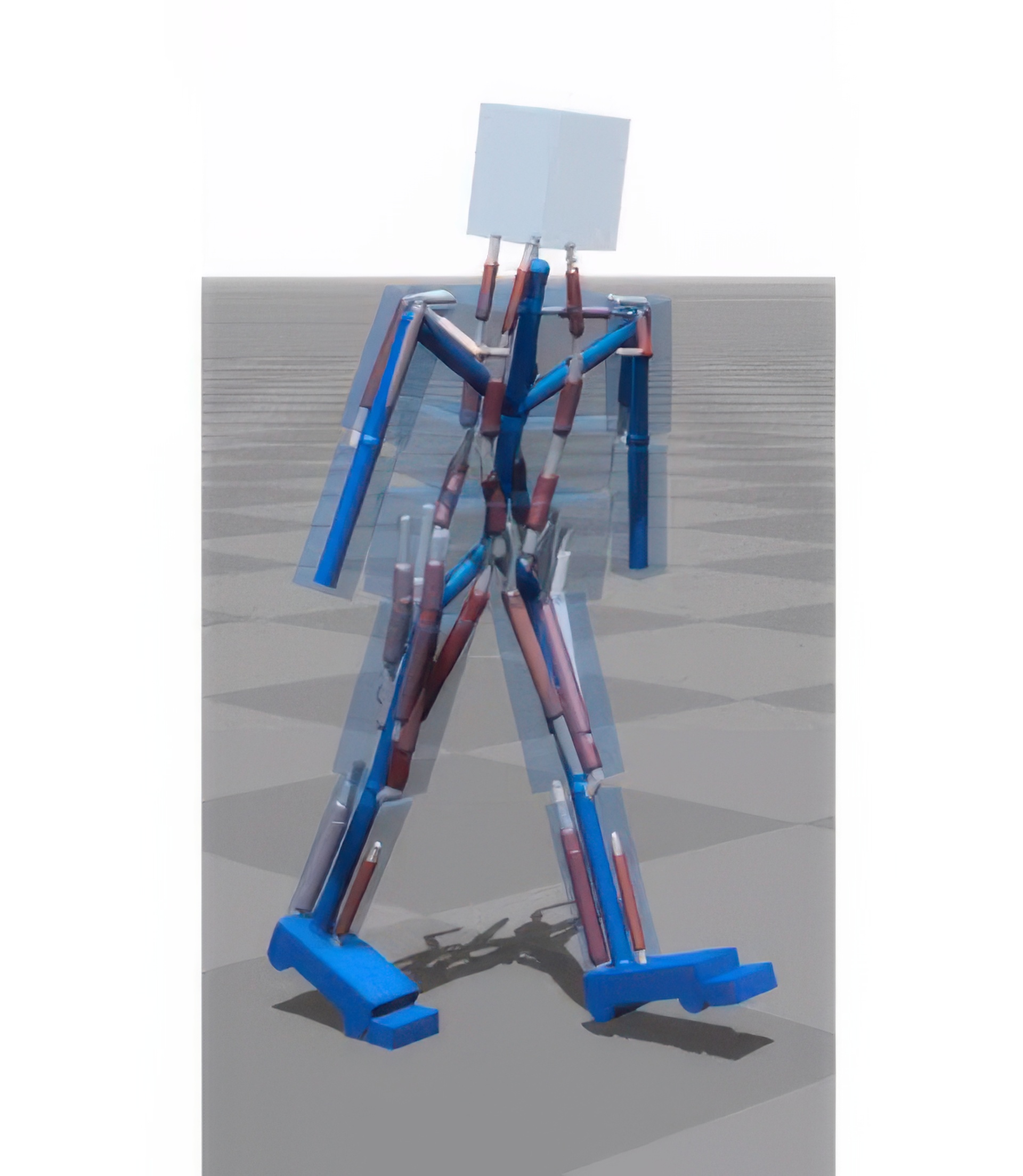
We present a muscle-based control method for simulated bipeds in which both the muscle routing and control parameters are optimized. This yields a generic locomotion control method that supports a variety of bipedal creatures. All actuation forces are the result of 3D simulated muscles, and a model of neural delay is included for all feedback paths. As a result, our controllers generate torque patterns that incorporate biomechanical constraints. The synthesized controllers find different gaits based on target speed, can cope with uneven terrain and external perturbations, and can steer to target directions.
References:
1. Ackermann, M., and van den Bogert, A. J. 2012. Predictive simulation of gait at low gravity reveals skipping as the preferred locomotion strategy. Journal of Biomechanics 45, 7, 1293–8.
2. Anderson, F., and Pandy, M. 2001. Dynamic optimization of human walking. Journal of Biomechanical Eng. 123, 381.
3. Coros, S., Beaudoin, P., and van de Panne, M. 2009. Robust Task-based Control Policies for Physics-based Characters. ACM Trans. on Graphics 28, 5.
4. Coros, S., Beaudoin, P., and van de Panne, M. 2010. Generalized biped walking control. ACM Trans. on Graphics 29, 4.
5. Coros, S., Karpathy, A., Jones, B., Reveret, L., and Van De Panne, M. 2011. Locomotion skills for simulated quadrupeds. ACM Trans. on Graphics 30, 4.
6. da Silva, M., Abe, Y., and Popović, J. 2008. Interactive simulation of stylized human locomotion. ACM Transactions on Graphics (SIGGRAPH) 27, 3 (Aug.), 1–10.
7. da Silva, M., Abe, Y., and Popovic, J. 2008. Simulation of human motion data using short-horizon model-predictive control. Computer Graphics Forum 27, 2, 371–380.
8. de Lasa, M., Mordatch, I., and Hertzmann, A. 2010. Feature-Based Locomotion Controllers. ACM Trans. on Graphics 29, 3.
9. Faloutsos, P., van de Panne, M., and Terzopoulos, D. 2001. Composable controllers for physics-based character animation. In ACM SIGGRAPH Papers, 251–260.
10. Geijtenbeek, T., and Pronost, N. 2012. Interactive Character Animation Using Simulated Physics: A State-of-the-Art Review. Computer Graphics Forum 31, 8 (Dec.), 2492–2515.
11. Geijtenbeek, T., van Den Bogert, A. J., van Basten, B. J. H., and Egges, A. 2010. Evaluating the physical realism of character animations using musculoskeletal models. In Motion in Games. Springer, 11–22.
12. Geijtenbeek, T., Pronost, N., and van der Stappen, A. 2012. Simple Data-Driven Control for Simulated Bipeds. In Proc. of the ACM SIGGRAPH/Eurographics Symp. on Computer Animation, The Eurographics Association, Lausanne, Switzerland, P. Kry and J. Lee, Eds., 211–219.
13. Geyer, H., and Herr, H. 2010. A muscle-reflex model that encodes principles of legged mechanics produces human walking dynamics and muscle activities. IEEE transactions on neural systems and rehabilitation engineering 18, 3 (June), 263–73.
14. Geyer, H., Seyfarth, A., and Blickhan, R. 2003. Positive force feedback in bouncing gaits? Proc. of the Royal Society of London. Series B: Biological Sciences 270, 1529, 2173–2183.
15. Geyer, H., Seyfarth, A., and Blickhan, R. 2006. Compliant leg behaviour explains basic dynamics of walking and running. Proc. of Biological sciences / The Royal Society 273, 1603 (Nov.), 2861–7.
16. Grzeszczuk, R., and Terzopoulos, D. 1995. Automated learning of muscle-actuated locomotion through control abstraction. In ACM SIGGRAPH Papers, 63–70.
17. Hansen, N. 2006. The CMA evolution strategy: a comparing review. Towards a new evolutionary computation, 75–102.
18. Hecker, C., Raabe, B., Enslow, R. W., DeWeese, J., Maynard, J., and van Prooijen, K. 2008. Real-time motion retargeting to highly varied user-created morphologies. ACM Trans. on Graphics 27, 3 (Aug.), 1.
19. Hodgins, J. K., Wooten, W. L., Brogan, D. C., and O’Brien, J. F. 1995. Animating human athletics. In ACM SIGGRAPH Papers, 71–78.
20. Ijspeert, A. J., Crespi, A., Ryczko, D., and Cabelguen, J.-M. 2007. From swimming to walking with a salamander robot driven by a spinal cord model. Science (New York, N.Y.) 315, 5817 (Mar.), 1416–20.
21. Jain, S., and Liu, C. 2011. Modal-space control for articulated characters. ACM Trans. on Graphics 30, 5.
22. Jain, S., Ye, Y., and Liu, C. K. 2009. Optimization-based interactive motion synthesis. ACM Trans. on Graphics 28, 1.
23. Kry, P., Reveret, L., Faure, F., and Cani, M.-P. 2009. Modal Locomotion: Animating Virtual Characters with Natural Vibrations. Computer Graphics Forum 28, 2 (Apr.), 289–298.
24. Kwon, T., and Hodgins, J. 2010. Control systems for human running using an inverted pendulum model and a reference motion capture sequence. In Proc. of the ACM SIGGRAPH/Eurographics Symp. on Computer Animation, 129–138.
25. Laszlo, J., van de Panne, M., and Fiume, E. 1996. Limit cycle control and its application to the animation of balancing and walking. In ACM SIGGRAPH Papers, 155–162.
26. Lee, Y., Kim, S., and Lee, J. 2010. Data-driven biped control. ACM Trans. on Graphics 29, 4 (July), 129.
27. Liu, C. K., Hertzmann, A., and Popović, Z. 2005. Learning physics-based motion style with nonlinear inverse optimization. ACM Transactions on Graphics 24, 3, 1071.
28. Liu, L., Yin, K., van de Panne, M., and Guo, B. 2012. Terrain Runner: Control, Parameterization, Composition, and Planning for Highly Dynamic Motions. ACM Trans. on Graphics 31, 6 (Nov.), 1.
29. Maufroy, C., Kimura, H., and Takase, K. 2008. Towards a general neural controller for quadrupedal locomotion. Neural networks: the official journal of the International Neural Network Society 21, 4 (May), 667–81.
30. Mordatch, I., de Lasa, M., and Hertzmann, A. 2010. Robust Physics-Based Locomotion Using Low-Dimensional Planning. ACM Trans. on Graphics 29, 4.
31. Muico, U., Lee, Y., Popović, J., and Popović, Z. 2009. Contact-aware nonlinear control of dynamic characters. ACM Trans. on Graphics 28, 3 (July).
32. Muico, U., Popović, J., and Popović, Z. 2011. Composite control of physically simulated characters. ACM Trans. on Graphics 30, 3 (May).
33. Pandy, M., Anderson, F., and Hull, D. 1992. A parameter optimization approach for the optimal control of large-scale musculoskeletal systems. Journal of Biomechanical Engineering, Transactions of the ASME 114, 4, 450–460.
34. Raibert, M. H., and Hodgins, J. K. 1991. Animation of dynamic legged locomotion. ACM SIGGRAPH Computer Graphics 25, 4 (July), 349–358.
35. Sims, K. 1994. Evolving virtual creatures. In ACM SIGGRAPH Papers, 15–22.
36. Smith, R., 2006. Open Dynamics Engine User Guide v0.5.
37. Sok, K., Kim, M., and Lee, J. 2007. Simulating biped behaviors from human motion data. ACM Trans. on Graphics 26, 3, 107.
38. Sueda, S., Kaufman, A., and Pai, D. K. 2008. Musculotendon simulation for hand animation. ACM Trans. on Graphics 27, 3, 83.
39. Sunada, C., Argaez, D., Dubowsky, S., and Mavroidis, C. 1994. A coordinated Jacobian transpose control for mobile multi-limbed robotic systems. In IEEE Int. Conf. on Robotics and Automation, 1910–1915.
40. Taga, G. 1995. A model of the neuro-musculo-skeletal system for human locomotion. Biological Cybernetics 73, 2, 97–111.
41. Tan, J., Gu, Y., Turk, G., and Liu, C. 2011. Articulated swimming creatures. ACM Trans. on Graphics 30, 4, 58.
42. Thelen, D., Anderson, F., and Delp, S. 2003. Generating dynamic simulations of movement using computed muscle control. Journal of Biomechanics 36, 321–328.
43. Tsai, Y.-Y., Lin, W.-C., Cheng, K. B., Lee, J., and Lee, T.- Y. 2010. Real-time physics-based 3d biped character animation using an inverted pendulum model. Visualization and Computer Graphics, IEEE Transactions on 16, 2, 325–337.
44. Tsang, W., Singh, K., and Fiume, E. 2005. Helping hand: an anatomically accurate inverse dynamics solution for unconstrained hand motion. In Proc. of the ACM SIGGRAPH/Eurographics Symp. on Computer Animation, ACM, 319–328.
45. Wampler, K., and Popović, Z. 2009. Optimal gait and form for animal locomotion. ACM Trans. on Graphics 28, 3 (July), 1.
46. Wampler, K., Popović, J., and Popović, Z. 2013. Animal Locomotion Controllers From Scratch. Computer Graphics Forum 32.
47. Wang, J., Fleet, D., and Hertzmann, A. 2009. Optimizing walking controllers. ACM Trans. on Graphics 28, 5, 168.
48. Wang, J., Fleet, D., and Hertzmann, A. 2010. Optimizing Walking Controllers for Uncertain Inputs and Environments. ACM Trans. on Graphics 29, 4.
49. Wang, J., Hamner, S., Delp, S., and Koltun, V. 2012. Optimizing locomotion controllers using biologically-based actuators and objectives. ACM Trans. on Graphics 31, 4, 25.
50. Wu, J.-c., and Popovic, Z. 2010. Terrain-Adaptive Bipedal Locomotion Control. ACM Trans. on Graphics 29, 4.
51. Ye, Y., and Liu, C. 2010. Optimal feedback control for character animation using an abstract model. ACM Trans. on Graphics 29, 4 (July), 74.
52. Yin, K. K., Loken, K., and van de Panne, M. 2007. Simbicon: Simple biped locomotion control. ACM Trans. on Graphics 26, 3, 105.
53. Zajac, F. E. 1989. Muscle and tendon: properties, models, scaling, and application to biomechanics and motor control. Critical reviews in biomedical engineering 17, 4, 359–411.



