
“Fast and versatile fluid-solid coupling for turbulent flow simulation” by Lyu, Li, Desbrun and Liu
Conference:
Type(s):
Title:
- Fast and versatile fluid-solid coupling for turbulent flow simulation
Session/Category Title:
- Turbulence and Fluids
Presenter(s)/Author(s):
Abstract:
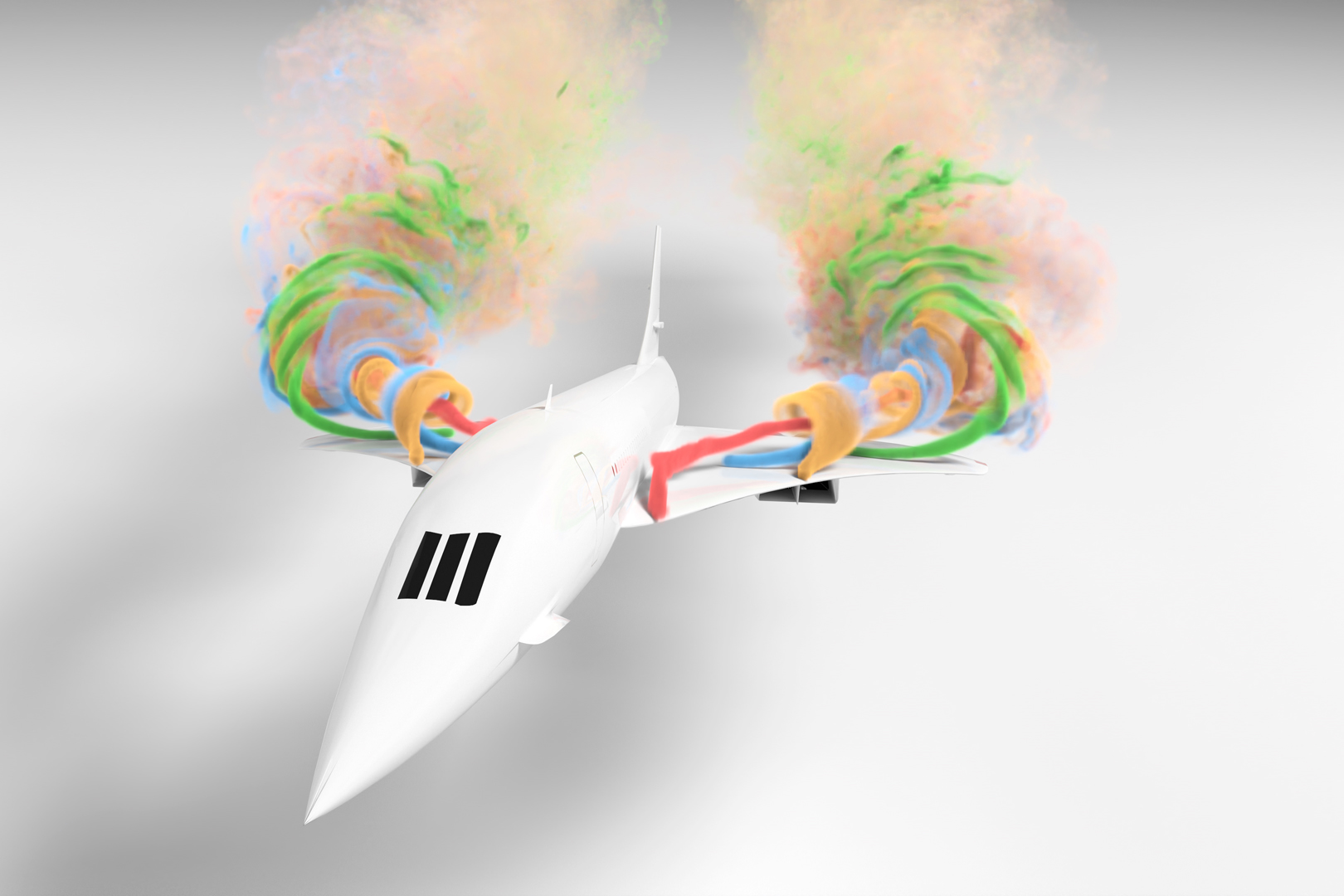
The intricate motions and complex vortical structures generated by the interaction between fluids and solids are visually fascinating. However, reproducing such a two-way coupling between thin objects and turbulent fluids numerically is notoriously challenging and computationally costly: existing approaches such as cut-cell or immersed-boundary methods have difficulty achieving physical accuracy, or even visual plausibility, of simulations involving fast-evolving flows with immersed objects of arbitrary shapes. In this paper, we propose an efficient and versatile approach for simulating two-way fluid-solid coupling within the kinetic (lattice-Boltzmann) fluid simulation framework, valid for both laminar and highly turbulent flows, and for both thick and thin objects. We introduce a novel hybrid approach to fluid-solid coupling which systematically involves a mesoscopic double-sided bounce-back scheme followed by a cut-cell velocity correction for a more robust and plausible treatment of turbulent flows near moving (thin) solids, preventing flow penetration and reducing boundary artifacts significantly. Coupled with an efficient approximation to simplify geometric computations, the whole boundary treatment method preserves the inherent massively parallel computational nature of the kinetic method. Moreover, we propose simple GPU optimizations of the core LBM algorithm which achieve an even higher computational efficiency than the state-of-the-art kinetic fluid solvers in graphics. We demonstrate the accuracy and efficacy of our two-way coupling through various challenging simulations involving a variety of rigid body solids and fluids at both high and low Reynolds numbers. Finally, comparisons to existing methods on benchmark data and real experiments further highlight the superiority of our method.
References:
1. Cyrus K Aidun and Jonathan R Clausen. 2010. Lattice-Boltzmann method for complex flows. Annual Review of Fluid Mechanics 42 (2010), 439–472.
2. Cyrus K Aidun, Yannan Lu, and E-Jiang Ding. 1998. Direct analysis of particulate suspensions with inertia using the discrete Boltzmann equation. Journal of Fluid Mechanics 373 (1998), 287–311.
3. John D Anderson. 2010. Aircraft Performance & Design. McGraw-Hill Education (India) Pvt Limited.
4. Ansys Inc. 2014. Ansys Fluent. (2014). www.ansys.com/products/fluids/ansys-fluent
5. Vinicius C Azevedo, Christopher Batty, and Manuel M Oliveira. 2016. Preserving geometry and topology for fluid flows with thin obstacles and narrow gaps. ACM Transactions on Graphics 35, 4 (2016), 97.
6. Stefan Band, Christoph Gissler, Markus Ihmsen, Jens Cornelis, Andreas Peer, and Matthias Teschner. 2018. Pressure boundaries for implicit incompressible SPH. ACM Transactions on Graphics 37, 2, Article 14 (2018).
7. Christopher Batty, Florence Bertails, and Robert Bridson. 2007. A fast variational framework for accurate solid-fluid coupling. In ACM Transactions on Graphics, Vol. 26. 100.
8. Miklós Bergou, Max Wardetzky, Stephen Robinson, Basile Audoly, and Eitan Grinspun. 2008. Discrete Elastic Rods. ACM Transactions on Graphics, Article 63 (2008).
9. M’hamed Bouzidi, Mouaouia Firdaouss, and Pierre Lallemand. 2001. Momentum transfer of a Boltzmann-lattice fluid with boundaries. Physics of Fluids 13, 11 (2001), 3452–3459.
10. R. Bridson, S. Marino, and R. Fedkiw. 2003. Simulation of clothing with folds and wrinkles. In Symposium on Computer Animation. 28–36.
11. Yunan Cai, Sheng Li, and Jianhua Lu. 2018. An improved immersed boundary-lattice Boltzmann method based on force correction technique. International Journal for Numerical Methods in Fluids 87, 3 (2018), 109–133.
12. Mark Carlson, Peter J Mucha, and Greg Turk. 2004. Rigid fluid: animating the interplay between rigid bodies and fluid. In ACM Transactions on Graphics, Vol. 23. 377–384.
13. Li Chen, Yang Yu, and Guoxiang Hou. 2013. Sharp-interface immersed boundary lattice Boltzmann method with reduced spurious-pressure oscillations for moving boundaries. Physical Review E 87, 5 (2013), 053306.
14. Shiyi Chen and Gary D Doolen. 1998. Lattice Boltzmann method for fluid flows. Annual Review of Fluid Mechanics 30, 1 (1998), 329–364.
15. Yixin Chen, Wei Li, Rui Fan, and Xiaopei Liu. 2021. GPU Optimization for High-Quality Kinetic Fluid Simulation. IEEE Transactions on Visualization and Computer Graphics (2021).
16. Nuttapong Chentanez, Tolga G. Goktekin, Bryan E. Feldman, and James F. O’Brien. 2006. Simultaneous Coupling of Fluids and Deformable Bodies. In Symposium on Computer Animation. 83–89.
17. Pascal Clausen, Martin Wicke, Jonathan R Shewchuk, and James F O’Brien. 2013. Simulating liquids and solid-liquid interactions with Lagrangian meshes. ACM Transactions on Graphics 32, 2, Article 17 (2013).
18. Meizhong Dai and David P Schmidt. 2005. Adaptive tetrahedral meshing in free-surface flow. J. Comput. Phys. 208, 1 (2005), 228–252.
19. Orla Dardis and John McCloskey. 1998. Lattice Boltzmann scheme with real numbered solid density for the simulation of flow in porous media. Physical Review E 57, 4 (1998), 4834.
20. Alessandro De Rosis and Kai H. Luo. 2019. Role of higher-order Hermite polynomials in the central-moments-based lattice Boltzmann framework. Physical Review E 99, 1 (2019), 013301.
21. Daniel Dunbar and Greg Humphreys. 2006. A spatial data structure for fast Poisson-disk sample generation. ACM Transactions on Graphics 25, 3 (2006), 503–508.
22. Jean M Délery. 2001. Robert Legendre and Henri Werlé: Toward the Elucidation of Three-Dimensional Separation. Annual Review of Fluid Mechanics 33, 1 (2001), 129–154.
23. Essex Edwards and Robert Bridson. 2014. Detailed water with coarse grids: combining surface meshes and adaptive discontinuous Galerkin. ACM Transactions on Graphics 33, 4, Article 136 (2014).
24. Sharif Elcott, Yiying Tong, Eva Kanso, Peter Schröder, and Mathieu Desbrun. 2007. Stable, circulation-preserving, simplicial fluids. ACM Transactions on Graphics 26, 1, Article 4 (2007).
25. Yu Fang, Ziyin Qu, Minchen Li, Xinxin Zhang, Yixin Zhu, Mridul Aanjaneya, and Chenfanfu Jiang. 2020. IQ-MPM: an interface quadrature material point method for non-sticky strongly two-way coupled nonlinear solids and fluids. ACM Transactions on Graphics 39, 4 (2020), 51–1.
26. Linlin Fei, Kai H Luo, and Qing Li. 2018b. Three-dimensional cascaded lattice Boltzmann method: Improved implementation and consistent forcing scheme. Physical Review E 97, 5 (2018), 053309.
27. Yun (Raymond) Fei, Christopher Batty, Eitan Grinspun, and Changxi Zheng. 2018a. A Multi-scale Model for Simulating Liquid-fabric Interactions. ACM Transactions on Graphics 37, 4, Article 51 (2018).
28. Yun (Raymond) Fei, Christopher Batty, Eitan Grinspun, and Changxi Zheng. 2019. A Multi-Scale Model for Coupling Strands with Shear-Dependent Liquid. ACM Transactions on Graphics 38, 6 (2019).
29. Bryan E Feldman, James F O’Brien, and Bryan M Klingner. 2005a. Animating gases with hybrid meshes. In ACM Transactions on Graphics, Vol. 24. 904–909.
30. Bryan E. Feldman, James F. O’Brien, Bryan M. Klingner, and Tolga G. Goktekin. 2005b. Fluids in deforming meshes. In Symposium on Computer Animation. 255–259.
31. Grahaml Feltham. 2014. Automotive Aerodynamics Episode 1: Flow Visualizations of MR2, RX7, Supra, FRS. https://www.youtube.com/watch?v=quDLzxmJl5I
32. Nick Foster and Ronald Fedkiw. 2001. Practical Animation of Liquids. In Proceedings of the Annual Conference on Computer Graphics and Interactive Techniques. 23–30.
33. Yang Gao, Shuai Li, Hong Qin, and Aimin Hao. 2017. A Novel Fluid-Solid Coupling Framework Integrating FLIP and Shape Matching Methods. In Computer Graphics International. Article 11.
34. Sebastian Geller, Jonas Tölke, and Manfred Krafczyk. 2006. Lattice-Boltzmann method on quadtree-type grids for fluid-structure interaction. In Fluid-Structure Interaction. 270–293.
35. Olivier Génevaux, Arash Habibi, and Jean-Michel Dischler. 2003. Simulating Fluid-Solid Interaction.. In Graphics Interface. 31–38.
36. Frédéric Gibou and Chohong Min. 2012. Efficient symmetric positive definite second-order accurate monolithic solver for fluid/solid interactions. J. Comput. Phys. 231, 8 (2012), 3246–3263.
37. Boyce E Griffith and Neelesh A Patankar. 2020. Immersed methods for fluid-structure interaction. Annual Review of Fluid Mechanics 52 (2020), 421–448.
38. Eitan Grinspun, Anil N. Hirani, Mathieu Desbrun, and Peter Schröder. 2003. Discrete Shells. In Symposium on Computer Animation. 62–67.
39. Eran Guendelman, Andrew Selle, Frank Losasso, and Ronald Fedkiw. 2005. Coupling water and smoke to thin deformable and rigid shells. ACM Transactions on Graphics 24, 3 (2005), 973–981.
40. Zhaoli Guo, Chuguang Zheng, and Baochang Shi. 2002. Discrete lattice effects on the forcing term in the lattice Boltzmann method. Physical review E 65, 4 (2002), 046308.
41. Yuanming Hu, Yu Fang, Ziheng Ge, Ziyin Qu, Yixin Zhu, Andre Pradhana, and Chenfanfu Jiang. 2018. A moving least squares material point method with displacement discontinuity and two-way rigid body coupling. ACM Transactions on Graphics 37, 4, Article 150 (2018).
42. Markus Ihmsen, Jens Cornelis, Barbara Solenthaler, Christopher Horvath, and Matthias Teschner. 2013. Implicit incompressible SPH. IEEE Trans. Vis. Comp. Graph. 20, 3 (2013), 426–435.
43. Chen Jiang, Jian-Yao Yao, Zhi-Qian Zhang, Guang-Jun Gao, and GR Liu. 2018. A sharp-interface immersed smoothed finite element method for interactions between incompressible flows and large deformation solids. Computer Methods in Applied Mechanics and Engineering 340 (2018), 24–53.
44. Shin K Kang and Yassin A Hassan. 2011. A comparative study of direct-forcing immersed boundary-lattice Boltzmann methods for stationary complex boundaries. International Journal for Numerical Methods in Fluids 66, 9 (2011), 1132–1158.
45. Po-Hao Kao and Ruey-Jen Yang. 2008. An investigation into curved and moving boundary treatments in the lattice Boltzmann method. J. Comput. Phys. 227, 11 (2008), 5671–5690.
46. Bryan M Klingner, Bryan E Feldman, Nuttapong Chentanez, and James F O’Brien. 2006. Fluid animation with dynamic meshes. ACM Transactions on Graphics 25, 3 (2006), 820–825.
47. Timm Krüger, Halim Kusumaatmaja, Alexandr Kuzmin, Orest Shardt, Goncalo Silva, and Erlend Magnus Viggen. 2017. The lattice Boltzmann method. Springer International Publishing 10, 978-3 (2017), 4–15.
48. Anthony J. C. Ladd. 1994. Numerical simulations of particulate suspensions via a discretized Boltzmann equation. Part 1. Theoretical foundation. Journal of Fluid Mechanics 271 (1994), 285–309.
49. Pierre Lallemand and Li-Shi Luo. 2003. Lattice Boltzmann method for moving boundaries. J. Comput. Phys. 184, 2 (2003), 406–421.
50. J Gordon Leishman. 2016. Principles of helicopter aerodynamics. Cambridge University Press.
51. Wei Li, Kai Bai, and Xiapei Liu. 2019. Continuous-Scale Kinetic Fluid Simulation. IEEE Trans. Vis. Comp. Graph. 25, 9 (2019), 2694–2709.
52. Wei Li, Yixin Chen, Mathieu Desbrun, Changxi Zheng, and Xiaopei Liu. 2020. Fast and Scalable Turbulent Flow Simulation with Two-Way Coupling. ACM Transactions on Graphics 39, 4 (2020).
53. Zhe Li, Julien Favier, Umberto D’Ortona, and Sébastien Poncet. 2016. An immersed boundary-lattice Boltzmann method for single-and multi-component fluid flows. J. Comput. Phys. 304 (2016), 424–440.
54. Jiajing Lin, Peng Chen, and Kuo Liang. 2020. Screw, power component and aircraft. CN Patent 110,896,626.
55. Beibei Liu, Gemma Mason, Julian Hodgson, Yiying Tong, and Mathieu Desbrun. 2015. Model-reduced Variational Fluid Simulation. ACM Transactions on Graphics 34, 6, Article 244 (2015).
56. Jianhua Lu, Haifeng Han, Baochang Shi, and Zhaoli Guo. 2012. Immersed boundary lattice Boltzmann model based on multiple relaxation times. Physical Review E 85, 1 (2012), 016711.
57. Maxon. 2021. Redshift renderer. (2021). https://www.redshift3d.com/product
58. Renwei Mei, Li-Shi Luo, and Wei Shyy. 1999. An accurate curved boundary treatment in the lattice Boltzmann method. J. Comput. Phys. 155, 2 (1999), 307–330.
59. Marek Krzysztof Misztal, Robert Bridson, Kenny Erleben, Jakob Andreas Bærentzen, and François Anton. 2010. Optimization-based fluid simulation on unstructured meshes. In VRIPHYS. 11–20.
60. Rajat Mittal, Haibo Dong, Meliha Bozkurttas, FM Najjar, Abel Vargas, and Alfred Von Loebbecke. 2008. A versatile sharp interface immersed boundary method for incompressible flows with complex boundaries. J. Comput. Phys. 227, 10 (2008), 4825–4852.
61. Yen Ting Ng, Chohong Min, and Frédéric Gibou. 2009. An efficient fluid-solid coupling algorithm for single-phase flows. J. Comput. Phys. 228, 23 (2009), 8807–8829.
62. DR Noble and JR Torczynski. 1998. A lattice-Boltzmann method for partially saturated computational cells. International Journal of Modern Physics C 9, 08 (1998), 1189–1201.
63. Nathan M. Olson. 2015. A Near-Boundary Modification for the Link Bounce-Back Boundary Condition in the Lattice Boltzmann Method. J. Comput. Phys. 301, C (2015), 102–110.
64. Jitendra Kumar Patel and Ganesh Natarajan. 2018. Diffuse interface immersed boundary method for multi-fluid flows with arbitrarily moving rigid bodies. J. Comput. Phys. 360 (2018), 202–228.
65. Andreas Peer, Markus Ihmsen, Jens Cornelis, and Matthias Teschner. 2015. An implicit viscosity formulation for SPH fluids. ACM Transactions on Graphics 34, 4 (2015), 1–10.
66. Cheng Peng, Yihua Teng, Brian Hwang, Zhaoli Guo, and Lian-Ping Wang. 2016. Implementation issues and benchmarking of lattice Boltzmann method for moving rigid particle simulations in a viscous flow. Computers & Mathematics with Applications 72, 2 (2016), 349–374.
67. Charles S Peskin. 1972. Flow patterns around heart valves: a numerical method. J. Comput. Phys. 10, 2 (1972), 252–271.
68. Ziyin Qu, Xinxin Zhang, Ming Gao, Chenfanfu Jiang, and Baoquan Chen. 2019. Efficient and conservative fluids using bidirectional mapping. ACM Transactions on Graphics 38, 4 (2019), 1–12.
69. Avi Robinson-Mosher, R. Elliot English, and Ronald Fedkiw. 2009. Accurate tangential velocities for solid fluid coupling. In Symposium on Computer Animation. 227–236.
70. Avi Robinson-Mosher, Tamar Shinar, Jon Gretarsson, Jonathan Su, and Ronald Fedkiw. 2008. Two-way coupling of fluids to rigid and deformable solids and shells. In ACM Transactions on Graphics, Vol. 27. 46.
71. Doug Roble, Nafees bin Zafar, and Henrik Falt. 2005. Cartesian grid fluid simulation with irregular boundary voxels. In ACM SIGGRAPH 2005 Sketches. 138.
72. Jung Hee Seo and Rajat Mittal. 2011. A sharp-interface immersed boundary method with improved mass conservation and reduced spurious pressure oscillations. J. Comput. Phys. 230, 19 (2011), 7347–7363.
73. Xiaowen Shan, Xue-Feng Yuan, and Hudong Chen. 2006. Kinetic theory representation of hydrodynamics: a way beyond the Navier-Stokes equation. Journal of Fluid Mechanics 550 (2006), 413–441.
74. Tetsuya Takahashi and Christopher Batty. 2020. Monolith: a monolithic pressure-viscosity-contact solver for strong two-way rigid-rigid rigid-fluid coupling. ACM Transactions on Graphics 39, 6 (2020), 1–16.
75. Tetsuya Takahashi and Ming C. Lin. 2019. A Geometrically Consistent Viscous Fluid Solver with Two-Way Fluid-Solid Coupling. Comp. Graph. Forum 38, 2 (2019), 49–58.
76. Tsunemi Takahashi, Heihachi Ueki, Atsushi Kunimatsu, and Hiroko Fujii. 2002. The simulation of fluid-rigid body interaction. In ACM SIGGRAPH 2002 Conference Abstracts and Applications. 266–266.
77. Shi Tao, Qing He, Baiman Chen, and Simin Huang. 2018. A distribution function correction-based immersed boundary-lattice Boltzmann method with truly second-order accuracy for fluid-solid flows. arXiv preprint arXiv:1803.09380 (2018).
78. Shi Tao, Qing He, Jiechao Chen, Baiman Chen, Guang Yang, and Zhibin Wu. 2019. Anon-iterative immersed boundary-lattice Boltzmann method with boundary condition enforced for fluid-solid flows. Applied Mathematical Modelling 76 (2019), 362–379.
79. Alessandro Tasora, Radu Serban, Hammad Mazhar, Arman Pazouki, Daniel Melanz, Jonathan Fleischmann, Michael Taylor, Hiroyuki Sugiyama, and Dan Negrut. 2016. Chrono: An open source multi-physics dynamics engine. In International Conference on High Performance Computing in Science and Engineering. 19–49.
80. Yun Teng, David I. W. Levin, and Theodore Kim. 2016. Eulerian Solid-fluid Coupling. ACM Transactions on Graphics 35, 6, Article 200 (2016).
81. Nils Thürey. 2007. Physically based animation of free surface flows with the lattice Boltzmann method. Ph. D. Thesis, University of Erlangen (2007).
82. Stuart DC Walsh, Holly Burwinkle, and Martin O Saar. 2009. A new partial-bounceback lattice-Boltzmann method for fluid flow through heterogeneous media. Computers & Geosciences 35, 6 (2009), 1186–1193.
83. Kevin Wang, J Grétarsson, A Main, and C Farhat. 2012. Computational algorithms for tracking dynamic fluid-structure interfaces in embedded boundary methods. International Journal for Numerical Methods in Fluids 70, 4 (2012), 515–535.
84. Zhengdao Wang, Yikun Wei, and Yuehong Qian. 2020. A bounce back-immersed boundary-lattice Boltzmann model for curved boundary. Applied Mathematical Modelling 81 (2020), 428–440.
85. Daniel Weber, Johannes Mueller-Roemer, André Stork, and Dieter Fellner. 2015. A Cut-Cell Geometric Multigrid Poisson Solver for Fluid Simulation. In Comp. Graph. Forum, Vol. 34. 481–491.
86. Sheng Xu and Z Jane Wang. 2006. An immersed interface method for simulating the interaction of a fluid with moving boundaries. J. Comput. Phys. 216, 2 (2006), 454–493.
87. Xuewen Yin and Junfeng Zhang. 2012. An improved bounce-back scheme for complex boundary conditions in lattice Boltzmann method. J. Comput. Phys. 231, 11 (2012), 4295–4303.
88. Gary D. Yngve, James F. O’Brien, and Jessica K. Hodgins. 2000. Animating Explosions. In Proceedings of the Annual Conference on Computer Graphics and Interactive Techniques. 29–36.
89. Jonas Zehnder, Rahul Narain, and Bernhard Thomaszewski. 2018. An advection-reflection solver for detail-preserving fluid simulation. ACM Transactions on Graphics 37, 4 (2018), 1–8.
90. Chunze Zhang, Yongguang Cheng, Luoding Zhu, and Jiayang Wu. 2016a. Accuracy improvement of the immersed boundary-lattice Boltzmann coupling scheme by iterative force correction. Computers & Fluids 124 (2016), 246–260.
91. Xinxin Zhang, Minchen Li, and Robert Bridson. 2016b. Resolving Fluid Boundary Layers with Particle Strength Exchange and Weak Adaptivity. ACM Transactions on Graphics 35, 4, Article 76 (July 2016).



