
“Evaluating the distinctiveness and attractiveness of human motions on realistic virtual bodies”
Conference:
Type(s):
Title:
- Evaluating the distinctiveness and attractiveness of human motions on realistic virtual bodies
Session/Category Title:
- Modeling Humans
Presenter(s)/Author(s):
Abstract:
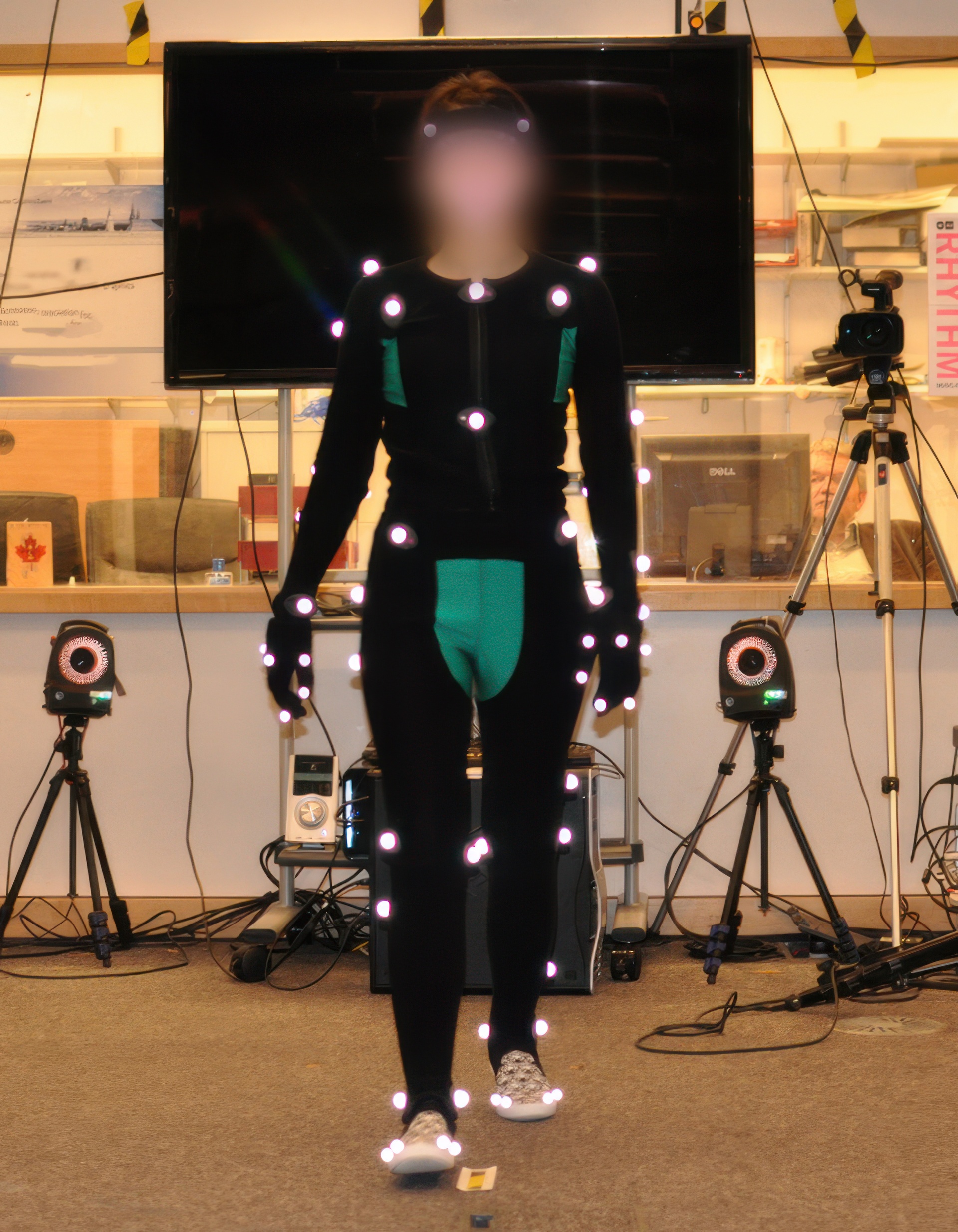
Recent advances in rendering and data-driven animation have enabled the creation of compelling characters with impressive levels of realism. While data-driven techniques can produce animations that are extremely faithful to the original motion, many challenging problems remain because of the high complexity of human motion. A better understanding of the factors that make human motion recognizable and appealing would be of great value in industries where creating a variety of appealing virtual characters with realistic motion is required. To investigate these issues, we captured thirty actors walking, jogging and dancing, and applied their motions to the same virtual character (one each for the males and females). We then conducted a series of perceptual experiments to explore the distinctiveness and attractiveness of these human motions, and whether characteristic motion features transfer across an individual’s different gaits. Average faces are perceived to be less distinctive but more attractive, so we explored whether this was also true for body motion. We found that dancing motions were most easily recognized and that distinctiveness in one gait does not predict how recognizable the same actor is when performing a different motion. As hypothesized, average motions were always amongst the least distinctive and most attractive. Furthermore, as 50% of participants in the experiment were Caucasian European and 50% were Asian Korean, we found that the latter were as good as or better at recognizing the motions of the Caucasian actors than their European counterparts, in particular for dancing males, whom they also rated more highly for attractiveness.
References:
1. Arikan, O., and Forsyth, D. A. 2002. Interactive motion generation from examples. ACM Trans. Graph. 21, 3, 483–490.
2. Beardsworth, T., and Buckner, T. 1981. The ability to recognize oneself from a video recording of ones movements without seeing ones body. Bulletin of the Psychonomic Society 18, 1, 19–22.
3. Blais, C., Jack, R. E., Scheepers, C., Fiset, D., and Caldara, R. 2008. Culture shapes how we look at faces. PLoS One 3, 8, e3022.
4. Borkowska, B., and Pawlowski, B. 2011. Female voice frequency in the context of dominance and attractiveness perception. Animal Behaviour 82, 1, 55–59.
5. Brand, M., and Hertzmann, A. 2000. Style machines. In Proc. of ACM SIGGRAPH 2000, 183–192.
6. Brown, W., Cronk, L., Grochow, K., Jacobson, A., Liu, K., Popovic, Z., and Trivers, R. 2005. Dance reveals symmetry especially in young men. Nature 438, 7071, 1148–50.
7. Cunningham, M. R. 1986. Measuring the physical in physical attractiveness: Quasi-experiments on the sociobiology of female facial beauty. Journal of Personality and Social Psychology 50, 5, 925–935.
8. Cutting, J. E., and Kozlowski, L. T. 1977. Recognizing friends by their walk: Gait perception without familiarity cues. Bulletin of the Psychonomic Society 9, 5, 353–356.
9. Fugard, A., Pfeifer, N., Mayerhofer, B., and Kleiter, G. 2011. How people interpret conditionals: shifts toward the conditional event. Journal of Experimental Psychology: Learning, Memory and Cognition 37, 3, 635–48.
10. Grammer, K., Keki, V., Striebel, B., Atzmüller, M., and Fink, B. 2003. Bodies in motion: A window to the soul. In Evolutionary Aesthetics. 295–323.
11. Grochow, K., Martin, S. L., Hertzmann, A., and Popović, Z. 2004. Style-based inverse kinematics. ACM Trans. Graph. 23, 3, 522–531.
12. Hecker, C., Raabe, B., Enslow, R. W., DeWeese, J., Maynard, J., and van Prooijen, K. 2008. Real-time motion retargeting to highly varied user-created morphologies. ACM Trans. Graph. 27, 3, 27:1–27:11.
13. Johansson, G. 1973. Visual perception of biological motion and a model for its analysis. Perception & Psychophysics 14, 201–211.
14. Johnson, K. L., and Tassinary, L. G. 2005. Perceiving sex directly and indirectly: Meaning in motion and morphology. Psychological Science 16, 11, 890–897.
15. Johnson, K. L., and Tassinary, L. G. 2007. Compatibility of basic social perceptions determines perceived attractiveness. Proc. of the National Academy of Sciences 104, 12, 5246–5251.
16. Kovar, L., Gleicher, M., and Pighin, F. 2002. Motion graphs. ACM Trans. Graph. 21, 3, 473–482.
17. Kovar, L., Schreiner, J., and Gleicher, M. 2002. Footskate cleanup for motion capture editing. In Proc. of the ACM SIGGRAPH/Eurographics Symposium on Computer Animation (SCA), 97–104.
18. Krumhansl, C. L., and Schenck, D. L. 1997. Can dance reflect the structural and expressive qualities of music? a perceptual experiment on balanchine’s choreography of mozart’s divertimento no. 15. Musicae Scientiae 1, 1, 63–85.
19. Kulpa, R., Multon, F., and Arnaldi, B. 2005. Morphology-independent representation of motions for interactive human-like animation. Computer Graphics Forum 24, 3, 343–352.
20. Le Callennec, B., and Boulic, R. 2006. Robust kinematic constraint detection for motion data. In Proc. of the ACM SIGGRAPH/Eurographics Symposium on Computer Animation (SCA), 281–290.
21. Lee, J., Chai, J., Reitsma, P. S. A., Hodgins, J. K., and Pollard, N. S. 2002. Interactive control of avatars animated with human motion data. ACM Trans. Graph. 21, 3, 491–500.
22. Ma, W., Xia, S., Hodgins, J. K., Yang, X., Li, C., and Wang, Z. 2010. Modeling style and variation in human motion. In Proc. of the ACM SIGGRAPH/Eurographics Symposium on Computer Animation (SCA), 21–30.
23. Mather, G., Pavan, A., Bellacosa Marotti, R., Campana, G., and Casco, C. 2013. Interactions between motion and form processing in the human visual system. Frontiers in Computational Neuroscience 7, 65.
24. McDonnell, R., Larkin, M., Dobbyn, S., Collins, S., and O’Sullivan, C. 2008. Clone attack! perception of crowd variety. ACM Trans. Graph. 27, 3, 26:1–26:8.
25. McDonnell, R., Larkin, M., Hernández, B., Rudomin, I., and O’Sullivan, C. 2009. Eye-catching crowds: saliency based selective variation. ACM Trans. Graph. 28, 3, 55:1–55:10.
26. Meissner, C. A., and Brigham, J. C. 2001. Thirty years of investigating the own-race bias in memory for faces: A meta-analytic review. Psychology, Public Policy, & Law 7, 1, 3–35.
27. Mondloch, C. J., Elms, N., Maurer, D., Rhodes, G., Hayward, W. G., Tanaka, J. W., and G., Z. 2010. Processes underlying the cross-race effect: an investigation of holistic, featural, and relational processing of own-race versus other-race faces. Perception 39, 8, 1065–85.
28. Perrett, D., May, K., and Yoshikawa, S. 1994. Facial shape and judgements of female attractiveness. Nature 368, 239–242.
29. Peskin, M., and Newell, F. N. 2004. Familiarity breeds attraction: Effects of exposure on the attractiveness of typical and distinctive faces. Perception 33, 2, 147–158.
30. Pica, P., Jackson, S., Blake, R., and Troje, N. 2011. Comparing biological motion perception in two distinct human societies. PLoS ONE 6, 12, e28391.
31. Pollick, F., Kay, J., Heim, K., and Stringer, R. 2005. Gender recognition from point-light walkers. Journal of Experimental Psychology: Human Perception and Performance 31, 6, 1247–65.
32. Pražák, M., and O’Sullivan, C. 2011. Perceiving human motion variety. In Proc. of the ACM SIGGRAPH/Eurographics Symposium on Applied Perception in Graphics and Visualization (APGV), 87–92.
33. Pražák, M., McDonnell, R., and O’Sullivan, C. 2010. Perceptual evaluation of human animation timewarping. In ACM SIGGRAPH ASIA 2010 Sketches, 30:1–30:2.
34. Pullen, K., and Bregler, C. 2002. Motion capture assisted animation: texturing and synthesis. ACM Trans. Graph. 21, 3, 501–508.
35. Reich, E. S. 2013. Symmetry study deemed a fraud. Nature 497, 170–171.
36. Rhodes, G. 2006. The evolutionary psychology of facial beauty. Annual Review of Psychology 57, 199–226.
37. Ryall, K., Hoyet, L., Hodgins, J. K., and O’Sullivan, C. 2012. Exploring sensitivity to time-warped biological motion. Perception (ECVP Abstract Supplement) 41, 149.
38. Troje, N. F. 2002. Decomposing biological motion: A framework for analysis and synthesis of human gait patterns. Journal of Vision 2, 5, 371–87.
39. Troje, N. F. 2008. Retrieving information from human movement patterns. In Understanding Events: How Humans See, Represent and Act on Events, T. Shipley and J. Zacks, Eds., 308–334.
40. Wang, J., and Bodenheimer, B. 2003. An evaluation of a cost metric for selecting transitions between motion segments. In Proc. of the ACM SIGGRAPH/Eurographics Symposium on Computer Animation (SCA), 232–238.
41. Wang, J., and Bodenheimer, B. 2004. Computing the duration of motion transitions: an empirical approach. In Proc. of the ACM SIGGRAPH/Eurographics Symposium on Computer Animation (SCA), 335–344.



