
“Continuous and orientation-preserving correspondences via functional maps”
Conference:
Type(s):
Title:
- Continuous and orientation-preserving correspondences via functional maps
Session/Category Title:
- Mapping + transport
Presenter(s)/Author(s):
Moderator(s):
Abstract:
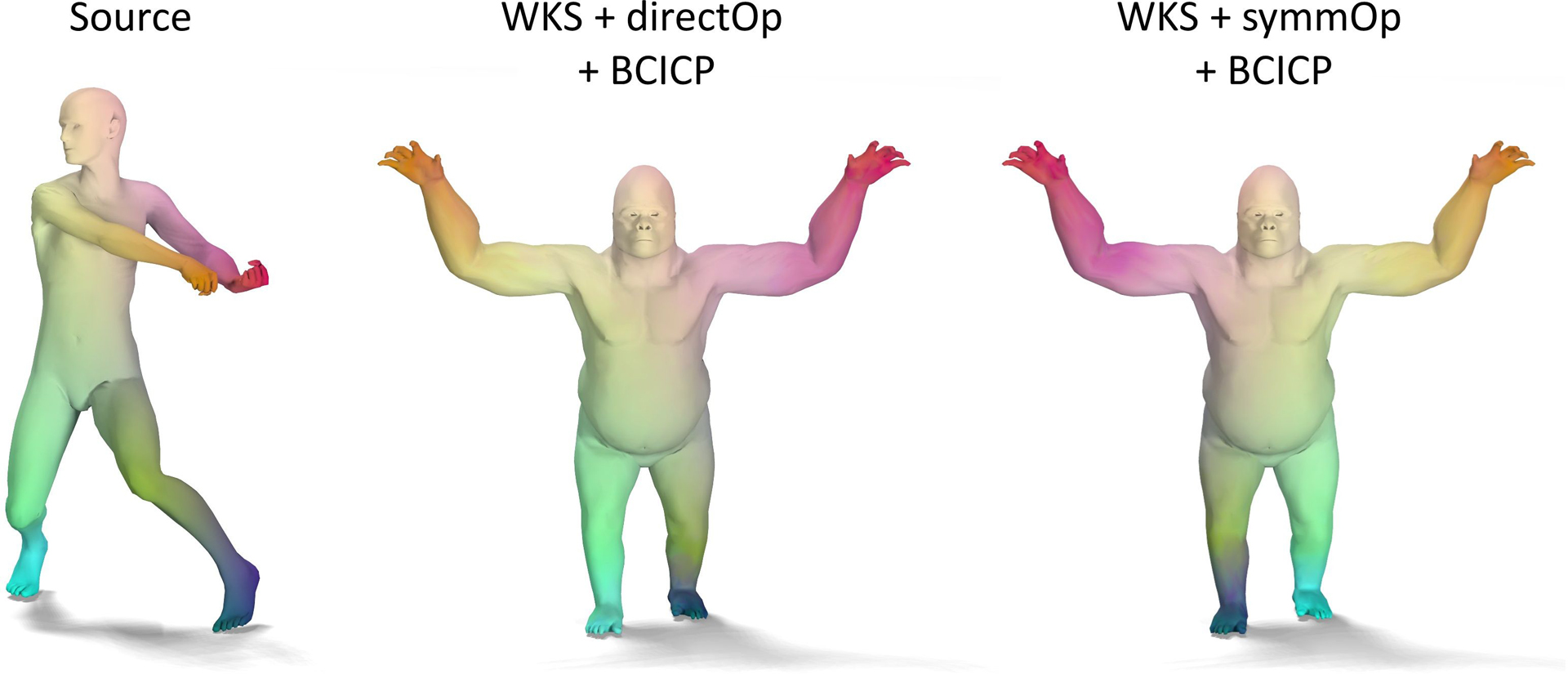
We propose a method for efficiently computing orientation-preserving and approximately continuous correspondences between non-rigid shapes, using the functional maps framework. We first show how orientation preservation can be formulated directly in the functional (spectral) domain without using landmark or region correspondences and without relying on external symmetry information. This allows us to obtain functional maps that promote orientation preservation, even when using descriptors, that are invariant to orientation changes. We then show how higher quality, approximately continuous and bijective pointwise correspondences can be obtained from initial functional maps by introducing a novel refinement technique that aims to simultaneously improve the maps both in the spectral and spatial domains. This leads to a general pipeline for computing correspondences between shapes that results in high-quality maps, while admitting an efficient optimization scheme. We show through extensive evaluation that our approach improves upon state-of-the-art results on challenging isometric and non-isometric correspondence benchmarks according to both measures of continuity and coverage as well as producing semantically meaningful correspondences as measured by the distance to ground truth maps.
References:
1. Yonathan Aflalo and Ron Kimmel. 2013. Spectral multidimensional scaling. 110, 45 (2013), 18052–18057.Google Scholar
2. Noam Aigerman, Shahar Z. Kovalsky, and Yaron Lipman. 2017. Spherical Orbifold Tutte Embeddings. ACM Trans. Graph. 36, 4, Article 90 (2017), 13 pages. Google ScholarDigital Library
3. Noam Aigerman and Yaron Lipman. 2015. Orbifold Tutte Embeddings. ACM Trans. Graph. 34, 6, Article 190 (2015), 190:1–190:12 pages. Google ScholarDigital Library
4. Noam Aigerman and Yaron Lipman. 2016. Hyperbolic orbifold tutte embeddings. ACM Trans. Graph. 35, 6 (2016), 217–1. Google ScholarDigital Library
5. Noam Aigerman, Roi Poranne, and Yaron Lipman. 2015. Seamless Surface Mappings. ACM Transactions on Graphics (TOG) 34, 4 (2015), 72. Google ScholarDigital Library
6. Mathieu Aubry, Ulrich Schlickewei, and Daniel Cremers. 2011a. The Wave Kernel Signature: A Quantum Mechanical Approach to Shape Analysis. In Proc. ICCV Workshops. IEEE, 1626–1633.Google ScholarCross Ref
7. Mathieu Aubry, Ulrich Schlickewei, and Daniel Cremers. 2011b. The wave kernel signature: A quantum mechanical approach to shape analysis. In ICCV Workshops. IEEE, 1626–1633.Google ScholarCross Ref
8. Paul J Besl and Neil D McKay. 1992. A Method for Registration of 3-D Shapes. IEEE Transactions on Pattern Analysis and Machine Intelligence 14, 2 (1992), 239–256. Google ScholarDigital Library
9. Silvia Biasotti, Andrea Cerri, A Bronstein, and M Bronstein. 2016. Recent trends, applications, and perspectives in 3D shape similarity assessment. In Computer Graphics Forum, Vol. 35. 87–119. Google ScholarDigital Library
10. Federica Bogo, Javier Romero, Matthew Loper, and Michael J Black. 2014. FAUST: Dataset and Evaluation for 3D Mesh Registration. In Proc. CVPR. 3794–3801. Google ScholarDigital Library
11. Davide Boscaini, Jonathan Masci, Emanuele Rodolà, and Michael Bronstein. 2016. Learning shape correspondence with anisotropic convolutional neural networks. In Advances in Neural Information Processing Systems. 3189–3197. Google ScholarDigital Library
12. Alexander M Bronstein, Michael M Bronstein, and Ron Kimmel. 2006. Generalized multidimensional scaling: a framework for isometry-invariant partial surface matching. PNAS 103, 5 (2006), 1168–1172.Google ScholarCross Ref
13. Alexander M Bronstein, Michael M Bronstein, and Ron Kimmel. 2008. Numerical Geometry of Non-Rigid Shapes. Springer Science & Business Media. Google Scholar
14. Eranda Çela. 2013. The quadratic assignment problem: theory and algorithms. Vol. 1. Springer Science & Business Media.Google Scholar
15. Etienne Corman, Maks Ovsjanikov, and Antonin Chambolle. 2015. Continuous matching via vector field flow. In Computer Graphics Forum, Vol. 34. Wiley Online Library, 129–139.Google Scholar
16. Marco Cuturi. 2013. Sinkhorn distances: Lightspeed computation of optimal transport. In Advances in neural information processing systems. 2292–2300. Google ScholarDigital Library
17. Nadav Dym, Haggai Maron, and Yaron Lipman. 2017. DS++: A Flexible, Scalable and Provably Tight Relaxation for Matching Problems. ACM Trans. Graph. 36, 6, Article 184 (Nov. 2017), 184:1–184:14 pages. Google ScholarDigital Library
18. Danielle Ezuz and Mirela Ben-Chen. 2017. Deblurring and Denoising of Maps between Shapes. In Computer Graphics Forum, Vol. 36. Wiley Online Library, 165–174. Google ScholarDigital Library
19. Daniela Giorgi, Silvia Biasotti, and Laura Paraboschi. 2007. SHape REtrieval Contest 2007: Watertight Models Track. (2007).Google Scholar
20. Victor Guillemin and Alan Pollack. 2010. Differential topology. Vol. 370. American Mathematical Soc.Google Scholar
21. Qixing Huang, Fan Wang, and Leonidas Guibas. 2014. Functional map networks for analyzing and exploring large shape collections. ACM Transactions on Graphics (TOG) 33, 4 (2014), 36. Google ScholarDigital Library
22. Qi-Xing Huang, Bart Adams, Martin Wicke, and Leonidas J Guibas. 2008. Non-rigid registration under isometric deformations. In Computer Graphics Forum, Vol. 27. Wiley Online Library, 1449–1457. Google ScholarDigital Library
23. Ruqi Huang and Maks Ovsjanikov. 2017. Adjoint Map Representation for Shape Analysis and Matching. In Computer Graphics Forum, Vol. 36. Wiley Online Library, 151–163. Google ScholarDigital Library
24. Itay Kezurer, Shahar Z Kovalsky, Ronen Basri, and Yaron Lipman. 2015. Tight relaxation of quadratic matching. In Computer Graphics Forum, Vol. 34. Wiley Online Library, 115–128.Google Scholar
25. Vladimir G Kim, Yaron Lipman, and Thomas Funkhouser. 2011. Blended Intrinsic Maps. In ACM Transactions on Graphics (TOG), Vol. 30. ACM, 79. Google ScholarDigital Library
26. Yanir Kleiman and Maks Ovsjanikov. 2017. Robust Structure-based Shape Correspondence. arXiv preprint arXiv:1710.05592 (2017).Google Scholar
27. Artiom Kovnatsky, Michael M Bronstein, Alexander M Bronstein, Klaus Glashoff, and Ron Kimmel. 2013. Coupled quasi-harmonic bases. In Computer Graphics Forum, Vol. 32. 439–448.Google ScholarCross Ref
28. Artiom Kovnatsky, Klaus Glashoff, and Michael M Bronstein. 2016. MADMM: a generic algorithm for non-smooth optimization on manifolds. In Proc. ECCV. Springer, 680–696.Google Scholar
29. Yaron Lipman and Thomas Funkhouser. 2009. Möbius Voting for Surface Correspondence. In ACM Transactions on Graphics (TOG), Vol. 28. ACM, 72. Google ScholarDigital Library
30. Or Litany, Tal Remez, Emanuele Rodolà, Alex M Bronstein, and Michael M Bronstein. 2017. Deep Functional Maps: Structured Prediction for Dense Shape Correspondence. In Proc. ICCV.Google ScholarCross Ref
31. Manish Mandad, David Cohen-Steiner, Leif Kobbelt, Pierre Alliez, and Mathieu Desbrun. 2017. Variance-Minimizing Transport Plans for Inter-surface Mapping. ACM Transactions on Graphics 36 (2017), 14. Google ScholarDigital Library
32. Haggai Maron, Nadav Dym, Itay Kezurer, Shahar Kovalsky, and Yaron Lipman. 2016. Point registration via efficient convex relaxation. ACM Transactions on Graphics (TOG) 35, 4 (2016), 73. Google ScholarDigital Library
33. Facundo Mémoli and Guillermo Sapiro. 2005. A theoretical and computational framework for isometry invariant recognition of point cloud data. Foundations of Computational Mathematics 5, 3 (2005), 313–347.Google ScholarDigital Library
34. Dorian Nogneng and Maks Ovsjanikov. 2017. Informative Descriptor Preservation via Commutativity for Shape Matching. Computer Graphics Forum 36, 2 (2017), 259–267. Google ScholarDigital Library
35. Maks Ovsjanikov, Mirela Ben-Chen, Justin Solomon, Adrian Butscher, and Leonidas Guibas. 2012. Functional Maps: A Flexible Representation of Maps Between Shapes. ACM Transactions on Graphics (TOG) 31, 4 (2012), 30. Google ScholarDigital Library
36. Maks Ovsjanikov, Etienne Corman, Michael Bronstein, Emanuele Rodolà, Mirela Ben-Chen, Leonidas Guibas, Frederic Chazal, and Alex Bronstein. 2017. Computing and Processing Correspondences with Functional Maps. In ACM SIGGRAPH 2017 Courses. Article 5, 5:1–5:62 pages. Google ScholarDigital Library
37. Maks Ovsjanikov, Quentin Mérigot, Facundo Mémoli, and Leonidas Guibas. 2010. One point isometric matching with the heat kernel. In Computer Graphics Forum, Vol. 29. 1555–1564.Google ScholarCross Ref
38. Maks Ovsjanikov, Quentin Mérigot, Viorica Pătrăucean, and Leonidas Guibas. 2013. Shape matching via quotient spaces. In Computer Graphics Forum, Vol. 32. 1–11. Google ScholarDigital Library
39. Chavdar Papazov and Darius Burschka. 2011. Deformable 3D shape registration based on local similarity transforms. In Computer Graphics Forum, Vol. 30. Wiley Online Library, 1493–1502.Google Scholar
40. Emanuele Rodolà, Luca Cosmo, Michael M Bronstein, Andrea Torsello, and Daniel Cremers. 2017. Partial functional correspondence. In Computer Graphics Forum, Vol. 36. 222–236. Google ScholarDigital Library
41. Emanuele Rodolà, Michael Möller, and Daniel Cremers. 2015. Point-wise Map Recovery and Refinement from Functional Correspondence. In Proc. Vision, Modeling and Visualization (VMV).Google Scholar
42. Raif M Rustamov, Maks Ovsjanikov, Omri Azencot, Mirela Ben-Chen, Frédéric Chazal, and Leonidas Guibas. 2013. Map-based exploration of intrinsic shape differences and variability. ACM Transactions on Graphics (TOG) 32, 4 (2013), 72. Google ScholarDigital Library
43. Yusuf Sahillioğlu and Yücel Yemez. 2013. Coarse-to-Fine Isometric Shape Correspondence by Tracking Symmetric Flips. In Computer Graphics Forum, Vol. 32. Wiley Online Library, 177–189.Google Scholar
44. Yusuf Sahillioğlu and Yiicel Yemez. 2010. 3d shape correspondence by isometry-driven greedy optimization. In Computer Vision and Pattern Recognition (CVPR), 2010 IEEE Conference on. IEEE, 453–458.Google ScholarCross Ref
45. Justin Solomon, Fernando De Goes, Gabriel Peyré, Marco Cuturi, Adrian Butscher, Andy Nguyen, Tao Du, and Leonidas Guibas. 2015. Convolutional Wasserstein distances: Efficient optimal transportation on geometric domains. ACM Transactions on Graphics (TOG) 34, 4 (2015), 66. Google ScholarDigital Library
46. Justin Solomon, Andy Nguyen, Adrian Butscher, Mirela Ben-Chen, and Leonidas Guibas. 2012. Soft maps between surfaces. In Computer Graphics Forum, Vol. 31. Wiley Online Library, 1617–1626. Google ScholarDigital Library
47. Justin Solomon, Gabriel Peyré, Vladimir G Kim, and Suvrit Sra. 2016. Entropic metric alignment for correspondence problems. ACM Transactions on Graphics (TOG) 35, 4 (2016), 72. Google ScholarDigital Library
48. Robert W Sumner and Jovan Popović. 2004. Deformation Transfer for Triangle Meshes. ACM TOG 23, 3 (2004), 399–405. Google ScholarDigital Library
49. Gary KL Tam, Zhi-Quan Cheng, Yu-Kun Lai, Frank C Langbein, Yonghuai Liu, David Marshall, Ralph R Martin, Xian-Fang Sun, and Paul L Rosin. 2013. Registration of 3D point clouds and meshes: a survey from rigid to nonrigid. IEEE TVCG 19, 7 (2013), 1199–1217. Google ScholarDigital Library
50. Art Tevs, Martin Bokeloh, Michael Wand, Andreas Schilling, and Hans-Peter Seidel. 2009. Isometric Registration of Ambiguous and Partial Data. In Computer Vision and Pattern Recognition, 2009. CVPR 2009. IEEE Conference on. IEEE, 1185–1192.Google ScholarCross Ref
51. Oliver Van Kaick, Hao Zhang, Ghassan Hamarneh, and Daniel Cohen-Or. 2011. A survey on shape correspondence. In Computer Graphics Forum, Vol. 30. 1681–1707.Google ScholarCross Ref
52. Matthias Vestner, Zorah Lähner, Amit Boyarski, Or Litany, Ron Slossberg, Tal Remez, Emanuele Rodola, Alex Bronstein, Michael Bronstein, Ron Kimmel, and Daniel Cremers. 2017a. Efficient Deformable Shape Correspondence via Kernel Matching. In Proc. 3DV.Google ScholarCross Ref
53. M. Vestner, R. Litman, E. Rodolà, A. Bronstein, and D. Cremers. 2017b. Product Manifold Filter: Non-rigid Shape Correspondence via Kernel Density Estimation in the Product Space. In Proc. CVPR. 6681–6690.Google Scholar
54. Dong-Ming Yan, Guanbo Bao, Xiaopeng Zhang, and Peter Wonka. 2014. Low-resolution remeshing using the localized restricted Voronoi diagram. IEEE transactions on visualization and computer graphics 20, 10 (2014), 1418–1427.Google ScholarCross Ref



