“Building a Scalable UGC Auto-Rigging Pipeline with OpenUSD” by Wu and Munisso
Conference:
Type(s):
Title:
- Building a Scalable UGC Auto-Rigging Pipeline with OpenUSD
Session/Category Title:
- Enlightening and Moving Workflows
Presenter(s)/Author(s):
Moderator(s):
Abstract:
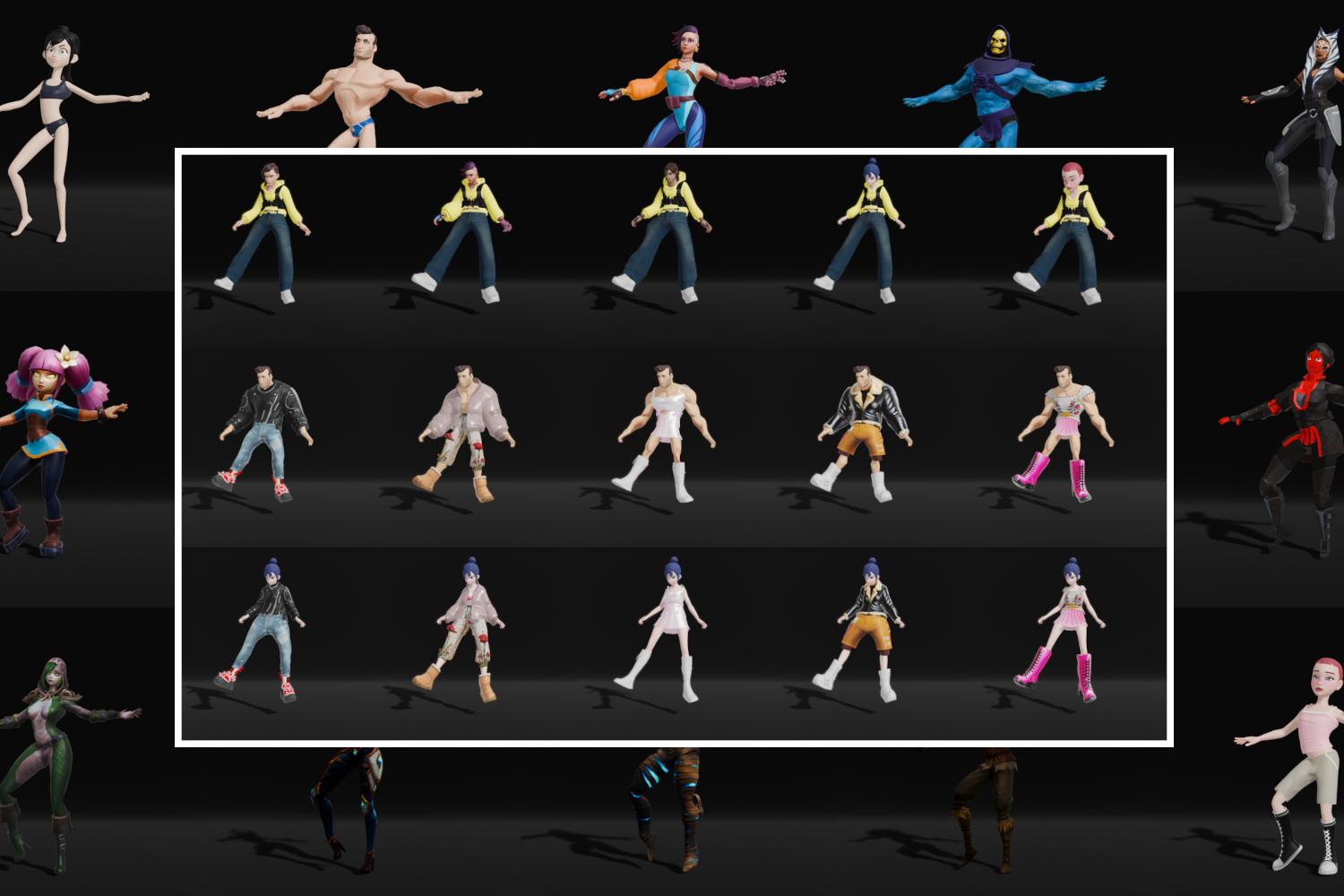
User-generated content (UGC) is at the core of digital avatar ecosystems, enabling limitless customization. However, integrating diverse UGC assets—such as humanoid avatars, wearables, and emotes—requires an efficient and scalable pipeline to process and conform them into an interoperable 3D representation. A critical component of this pipeline is auto-rigging, which must be robust enough to handle assets from potentially millions of users. This talk introduces a novel UGC auto-rigging pipeline built on OpenUSD. By leveraging OpenUSD’s vectorized data representation with NumPy, we create an efficient, lightweight procedural pipeline that minimizes data conversion overhead. We further enhance our approach with custom schemas that define standardized representations for avatars and wearables, ensuring broad applicability, seamless customization, and asset interoperability. Additionally, we develop a task graph system built upon the USD layer stack, facilitating debugging, iterative improvements, and seamless reintegration into the pipeline. Our results demonstrate a significant reduction in end-to-end processing time, enabling scalability across thousands of assets. We also showcase interactive avatar configuration and visualization using OpenUSD, entirely independent of game engine dependencies. Finally, we discuss challenges related to visualization tools and digital content creation (DCC) adoption, as well as future work aimed at expanding OpenUSD’s role in our real-time avatar ecosystem.
References:
[1] A. de Boer, M.S. van der Schoot, and H. Bijl. 2007. Mesh deformation based on radial basis function interpolation. Computers & Structures 85, 11 (2007), 784–795. Fourth MIT Conference on Computational Fluid and Solid Mechanics.
[2] Miles Macklin. 2024. Warp: Differentiable Spatial Computing for Python. In ACM SIGGRAPH 2024 Courses (Denver, CO, USA) (SIGGRAPH Courses ’24). Association for Computing Machinery, New York, NY, USA, Article 24, 147 pages.
[3] Weiqi Shi, Maurice Chu, Dario Kneubuhler, Ervin Teng, Adam Burr, Tallon Hodge, Ian Sachs, and Andrew Kunz. 2024. End-to-end Automatic Body and Face Setup for Generative or User Created 3D Avatar. In ACM SIGGRAPH 2024 Talks (Denver, CO, USA) (SIGGRAPH ’24). Association for Computing Machinery, New York, NY, USA, Article 13, 2 pages.