“Anatomy transfer” by Dicko, Liu, Gilles, Kavan, Faure, et al. …
Conference:
Type(s):
Title:
- Anatomy transfer
Session/Category Title:
- Avatars
Presenter(s)/Author(s):
Abstract:
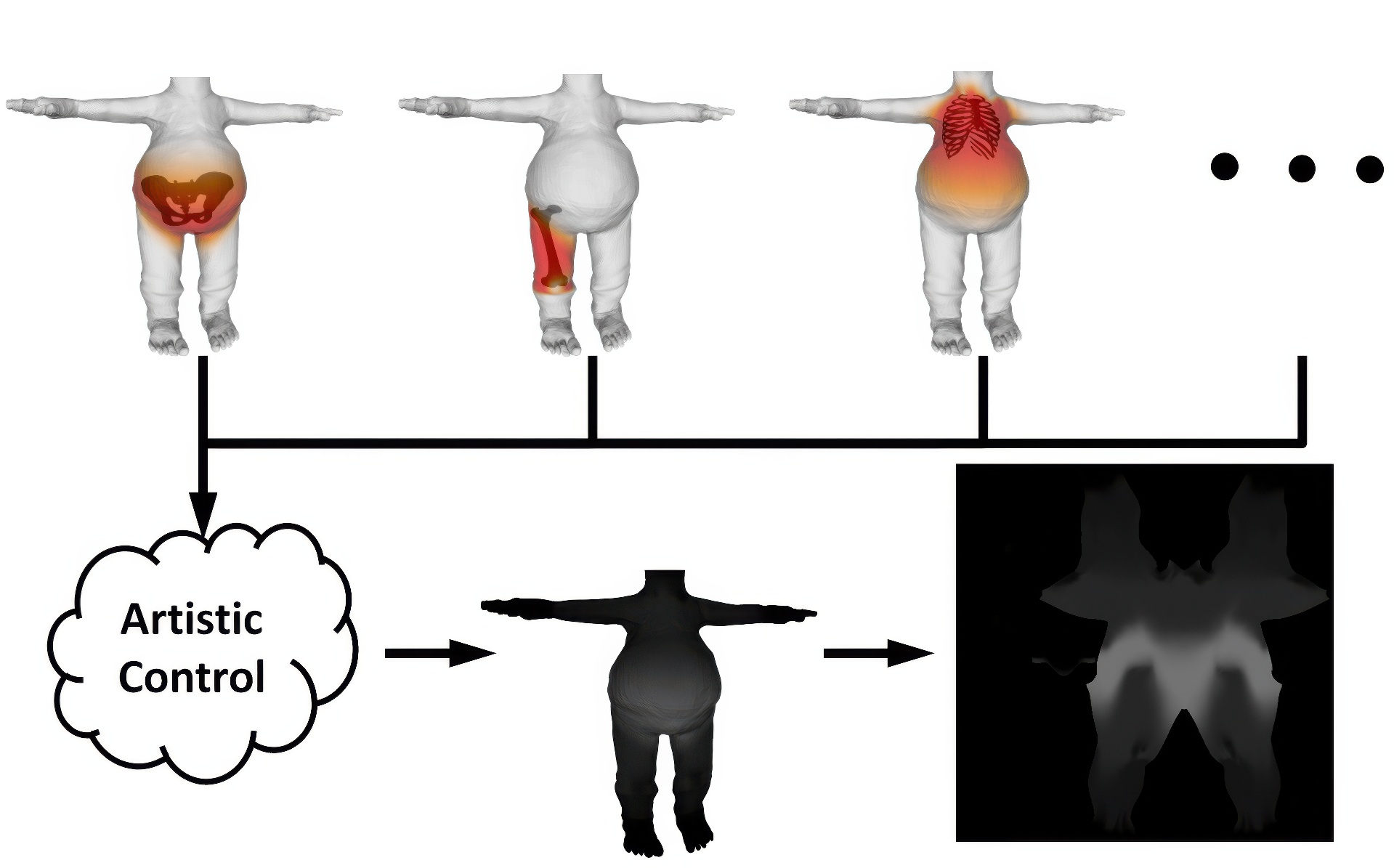
Characters with precise internal anatomy are important in film and visual effects, as well as in medical applications. We propose the first semi-automatic method for creating anatomical structures, such as bones, muscles, viscera and fat tissues. This is done by transferring a reference anatomical model from an input template to an arbitrary target character, only defined by its boundary representation (skin). The fat distribution of the target character needs to be specified. We can either infer this information from MRI data, or allow the users to express their creative intent through a new editing tool. The rest of our method runs automatically: it first transfers the bones to the target character, while maintaining their structure as much as possible. The bone layer, along with the target skin eroded using the fat thickness information, are then used to define a volume where we map the internal anatomy of the source model using harmonic (Laplacian) deformation. This way, we are able to quickly generate anatomical models for a large range of target characters, while maintaining anatomical constraints.
References:
1. Aubel, A., and Thalmann, D. 2001. Interactive modeling of the human musculature. In In Proceedings of Computer Animation, 7–8.
2. Baraff, D., and Witkin, A. 1998. Large steps in cloth simulation. In Proceedings of the 25th annual conference on Computer graphics and interactive techniques, ACM, New York, NY, USA, SIGGRAPH ’98, 43–54.
3. Baran, I., and Popović, J. 2007. Automatic rigging and animation of 3d characters. ACM Trans. Graph. 26, 3 (July).
4. Besl, P., and McKay, N. 1992. A method for registration of 3-d shapes. IEEE Trans. PAMI 14, 2, 239–256.
5. Binvox, 2013. http://www.cs.princeton.edu/~min/binvox/.
6. Blemker, S., Asakawa, D., Gold, G., and Delp, S. 2007. Image-based musculoskeletal modeling: Applications, advances, and future opportunities. Journal of Magnetic Resonance Imaging 25, 2, 441–451.
7. Bronstein, A., Bronstein, M., and Kimmel, R. 2008. Numerical Geometry of Non-Rigid Shapes, 1 ed. Springer Publishing Company, Incorporated.
8. Faloutsos, P., van de Panne, M., and Terzopoulos, D. 2001. Composable controllers for physics-based character animation. In Proceedings of the 28th annual conference on Computer graphics and interactive techniques, ACM, New York, NY, USA, SIGGRAPH ’01, 251–260.
9. Gilles, B., Reveret, L., and Pai, D. 2010. Creating and animating subject-specific anatomical models. Computer Graphics Forum (June), http://onlinelibrary.wiley.com/doi/10.1111/j.1467-8659.2010.01718.x/abstract.
10. Gray, H., and Lewis, W. H. 1918. Anatomy of the human body. Philadelphia: Lea and Febiger,. http://www.biodiversitylibrary.org/bibliography/20311.
11. Guennebaud, G., Jacob, B., et al., 2010. Eigen v3. http://eigen.tuxfamily.org.
12. Huang, Q.-X., Adams, B., Wicke, M., and Guibas, L. J. 2008. Non-rigid registration under isometric deformations. In Proceedings of the Symposium on Geometry Processing, 1449–1457.
13. Jacobson, A., Baran, I., Popović, J., and Sorkine, O. 2011. Bounded biharmonic weights for real-time deformation. In ACM SIGGRAPH 2011 papers, ACM, New York, NY, USA, SIGGRAPH ’11, 78:1–78:8.
14. Kaick, O. V., Zhang, H., Hamarneh, G., and Cohen-or, D. 2011. A survey on shape correspondence. Computer Graphics Forum 30, 6, 1681–1707.
15. Kavan, L., Collins, S., Zara, J., and O’Sullivan, C. 2008. Geometric skinning with approximate dual quaternion blending. ACM Trans. Graph. 27, 4, 105.
16. Kry, P. G., and Pai, D. K. 2006. Interaction capture and synthesis. ACM Trans. Graph. 25, 3, 872–880.
17. Lee, S.-H., and Terzopoulos, D. 2006. Heads up!: biomechanical modeling and neuromuscular control of the neck. In ACM SIGGRAPH 2006 Papers, ACM, New York, NY, USA, SIGGRAPH ’06, 1188–1198.
18. Lee, S., Sifakis, E., and Terzopoulos, D. 2009. Comprehensive biomechanical modeling and simulation of the upper body. ACM Trans. Graph. 28 (September), 99:1–99:17.
19. Li, H., Sumner, R. W., and Pauly, M. 2008. Global correspondence optimization for non-rigid registration of depth scans. In Proceedings of the Symposium on Geometry Processing, SGP ’08, 1421–1430.
20. Lipman, Y., and Funkhouser, T. 2009. Möbius voting for surface correspondence. ACM Trans. Graph., Proc. SIGGRAPH 28, 3.
21. M. Gilroy, Brian R. MacPherson, L. M. R. 2008. Atlas of anatomy. Thieme.
22. Mateus, D., Horaud, R., Knossow, D., Cuzzolin, F., and Boyer, E. 2008. Articulated Shape Matching Using Laplacian Eigenfunctions and Unsupervised Point Registration. In IEEE Conference on Computer Vision and Pattern Recognition (CVPR ’08), IEEE Computer Society, 1–8.
23. Maya-Muscle, 2013. http://images.autodesk.com/adsk/files/muscle.pdf.
24. Moore, K. L., and Dalley, A. F. 1999. Anatomy Clinically Oriented, fourth ed. Lippincott Williams & Wilkins.
25. Müller, M., Heidelberger, B., Teschner, M., and Gross, M. 2005. Meshless deformations based on shape matching. ACM Trans. Graph. (Proc. of SIGGRAPH), 471–478.
26. Ovsjanikov, M., Ben-Chen, M., Solomon, J., Butscher, A., and Guibas, L. 2012. Functional maps: a flexible representation of maps between shapes. ACM Trans. Graph. 31, 4, 30:1–30:11.
27. Patterson, T., Mitchell, N., and Sifakis, E. 2012. Simulation of complex nonlinear elastic bodies using lattice deformers. ACM Trans. Graph. 31, 6 (Nov.), 197:1–197:10.
28. Pollard, N. S., and Zordan, V. B. 2005. Physically based grasping control from example. In Proceedings of the 2005 ACM SIGGRAPH/Eurographics symposium on Computer animation, ACM, New York, NY, USA, SCA ’05, 311–318.
29. Press, Teukolski, Vetterling, and Flannery. 2002. Numerical Recipes in C++. Cambridge University Press.
30. Scheepers, F., Parent, R. E., Carlson, W. E., and May, S. F. 1997. Anatomy-based modeling of the human musculature. In Proceedings of the 24th annual conference on Computer graphics and interactive techniques, ACM Press/Addison-Wesley Publishing Co., New York, NY, USA, SIGGRAPH ’97, 163–172.
31. Sifakis, E., Neverov, I., and Fedkiw, R. 2005. Automatic determination of facial muscle activations from sparse motion capture marker data. ACM Trans. Graph. 24, 3.
32. Sueda, S., Kaufman, A., and Pai, D. 2008. Musculotendon simulation for hand animation. ACM Transactions on Graphics 27, 3, 83:1–83:8.
33. Sumner, R. W., and Popović, J. 2004. Deformation transfer for triangle meshes. ACM Trans. Graph. 23, 3, 399–405.
34. Thelen, D. 2003. Adjustment of muscle mechanics model parameters to simulate dynamic contractions in older adults. ASME 125, 1, 70–77.
35. Wang, J. M., Hamner, S. R., Delp, S. L., and Koltun, V. 2012. Optimizing locomotion controllers using biologically-based actuators and objectives. ACM Trans. Graph. 31, 4 (July), 25:1–25:11.
36. Waters, K. 1987. A muscle model for animation three-dimensional facial expression. SIGGRAPH Comput. Graph. 21, 4 (Aug.), 17–24.
37. Wei, Q., Sueda, S., and Pai, D. K. 2010. Biomechanical simulation of human eye movement. In Proceedings of the 5th international conference on Biomedical Simulation, Springer-Verlag, Berlin, Heidelberg, ISBMS’10, 108–118.
38. Wilhelms, J., and Van Gelder, A. 1997. Anatomically based modeling. In Proceedings of the 24th annual conference on Computer graphics and interactive techniques, ACM Press/Addison-Wesley Publishing Co., New York, NY, USA, SIGGRAPH ’97, 173–180.
39. Zhu, Y., Sifakis, E., Teran, J., and Brandt, A. 2010. An efficient multigrid method for the simulation of high-resolution elastic solids. ACM Transcations on Graphics (Presented at SIGGRAPH 2010) 29, 2, 16:1–16:18.
40. Zordan, V. B., Majkowska, A., Chiu, B., and Fast, M. 2005. Dynamic response for motion capture animation. ACM Trans. Graph. 24, 3 (July), 697–701.