““Bodyreath”: An Interactive VR Installation to Experience and Understand People with Autism” by Zhang and Yan
Conference:
Experience Type(s):
Title:
- “Bodyreath”: An Interactive VR Installation to Experience and Understand People with Autism
Presenter(s):
Description:
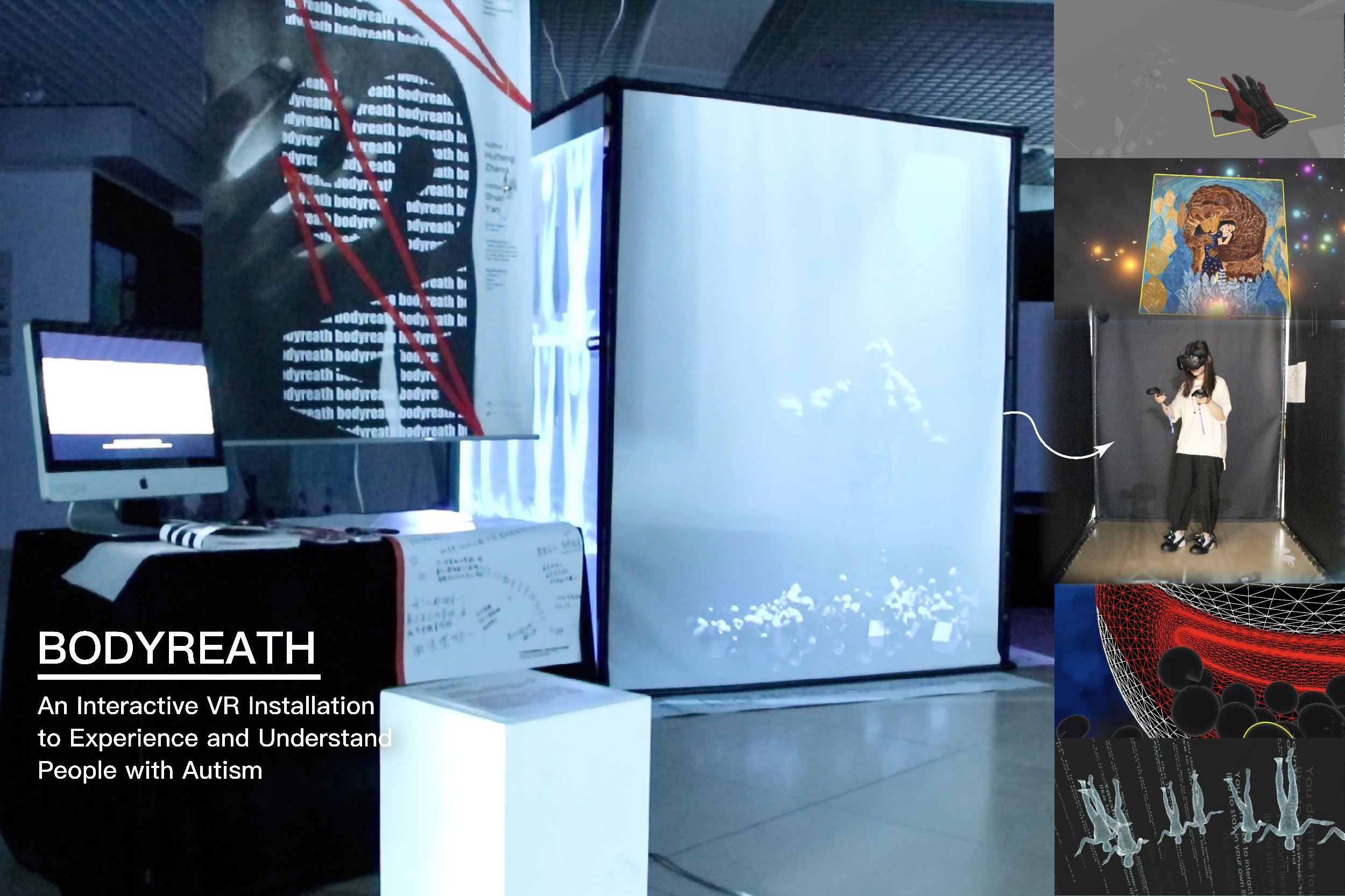
“Bodyreath” is an interactive virtual reality (VR) installation for understanding people with autism, which is divided into two parts, “external” and “internal”. The “external” is the external projection, which is the artistic effect of four virtual avatars based on the characters and behaviors of autistic people. The “internal” is the interactive VR scenarios, allowing the audience to gain insight into the characteristics of the autistic people represented in each feature: “Stereotyped Behavior”, “Children from the Stars”, “Emotional Instability”, and “Invisibility”. Our VR installation provides an interactive narrative through body interaction and role perception, allowing the audience to transform their identity into an autistic person and perceive it from their perspective. It helps the audience to appreciate the innocence of autistic people in a different way and to understand them artistically.
References:
[1] Mar Gonzalez-Franco, Parastoo Abtahi and Anthony Steed. 2019. Individual Differences in Embodied Distance Estimation in Virtual Reality. IEEE Conference on Virtual Reality and 3D User Interfaces (VR), pp. 941-943.
[2] Ali Adjorlu and Stefania Serafin. 2019. Teachers’ Views on how to use Virtual Reality to Instruct Children and Adolescents Diagnosed with Autism Spectrum Disorder. IEEE Conference on Virtual Reality and 3D User Interfaces (VR), pp. 1439-1442.
[3] Stephan Jürgens, Carla Fernandes and Rafael Kuffner. 2020. Experiencing Choreographed 4D Visuals in a VR Dance Installation. Performance Research, 25:4, 94-97,
[4] Rosemary E. Cisneros, Kathryn Stamp, Sarah Whatley and Karen Wood. 2019. WhoLoDancE: digital tools and the dance learning environment. Research in Dance Education, 20:1, 54-72.