“X-Wing: Propeller-Based Force Feedback to Head in a Virtual Environment” by Watanabe, Nakamura, Sakurada, Teo and Sugimoto
Conference:
Experience Type(s):
Title:
- X-Wing: Propeller-Based Force Feedback to Head in a Virtual Environment
Presenter(s):
Description:
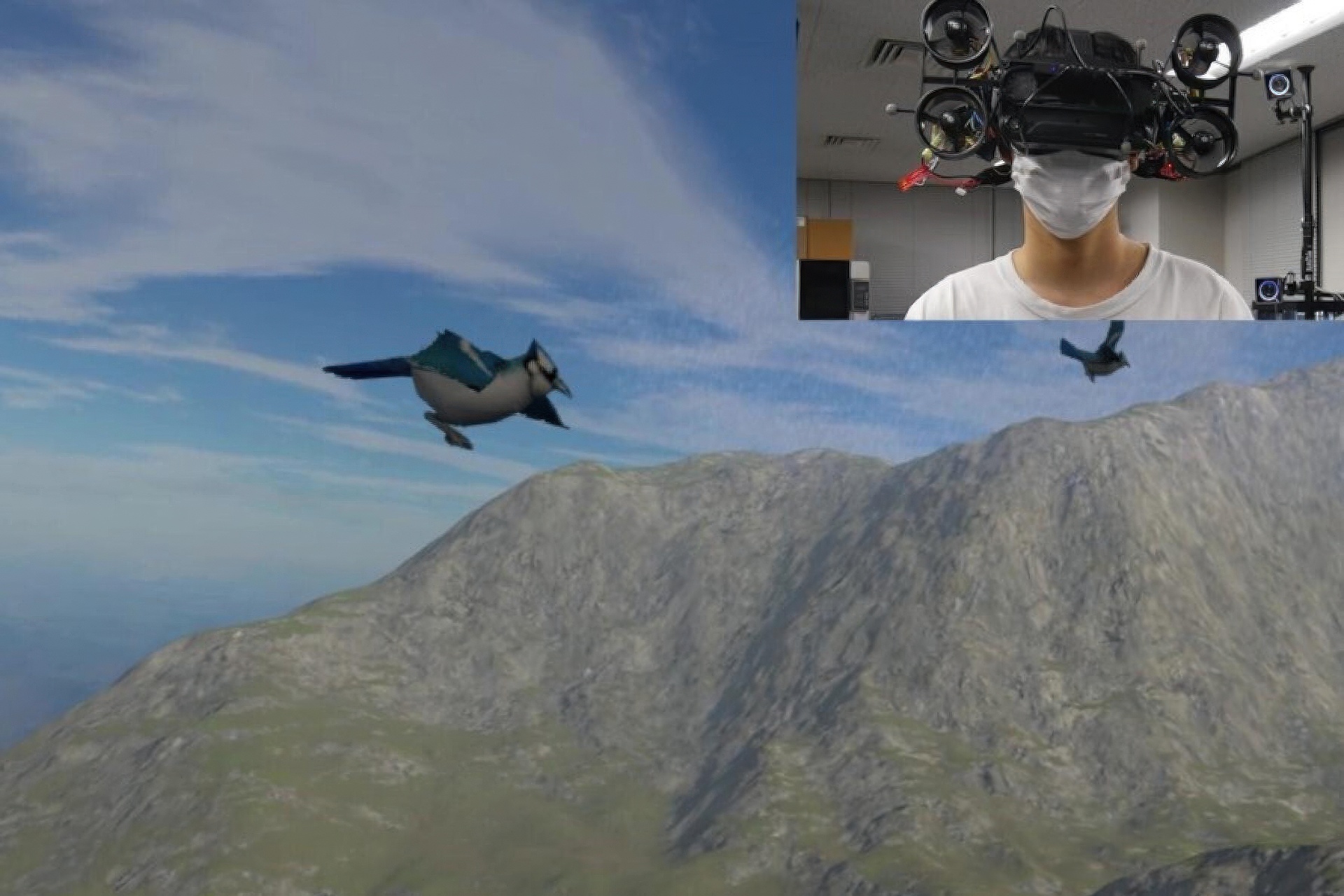
In this demonstration, we present X-Wing, a force feedback device using ducted fans attached to VR Head Mounted Display (HMD). Applying haptic technologies to Virtual Reality (VR) has become a standard solution to enhance the immersive experience. It is also essential for interactions in virtual environments where feedback is critical for user experience and performance. This research focuses on a head-based, wearable device that provides force to the VR user using exertion force by electric thrusters with controllable strengths and directions. Our system allows the user to experience virtual force based on their virtual momentum and velocity. It enables a VR user to receive force feedback based on different thrust power converted into translation and rotation force for a unique VR experience such as virtual aerial simulation. We present the prototype to the attendees of SIGGRAPH Asia 2021 through a live demonstration.
References:
[1] Hong-Yu Chang, Wen-Jie Tseng, Chia-En Tsai, Hsin-Yu Chen, Roshan Lalintha Peiris, and Liwei Chan. 2018. FacePush: Introducing Normal Force on Face with Head-Mounted Displays. In Proceedings of the 31st Annual ACM Symposium on User Interface Software and Technology (Berlin, Germany) (UIST ’18). Association for Computing Machinery, New York, NY, USA, 927–935. https://doi.org/10.1145/3242587.3242588
[2] Seongkook Heo, Christina Chung, Geehyuk Lee, and Daniel Wigdor. 2018. Thor’s Hammer: An Ungrounded Force Feedback Device Utilizing Propeller-Induced Propulsive Force. In Proceedings of the 2018 CHI Conference on Human Factors in Computing Systems. Association for Computing Machinery, New York, NY, USA, 1–11. https://doi.org/10.1145/3173574.3174099
[3] Shi-Hong Liu, Pai-Chien Yen, Yi-Hsuan Mao, Yu-Hsin Lin, Erick Chandra, and Mike Y. Chen. 2020. HeadBlaster: A Wearable Approach to Simulating Motion Perception Using Head-Mounted Air Propulsion Jets. ACM Trans. Graph. 39, 4, Article 84 (July 2020), 12 pages. https://doi.org/10.1145/3386569.3392482
[4] Tomoya Sasaki, Richard Sahala Hartanto, Kao-Hua Liu, Keitarou Tsuchiya, Atsushi Hiyama, and Masahiko Inami. 2018. Leviopole: Mid-Air Haptic Interactions Using Multirotor. In ACM SIGGRAPH 2018 Emerging Technologies (Vancouver, British Columbia, Canada) (SIGGRAPH ’18). Association for Computing Machinery, New York, NY, USA, Article 12, 2 pages. https://doi.org/10.1145/3214907.3214913
[5] Taku Tanichi, Futa Asada, Kento Matsuda, Danny Hynds, and Kouta Minamizawa. 2020. KABUTO: Inducing Upper-Body Movements Using a Head Mounted Haptic Display with Flywheels. In SIGGRAPH Asia 2020 Emerging Technologies (Virtual Event, Republic of Korea) (SA ’20). Association for Computing Machinery, New York, NY, USA, Article 9, 2 pages. https://doi.org/10.1145/3415255.3422880