
“Skylight: Real-Time Projection Mapping for Surgical Navigation Leveraging Skin-Adhered Fiducials” by Shelton and Omale
Conference:
Type(s):
Title:
- Skylight: Real-Time Projection Mapping for Surgical Navigation Leveraging Skin-Adhered Fiducials
Session/Category Title:
- Interactive Techniques
Presenter(s)/Author(s):
Abstract:
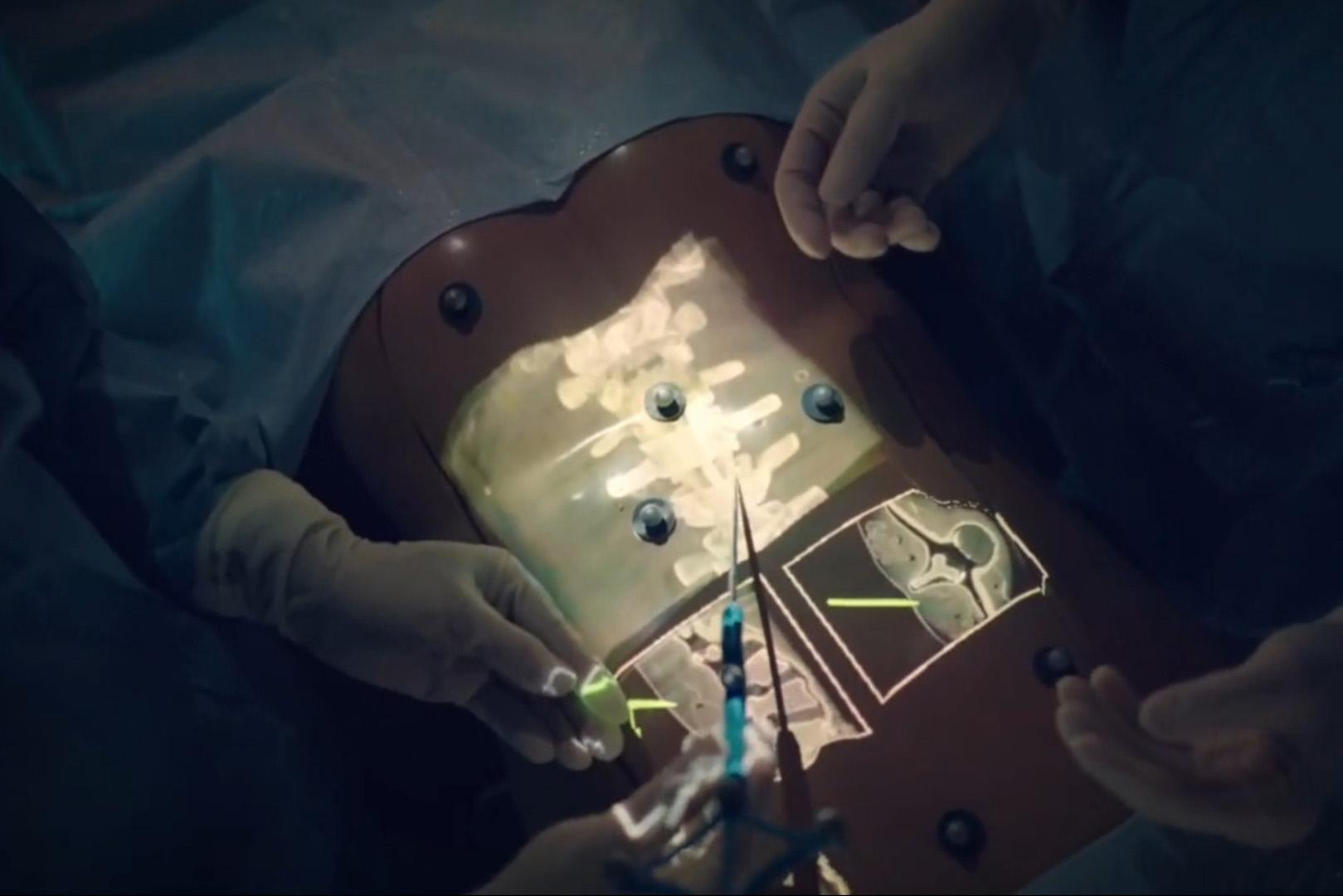
Skylight is a surgical navigation system that uses skin-mounted fiducials and real-time projection mapping to display high-accuracy, CT-registered guidance directly onto the patient’s body — eliminating the need for bone-mounted trackers and enhancing surgical precision and usability.
References:
[1] Suri, I., Ezzat, B., Suthakaran, S., Arroyave Villada, J. S., Kwon, D., Martin, L., Hu, J., Yaeger, K., and Carr, M. 2025. Systematic review of surgical success, complications, revision rates, radiation dosage, and operative time of 3D-navigated versus non-navigated spinal procedures. World Neurosurgery 194 (Feb.), Article 123550.
[2] Bovonratwet, P., Gu, A., Chen, A. Z., Samuel, A. M., Vaishnav, A. S., Sheha, E. D., Gang, C. H., and Qureshi, S. A. 2023. Computer-assisted navigation is associated with decreased rates of hardware-related revision after instrumented posterior lumbar fusion. Global Spine Journal 13, 4, 1104–1111.
[3] Bernatz, J. T., and Anderson, P. A. 2015. Thirty-day readmission rates in spine surgery: systematic review and meta-analysis. Neurosurgical Focus 39, 4, E7.
[4] Malter, A. D., McNeney, B., Loeser, J. D., and Deyo, R. A. 1998. 5-year reoperation rates after different types of lumbar spine surgery. Spine 23, 7, 814–820.
[5] Paul, J. C., Lonner, B. S., Vira, S., Kaye, I. D., and Errico, T. J. 2016. Reoperation rates after long posterior spinal fusion: Use of recombinant bone morphogenetic protein in idiopathic and non-idiopathic scoliosis. Spine Deformity 4, 4, 304–309.
[6] Miller, M. E. 2008. Report to the Congress: Reforming the delivery system. Medicare Payment Advisory Commission.
[7] Vonlanthen, R., Slankamenac, K., Breitenstein, S., Puhan, M. A., Muller, M. K., Hahnloser, D., Hauri, D., Graf, R., and Clavien, P. A. 2011. The impact of complications on costs of major surgical procedures: A cost analysis of 1200 patients. Annals of Surgery 254, 6, 907–913.
[8] Mason, A., Paulsen, R., Babuska, J. M., Rajpal, S., Burneikiene, S., Nelson, E. L., and Villavicencio, A. T. 2014. The accuracy of pedicle screw placement using intraoperative image guidance systems: A systematic review. Journal of Neurosurgery: Spine 20, 2, 196–203.
[9] Choo, A. D., Regev, G., Garfin, S. R., and Kim, C. W. 2008. Surgeons’ perceptions of spinal navigation: Analysis of key factors affecting the lack of adoption of spinal navigation technology. International Journal of Spine Surgery 2, 4, 189–194.
[10] Maithel, S. K., Villegas, L., Stylopoulos, N., Dawson, S., and Jones, D. B. 2005. Simulated laparoscopy using a head-mounted display vs traditional video monitor: An assessment of performance and muscle fatigue. Surgical Endoscopy 19, 3, 406–411.
[11] Koesveld, J., Tetteroo, G. & Graaf, E. Use of head-mounted display in transanal endoscopic microsurgery . Surg Endosc 17, 943–946 (2003).
[12] Léger, É., Drouin, S., Collins, D. L., Popa, T., and Kersten-Oertel, M. 2017. Quantifying attention shifts in augmented reality image-guided neurosurgery. Healthcare Technology Letters 4, 5, 188–192.
[13] Fitzpatrick, J. M., West, J. B., and Maurer, C. R. Jr. 1998. Predicting error in rigid-body point-based registration. IEEE Transactions on Medical Imaging 17, 5, 694–702.



