
“Designing Balancing Toys Through Mass and Shape Optimization” by Hirata, Noma, Narumi and Kawahara
Conference:
Type(s):
Title:
- Designing Balancing Toys Through Mass and Shape Optimization
Session/Category Title:
- 3D & Geometry
Presenter(s)/Author(s):
Abstract:
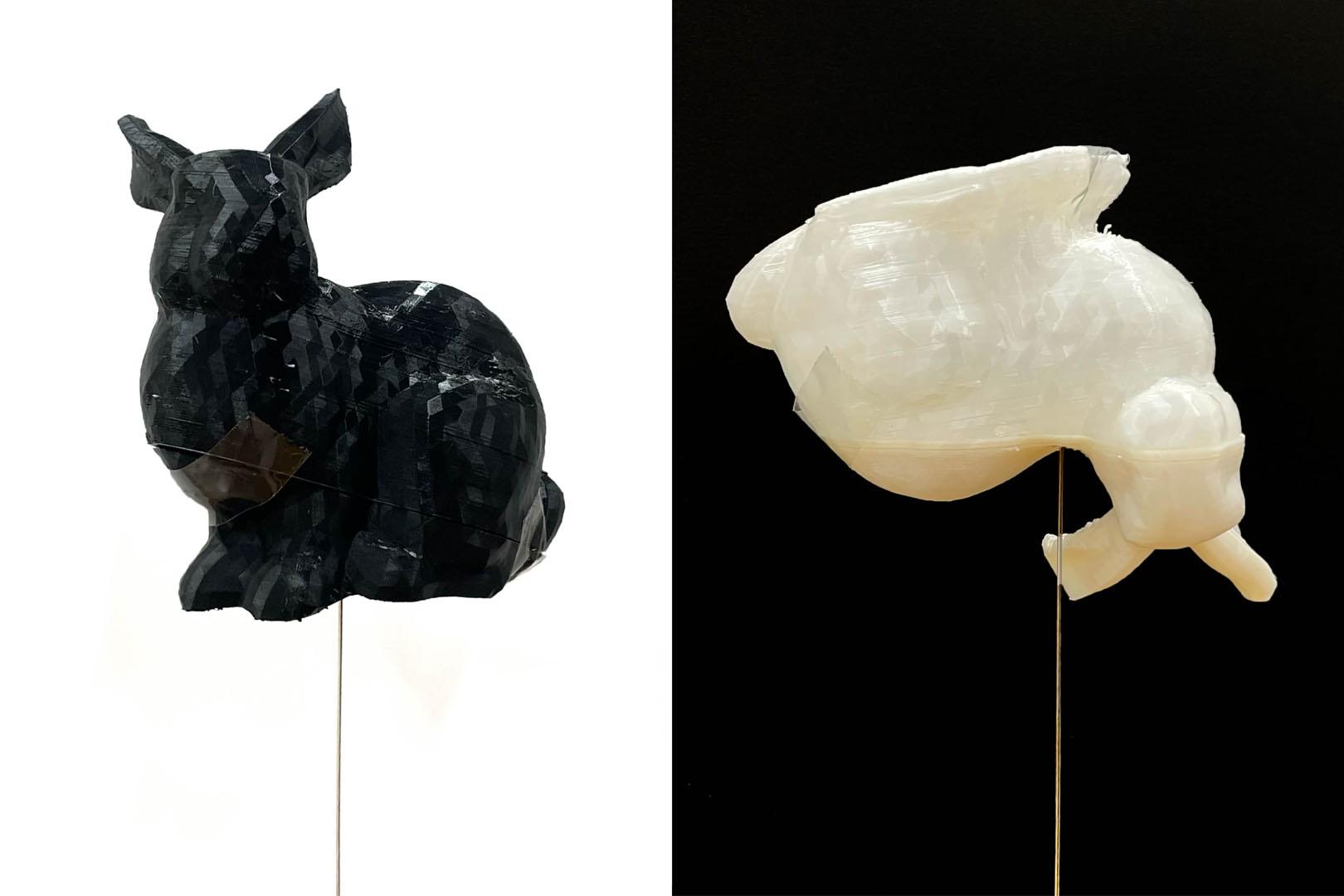
This study presents a method for designing balancing toys. Through interactive modeling techniques that optimize both shape and mass distribution, this research achieves the challenging feat of locating the center of mass outside the body. The designed balancing toys were successfully fabricated using an FDM 3D printer. INVITED TO THE FIRST ROUND OF THE STUDENT RESEARCH COMPETITION
References:
[1] Moritz Bächer, Emily Whiting, Bernd Bickel, and Olga Sorkine-Hornung. 2014. Spin-it: optimizing moment of inertia for spinnable objects. ACM Trans. Graph. 33, 4, Article 96 (Jul 2014), 10 pages.
[2] Christian Hafner, Mickaël Ly, and Chris Wojtan. 2024. Spin-It Faster: Quadrics Solve All Topology Optimization Problems That Depend Only On Mass Moments. ACM Trans. Graph. 43, 4, Article 171 (Sep 2024), 13 pages.
[3] Shunsuke Hirata, Yuta Noma, Koya Narumi, and Yoshihiro Kawahara. 2024. ARAP-Based Shape Editing to Manipulate the Center of Mass. In SIGGRAPH Asia 2024 Posters(SA ’24). Association for Computing Machinery, New York, NY, USA, Article 68, 2 pages.
[4] Minchen Li, Zachary Ferguson, Teseo Schneider, Timothy Langlois, Denis Zorin, Daniele Panozzo, Chenfanfu Jiang, and Danny M. Kaufman. 2020. Incremental potential contact: intersection-and inversion-free, large-deformation dynamics. ACM Trans. Graph. 39, 4, Article 49 (Aug. 2020), 20 pages.
[5] Romain Prévost, Emily Whiting, Sylvain Lefebvre, and Olga Sorkine-Hornung. 2013. Make it stand: balancing shapes for 3D fabrication. ACM Trans. Graph. 32, 4, Article 81 (Jul 2013), 10 pages.
[6] Lingfeng Wang and Emily Whiting. 2016. Buoyancy optimization for computational fabrication. Computer Graphics Forum 35, 2 (May 2016), 49–58.



