“Towards a sustainable use of GPUs in Graphics Research” by Yu, Michel, Crespel, Paris and Hähnlein
Conference:
Type(s):
Title:
- Towards a sustainable use of GPUs in Graphics Research
Session/Category Title:
- Sustainable Graphics in a Changing World
Presenter(s)/Author(s):
Moderator(s):
Abstract:
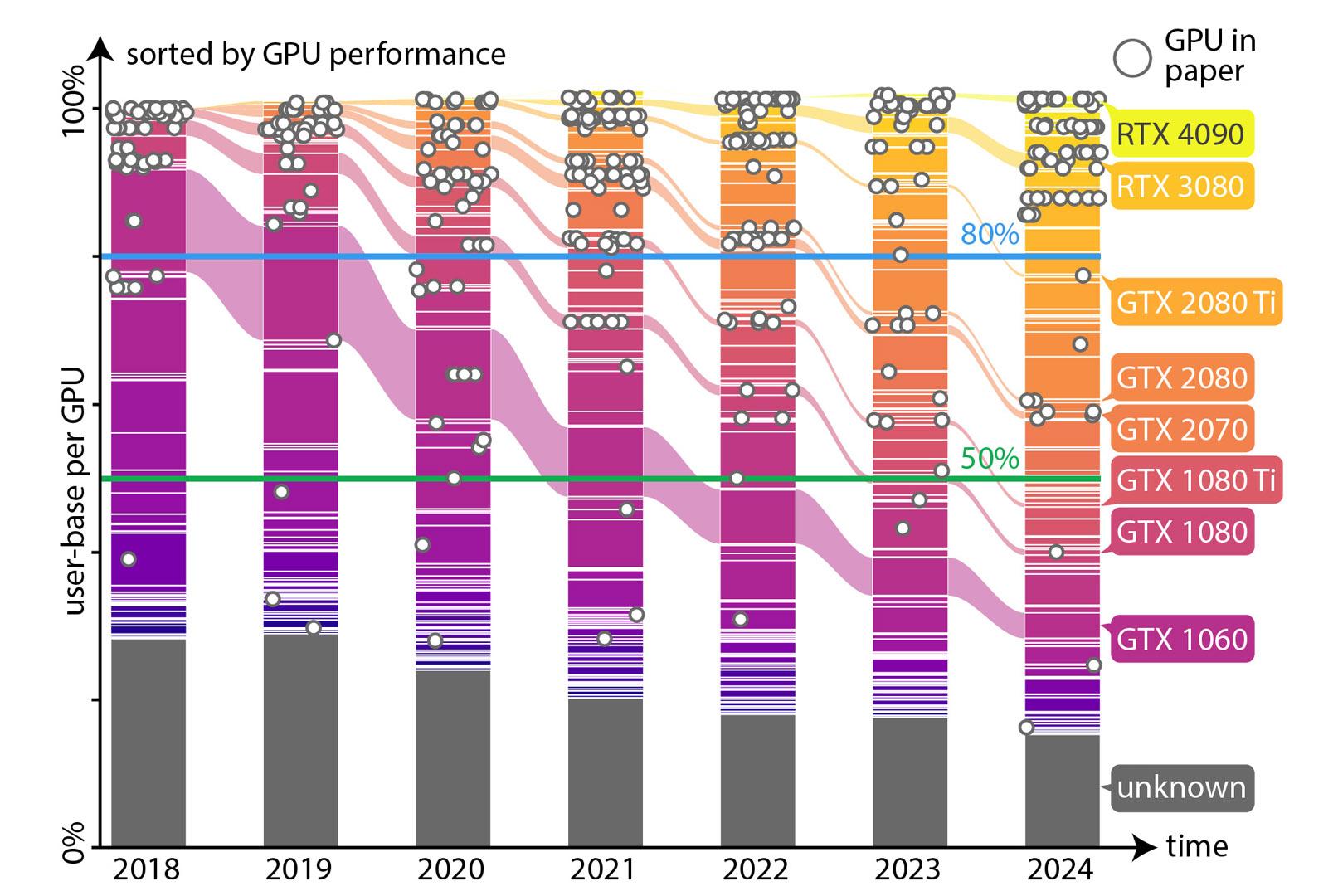
Graphical Processing Units are at the core of Computer Graphics Research. Research labs feel compelled to frequently update their hardware, as new GPUs increase the performance of existing methods and as they enable new algorithmic possibilities. And while the wider public does not have access to costly, high-performance hardware, the hegemonic assumption of researchers is that large-scale tech hardware renewal is inevitable. We want to question the performative nature of this assumption: aren’t we researchers in Computer Graphics — contributing-factors driving this renewal of users’ hardware? While we strive to develop more realistic, controllable, and fast ways to create digital content over the years, what material substrate do we depend on and what are the consequences of that dependency? We surveyed 888 papers from 2018 to 2024 presented at SIGGRAPH, systematically gathering author-reported GPU models. By putting in perspective the hardware reported in graphics papers with publicly available data of consumers’ hardware, we demonstrate that graphics research is consistently developed and tested on new high-end devices that do not reflect the state of the consumer-level market. We find this pattern of hardware usage is incompatible with the ACM’s code of ethics to “promote environmental sustainability”. Specifically, developing algorithms that require newer and more powerful hardware than what users have may reinforce trends of overconsumption caused by the premature replacement of devices, or increase the dependency of individuals and businesses on resource-hungry, industry-owned services in the “cloud”. Looking forward, we show that there are avenues for our research community to develop methods that embrace more realistic and sustainable hardware configurations. We contribute a set of recommendations at multiple institutional levels (authors, reviewing committees, research institutions) to support and incentivize the transition towards more sustainable graphics research. We release our data collection code and dataset of 888 papers with extracted GPU models.
References:
[1] Nathan Ensmenger. 2021. The Cloud Is a Factory. In Your Computer Is on Fire.
[2] IDRIS. 2024. Jean Zay. http://www.idris.fr/eng/jean-zay/
[3] Matthew J. Keeter. 2020. Massively Parallel Rendering of Complex Closed-Form Implicit Surfaces. ACM Transactions on Graphics (2020).
[4] Michael Kenzel, Bernhard Kerbl, Dieter Schmalstieg, and Markus Steinberger. 2018. A high-performance software graphics pipeline architecture for the GPU. ACM Transactions on Graphics (2018).
[5] Rafael Laurenti, Rajib Sinha, Jagdeep Singh, and Björn Frostell. 2015. Some pervasive challenges to sustainability by design of electronic products–a conceptual discussion. Journal of Cleaner Production (2015).
[6] L. Magnier and R. Mugge. 2022. Replaced too soon? An exploration of Western European consumers’ replacement of electronic products. (2022).
[7] Bonnie Nardi, Bill Tomlinson, Donald J Patterson, Jay Chen, Daniel Pargman, Barath Raghavan, and Birgit Penzenstadler. 2018. Computing within limits. (2018).
[8] Dhanabalan Thangam, Haritha Muniraju, R Ramesh, Ramakrishna Narasimhaiah, N Muddasir, Ahamed Khan, Shabista Booshan, Bharath Booshan, and R Ganesh. 2024. Impact of Data Centers on Power Consumption, Climate Change, and Sustainability.
[9] Peng Wang, Ling-Yu Zhang, Asaf Tzachor, and Wei-Qiang Chen. 2024. E-waste challenges of generative artificial intelligence. (2024).
[10] Shoshana Zuboff. 2023. The age of surveillance capitalism. Routledge.