“From Loom to Code and Back Again” by Davison, Pernin and Andrus
Conference:
Type(s):
Title:
- From Loom to Code and Back Again
Session/Category Title:
- Cloth and a Haircut: More Than 2 Bits
Presenter(s)/Author(s):
Moderator(s):
Abstract:
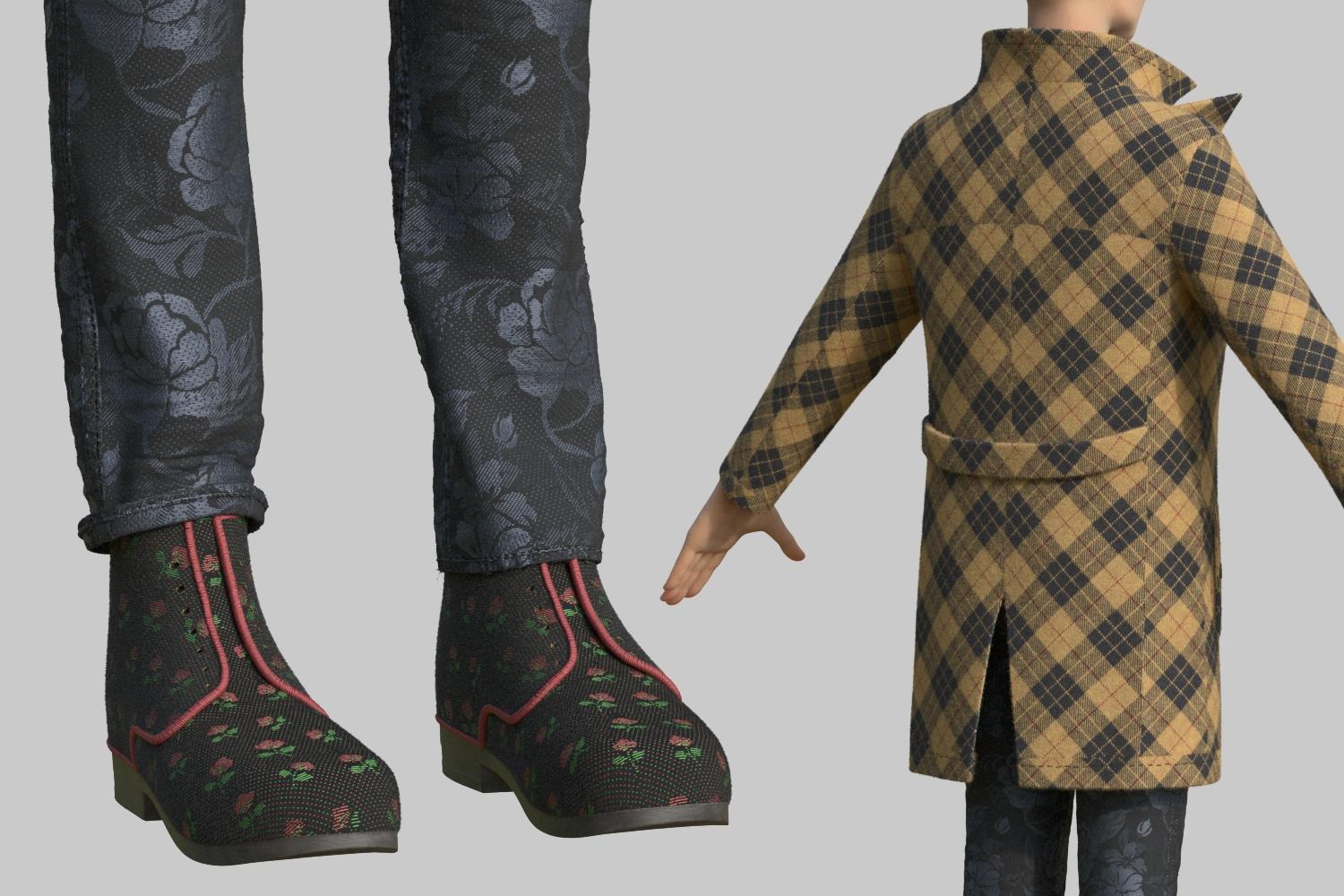
During the development of an upcoming feature at Netflix Animation Studios, we have made several advances in our use of fiber-level cloth geometry, specifically through the use of Weave, a tool that we have developed for several years (formerly as Animal Logic Studios). Fiber-level modelling has become our preferred technique in production over traditional surface based modelling for fabrics. It allows for more rapid achievement of creative goals, enhancing the visual quality of fabrics by providing subtle internal reflections, self-shadowing, occlusion, and a sense of depth and weight. Initially, fabric design involved a simple user interface for defining weave patterns, with color added through standard texture mapping. However, creating complex patterns was cumbersome and prone to errors. To address these challenges, the team drew inspiration from Jacquard looms, whose history and significance we will discuss, and we will share details of the color quantization technique that we have settled upon to empower surfacing artists to turn their designs into weavable fabric. Known for their intricate designs and the luxurious feel of the fabrics they produce, the introduction of a simulated Jacquard loom and a color layout mechanism in Weave has enabled artists to create complex textile designs suitable for period and luxury costumes. The talk also explores multi-color weaving techniques, using alternating colored fibers and blocks of colored fibers to create distinct visual effects. Our new color controls have enabled the creation of a variety of classic fabric patterns, such as plaid, checkered and houndstooth designs. The enhancements in Weave that we will discuss have significantly improved the quality of upholstery fabrics and period costuming, offering a luxurious appearance and reinforcing the value of fiber-level cloth geometry.
References:
[1] Curtis Andrus, Burak Ertekin, Guillaume Pernin, and Stefan Feess. 2023. Artist-Friendly Tools for Realistic Knitted Cloth. In ACM SIGGRAPH 2023 Talks (Los Angeles, CA, USA). Association for Computing Machinery, New York, NY, USA, Article 15, 2 pages.
[2] Ylva Fernaeus, Martin Jonsson, and Jakob Tholander. 2012. Revisiting the jacquard loom: threads of history and current patterns in HCI. In Proceedings of the SIGCHI Conference on Human Factors in Computing Systems (Austin, Texas, USA). Association for Computing Machinery, New York, NY, USA, 1593–1602.
[3] Dan Lipson and José Velasquez. 2023. Creating Curve-Based Garments with Custom Weave Patterns. In ACM SIGGRAPH 2023 Talks (Los Angeles, CA, USA). Association for Computing Machinery, New York, NY, USA, Article 18, 2 pages.
[4] Bryan Smith, Roman Fedotov, Sang N. Le, Matthias Frei, Alex Latyshev, Luke Emrose, and Jean Pascal leBlanc. 2018. Simulating woven fabrics with weave. In ACM SIGGRAPH 2018 Talks (Vancouver, British Columbia, Canada). Association for Computing Machinery, New York, NY, USA, Article 12, 2 pages.
[5] Jose Velasquez, Alexander Alvarado, Ying Liu, and Maryann Simmons. 2022. Embroidery and Cloth Fiber Workflows on Disney’s ”Encanto”. In ACM SIGGRAPH 2022 Talks (Vancouver, BC, Canada). Association for Computing Machinery, New York, NY, USA, Article 22, 2 pages.