“Data-Efficient Discovery of Hyperelastic TPMS Metamaterials with Extreme Energy Dissipation” by Perroni-Scharf and Ferguson
Conference:
Type(s):
Title:
- Data-Efficient Discovery of Hyperelastic TPMS Metamaterials with Extreme Energy Dissipation
Session/Category Title:
- Microstructures & Materials
Presenter(s)/Author(s):
Moderator(s):
Abstract:
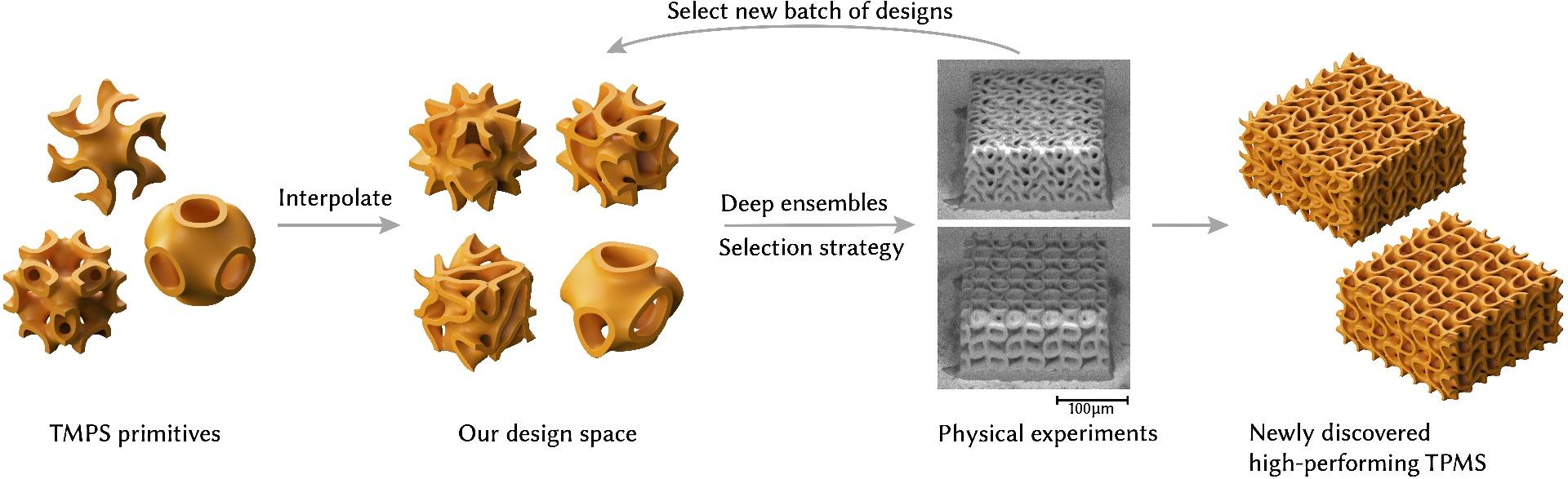
Triply periodic minimal surfaces (TPMS) are a class of metamaterials with a variety of applications and well-known primitives. We present a new method for discovering novel microscale TPMS structures with exceptional energy -dissipation capabilities, achieving double the energy absorption of the best existing TPMS primitive structure. Our approach employs a parametric representation, allowing seamless interpolation between structures and representing a rich TPMS design space. We show that simulations are intractable for optimizing microscale hyperelastic structures, and instead propose a sample-efficient computational strategy for rapidly discovering structures with extreme energy dissipation using limited amounts of empirical data from 3D-printed and tested microscale metamaterials. This strategy ensures high-fidelity results but involves time-consuming 3D printing and testing. To address this, we leverage an uncertainty-aware Deep Ensembles model to predict microstructure behaviors and identify which structures to fabricate and test next. We iteratively refine our model through batch Bayesian optimization, selecting structures for fabrication that maximize exploration of the performance space and exploitation of our energy-dissipation objective. Using our method, we produce the first open-source dataset of hyperelastic microscale TPMS structures, including a set of novel structures that demonstrate extreme energy dissipation capabilities. We show several potential applications of these structures in protective equipment and bone implants.
References:
[1] Hervé Abdi and Lynne J Williams. 2010. Principal component analysis. Wiley Interdisciplinary Reviews: Computational Statistics 2, 4 (2010), 433–459.
[2] Oraib Al-Ketan and Rashid K. Abu Al-Rub. 2021. MSLattice: A free software for generating uniform and graded lattices based on triply periodic minimal surfaces. Material Design & Processing Communications 3, 6 (2021), e205. e205 MDPC-2020-042.R1.
[3] M.F Ashby. 2006. The properties of foams and lattices. Philosophical Transactions of the Royal Society A: Mathematical, Physical and Engineering Sciences 364, 1838 (Jan. 2006), 15–30.
[4] Reza Attarzadeh, Seyed-Hosein Attarzadeh-Niaki, and Christophe Duwig. 2022. Multi-objective optimization of TPMS-based heat exchangers for low-temperature waste heat recovery. Applied Thermal Engineering 212 (2022), 118448.
[5] Sahab Babaee, Jongmin Shim, James C. Weaver, Elizabeth R. Chen, Nikita Patel, and Katia Bertoldi. 2013. 3D Soft Metamaterials with Negative Poisson’s Ratio. Advanced Materials 25, 36 (Sept. 2013), 5044–5049.
[6] A.T. Barnes, K. Ravi-Chandar, S. Kyriakides, and S. Gaitanaros. 2014. Dynamic crushing of aluminum foams: Part I – Experiments. International Journal of Solids and Structures 51, 9 (May 2014), 1631–1645.
[7] Jan-Hendrik Bastek, Siddhant Kumar, Bastian Telgen, Raphaël N Glaesener, and Dennis M Kochmann. 2022. Inverting the structure–property map of truss metamaterials by deep learning. Proceedings of the National Academy of Sciences 119, 1 (2022), e2111505119.
[8] Jens Bauer, Lucas R. Meza, Tobias A. Schaedler, Ruth Schwaiger, Xiaoyu Zheng, and Lorenzo Valdevit. 2017. Nanolattices: An emerging class of mechanical metamaterials. Advanced Materials 29, 40 (2017), 1701850. arXiv:https://onlinelibrary.wiley.com/doi/pdf/10.1002/adma.201701850
[9] Bernd Bickel, Moritz Bächer, Miguel A. Otaduy, Hyunho Richard Lee, Hanspeter Pfister, Markus Gross, and Wojciech Matusik. 2010. Design and Fabrication of Materials with Desired Deformation Behavior. In ACM SIGGRAPH 2010 Papers. Association for Computing Machinery, New York, NY, USA, 1–10.
[10] Rich Caruana, Steve Lawrence, and C Giles. 2000. Overfitting in neural nets: Backpropagation, conjugate gradient, and early stopping. Advances in Neural Information Processing Systems 13 (2000), 381–387.
[11] Tian Chen, Julian Panetta, Max Schnaubelt, and Mark Pauly. 2021. Bistable auxetic surface structures. ACM Trans. Graph. 40, 4, Article 39 (jul 2021), 9 pages.
[12] Cameron Crook, Jens Bauer, Anna Guell Izard, Cristine Santos de Oliveira, Juliana Martins de Souza e Silva, Jonathan B. Berger, and Lorenzo Valdevit. 2020. Plate-nanolattices at the theoretical limit of stiffness and strength. Nature Communications 11, 1 (2020), 1579.
[13] Dana M. Dattelbaum, Axinte Ionita, Brian M. Patterson, Brittany A. Branch, and Lindsey Kuettner. 2020. Shockwave dissipation by interface-dominated porous structures. AIP Advances 10, 7 (July 2020), 075016.
[14] V.S. Deshpande, M.F. Ashby, and N.A. Fleck. 2001. Foam topology: Bending versus stretching dominated architectures. Acta Materialia 49, 6 (April 2001), 1035–1040.
[15] V.S. Deshpande and N.A. Fleck. 2000. High strain rate compressive behaviour of aluminium alloy foams. International Journal of Impact Engineering 24, 3 (March 2000), 277–298.
[16] Zhifei Dong and Xin Zhao. 2021. Application of TPMS structure in bone regeneration. Engineered Regeneration 2 (2021), 154–162.
[17] Timothy Erps, Michael Foshey, Mina Konaković Luković, Wan Shou, Hanns Hagen Goetzke, Herve Dietsch, Klaus Stoll, Bernhard von Vacano, and Wojciech Matusik. 2021. Accelerated discovery of 3D printing materials using data-driven multiobjective optimization. Science Advances 7, 42 (2021), eabf7435. arXiv:https://www.science.org/doi/pdf/10.1126/sciadv.abf7435
[18] Zhaohui Fan, Renjing Gao, and Shutian Liu. 2022. Thermal conductivity enhancement and thermal saturation elimination designs of battery thermal management system for phase change materials based on triply periodic minimal surface. Energy 259 (2022), 125091.
[19] Zhiwei Fang and Justin Zhan. 2019. Deep physical informed neural networks for metamaterial design. IEEE Access 8 (2019), 24506–24513.
[20] Jiawei Feng, Bo Liu, Zhiwei Lin, and Jianzhong Fu. 2021. Isotropic porous structure design methods based on triply periodic minimal surfaces. Materials & Design 210 (2021), 110050.
[21] Ruben Gatt and Joseph N Grima. 2008. Negative compressibility. physica status solidi (RRL)–Rapid Research Letters 2, 5 (2008), 236–238.
[22] Javier González, Zhenwen Dai, Philipp Hennig, and Neil Lawrence. 2016. Batch Bayesian optimization via local penalization. In Artificial Intelligence and Statistics. PMLR, 648–657.
[23] Chan Soo Ha, Desheng Yao, Zhenpeng Xu, Chenang Liu, Han Liu, Daniel Elkins, Matthew Kile, Vikram Deshpande, Zhenyu Kong, Mathieu Bauchy, et al. 2023. Rapid inverse design of metamaterials based on prescribed mechanical behavior through machine learning. Nature Communications 14, 1 (2023), 5765.
[24] J. A. Hawreliak, J. Lind, B. Maddox, M. Barham, M. Messner, N. Barton, B. J. Jensen, and M. Kumar. 2016. Dynamic Behavior of Engineered Lattice Materials. Scientific Reports 6, 1 (June 2016), 28094.
[25] Jiangbei Hu, Shengfa Wang, Baojun Li, Fengqi Li, Zhongxuan Luo, and Ligang Liu. 2020. Efficient representation and optimization for TPMS-based porous structures. IEEE Transactions on Visualization and Computer Graphics 28, 7 (2020), 2615–2627.
[26] Zizhou Huang, Davi Colli Tozoni, Arvi Gjoka, Zachary Ferguson, Teseo Schneider, Daniele Panozzo, and Denis Zorin. 2024. Differentiable solver for time-dependent deformation problems with contact. ACM Transactions on Graphics 43, 3 (May 2024), 1–30.
[27] Pengcheng Jiao, Jochen Mueller, Jordan R Raney, Xiaoyu Zheng, and Amir H Alavi. 2023. Mechanical metamaterials and beyond. Nature Communications 14, 1 (2023), 6004.
[28] Donald R Jones, Matthias Schonlau, and William J Welch. 1998. Efficient global optimization of expensive black-box functions. Journal of Global Optimization 13, 4 (1998), 455.
[29] I. Kuszczak, F.I. Azam, M.A. Bessa, P.J. Tan, and F. Bosi. 2023. Bayesian optimisation of hexagonal honeycomb metamaterial. Extreme Mechanics Letters 64 (2023), 102078.
[30] Balaji Lakshminarayanan, Alexander Pritzel, and Charles Blundell. 2017. Simple and S scalable predictive incertainty estimation using deep ensembles. In Advances in Neural Information Processing Systems 30 (NeurIPS 2017). Curran Associates, Inc., 6402–6413. https://proceedings.neurips.cc/paper_files/paper/2017/file/9ef2ed4b7fd2c810847ffa5fa85bce38-Paper.pdf
[31] Zizhou Huang, Daniele Panozzo, and Denis Zorin. 2024. Optimized shock-protecting microstructures. ACM Transactions on Graphics 43, 6 (2024), 1–21.
[32] Doksoo Lee, Yu-Chin Chan, Wei Chen, Liwei Wang, Anton van Beek, and Wei Chen. 2023. t-METASET: Task-aware acquisition of metamaterial datasets through diversity-based active learning. Journal of Mechanical Design 145, 3 (March 2023), 031704.
[33] Weichen Li, Fengwen Wang, Ole Sigmund, and Xiaojia Shelly Zhang. 2022. Digital synthesis of free-form multimaterial structures for realization of arbitrary programmed mechanical responses. Proceedings of the National Academy of Sciences 119, 10 (2022), e2120563119. arXiv:https://www.pnas.org/doi/pdf/10.1073/pnas.2120563119
[34] Yue Li, Stelian Coros, and Bernhard Thomaszewski. 2023. Neural metamaterial networks for nonlinear material design. ACM Transactions on Graphics (TOG) 42, 6 (2023), 1–13.
[35] Yee-Fun Lim, Chee Koon Ng, US Vaitesswar, and Kedar Hippalgaonkar. 2021. Extrapolative Bayesian optimization with Gaussian process and neural network ensemble surrogate models. Advanced Intelligent Systems 3, 11 (2021), 2100101.
[36] Jiayu Lin. 2016. On the Dirichlet distribution. Department of Mathematics and Statistics, Queens University 40 (2016).
[37] Jonathan Lind, Brian J. Jensen, Matthew Barham, and Mukul Kumar. 2019. In situ dynamic compression wave behavior in additively manufactured lattice materials. Journal of Materials Research 34, 1 (Jan. 2019), 2–19.
[38] Chenyang Liu, Xi Zhang, Jiahui Chang, You Lyu, Jianan Zhao, and Song Qiu. 2024. Programmable mechanical metamaterials: Basic concepts, types, construction strategies—a review. Frontiers in Materials 11 (2024), 1361408.
[39] Liane Makatura, Bohan Wang, Yi-Lu Chen, Bolei Deng, Chris Wojtan, Bernd Bickel, and Wojciech Matusik. 2023. Procedural metamaterials: A unified procedural graph for metamaterial design. ACM Transactions on Graphics 42, 5 (2023), 1–19.
[40] Jonàs Martínez, Jérémie Dumas, and Sylvain Lefebvre. 2016. Procedural Voronoi foams for additive manufacturing. ACM Trans. Graph. 35, 4, Article 44 (jul 2016), 12 pages.
[41] Jonàs Martínez, Samuel Hornus, Haichuan Song, and Sylvain Lefebvre. 2018. Polyhedral Voronoi diagrams for additive manufacturing. ACM Trans. Graph. 37, 4, Article 129 (jul 2018), 15 pages.
[42] Kathryn H. Matlack, Anton Bauhofer, Sebastian Krödel, Antonio Palermo, and Chiara Daraio. 2016. Composite 3D-printed metastructures for low-frequency and broadband vibration absorption. Proceedings of the National Academy of Sciences 113, 30 (2016), 8386–8390. arXiv:https://www.pnas.org/doi/pdf/10.1073/pnas.1600171113
[43] Paul P Meyer, Colin Bonatti, Thomas Tancogne-Dejean, and Dirk Mohr. 2022. Graph-based metamaterials: Deep learning of structure-property relations. Materials & Design 223 (2022), 111175.
[44] R.A.W. Mines, S. Tsopanos, Y. Shen, R. Hasan, and S.T. McKown. 2013. Drop weight impact behaviour of sandwich panels with metallic micro lattice cores. International Journal of Impact Engineering 60 (Oct. 2013), 120–132.
[45] Praveen Babu Nakshatrala, Daniel A Tortorelli, and KB3069875 Nakshatrala. 2013. Nonlinear structural design using multiscale topology optimization. Part I: Static formulation. Computer Methods in Applied Mechanics and Engineering 261 (2013), 167–176.
[46] Zachary G Nicolaou and Adilson E Motter. 2012. Mechanical metamaterials with negative compressibility transitions. Nature Materials 11, 7 (2012), 608–613.
[47] Nejc Novak, Oraib Al-Ketan, Anja Mauko, Yunus Emre Yilmaz, Lovre Krstulović-Opara, Shigeru Tanaka, Kazuyuki Hokamoto, Reza Rowshan, Rashid Abu Al-Rub, Matej Vesenjak, and Zoran Ren. 2023. Impact loading of additively manufactured metallic stochastic sheet-based cellular material. International Journal of Impact Engineering 174 (April 2023), 104527.
[48] Deniz Oktay, Mehran Mirramezani, Eder Medina, and Ryan P Adams. 2023. Neuromechanical autoencoders: Learning to couple elastic and neural network nonlinearity. In The Eleventh International Conference on Learning Representations. https://openreview.net/forum?id=QubsmJT_A0
[49] Julian Panetta, Abtin Rahimian, and Denis Zorin. 2017. Worst-case stress relief for microstructures. ACM Transactions on Graphics (TOG) 36, 4 (2017), 1–16.
[50] Julian Panetta, Qingnan Zhou, Luigi Malomo, Nico Pietroni, Paolo Cignoni, and Denis Zorin. 2015. Elastic textures for additive fabrication. ACM Transactions on Graphics (TOG) 34, 4 (2015), 1–12.
[51] Bo Peng, Ye Wei, Yu Qin, Jiabao Dai, Yue Li, Aobo Liu, Yun Tian, Liuliu Han, Yufeng Zheng, and Peng Wen. 2023. Machine learning-enabled constrained multi-objective design of architected materials. Nature Communications 14, 1 (2023), 6630.
[52] Shibani Santurkar, Dimitris Tsipras, Andrew Ilyas, and Aleksander Madry. 2018. How does batch normalization help optimization?. In Advances in Neural Information Processing Systems 31 (NeurIPS 2018). Curran Associates, Inc., 2488–2498. https://proceedings.neurips.cc/paper_files/paper/2018/file/90556c1c1a5d7c2c4f5f7f1e1c1e1e1e-Paper.pdf
[53] Tobias A Schaedler, Alan J Jacobsen, Anna Torrents, Adam E Sorensen, Jie Lian, Julia R Greer, Lorenzo Valdevit, and Wiliam B Carter. 2011. Ultralight metallic microlattices. Science 334, 6058 (2011), 962–965.
[54] Ronald W Schafer. 2011. What is a Savitzky-Golay filter? [Lecture notes]. IEEE Signal Processing Magazine 28, 4 (2011), 111–117.
[55] Teseo Schneider, Jérémie Dumas, Xifeng Gao, Denis Zorin, and Daniele Panozzo. 2019. PolyFEM. https://polyfem.github.io/.
[56] Christian Schumacher, Bernd Bickel, Jan Rys, Steve Marschner, Chiara Daraio, and Markus Gross. 2015. Microstructures to control elasticity in 3D printing. ACM Trans. Graph. 34, 4, Article 136 (jul 2015), 13 pages.
[57] Peter Serles, Jinwook Yeo, Michel Haché, Pedro Guerra Demingos, Jonathan Kong, Pascal Kiefer, Somayajulu Dhulipala, Boran Kumral, Katherine Jia, Shuo Yang, et al. 2025. Ultrahigh specific strength by Bayesian optimization of carbon nanolattices. Advanced Materials 37, 14 (2025), 2570108.
[58] B. Shahriari, K. Swersky, Z. Wang, R. P. Adams, and N. de Freitas. 2016. Taking the human out of the loop: A review of Bayesian Optimization. Proc. IEEE 104, 1 (2016), 148–175.
[59] Angkur Jyoti Dipanka Shaikeea, Huachen Cui, Mark O’Masta, Xiaoyu Rayne Zheng, and Vikram Sudhir Deshpande. 2022. The toughness of mechanical metamaterials. Nature Materials 21, 3 (March 2022), 297–304.
[60] C. Sharpe, C. Seepersad, D. A. Tortorelli, and S. E. Watts. 2018. Design of mechanical metamaterials via constrained Bayesian optimization. In Proceedings of the ASME 2018 International Design Engineering Technical Conferences and Computers and Information in Engineering Conference (IDETC/CIE 2018).
[61] Jongmin Shim, Sicong Shan, Andrej Košmrlj, Sung H. Kang, Elizabeth R. Chen, James C. Weaver, and Katia Bertoldi. 2013. Harnessing instabilities for design of soft reconfigurable auxetic/chiral materials. Soft Matter 9 (2013), 8198–8202. Issue 34.
[62] Kelsey L Snapp, Benjamin Verdier, Aldair E Gongora, Samuel Silverman, Adedire D Adesiji, Elise F Morgan, Timothy J Lawton, Emily Whiting, and Keith A Brown. 2024. Superlative mechanical energy absorbing efficiency discovered through self-driving lab-human partnership. Nature Communications 15, 1 (2024), 4290.
[63] Niranjan Srinivas, Andreas Krause, Sham Kakade, and Matthias W. Seeger. 2010. Gaussian process optimization in the bandit setting: No regret and experimental design. In Proceedings of the 27th International Conference on Machine Learning (ICML). Omnipress, 1015–1022. http://www.icml2010.org/papers/422.pdf
[64] Nitish Srivastava, Geoffrey Hinton, Alex Krizhevsky, Ilya Sutskever, and Ruslan Salakhutdinov. 2014. Dropout: A simple way to prevent neural networks from overfitting. Journal of Machine Learning Research 15, 1 (2014), 1929–1958.
[65] James Utama Surjadi and Carlos M. Portela. 2025. Enabling three-dimensional architected materials across length scales and timescales. Nature Materials 24, 4 (April 2025), 493–505.
[66] T. Tancogne-Dejean, X. Li, M. Diamantopoulou, C. C. Roth, and D. Mohr. 2019. High strain rate response of additively-manufactured plate-lattices: Experiments and modeling. Journal of Dynamic Behavior of Materials 5, 3 (Sept. 2019), 361–375.
[67] Prakash Thakolkaran, Michael Espinal, Somayajulu Dhulipala, Siddhant Kumar, and Carlos M. Portela. 2025. Experiment-informed finite-strain inverse design of spinodal metamaterials. Extreme Mechanics Letters 74 (Jan. 2025), 102274.
[68] The CGAL Project. 2024. CGAL (5.6.1 ed.). https://www.cgal.org/
[69] Yunsheng Tian, Ane Zuniga, Xinwei Zhang, Johannes P. Dürholt, Payel Das, Jie Chen, Wojciech Matusik, and Mina Konaković Luković. 2024. Boundary exploration for Bayesian optimization with unknown physical constraints. In Proceedings of the 41st International Conference on Machine Learning (ICML). PMLR, 48295–48320. https://arxiv.org/abs/2402.07692
[70] Davi Colli Tozoni, Jérémie Dumas, Zhongshi Jiang, Julian Panetta, Daniele Panozzo, and Denis Zorin. 2020. A low-parametric rhombic microstructure family for irregular lattices. ACM Trans. Graph. 39, 4, Article 101 (aug 2020), 20 pages.
[71] Rodger M Walser. 2001. Electromagnetic metamaterials. In Complex Mediums II: Beyond Linear Isotropic Dielectrics, Vol. 4467. SPIE, 1–15.
[72] Liwei Wang, Yu-Chin Chan, Faez Ahmed, Zhao Liu, Ping Zhu, and Wei Chen. 2020. Deep generative modeling for mechanistic-based learning and design of metamaterial systems. Computer Methods in Applied Mechanics and Engineering 372 (2020), 113377.
[73] Yujia Wang, Xuan Zhang, Zihe Li, Huajian Gao, and Xiaoyan Li. 2022. Achieving the theoretical limit of strength in shell-based carbon nanolattices. Proceedings of the National Academy of Sciences 119, 34 (Aug. 2022), e2119536119.
[74] J. S. Weeks and G. Ravichandran. 2023. Effect of topology on transient dynamic and shock response of polymeric lattice structures. Journal of Dynamic Behavior of Materials 9, 1 (March 2023), 44–64.
[75] Xiaoxing Xia, Christopher M. Spadaccini, and Julia R. Greer. 2022. Responsive materials architected in space and time. Nature Reviews Materials 7, 9 (2022), 683–701.
[76] Amir A. Zadpoor, Mohammad J. Mirzaali, Lorenzo Valdevit, and Jonathan B. Hopkins. 2023. Design, material, function, and fabrication of metamaterials. APL Materials 11, 2 (2023), 020401.
[77] Hengrui Zhang, Wei Chen, Akshay Iyer, Daniel W Apley, and Wei Chen. 2022. Uncertainty-aware mixed-variable machine learning for materials design. Scientific Reports 12, 1 (2022), 19760.
[78] Jing Zhang, Suchao Xie, Tao Li, Zinan Liu, Shiwei Zheng, and Hui Zhou. 2023. A study of multi-stage energy absorption characteristics of hybrid sheet TPMS lattices. Thin-Walled Structures 190 (2023), 110989.
[79] Xuan Zhang, Yujia Wang, Bin Ding, and Xiaoyan Li. 2020. Design, fabrication, and mechanics of 3D micro-/nanolattices. Small 16, 15 (2020), e1902842.
[80] Xuejin Zhao, Zhenzong Li, Yupeng Zou, and Xiaoyu Zhao. 2024. Compressive characteristics and energy absorption capacity of automobile energy-absorbing box with filled porous TPMS structures. Applied Sciences 14, 9 (2024), 3790.
[81] Xiaoyu Zheng, Howon Lee, Todd H. Weisgraber, Maxim Shusteff, Joshua DeOtte, Eric B. Duoss, Joshua D. Kuntz, Monika M. Biener, Qi Ge, Julie A. Jackson, Sergei O. Kucheyev, Nicholas X. Fang, and Christopher M. Spadaccini. 2014. Ultralight, ultrastiff mechanical metamaterials. Science 344, 6190 (2014), 1373–1377. arXiv:https://www.science.org/doi/pdf/10.1126/science.1252291