
“Digital Crazing: Applying Quadtree Structures to Simulate Time and Human Intervention” by Lu and Chou
Conference:
Type(s):
Title:
- Digital Crazing: Applying Quadtree Structures to Simulate Time and Human Intervention
Session/Category Title:
- Craft and Creativity
Presenter(s)/Author(s):
Moderator(s):
Abstract:
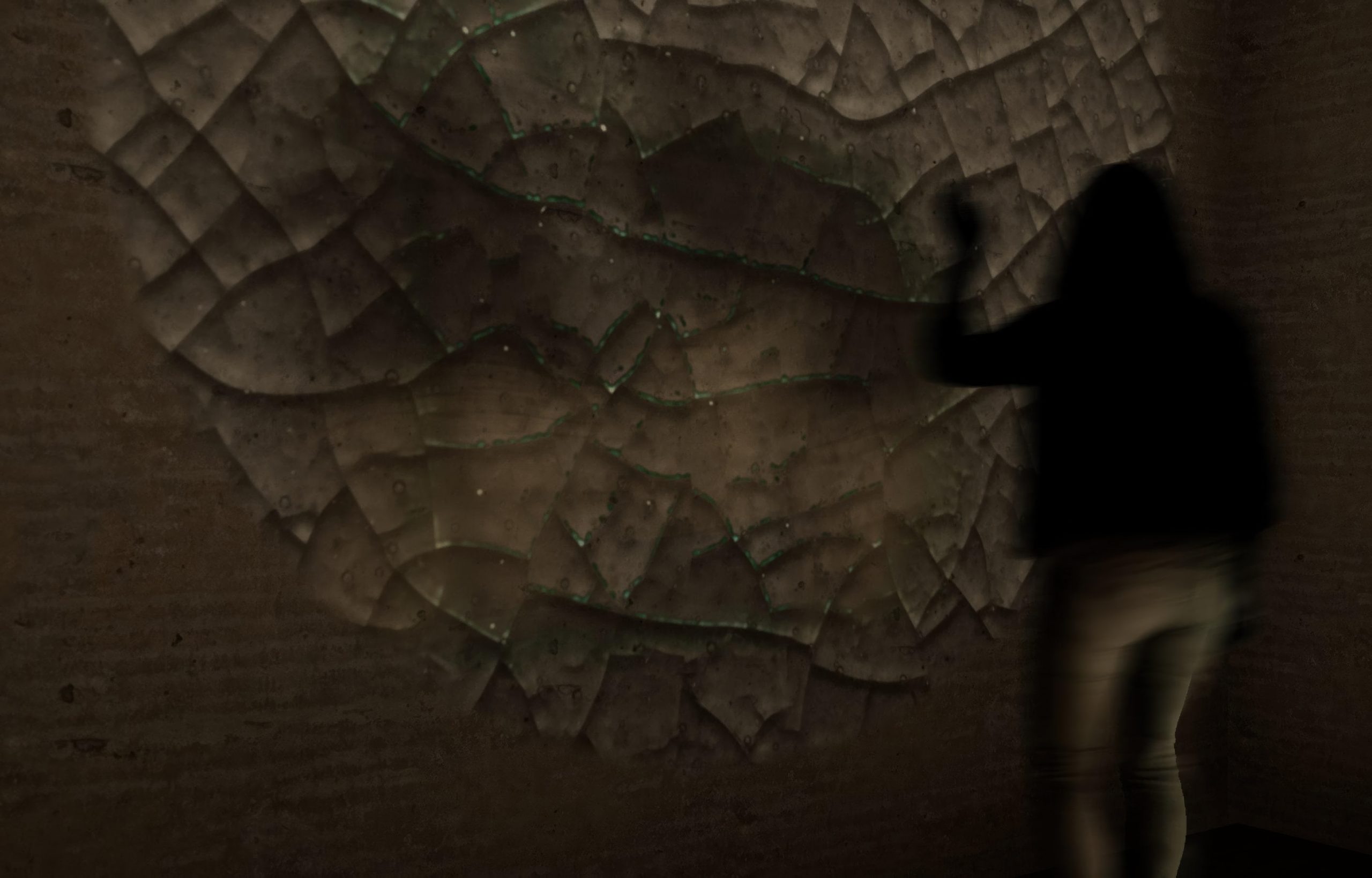
We present a novel tool for generating crazing patterns that explores the relationship between time and user intervention. Inspired by the formation of crazing during firing, this tool reinterprets this phenomenon, which has evolved into a culturally significant aesthetic. This tool employs a hierarchical depth slicing technique to simulate the evolution of crazing, showcasing the transition from prominent fissures to intricate patterns. It combines the natural progression of cracks over time with those shaped by human intervention, capturing the underlying logic of crazing formation. Our interactive work exploits the user intervention characteristics, where the crazing changes in response to the duration of the observer’s shadow. This simulation highlights how coarse cracks are more prone to absorb dye, while fine cracks resist coloration. The observer’s shadow is conceptualized as the “dye,” emphasizing the contrast between human and natural influences over time. This design amplifies the relationship between temporality and human intervention, offering viewers a novel aesthetic experience. This work integrates cultural context and artistic theory, digitizes the logic behind crazing formation, and explores the aesthetic significance of material transformation. The tool framework dynamically presents the interaction between time and human influence by simulating dye deposition, temporal progression, and crazing formation. In future work, we aim to enhance the tool performance by developing plugins for relevant design software. Via integrating the plugins, the relevant design software can expand its applications in interactive design and digital creation, opening new possibilities for digital material generation techniques.
References:
[1] Rachele Bellini, Yanir Kleiman, and Daniel Cohen-Or. 2016. Time-varying weathering in texture space. ACM Trans. Graph. 35, 4, Article 141 (July 2016), 11 pages.
[2] Simon Berger. 2023. Museo del Vetro. https://www.simonberger.art/post/shattering-beauty
[3] Patrick Bergsma. [n. d.]. Famille rose. https://patrickbergsma.nl/
[4] John Canny. 1986. A Computational Approach to Edge Detection. IEEE Transactions on Pattern Analysis and Machine Intelligence PAMI-8, 6 (1986), 679–698.
[5] Wenqing Chen. 2007. Solving the Mystery of the Five Dynasties: An Exploration of the Chai Kiln. History Monthly230 (Mar 2007), 4–12.
[6] Ji Cheng. 2017. The Craft of Gardens. Chongqing Publishing House. 40–174 pages.
[7] Dong he Chen and Yunjie Chen. 2017. Perfect Imperfection: Microscopic Analysis of the Glaze on Ru Ware Narcissus Basin. The National Palace Museum Monthly of Chinese Art463 (2017), 60–69.
[8] Ju-Jiang Hung. 2018. Civil engineering and culture (II): The beauty of civil engineering. Journal of Civil and Hydraulic Engineering 45, 2 (Apr 2018), 68–80.
[9] Hayley N. Iben and James F. O’Brien. 2009. Generating surface crack patterns. Graphical Models 71, 6 (2009), 198–208. 2006 ACM SIGGRAPH/Eurographics Symposium on Computer Animation (SCA 2006).
[10] Satoshi Iizuka, Yuki Endo, Yoshihiro Kanamori, and Jun Mitani. 2016. Single Image Weathering via Exemplar Propagation. Computer Graphics Forum (Proc. of Eurographics 2016) (2016).
[11] Bennett Jane. 2010. Vibrant Matter A Political Ecology of Things. Duke University Press.
[12] Bernard Fibicher Ai Weiwei Karen Smith, Hans Ulrich Obrist. 2009. Ai Weiwei. Phaidon Press.
[13] Sophia Lahlil, Weidong Li, and Ji Xu. 2013. Crack patterns morphology of ancient Chinese wares. The Old Potter’s Almanach 18 (01 2013), 1–9.
[14] Feng Jiaquan Lai Zhide, Hui Dong. 1999. Commentary on the Appended Phrases (Xici zhuan) of the Yijing. Ding Yuan.
[15] Zehou Li. 1994. The Path of Beautys. STORM & STRESS PUBLISHING CO., LTD. 195–197 pages.
[16] Ming liang Xie. 2021. On the Ru Ware Celadon Boat-shaped Cup. The National Palace Museum Monthly of Chinese Art463 (2021), 57–69.
[17] Benoit B. Mandelbrot, Dann E. Passoja, and Alvin J. Paullay. 1984. Fractal character of fracture surfaces of metals. Nature 308, 5961 (1984), 721–722.
[18] Lan Pu and Zheng Tinggui. 2024. Ching-te-chen Tao-lu or The Potteries of China (translator: Lian Mian). Shandong Pictorial Publishing House. 56 pages.
[19] Iasef Md Rian. 2024. Random fractal-based computational design of an ice-ray (IR) lattice shell structure. Frontiers of Architectural Research 13, 2 (2024), 406–424.
[20] Mohee Datta Gupta Shivansh Rakesh, Mohsin Mamoon Hafiz and Srivathsan Baskaran. 2020. time-varying-weathering-in-texture-space. https://github.com/ShivanshRakesh/time-varying-weathering-in-texture-space/tree/main?tab=readme-ov-file/
[21] G Stiny. 1977. Ice-Ray: A Note on the Generation of Chinese Lattice Designs. Environment and Planning B: Planning and Design 4, 1 (1977), 89–98. arXiv:
[22] Albert Sweigart. 2012. Making Games With Python & Pygame. Createspace Independent Pub.
[23] unknown. ca.1127-1279 AD. Southern Song Guan ware. Celadon Circular Washer. Ceramics, dimensions: unknown. https://digitalarchive.npm.gov.tw/opendata/
[24] unknown. ca.1127-1279 AD. Southern Song Guan ware. Celadon Lobed Washer. Ceramics, dimensions: unknown. https://digitalarchive.npm.gov.tw/opendata/
[25] unknown. ca.1127-1368 AD. Southern Song to Yuan Dynasty Ge ware. Celadon Lobed Dish. Ceramics, dimensions: unknown. https://digitalarchive.npm.gov.tw/opendata/
[26] Zhen Zhang. 2023. Designing the Ice-Crack Pattern of Traditional Chinese Windows. Nexus Network Journal 25, 4 (2023), 961–984.



