“Becoming Space: Exploring Agential Materiality Through AI-Generated Metamorphosis in Artistic Practice” by Ma, Meng, Wu, Wang and Chamier-Waite
Conference:
Type(s):
Title:
- Becoming Space: Exploring Agential Materiality Through AI-Generated Metamorphosis in Artistic Practice
Session/Category Title:
- Craft and Creativity
Presenter(s)/Author(s):
Moderator(s):
Abstract:
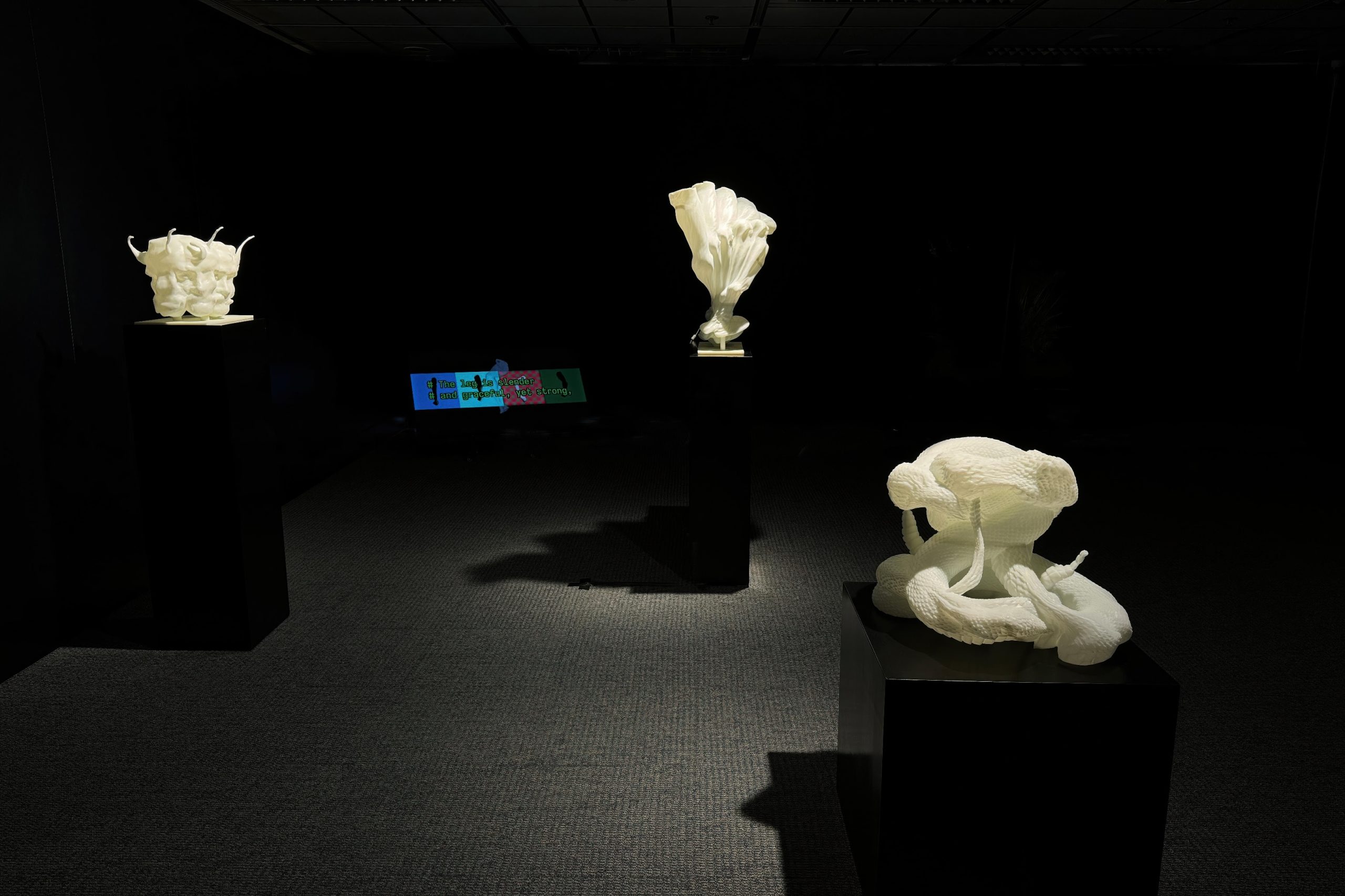
This paper examines the intersection of materiality, agency, and transformation in AI-assisted artistic practice through “Becoming Space”, an installation of 3D-printed sculptures and video. Drawing from Ovid’s Metamorphoses, the work investigates states of transformation between human and animal forms using generative AI and additive manufacturing. Through a theoretical investigation, this paper tries to analyze how material-discursive practices emerge in the convergence of language and physical materials. The work demonstrates how agency distributes across human and nonhuman actors in creative processes, challenging traditional notions of artistic authorship and subjectivity. This investigation contributes to understanding how generative AI technologies participate in artistic practices, revealing creativity as an entangled phenomenon where multiple agencies converge and transform.
References:
[1] Noam Aigerman, Kunal Gupta, Vladimir G. Kim, Siddhartha Chaudhuri, Jun Saito, and Thibault Groueix. 2022. Neural Jacobian Fields: Learning Intrinsic Mappings of Arbitrary Meshes. ACM Trans. Graph. 41, 4, Article 109 (Jul 2022), 17 pages.
[2] Karen Barad. 2003. Posthumanist Performativity: Toward an Understanding of How Matter Comes to Matter. Signs: Journal of Women in Culture and Society 28, 3 (March 2003), 801–831.
[3] Matthew Barney. 2018. Matthew Barney: Redoubt. Yale University Art Gallery. Retrieved Jan 15, 2025 from https://artgallery.yale.edu/exhibitions/exhibition/matthew-barney-redoubt
[4] Henri Bergson. 2001. Time and Free Will: An Essay on the Immediate Data of Consciousness. Dover Publications, Mineola, N.Y
[5] Rosi Braidotti. 2002. Metamorphoses: Towards a Materialist Theory of Becoming (1st edition ed.). Polity, Cambridge.
[6] Matthew Calarco. 2004. Heidegger’s Zoontology. In Animal Philosophy: Essential Readings in Continental Thought. Continuum, New York, NY, USA, 18–30.
[7] Ian Cheng. 2018. BOB (Bag Of Beliefs). Artist Website. Retrieved Jan 15, 2025 from https://iancheng.com/bob
[8] Adam Cole and Mick Grierson. 2023. Kiss/Crash: Using Diffusion Models to Explore Real Desire in the Shadow of Artificial Representations. Proc. ACM Comput. Graph. Interact. Tech. 6, 2, Article 17 (Aug. 2023), 11 pages.
[9] Adam Cole, Gregor Petrikovič, and Mick Grierson. 2024. Me vs. You: On queer intimacy and the interpretive limits of AI vision systems. In SIGGRAPH Asia 2024 Art Gallery. Association for Computing Machinery, New York, NY, USA, Article 9, 1 pages.
[10] Tony Cragg. 2019. In No Time. Artist Website. Retrieved Jan 15, 2025 from https://www.tony-cragg.com/works/sculptures/new-works/in-no-time.html
[11] Kate Crawford and Vladan Joler. 2019. Anatomy of an AI System. Virtual Creativity 9, 1 (Dec. 2019), 117–120.
[12] Gilles Deleuze and Félix Guattari. 1987. A Thousand Plateaus: Capitalism and Schizophrenia (first edition ed.). University of Minnesota Press, Minneapolis, MN, USA.
[13] Martin Heidegger. 1995. The Fundamental Concepts of Metaphysics: World, Finitude, Solitude. Indiana University Press, Bloomington, IN, USA.
[14] Jiayang Huang, Yue Huang, David Yip, and Varvara Guljajeva. 2024. Ephemera: Language as a Virus – AI-driven Interactive and Immersive Art Installation. Proc. ACM Comput. Graph. Interact. Tech. 7, 4, Article 62 (July 2024), 8 pages.
[15] Samuli Laine, Janne Hellsten, Tero Karras, Yeongho Seol, Jaakko Lehtinen, and Timo Aila. 2020. Modular primitives for high-performance differentiable rendering. ACM Trans. Graph. 39, 6, Article 194 (Nov. 2020), 14 pages.
[16] Clément Minighetti. 2017. Tony Cragg Monographic Exhibition. The Contemporary Art Museum of Luxembourg. Retrieved Jan 15, 2025 from https://www.mudam.com/exhibitions/tony-cragg
[17] Ovid. 1995. The Metamorphoses of Ovid. Houghton Mifflin Harcourt; Harcourt Brace, Boston, MA, USA.
[18] Ben Poole, Ajay Jain, Jonathan T. Barron, and Ben Mildenhall. 2022. DreamFusion: Text-to-3D using 2D Diffusion. https://arxiv.org/abs/2209.14988
[19] Alec Radford, Jong Wook Kim, Chris Hallacy, Aditya Ramesh, Gabriel Goh, Sandhini Agarwal, Girish Sastry, Amanda Askell, Pamela Mishkin, Jack Clark, Gretchen Krueger, and Ilya Sutskever. 2021. Learning Transferable Visual Models From Natural Language Supervision. https://arxiv.org/abs/2103.00020
[20] Robin Rombach, Andreas Blattmann, Dominik Lorenz, Patrick Esser, and Björn Ommer. 2022. High-Resolution Image Synthesis with Latent Diffusion Models. In 2022 IEEE/CVF Conference on Computer Vision and Pattern Recognition (CVPR). Institute of Electrical and Electronics Engineers (IEEE), New Orleans, LA, USA, 10674–10685.
[21] Daniel Rourke and Morehshin Allahyari. 2015. The 3D Additivist Manifesto. Retrieved Jan 15, 2025 from https://www.academia.edu/11634679/The_3D_Additivist_Manifesto
[22] Tianchang Shen, Jun Gao, Kangxue Yin, Ming-Yu Liu, and Sanja Fidler. 2021. Deep Marching Tetrahedra: a Hybrid Representation for High-resolution 3D Shape Synthesis. Advances in Neural Information Processing Systems 34 (2021), 6087–6101.
[23] James Urpeth. 2004. Animal Becomings. In Animal Philosophy: Essential Readings in Continental Thought. Continuum, New York, NY, USA, 101–110.
[24] Belén Zahera. 2015. Surface Breeding. Artist Website. Retrieved Jan 15, 2025 from https://belenzahera.net/surface-breeding