
“MCNeRF: Monte Carlo Rendering and Denoising for Real-Time NeRFs” by Gupta, Hasan, Xu, Luan, Sunkavalli, et al. …
Conference:
Type(s):
Title:
- MCNeRF: Monte Carlo Rendering and Denoising for Real-Time NeRFs
Session/Category Title:
- Technical Papers Fast-Forward
Presenter(s)/Author(s):
Abstract:
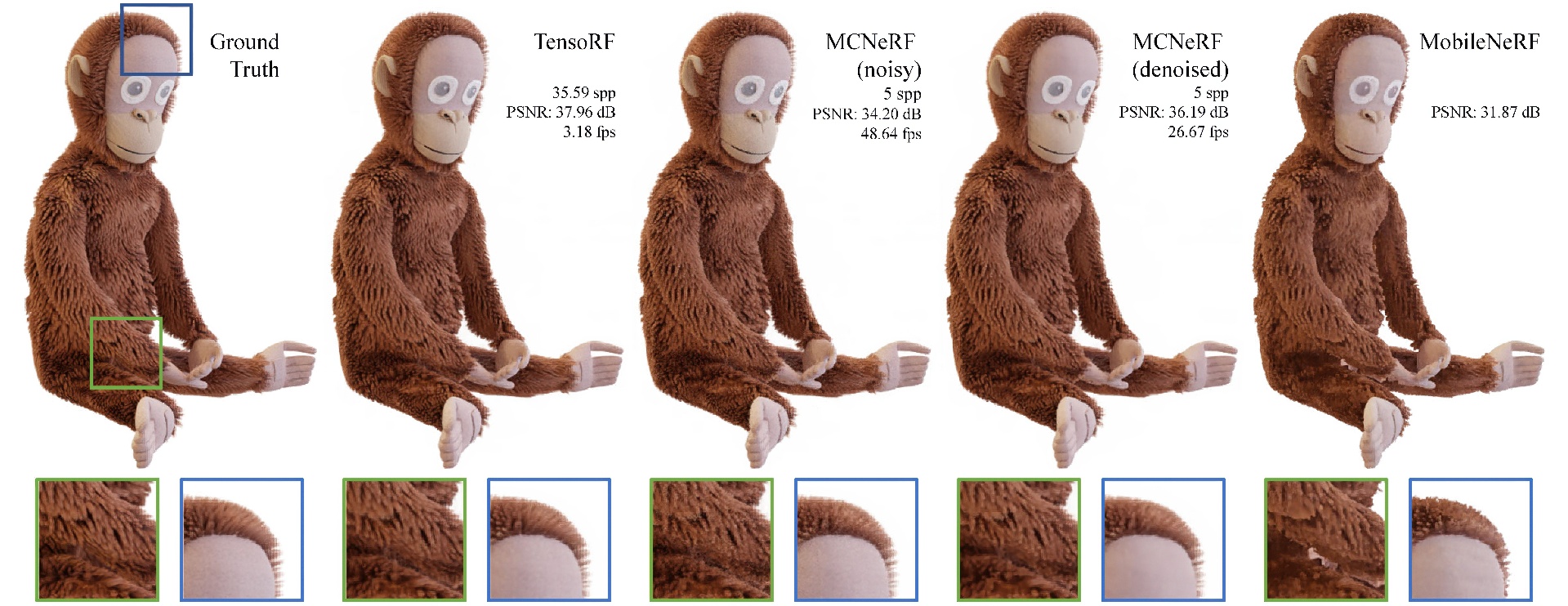
The volume rendering step used in Neural Radiance Fields (NeRFs) produces highly photorealistic results, but is inherently slow because it evaluates an MLP at a large number of sample points per ray. Previous work has addressed this by either proposing neural scene representations that are faster to evaluate or by pre-computing (and approximating) scene properties to reduce render times. In this work, we propose \mcnerf, a \emph{general} Monte Carlo-based rendering algorithm that can speed up \emph{any} NeRF representation. We show that the NeRF volume rendering integral can be efficiently computed via Monte Carlo integration using an importance sampling scheme based on ray transmittance distributions. This allows us to, at render time, vary the number of color samples evaluated per ray to trade-off visual quality (noise variance) against performance. These noisy Monte Carlo estimates can be further denoised using an inexpensive image-space denoiser trained per-scene. We demonstrate that \mcnerf can be used to speed up NeRF representations like TensoRF and Instant-NGP by $7\times$ while closely matching their visual quality and without making the scene approximations that real-time NeRF rendering methods usually make.
References:
[1]
Relja Arandjelović and Andrew Zisserman. 2021. Nerf in detail: Learning to sample for view synthesis. arXiv preprint arXiv:2106.05264 (2021).
[2]
Steve Bako, Thijs Vogels, Brian Mcwilliams, Mark Meyer, Jan NováK, Alex Harvill, Pradeep Sen, Tony Derose, and Fabrice Rousselle. 2017. Kernel-Predicting Convolutional Networks for Denoising Monte Carlo Renderings. ACM Trans. Graph. 36, 4, Article 97 (jul 2017), 14 pages.
[3]
Jonathan T Barron, Ben Mildenhall, Dor Verbin, Pratul P Srinivasan, and Peter Hedman. 2022. Mip-nerf 360: Unbounded anti-aliased neural radiance fields. In Proceedings of the IEEE/CVF Conference on Computer Vision and Pattern Recognition. 5470–5479.
[4]
Chakravarty R Alla Chaitanya, Anton S Kaplanyan, Christoph Schied, Marco Salvi, Aaron Lefohn, Derek Nowrouzezahrai, and Timo Aila. 2017. Interactive reconstruction of Monte Carlo image sequences using a recurrent denoising autoencoder. ACM Transactions on Graphics (TOG) 36, 4 (2017), 1–12.
[5]
Anpei Chen, Zexiang Xu, Andreas Geiger, Jingyi Yu, and Hao Su. 2022b. Tensorf: Tensorial radiance fields. In Computer Vision–ECCV 2022: 17th European Conference, Tel Aviv, Israel, October 23–27, 2022, Proceedings, Part XXXII. Springer, 333–350.
[6]
Zhiqin Chen, Thomas Funkhouser, Peter Hedman, and Andrea Tagliasacchi. 2022a. Mobilenerf: Exploiting the polygon rasterization pipeline for efficient neural field rendering on mobile architectures. arXiv preprint arXiv:2208.00277 (2022).
[7]
Michaël Gharbi, Tzu-Mao Li, Miika Aittala, Jaakko Lehtinen, and Frédo Durand. 2019. Sample-based Monte Carlo denoising using a kernel-splatting network. ACM Transactions on Graphics (TOG) 38, 4 (2019), 1–12.
[8]
Yuan-Chen Guo. 2022. Instant Neural Surface Reconstruction. https://github.com/bennyguo/instant-nsr-pl.
[9]
Miloš Hašan, Jaroslav Křivánek, Bruce Walter, and Kavita Bala. 2009. Virtual spherical lights for many-light rendering of glossy scenes. In ACM SIGGRAPH Asia 2009 papers. 1–6.
[10]
Peter Hedman, Pratul P Srinivasan, Ben Mildenhall, Jonathan T Barron, and Paul Debevec. 2021. Baking neural radiance fields for real-time view synthesis. In Proceedings of the IEEE/CVF International Conference on Computer Vision. 5875–5884.
[11]
Mustafa Işık, Krishna Mullia, Matthew Fisher, Jonathan Eisenmann, and Michaël Gharbi. 2021. Interactive Monte Carlo denoising using affinity of neural features. ACM Transactions on Graphics (TOG) 40, 4 (2021), 1–13.
[12]
Yifan Jiang, Peter Hedman, Ben Mildenhall, Dejia Xu, Jonathan T Barron, Zhangyang Wang, and Tianfan Xue. 2022. AligNeRF: High-Fidelity Neural Radiance Fields via Alignment-Aware Training. arXiv preprint arXiv:2211.09682 (2022).
[13]
Diederik P Kingma and Jimmy Ba. 2014. Adam: A method for stochastic optimization. arXiv preprint arXiv:1412.6980 (2014).
[14]
Murat Kurt, László Szirmay-Kalos, and Jaroslav Křivánek. 2010. An anisotropic BRDF model for fitting and Monte Carlo rendering. ACM SIGGRAPH Computer Graphics 44, 1 (2010), 1–15.
[15]
Andreas Kurz, Thomas Neff, Zhaoyang Lv, Michael Zollhöfer, and Markus Steinberger. 2022. AdaNeRF: Adaptive Sampling for Real-Time Rendering of Neural Radiance Fields. In Computer Vision–ECCV 2022: 17th European Conference, Tel Aviv, Israel, October 23–27, 2022, Proceedings, Part XVII. Springer, 254–270.
[16]
Peter Kutz, Ralf Habel, Yining Karl Li, and Jan Novák. 2017. Spectral and decomposition tracking for rendering heterogeneous volumes. ACM Transactions on Graphics (TOG) 36, 4 (2017), 1–16.
[17]
Jason Lawrence, Szymon Rusinkiewicz, and Ravi Ramamoorthi. 2004. Efficient BRDF importance sampling using a factored representation. ACM Transactions on Graphics (ToG) 23, 3 (2004), 496–505.
[18]
Jun S Liu and Jun S Liu. 2001. Monte Carlo strategies in scientific computing. Vol. 75. Springer.
[19]
Nelson Max. 1995. Optical models for direct volume rendering. IEEE Transactions on Visualization and Computer Graphics 1, 2 (1995), 99–108.
[20]
Ben Mildenhall, Pratul P Srinivasan, Rodrigo Ortiz-Cayon, Nima Khademi Kalantari, Ravi Ramamoorthi, Ren Ng, and Abhishek Kar. 2019. Local light field fusion: Practical view synthesis with prescriptive sampling guidelines. ACM Transactions on Graphics (TOG) 38, 4 (2019), 1–14.
[21]
Ben Mildenhall, Pratul P Srinivasan, Matthew Tancik, Jonathan T Barron, Ravi Ramamoorthi, and Ren Ng. 2020. NeRF: Representing Scenes as Neural Radiance Fields for View Synthesis. In Computer Vision–ECCV 2020: 16th European Conference, Glasgow, UK, August 23–28, 2020, Proceedings, Part I. 405–421.
[22]
Thomas Müller, Alex Evans, Christoph Schied, and Alexander Keller. 2022. Instant neural graphics primitives with a multiresolution hash encoding. ACM Transactions on Graphics (ToG) 41, 4 (2022), 1–15.
[23]
Thomas Müller, Markus Gross, and Jan Novák. 2017. Practical path guiding for efficient light-transport simulation. In Computer Graphics Forum, Vol. 36. Wiley Online Library, 91–100.
[24]
Thomas Neff, Pascal Stadlbauer, Mathias Parger, Andreas Kurz, Joerg H Mueller, Chakravarty R Alla Chaitanya, Anton Kaplanyan, and Markus Steinberger. 2021. DONeRF: Towards Real-Time Rendering of Compact Neural Radiance Fields using Depth Oracle Networks. In Computer Graphics Forum, Vol. 40. Wiley Online Library, 45–59.
[25]
Alexander Rath, Pascal Grittmann, Sebastian Herholz, Petr Vévoda, Philipp Slusallek, and Jaroslav Křivánek. 2020. Variance-aware path guiding. ACM Transactions on Graphics (TOG) 39, 4 (2020), 151–1.
[26]
Christian Reiser, Songyou Peng, Yiyi Liao, and Andreas Geiger. 2021. Kilonerf: Speeding up neural radiance fields with thousands of tiny mlps. In Proceedings of the IEEE/CVF International Conference on Computer Vision. 14335–14345.
[27]
Christian Reiser, Rick Szeliski, Dor Verbin, Pratul Srinivasan, Ben Mildenhall, Andreas Geiger, Jon Barron, and Peter Hedman. 2023. Merf: Memory-efficient radiance fields for real-time view synthesis in unbounded scenes. ACM Transactions on Graphics (TOG) 42, 4 (2023), 1–12.
[28]
Christian P Robert, George Casella, and George Casella. 1999. Monte Carlo statistical methods. Vol. 2. Springer.
[29]
Cheng Sun, Min Sun, and Hwann-Tzong Chen. 2022. Direct voxel grid optimization: Super-fast convergence for radiance fields reconstruction. In Proceedings of the IEEE/CVF Conference on Computer Vision and Pattern Recognition. 5459–5469.
[30]
Petr Vévoda, Ivo Kondapaneni, and Jaroslav Křivánek. 2018. Bayesian online regression for adaptive direct illumination sampling. ACM Transactions on Graphics (TOG) 37, 4 (2018), 1–12.
[31]
Thijs Vogels, Fabrice Rousselle, Brian Mcwilliams, Gerhard Röthlin, Alex Harvill, David Adler, Mark Meyer, and Jan Novák. 2018. Denoising with Kernel Prediction and Asymmetric Loss Functions. ACM Trans. Graph. 37, 4, Article 124 (jul 2018), 15 pages.
[32]
E Woodcock, T Murphy, P Hemmings, and S Longworth. 1965. Techniques used in the GEM code for Monte Carlo neutronics calculations in reactors and other systems of complex geometry. In Proc. Conf. Applications of Computing Methods to Reactor Problems, Vol. 557. Argonne National Laboratory.
[33]
Lior Yariv, Peter Hedman, Christian Reiser, Dor Verbin, Pratul P Srinivasan, Richard Szeliski, Jonathan T Barron, and Ben Mildenhall. 2023. BakedSDF: Meshing Neural SDFs for Real-Time View Synthesis. arXiv preprint arXiv:2302.14859 (2023).
[34]
Alex Yu, Sara Fridovich-Keil, Matthew Tancik, Qinhong Chen, Benjamin Recht, and Angjoo Kanazawa. 2021a. Plenoxels: Radiance fields without neural networks. arXiv preprint arXiv:2112.05131 (2021).
[35]
Alex Yu, Ruilong Li, Matthew Tancik, Hao Li, Ren Ng, and Angjoo Kanazawa. 2021b. Plenoctrees for real-time rendering of neural radiance fields. In Proceedings of the IEEE/CVF International Conference on Computer Vision. 5752–5761.



