“Extended Path Space Manifolds for Physically Based Differentiable Rendering” by Xing, Hu, Luan, Yan and Xu
Conference:
Type(s):
Title:
- Extended Path Space Manifolds for Physically Based Differentiable Rendering
Session/Category Title:
- Applications & Innovations
Presenter(s)/Author(s):
Abstract:
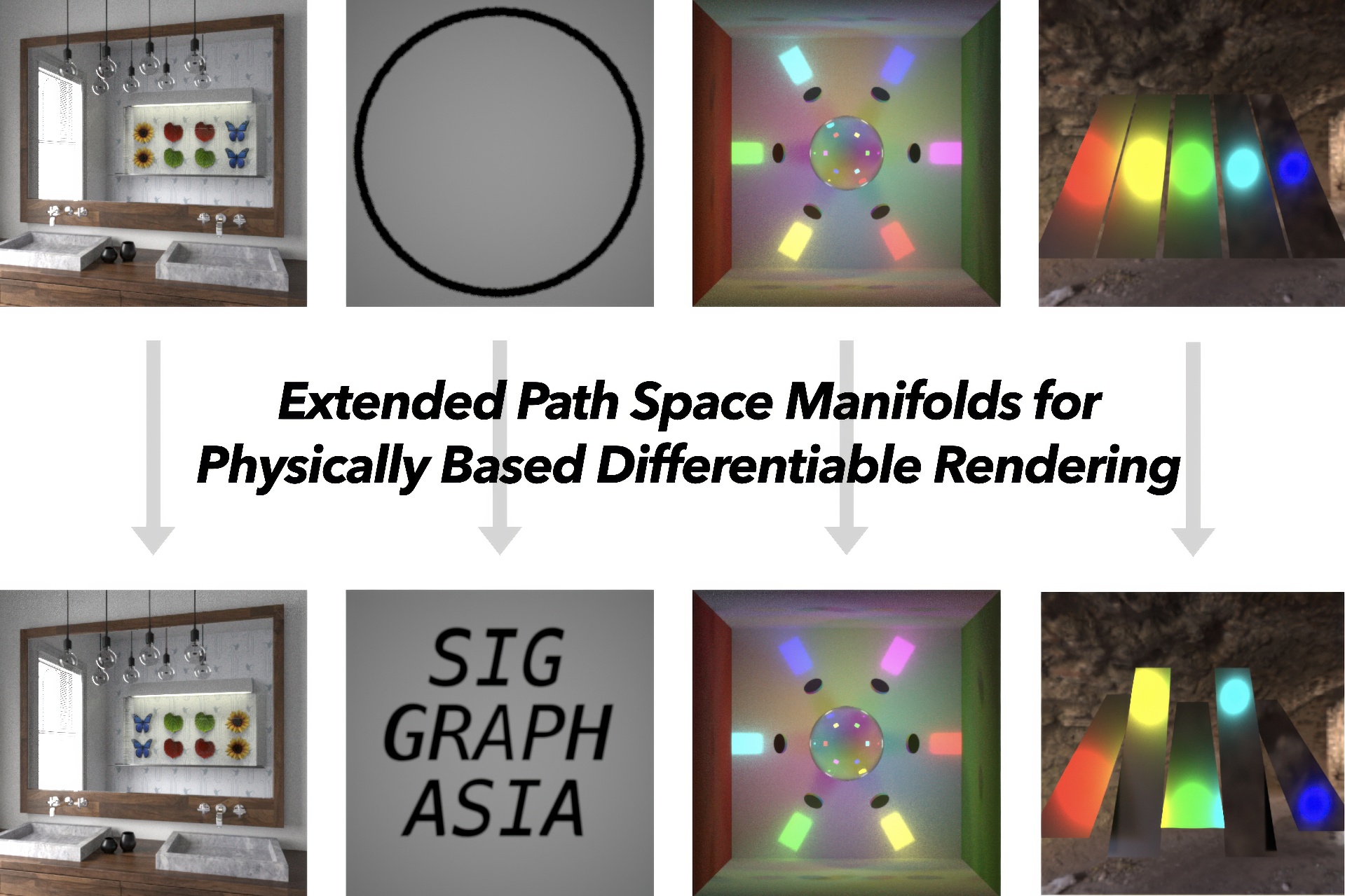
Physically based differentiable rendering has become an increasingly important topic in recent years. A common pipeline computes local color derivatives of light paths or pixels with respect to arbitrary scene parameters, and enables optimizing or recovering the scene parameters through iterative gradient descent by minimizing the difference between rendered and target images. However, existing approaches cannot robustly handle complex illumination effects including reflections, refractions, caustics, shadows, and highlights, especially when the initial and target locations of such illumination effects are not close to each other in the image space. To address this problem, we propose a novel data structure named extended path space manifolds. The manifolds are defined in the combined space of path vertices and scene parameters. By enforcing geometric constraints, the path vertices could be implicitly and uniquely determined by perturbed scene parameters. This enables the manifold to track specific illumination effects and the corresponding paths, i.e., specular paths will still be specular paths after scene parameters are perturbed. Besides, the path derivatives with respect to scene parameters could be computed by solving small linear systems. We further propose a physically based differentiable rendering method built upon the theoretical results of extended path space manifolds. By incorporating the path derivatives computed from the manifolds and an optimal transport based loss function, our method is demonstrated to be more effective and robust than state-of-the-art approaches in inverse rendering applications involving complex illumination effects.
References:
[1]
Sai Praveen Bangaru, Tzu-Mao Li, and Frédo Durand. 2020. Unbiased warped-area sampling for differentiable rendering. ACM Transactions on Graphics (TOG) 39, 6 (2020), 1–18.
[2]
Benedikt Bitterli. 2016. Rendering resources. https://benedikt-bitterli.me/resources/.
[3]
Guangyan Cai, Kai Yan, Zhao Dong, Ioannis Gkioulekas, and Shuang Zhao. 2022. Physics-Based Inverse Rendering using Combined Implicit and Explicit Geometries. arXiv preprint arXiv:2205.01242 (2022).
[4]
Marco Cuturi. 2013. Sinkhorn distances: Lightspeed computation of optimal transport. Advances in neural information processing systems 26 (2013).
[5]
Xi Deng, Fujun Luan, Bruce Walter, Kavita Bala, and Steve Marschner. 2022. Reconstructing Translucent Objects using Differentiable Rendering. In Special Interest Group on Computer Graphics and Interactive Techniques Conference Proceedings. 1–10.
[6]
Jean Feydy, Thibault Séjourné, François-Xavier Vialard, Shun-ichi Amari, Alain Trouve, and Gabriel Peyré. 2019. Interpolating between Optimal Transport and MMD using Sinkhorn Divergences. In The 22nd International Conference on Artificial Intelligence and Statistics. 2681–2690.
[7]
Michael Fischer and Tobias Ritschel. 2022. Plateau-reduced Differentiable Path Tracing. Proceedings of the IEEE/CVF Conference on Computer Vision and Pattern Recognition (2022).
[8]
Duan Gao, Xiao Li, Yue Dong, Pieter Peers, Kun Xu, and Xin Tong. 2019. Deep inverse rendering for high-resolution SVBRDF estimation from an arbitrary number of images.ACM Trans. Graph. 38, 4 (2019), 134–1.
[9]
Ioannis Gkioulekas, Shuang Zhao, Kavita Bala, Todd Zickler, and Anat Levin. 2013. Inverse volume rendering with material dictionaries. ACM Transactions on Graphics (TOG) 32, 6 (2013), 1–13.
[10]
Yu Guo, Cameron Smith, Miloš Hašan, Kalyan Sunkavalli, and Shuang Zhao. 2020. MaterialGAN: reflectance capture using a generative SVBRDF model. arXiv preprint arXiv:2010.00114 (2020).
[11]
Paul S. Heckbert. 1990. Adaptive Radiosity Textures for Bidirectional Ray Tracing. In Proceedings of the 17th Annual Conference on Computer Graphics and Interactive Techniques (Dallas, TX, USA) (SIGGRAPH ’90). Association for Computing Machinery, New York, NY, USA, 145–154. https://doi.org/10.1145/97879.97895
[12]
Homan Igehy. 1999. Tracing ray differentials. In Proceedings of the 26th annual conference on Computer graphics and interactive techniques. 179–186.
[13]
Wenzel Jakob and Steve Marschner. 2012. Manifold exploration: A markov chain monte carlo technique for rendering scenes with difficult specular transport. ACM Transactions on Graphics (TOG) 31, 4 (2012), 1–13.
[14]
Wenzel Jakob, Sébastien Speierer, Nicolas Roussel, Merlin Nimier-David, Delio Vicini, Tizian Zeltner, Baptiste Nicolet, Miguel Crespo, Vincent Leroy, and Ziyi Zhang. 2022b. Mitsuba 3 renderer. https://mitsuba-renderer.org.
[15]
Wenzel Jakob, Sébastien Speierer, Nicolas Roussel, and Delio Vicini. 2022a. Dr.Jit: A Just-In-Time Compiler for Differentiable Rendering. Transactions on Graphics (Proceedings of SIGGRAPH) 41, 4 (July 2022). https://doi.org/10.1145/3528223.3530099
[16]
Wenzel Alban Jakob. 2013. Light transport on path-space manifolds. Cornell University.
[17]
Anton S Kaplanyan, Johannes Hanika, and Carsten Dachsbacher. 2014. The natural-constraint representation of the path space for efficient light transport simulation. ACM Transactions on Graphics (TOG) 33, 4 (2014), 1–13.
[18]
Hiroharu Kato, Yoshitaka Ushiku, and Tatsuya Harada. 2018. Neural 3d mesh renderer. In Proceedings of the IEEE conference on computer vision and pattern recognition. 3907–3916.
[19]
Pramook Khungurn, Daniel Schroeder, Shuang Zhao, Kavita Bala, and Steve Marschner. 2015. Matching Real Fabrics with Micro-Appearance Models.ACM Trans. Graph. 35, 1 (2015), 1–1.
[20]
Diederik P Kingma and Jimmy Ba. 2014. Adam: A method for stochastic optimization. arXiv preprint arXiv:1412.6980 (2014).
[21]
Samuli Laine, Janne Hellsten, Tero Karras, Yeongho Seol, Jaakko Lehtinen, and Timo Aila. 2020. Modular primitives for high-performance differentiable rendering. ACM Transactions on Graphics (TOG) 39, 6 (2020), 1–14.
[22]
Tzu-Mao Li, Miika Aittala, Frédo Durand, and Jaakko Lehtinen. 2018. Differentiable monte carlo ray tracing through edge sampling. ACM Transactions on Graphics (TOG) 37, 6 (2018), 1–11.
[23]
Shichen Liu, Tianye Li, Weikai Chen, and Hao Li. 2019. Soft rasterizer: A differentiable renderer for image-based 3d reasoning. In Proceedings of the IEEE/CVF International Conference on Computer Vision. 7708–7717.
[24]
Matthew Loper, Naureen Mahmood, Javier Romero, Gerard Pons-Moll, and Michael J. Black. 2015. SMPL: A Skinned Multi-Person Linear Model. ACM Trans. Graphics (Proc. SIGGRAPH Asia) 34, 6 (Oct. 2015), 248:1–248:16.
[25]
Matthew M Loper and Michael J Black. 2014. OpenDR: An approximate differentiable renderer. In European Conference on Computer Vision. Springer, 154–169.
[26]
Guillaume Loubet, Nicolas Holzschuch, and Wenzel Jakob. 2019. Reparameterizing discontinuous integrands for differentiable rendering. ACM Transactions on Graphics (TOG) 38, 6 (2019), 1–14.
[27]
Fujun Luan, Shuang Zhao, Kavita Bala, and Zhao Dong. 2021. Unified shape and svbrdf recovery using differentiable monte carlo rendering. In Computer Graphics Forum, Vol. 40. Wiley Online Library, 101–113.
[28]
Jiahui Lyu, Bojian Wu, Dani Lischinski, Daniel Cohen-Or, and Hui Huang. 2020. Differentiable refraction-tracing for mesh reconstruction of transparent objects. ACM Transactions on Graphics (TOG) 39, 6 (2020), 1–13.
[29]
Jacob Munkberg, Jon Hasselgren, Tianchang Shen, Jun Gao, Wenzheng Chen, Alex Evans, Thomas Müller, and Sanja Fidler. 2021. Extracting Triangular 3D Models, Materials, and Lighting From Images. arXiv preprint arXiv:2111.12503 (2021).
[30]
Merlin Nimier-David, Delio Vicini, Tizian Zeltner, and Wenzel Jakob. 2019. Mitsuba 2: A retargetable forward and inverse renderer. ACM Transactions on Graphics (TOG) 38, 6 (2019), 1–17.
[31]
Adam Paszke, Sam Gross, Francisco Massa, Adam Lerer, James Bradbury, Gregory Chanan, Trevor Killeen, Zeming Lin, Natalia Gimelshein, Luca Antiga, Alban Desmaison, Andreas Kopf, Edward Yang, Zachary DeVito, Martin Raison, Alykhan Tejani, Sasank Chilamkurthy, Benoit Steiner, Lu Fang, Junjie Bai, and Soumith Chintala. 2019. PyTorch: An Imperative Style, High-Performance Deep Learning Library. In Advances in Neural Information Processing Systems 32. Curran Associates, Inc., 8024–8035. http://papers.neurips.cc/paper/9015-pytorch-an-imperative-style-high-performance-deep-learning-library.pdf
[32]
Nikhila Ravi, Jeremy Reizenstein, David Novotny, Taylor Gordon, Wan-Yen Lo, Justin Johnson, and Georgia Gkioxari. 2020. Accelerating 3d deep learning with pytorch3d. arXiv preprint arXiv:2007.08501 (2020).
[33]
Liang Shi, Beichen Li, Miloš Hašan, Kalyan Sunkavalli, Tamy Boubekeur, Radomir Mech, and Wojciech Matusik. 2020. MATch: Differentiable material graphs for procedural material capture. (2020).
[34]
Michael Spivak. 1965. Calculus On Manifolds: A Modern Approach To Classical Theorems Of Advanced Calculus (1st ed.). CRC Press. https://doi.org/10.1201/9780429501906
[35]
Eric Veach. 1998. Robust Monte Carlo methods for light transport simulation. Stanford University.
[36]
Eric Veach and Leonidas J Guibas. 1997. Metropolis light transport. In Proceedings of the 24th annual conference on Computer graphics and interactive techniques. 65–76.
[37]
Delio Vicini, Sébastien Speierer, and Wenzel Jakob. 2021. Path Replay Backpropagation: Differentiating Light Paths using Constant Memory and Linear Time. Transactions on Graphics (Proceedings of SIGGRAPH) 40, 4 (Aug. 2021), 108:1–108:14. https://doi.org/10.1145/3450626.3459804
[38]
Delio Vicini, Sébastien Speierer, and Wenzel Jakob. 2022. Differentiable signed distance function rendering. ACM Transactions on Graphics (TOG) 41, 4 (2022), 1–18.
[39]
Bruce Walter, Stephen R Marschner, Hongsong Li, and Kenneth E Torrance. 2007. Microfacet models for refraction through rough surfaces. In Proceedings of the 18th Eurographics conference on Rendering Techniques. 195–206.
[40]
Jiankai Xing, Fujun Luan, Ling-Qi Yan, Xuejun Hu, Houde Qian, and Kun Xu. 2022. Differentiable Rendering using RGBXY Derivatives and Optimal Transport. ACM Trans. Graph. 41, 6, Article 189 (dec 2022), 13 pages. https://doi.org/10.1145/3550454.3555479
[41]
Kai Yan, Christoph Lassner, Brian Budge, Zhao Dong, and Shuang Zhao. 2022. Efficient Estimation of Boundary Integrals for Path-Space Differentiable Rendering. ACM Trans. Graph. 41, 4 (2022), 123:1–123:13.
[42]
Tizian Zeltner, Iliyan Georgiev, and Wenzel Jakob. 2020. Specular manifold sampling for rendering high-frequency caustics and glints. ACM Transactions on Graphics (TOG) 39, 4 (2020), 149–1.
[43]
Tizian Zeltner, Sébastien Speierer, Iliyan Georgiev, and Wenzel Jakob. 2021. Monte Carlo estimators for differential light transport. ACM Transactions on Graphics (TOG) 40, 4 (2021), 1–16.
[44]
Cheng Zhang, Bailey Miller, Kan Yan, Ioannis Gkioulekas, and Shuang Zhao. 2020. Path-space differentiable rendering. ACM transactions on graphics 39, 4 (2020).
[45]
Cheng Zhang, Zihan Yu, and Shuang Zhao. 2021. Path-space differentiable rendering of participating media. ACM Transactions on Graphics (TOG) 40, 4 (2021), 1–15.
[46]
Shuang Zhao, Lifan Wu, Frédo Durand, and Ravi Ramamoorthi. 2016. Downsampling scattering parameters for rendering anisotropic media. ACM Transactions on Graphics (TOG) 35, 6 (2016), 1–11.