
“Adaptive Tracking of a Single-Rigid-Body Character in Various Environments” by Kwon, Gu, Ahn and Lee
Conference:
Type(s):
Title:
- Adaptive Tracking of a Single-Rigid-Body Character in Various Environments
Session/Category Title:
- Motion Capture and Reconstruction
Presenter(s)/Author(s):
Abstract:
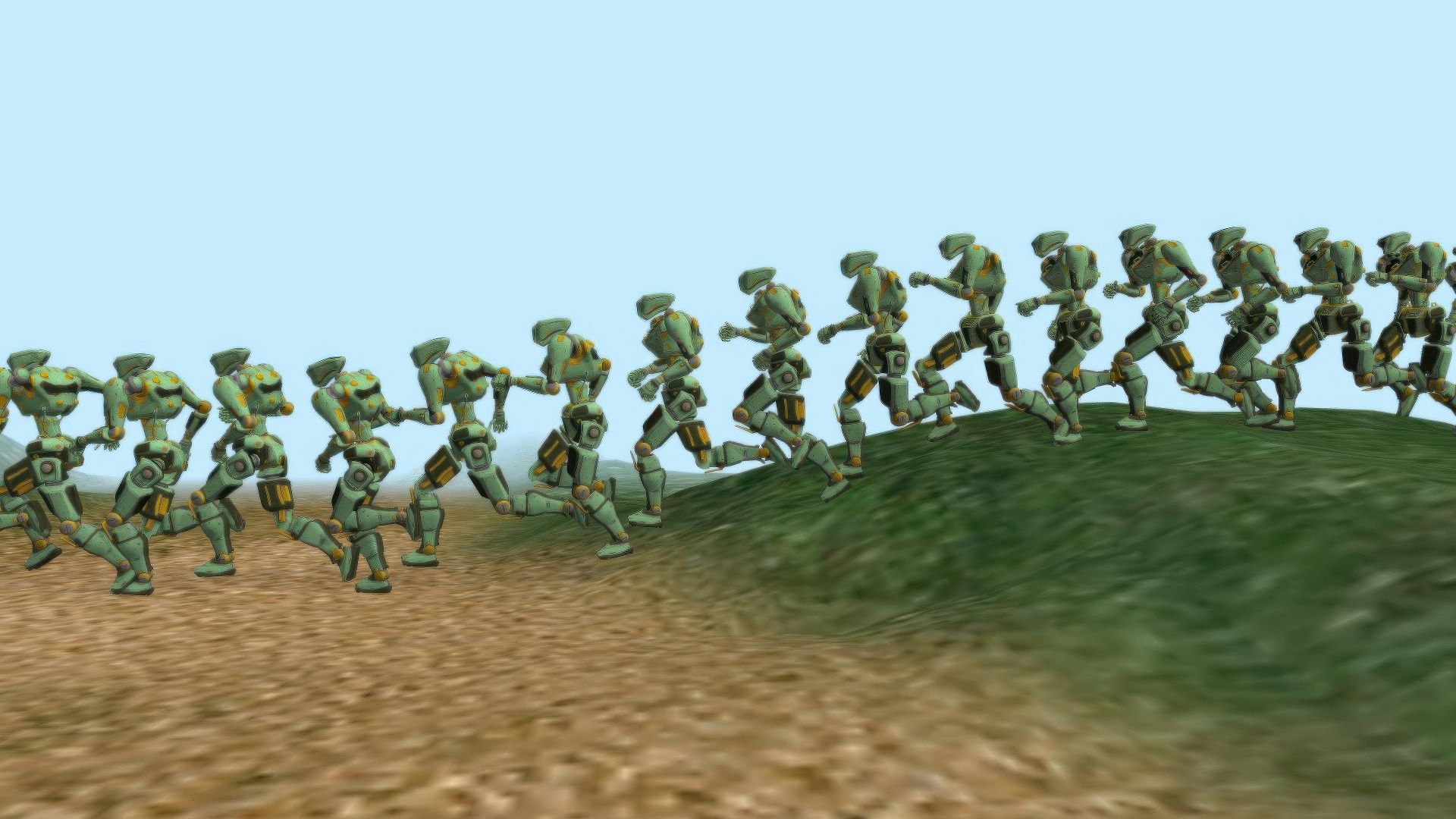
Since the introduction of DeepMimic [Peng et al. 2018], subsequent research has focused on expanding the repertoire of simulated motions across various scenarios. In this study, we propose an alternative approach for this goal, a deep reinforcement learning method based on the simulation of a single- rigid-body character. Using the centroidal dynamics model (CDM) to express the full-body character as a single rigid body (SRB) and training a policy to track a reference motion, we can obtain a policy that is capable of adapting to various unobserved environmental changes and controller transitions without requiring any additional learning. Due to the reduced dimension of state and action space, the learning process is sample-efficient. The final full-body motion is kinematically generated in a physically plausible way, based on the state of the simulated SRB character. The SRB simulation is formulated as a quadratic programming (QP) problem, and the policy outputs an action that allows the SRB character to follow the reference motion. We demonstrate that our policy, efficiently trained within 30 minutes on an ultraportable laptop, has the ability to cope with environments that have not been experienced during learning, such as running on uneven terrain or pushing a box, and transitions between learned policies, without any additional learning.
References:
[1]
Yeuhi Abe, Marco Da Silva, and Jovan Popović. 2007. Multiobjective control with frictional contacts. In Proceedings of the 2007 ACM SIGGRAPH/Eurographics symposium on Computer animation. 249–258.
[2]
Shailen Agrawal, Shuo Shen, and Michiel van de Panne. 2013. Diverse motion variations for physics-based character animation. In Proceedings of the 12th ACM SIGGRAPH/Eurographics Symposium on Computer Animation. 37–44.
[3]
Kevin Bergamin, Simon Clavet, Daniel Holden, and James Richard Forbes. 2019. DReCon: data-driven responsive control of physics-based characters. ACM Transactions on Graphics (TOG) 38, 6 (Nov. 2019), 206:1–206:11.
[4]
Greg Brockman, Vicki Cheung, Ludwig Pettersson, Jonas Schneider, John Schulman, Jie Tang, and Wojciech Zaremba. 2016. Openai gym. arXiv preprint arXiv:1606.01540 (2016).
[5]
Nuttapong Chentanez, Matthias Müller, Miles Macklin, Viktor Makoviychuk, and Stefan Jeschke. 2018. Physics-Based Motion Capture Imitation with Deep Reinforcement Learning. In Proceedings of the 11th ACM SIGGRAPH Conference on Motion, Interaction and Games(MIG ’18). Article 1, 10 pages.
[6]
Kyungmin Cho, Chaelin Kim, Jungjin Park, Joonkyu Park, and Junyong Noh. 2021. Motion recommendation for online character control. ACM Transactions on Graphics 40, 6 (2021).
[7]
Stelian Coros, Philippe Beaudoin, and Michiel van de Panne. 2009. Robust task-based control policies for physics-based characters. ACM Trans. Graph. (Proc. SIGGRAPH Asia) 28, 5 (2009), 1–9.
[8]
Stelian Coros, Philippe Beaudoin, and Michiel Van de Panne. 2010. Generalized biped walking control. ACM Transactions On Graphics (TOG) 29, 4 (2010), 1–9.
[9]
Marco Da Silva, Yeuhi Abe, and Jovan Popović. 2008. Simulation of human motion data using short-horizon model-predictive control. In Computer Graphics Forum, Vol. 27. 371–380.
[10]
Yan Duan, Xi Chen, Rein Houthooft, John Schulman, and Pieter Abbeel. 2016. Benchmarking deep reinforcement learning for continuous control. In Proceedings of the 33rd International Conference on International Conference on Machine Learning – Volume 48(ICML’16). 1329–1338.
[11]
Jane Ellis, Harald Winkler, Jan Corfee-Morlot, and Frédéric Gagnon-Lebrun. 2007. CDM: Taking stock and looking forward. Energy policy 35, 1 (2007), 15–28.
[12]
Sehoon Ha and C Karen Liu. 2014. Iterative training of dynamic skills inspired by human coaching techniques. ACM Transactions on Graphics (TOG) 34, 1 (2014), 1–11.
[13]
Perttu Hämäläinen, Joose Rajamäki, and C Karen Liu. 2015. Online control of simulated humanoids using particle belief propagation. ACM Transactions on Graphics (TOG) 34, 4 (2015), 1–13.
[14]
Daniel Holden, Taku Komura, and Jun Saito. 2017. Phase-Functioned Neural Networks for Character Control. ACM Transactions on Graphics 36, 4, Article 42 (2017), 13 pages.
[15]
Jaepyung Hwang, Kwanguk Kim, Il Hong Suh, and Taesoo Kwon. 2017. Performance-based animation using constraints for virtual object manipulation. IEEE computer graphics and applications 37, 4 (2017), 95–102.
[16]
Taesoo Kwon and Jessica K Hodgins. 2017. Momentum-mapped inverted pendulum models for controlling dynamic human motions. ACM Transactions on Graphics (TOG) 36, 1 (2017), 1–14.
[17]
Taesoo Kwon, Yoonsang Lee, and Michiel Van De Panne. 2020. Fast and flexible multilegged locomotion using learned centroidal dynamics. ACM Transactions on Graphics (TOG) 39, 4 (2020), 46–1.
[18]
Seyoung Lee, Jiye Lee, and Jehee Lee. 2022. Learning Virtual Chimeras by Dynamic Motion Reassembly. ACM Transactions on Graphics 41, 6 (2022), 182:1–182:13.
[19]
Seyoung Lee, Sunmin Lee, Yongwoo Lee, and Jehee Lee. 2021. Learning a family of motor skills from a single motion clip. ACM Transactions on Graphics 40, 4 (July 2021), 93:1–93:13.
[20]
Yoonsang Lee, Sungeun Kim, and Jehee Lee. 2010. Data-driven biped control. ACM Trans. Graph. 29, 4 (2010), 1–8.
[21]
Yoonsang Lee, Kyungho Lee, Soon-Sun Kwon, Jiwon Jeong, Carol O’Sullivan, Moon Seok Park, and Jehee Lee. 2015. Push-recovery Stability of Biped Locomotion. ACM Transactions on Graphics (TOG) 34, 6 (2015), 180:1–180:9.
[22]
Hung Yu Ling, Fabio Zinno, George Cheng, and Michiel Van De Panne. 2020. Character controllers using motion VAEs. ACM Transactions on Graphics 39, 4 (2020).
[23]
Libin Liu and Jessica Hodgins. 2017. Learning to schedule control fragments for physics-based characters using deep q-learning. ACM Transactions on Graphics (TOG) 36, 3 (2017), 1–14.
[24]
Adriano Macchietto, Victor Zordan, and Christian R. Shelton. 2009. Momentum control for balance. ACM Transactions on Graphics 28, 3 (July 2009), 80:1–80:8.
[25]
Igor Mordatch, Emanuel Todorov, and Zoran Popović. 2012. Discovery of complex behaviors through contact-invariant optimization. ACM Transactions on Graphics (TOG) 31, 4 (2012), 1–8.
[26]
Soohwan Park, Hoseok Ryu, Seyoung Lee, Sunmin Lee, and Jehee Lee. 2019. Learning predict-and-simulate policies from unorganized human motion data. ACM Transactions on Graphics 38, 6 (2019), 205:1–205:11.
[27]
Xue Bin Peng, Pieter Abbeel, Sergey Levine, and Michiel van de Panne. 2018a. Deepmimic: Example-guided deep reinforcement learning of physics-based character skills. ACM Transactions on Graphics (TOG) 37, 4 (2018), 1–14.
[28]
Xue Bin Peng, Glen Berseth, and Michiel Van de Panne. 2015. Dynamic terrain traversal skills using reinforcement learning. ACM Transactions on Graphics (TOG) 34, 4 (2015), 1–11.
[29]
Xue Bin Peng, Glen Berseth, and Michiel Van de Panne. 2016. Terrain-adaptive locomotion skills using deep reinforcement learning. ACM Transactions on Graphics (TOG) 35, 4 (2016), 1–12.
[30]
Xue Bin Peng, Glen Berseth, KangKang Yin, and Michiel van de Panne. 2017. DeepLoco: Dynamic Locomotion Skills Using Hierarchical Deep Reinforcement Learning. ACM Transactions on Graphics (Proc. SIGGRAPH 2017) 36, 4 (2017).
[31]
Xue Bin Peng, Yunrong Guo, Lina Halper, Sergey Levine, and Sanja Fidler. 2022. ASE: large-scale reusable adversarial skill embeddings for physically simulated characters. ACM Transactions on Graphics 41, 4 (July 2022), 94:1–94:17.
[32]
Xue Bin Peng, Angjoo Kanazawa, Jitendra Malik, Pieter Abbeel, and Sergey Levine. 2018b. SFV: Reinforcement Learning of Physical Skills from Videos. ACM Trans. Graph. 37, 6, Article 178 (dec 2018), 14 pages. https://doi.org/10.1145/3272127.3275014
[33]
Xue Bin Peng, Ze Ma, Pieter Abbeel, Sergey Levine, and Angjoo Kanazawa. 2021. AMP: adversarial motion priors for stylized physics-based character control. ACM Transactions on Graphics 40, 4 (2021), 144:1–144:20.
[34]
Aravind Rajeswaran, Vikash Kumar, Abhishek Gupta, Giulia Vezzani, John Schulman, Emanuel Todorov, and Sergey Levine. 2017. Learning complex dexterous manipulation with deep reinforcement learning and demonstrations. arXiv preprint arXiv:1709.10087 (2017).
[35]
Daniele Reda, Hung Yu Ling, and Michiel van de Panne. 2022. Learning to Brachiate via Simplified Model Imitation. In ACM SIGGRAPH 2022 Conference Proceedings(SIGGRAPH ’22). Article 24, 9 pages.
[36]
Sebastian Starke, He Zhang, Taku Komura, and Jun Saito. 2019. Neural State Machine for Character-Scene Interactions. ACM Transactions on Graphics 38, 6, Article 209 (2019), 14 pages.
[37]
Yuval Tassa, Tom Erez, and Emanuel Todorov. 2012. Synthesis and stabilization of complex behaviors through online trajectory optimization. In 2012 IEEE/RSJ International Conference on Intelligent Robots and Systems. IEEE, 4906–4913.
[38]
Vassilios Tsounis, Mitja Alge, Joonho Lee, Farbod Farshidian, and Marco Hutter. 2020. Deepgait: Planning and control of quadrupedal gaits using deep reinforcement learning. IEEE Robotics and Automation Letters 5, 2 (2020), 3699–3706.
[39]
Julian Viereck and Ludovic Righetti. 2021. Learning a centroidal motion planner for legged locomotion. In 2021 IEEE International Conference on Robotics and Automation (ICRA). IEEE, 4905–4911.
[40]
Kevin Wampler, Zoran Popović, and Jovan Popović. 2014. Generalizing locomotion style to new animals with inverse optimal regression. ACM Transactions on Graphics (TOG) 33, 4 (2014), 1–11.
[41]
Jack M Wang, Samuel R Hamner, Scott L Delp, and Vladlen Koltun. 2012. Optimizing locomotion controllers using biologically-based actuators and objectives. ACM Transactions on Graphics (TOG) 31, 4 (2012), 1–11.
[42]
Alexander W Winkler, C Dario Bellicoso, Marco Hutter, and Jonas Buchli. 2018. Gait and trajectory optimization for legged systems through phase-based end-effector parameterization. IEEE Robotics and Automation Letters 3, 3 (2018), 1560–1567.
[43]
Jungdam Won, Deepak Gopinath, and Jessica Hodgins. 2022. Physics-based character controllers using conditional VAEs. ACM Transactions on Graphics 41, 4 (2022), 96:1–96:12.
[44]
Zhaoming Xie, Xingye Da, Buck Babich, Animesh Garg, and Michiel van de Panne. 2022. Glide: Generalizable quadrupedal locomotion in diverse environments with a centroidal model. In Algorithmic Foundations of Robotics XV: Proceedings of the Fifteenth Workshop on the Algorithmic Foundations of Robotics. Springer, 523–539.
[45]
Zhaoming Xie, Hung Yu Ling, Nam Hee Kim, and Michiel van de Panne. 2020. ALLSTEPS: Curriculum-driven Learning of Stepping Stone Skills. Computer Graphics Forum 39, 8 (2020), 213–224.
[46]
Heyuan Yao, Zhenhua Song, Baoquan Chen, and Libin Liu. 2022. ControlVAE: Model-Based Learning of Generative Controllers for Physics-Based Characters. ACM Transactions on Graphics 41, 6 (2022), 183:1–183:16.
[47]
Yuting Ye and C. Karen Liu. 2010. Optimal feedback control for character animation using an abstract model. ACM Trans. Graph. 29, 4 (2010), 1–9.
[48]
KangKang Yin, Kevin Loken, and Michiel Van de Panne. 2007. Simbicon: Simple biped locomotion control. ACM Transactions on Graphics (TOG) 26, 3 (2007), 105–es.
[49]
Zhiqi Yin, Zeshi Yang, Michiel Van De Panne, and Kangkang Yin. 2021. Discovering diverse athletic jumping strategies. ACM Transactions on Graphics 40, 4 (July 2021), 91:1–91:17.
[50]
He Zhang, Sebastian Starke, Taku Komura, and Jun Saito. 2018. Mode-Adaptive Neural Networks for Quadruped Motion Control. ACM Transactions on Graphics 37, 4 (2018).



