“Joint computational design of workspaces and workplans” by Zhang, Huang, Plaku and Yu
Conference:
Type(s):
Title:
- Joint computational design of workspaces and workplans
Session/Category Title:
- Scene Synthesis and Navigation
Presenter(s)/Author(s):
Abstract:
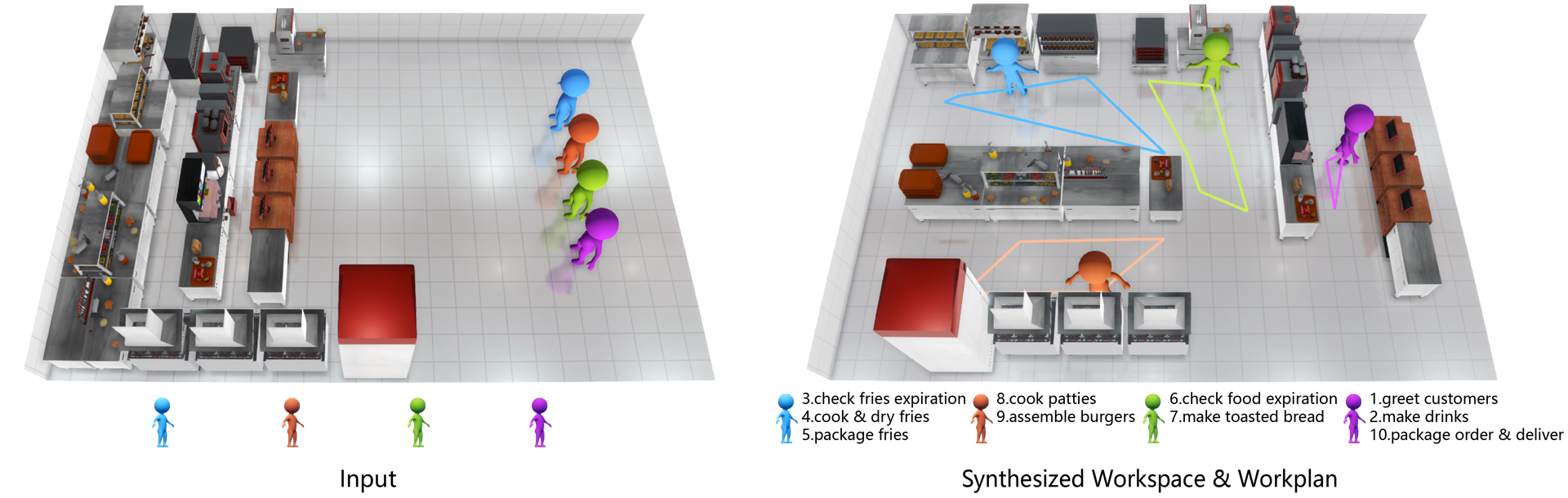
Humans assume different production roles in a workspace. On one hand, humans design workplans to complete tasks as efficiently as possible in order to improve productivity. On the other hand, a nice workspace is essential to facilitate teamwork. In this way, workspace design and workplan design complement each other. Inspired by such observations, we propose an automatic approach to jointly design a workspace and a workplan. Taking staff properties, a space, and work equipment as input, our approach jointly optimizes a workspace and a workplan, considering performance factors such as time efficiency and congestion avoidance, as well as workload factors such as walk effort, turn effort, and workload balances. To enable exploration of design trade-offs, our approach generates a set of Pareto-optimal design solutions with strengths on different objectives, which can be adopted for different work scenarios. We apply our approach to synthesize workspaces and workplans for different workplaces such as a fast food kitchen and a supermarket. We also extend our approach to incorporate other common work considerations such as dynamic work demands and accommodating staff members with different physical capabilities. Evaluation experiments with simulations validate the efficacy of our approach for synthesizing effective workspaces and workplans.
References:
1. Badreddine Aboulissane, Dikra El Haiek, Larbi El Bakkali, and Jalal El Bahaoui. 2019. On the workspace optimization of parallel robots based on CAD approach. Procedia Manufacturing 32 (2019), 1085–1092.
2. Shailen Agrawal and Michiel van de Panne. 2016. Task-based locomotion. ACM Transactions on Graphics 35, 4 (2016), 1–11.
3. Rachid Alami, Aurélie Clodic, Vincent Montreuil, Emrah Akin Sisbot, and Raja Chatila. 2005. Task planning for human-robot interaction. In Proceedings of the 2005 joint conference on Smart objects and ambient intelligence: innovative context-aware services: usages and technologies. 81–85.
4. Sergey Alatartsev, Sebastian Stellmacher, and Frank Ortmeier. 2015. Robotic task sequencing problem: A survey. Journal of intelligent & robotic systems 80, 2 (2015), 279–298.
5. Daniel G Aliaga, Carlos A Vanegas, and Bedrich Benes. 2008. Interactive example-based urban layout synthesis. ACM Transactions on Graphics 27, 5 (2008), 1–10.
6. Yunfei Bai, Kristin Siu, and C Karen Liu. 2012. Synthesis of concurrent object manipulation tasks. ACM Transactions on Graphics 31, 6 (2012), 1–9.
7. R Banos, C Gil, B Paechter, and J Ortega. 2006. Parallelization of population-based multi-objective meta-heuristics: An empirical study. Applied Mathematical Modelling 30, 7 (2006), 578–592.
8. Fan Bao, Dong-Ming Yan, Niloy J Mitra, and Peter Wonka. 2013. Generating and exploring good building layouts. ACM Transactions on Graphics 32, 4 (2013), 1–10.
9. Cenk Baykal and Ron Alterovitz. 2017. Asymptotically Optimal Design of Piece-wise Cylindrical Robots using Motion Planning.. In Robotics: Science and Systems, Vol. 2017.
10. Omar Binhomaid and Tarek Hegazy. 2020. Agent-based Simulation of Workers’ Behaviors, Productivity, and Safety around Construction Obstacles. Canadian Journal of Civil Engineering ja (2020).
11. Gabriel R Bitran and Devanath Tirupati. 1993. Hierarchical production planning. Handbooks in operations research and management science 4 (1993), 523–568.
12. Michael Brill. 1992. Workspace design and productivity.. In The Healthcare Forum Journal, Vol. 35. 51–53.
13. Ole Broberg. 2010. Workspace design: a case study applying participatory design principles of healthy workplaces in an industrial setting. International Journal of Technology Management 51, 1 (2010), 39–56.
14. Emma Campbell. 2013. The 7 Principles of Human Design Thinking for Workplace Design. https://www.davenport-campbell.com.au/newsroom/the-7-principles-of-human-design-thinking-for-workplace-design/. Accessed 12-31-2020.
15. Pascale Carayon, C Alvarado, and Ann Schoofs Hundt. 2003. Reducing workload and increasing patient safety through work and workspace design. Washington, DC: Institute of Medicine (2003).
16. Don B Chaffin. 2008. Digital human modeling for workspace design. Reviews of human factors and ergonomics 4, 1 (2008), 41–74.
17. Guoning Chen, Gregory Esch, Peter Wonka, Pascal Müller, and Eugene Zhang. 2008. Interactive procedural street modeling. In ACM SIGGRAPH 2008 papers. 1–10.
18. Siddhartha Chib and Edward Greenberg. 1995. Understanding the metropolis-hastings algorithm. The american statistician 49, 4 (1995), 327–335.
19. Michele Colledanchise and Petter Ögren. 2018. Behavior trees in robotics and AI: An introduction. CRC Press.
20. Jack Crosbie, Roongtiwa Vachalathiti, and Richard Smith. 1997. Age, gender and speed effects on spinal kinematics during walking. Gait & Posture 5, 1 (1997), 13–20.
21. Piotr Czyzżak and Adrezej Jaszkiewicz. 1998. Pareto simulated annealing—a meta-heuristic technique for multiple-objective combinatorial optimization. Journal of Multi-Criteria Decision Analysis 7, 1 (1998), 34–47.
22. Dyah Santhi Dewi and Tyasiliah Septiana. 2015. Workforce scheduling considering physical and mental workload: a case study of domestic freight forwarding. Procedia Manufacturing 4 (2015), 445–453.
23. Tian Feng, Lap-Fai Yu, Sai-Kit Yeung, KangKang Yin, and Kun Zhou. 2016. Crowd-driven Mid-scale Layout Design. ACM Transactions on Graphics 35, 4 (2016).
24. Matthew Fisher, Manolis Savva, Yangyan Li, Pat Hanrahan, and Matthias Nießner. 2015. Activity-centric Scene Synthesis for Functional 3D Scene Modeling. ACM Transactions on Graphics 34, 6 (2015).
25. Qiang Fu, Xiaowu Chen, Xiaotian Wang, Sijia Wen, Bin Zhou, and Hongbo Fu. 2017. Adaptive synthesis of indoor scenes via activity-associated object relation graphs. ACM Transactions on Graphics 36, 6 (2017), 1–13.
26. Cipriano Galindo, Juan-Antonio Fernández-Madrigal, Javier González, and Alessandro Saffiotti. 2008. Robot task planning using semantic maps. Robotics and autonomous systems 56, 11 (2008), 955–966.
27. Stephen C Graves. 1981. A review of production scheduling. Operations research 29, 4 (1981), 646–675.
28. Michael X Grey, Caelan R Garrett, C Karen Liu, Aaron D Ames, and Andrea L Thomaz. 2016. Humanoid manipulation planning using backward-forward search. In 2016 IEEE/RSJ International Conference on Intelligent Robots and Systems (IROS). IEEE, 5467–5473.
29. V Daniel R Guide Jr. 2000. Production planning and control for remanufacturing: industry practice and research needs. Journal of Operations Management 18, 4 (2000), 467–483.
30. Sehoon Ha, Stelian Coros, Alexander Alspach, Joohyung Kim, and Katsu Yamane. 2017. Joint Optimization of Robot Design and Motion Parameters using the Implicit Function Theorem.. In Robotics: Science and systems, Vol. 8.
31. Edward Twitchell Hall. 1966. The hidden dimension. Vol. 609. Garden City, NY: Double-day.
32. Ruizhen Hu, Zeyu Huang, Yuhan Tang, Oliver van Kaick, Hao Zhang, and Hui Huang. 2020. Graph2Plan: Learning Floorplan Generation from Layout Graphs. ACM Trans. on Graphics 39, 4 (2020).
33. Annette Kämpf-Dern and Jennifer Konkol. 2017. Performance-oriented office environments-framework for effective workspace design and the accompanying change processes. Journal of Corporate Real Estate (2017).
34. Benjamin Lafreniere, Tovi Grossman, Fraser Anderson, Justin Matejka, Heather Kerrick, Danil Nagy, Lauren Vasey, Evan Atherton, Nicholas Beirne, Marcelo H Coelho, et al. 2016. Crowdsourced fabrication. In Proceedings of the 29th Annual Symposium on User Interface Software and Technology. 15–28.
35. Wendy MacDonald. 2003. The impact of job demands and workload on stress and fatigue. Australian Psychologist 38, 2 (2003), 102–117.
36. Behnam Malakooti. 2014. Operations and production systems with multiple objectives. John Wiley & Sons.
37. Mollie McBride and David Metcalfe. 1995. General practitioners’ low morale: reasons and solutions. The British Journal of General Practice 45, 394 (1995), 227.
38. Paul Merrell, Eric Schkufza, and Vladlen Koltun. 2010. Computer-Generated Residential Building Layouts. ACM Trans. Graph. 29, 6, Article 181 (Dec. 2010), 12 pages.
39. Paul Merrell, Eric Schkufza, Zeyang Li, Maneesh Agrawala, and Vladlen Koltun. 2011. Interactive furniture layout using interior design guidelines. ACM transactions on graphics 30, 4 (2011), 1–10.
40. Gabor Nagy, Jay L Brand, David A Fik, Sally J Augustin, Haijie Ding, David S Meyer, and Rick A Perkins. 2013. System of evaluating work characteristics and providing workspace design suggestions. US Patent App. 14/003,611.
41. N Nishida. 1991. Practical Use of Operations Research for Production Planning. IFAC Proceedings Volumes 24, 12 (1991), 33–36.
42. Pawel Pawlewski. 2015. DES/ABS approach to simulate warehouse operations. In International Conference on Practical Applications of Agents and Multi-Agent Systems. Springer, 115–125.
43. Chi-Han Peng, Yong-Liang Yang, Fan Bao, Daniel Fink, Dong-Ming Yan, Peter Wonka, and Niloy J Mitra. 2016. Computational network design from functional specifications. ACM Transactions on Graphics 35, 4 (2016), 1–12.
44. Anetta Pizag. 2015. Create a Thriving Workspace: 7 Essential Design Principles for Positive High-Performance Physical Work Environments. Pizag.
45. Patrizia Ribino, Massimo Cossentino, Carmelo Lodato, and Salvatore Lopes. 2018. Agent-based simulation study for improving logistic warehouse performance. Journal of Simulation 12, 1 (2018), 23–41.
46. Daniel Ritchie, Kai Wang, and Yu-an Lin. 2019. Fast and flexible indoor scene synthesis via deep convolutional generative models. In Proceedings of the IEEE Conference on Computer Vision and Pattern Recognition. 6182–6190.
47. Michelle M Robertson, Yueng-Hsiang Huang, Michael J O’Neill, and Lawrence M Schleifer. 2008. Flexible workspace design and ergonomics training: Impacts on the psychosocial work environment, musculoskeletal health, and work effectiveness among knowledge workers. Applied ergonomics 39, 4 (2008), 482–494.
48. Nancy Ruiz, Adriana Giret, and Vicente Botti. 2006. Towards an agent-based simulation tool for manufacturing systems. In 2006 IEEE Conference on Emerging Technologies and Factory Automation. IEEE, 797–804.
49. Manolis Savva, Angel X Chang, Pat Hanrahan, Matthew Fisher, and Matthias Nießner. 2016. PiGraphs: Learning interaction snapshots from observations. ACM Transactions on Graphics 35, 4 (2016), 1–12.
50. Markus Schneider and Michael Ettl. 2012. Lean factory design. ZWF Zeitschrift für wirtschaftlichen Fabrikbetrieb 107, 1-2 (2012), 61–66.
51. Hrishi Shah, Madusudanan Sathia Narayanan, and Venkat N Krovi. 2010. CAD-enhanced workspace optimization for parallel manipulators: A case study. In International Conference on Automation Science and Engineering. IEEE, 816–821.
52. H Randolph Thomas, David R Riley, and Sunil K Sinha. 2006. Fundamental principles for avoiding congested work areas—A case study. Practice Periodical on Structural Design and Construction 11, 4 (2006), 197–205.
53. Inc TranSafety. 1997. Study compares older and younger pedestrian walking speeds. Road Management & Engineering Journal (1997).
54. Kimberly A Ulfig and Patricia A Venetucci. 1997. Kitchen layout, system. US Patent 5,590,586.
55. Hanqing Wang, Wei Liang, and Lap-Fai Yu. 2020. Scene Mover: Automatic Move Planning for Scene Arrangement by Deep Reinforcement Learning. ACM Transactions on Graphics 39, 6 (2020).
56. Kai Wang, Yu-An Lin, Ben Weissmann, Manolis Savva, Angel X Chang, and Daniel Ritchie. 2019. Planit: Planning and instantiating indoor scenes with relation graph and spatial prior networks. ACM Transactions on Graphics 38, 4 (2019), 1–15.
57. Kai Wang, Manolis Savva, Angel X Chang, and Daniel Ritchie. 2018. Deep convolutional priors for indoor scene synthesis. ACM Transactions on Graphics 37, 4 (2018), 1–14.
58. Wenming Wu, Lubin Fan, Ligang Liu, and Peter Wonka. 2018. MIQP-based Layout Design for Building Interiors. In Computer Graphics Forum, Vol. 37. 511–521.
59. Wenming Wu, Xiao-Ming Fu, Rui Tang, Yuhan Wang, Yu-Hao Qi, and Ligang Liu. 2019. Data-driven interior plan generation for residential buildings. ACM Transactions on Graphics 38, 6 (2019), 1–12.
60. Jie Xu, Tao Du, Michael Foshey, Beichen Li, Bo Zhu, Adriana Schulz, and Wojciech Matusik. 2019. Learning to fly: computational controller design for hybrid uavs with reinforcement learning. ACM Transactions on Graphics (TOG) 38, 4 (2019), 1–12.
61. Yong-Liang Yang, Jun Wang, Etienne Vouga, and Peter Wonka. 2013. Urban pattern: Layout design by hierarchical domain splitting. ACM Transactions on Graphics 32, 6 (2013), 1–12.
62. Yi-Ting Yeh, Lingfeng Yang, Matthew Watson, Noah D Goodman, and Pat Hanrahan. 2012. Synthesizing open worlds with constraints using locally annealed reversible jump mcmc. ACM Transactions on Graphics 31, 4 (2012), 1–11.
63. Lap-Fai Yu, Sai Kit Yeung, Chi-Keung Tang, Demetri Terzopoulos, Tony F. Chan, and Stanley Osher. 2011. Make it home: automatic optimization of furniture arrangement. ACM Trans. Graph. 30, 4 (2011), 86.
64. Y. Zhang, S. Sreedharan, A. Kulkarni, T. Chakraborti, H. H. Zhuo, and S. Kambhampati. 2017. Plan explicability and predictability for robot task planning. In 2017 IEEE International Conference on Robotics and Automation (ICRA). 1313–1320.
65. Yixin Zhu, Yibiao Zhao, and Song Chun Zhu. 2015. Understanding tools: Task-oriented object modeling, learning and recognition. In Proceedings of the IEEE Conference on Computer Vision and Pattern Recognition. 2855–2864.