
“Freeform quad-based kirigami” by Jiang, Rist, Pottmann and Wallner
Conference:
Type(s):
Title:
- Freeform quad-based kirigami
Session/Category Title:
- Fabrication: Computational Design
Presenter(s)/Author(s):
Abstract:
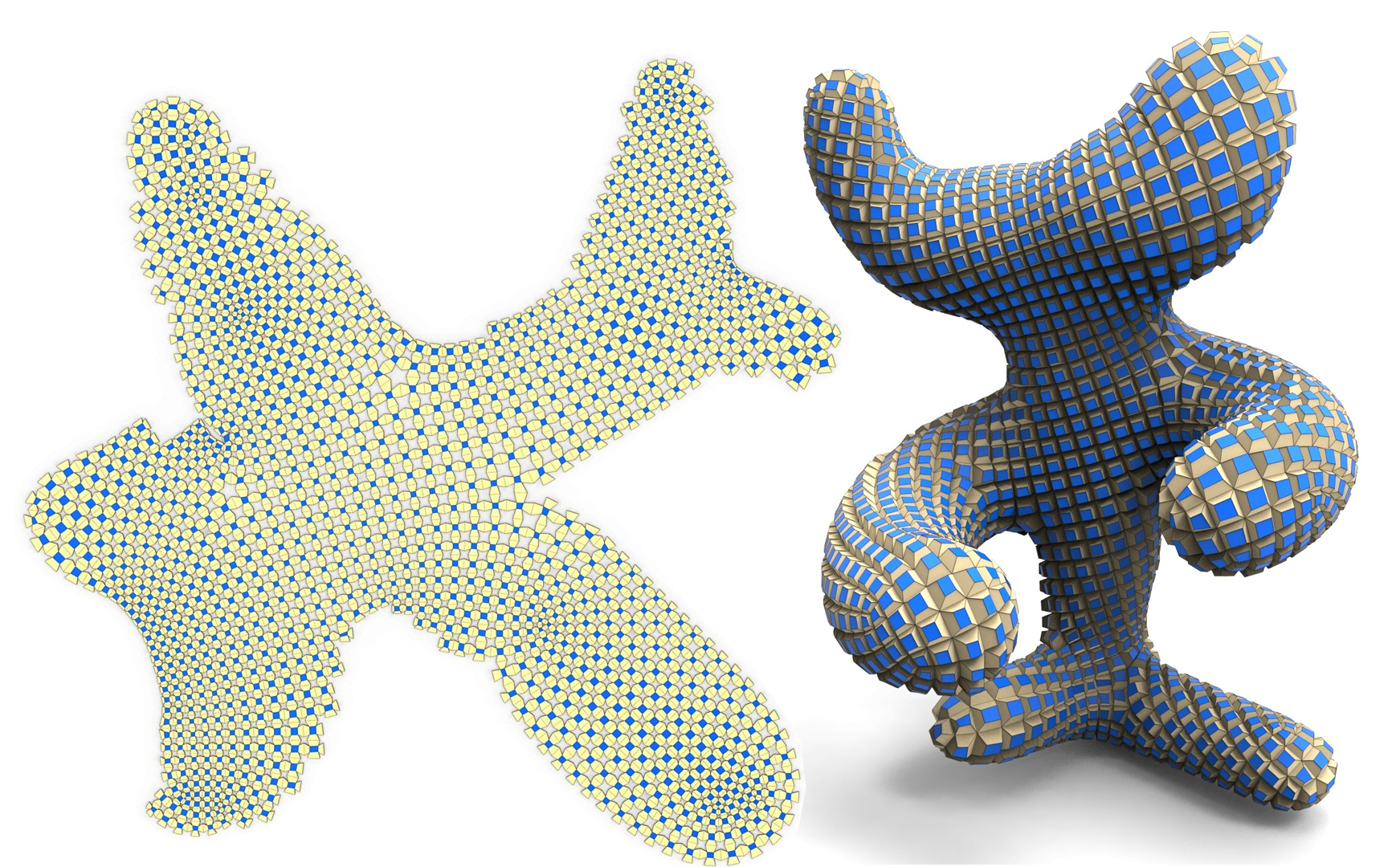
Kirigami, the traditional Japanese art of paper cutting and folding generalizes origami and has initiated new research in material science as well as graphics. In this paper we use its capabilities to perform geometric modeling with corrugated surface representations possessing an isometric unfolding into a planar domain after appropriate cuts are made. We initialize our box-based kirigami structures from orthogonal networks of curves, compute a first approximation of their unfolding via mappings between meshes, and complete the process by global optimization. Besides the modeling capabilities we also study the interesting geometry of special kirigami structures from the theoretical side. This experimental paper strives to relate unfoldable checkerboard arrangements of boxes to principal meshes, to the transformation theory of discrete differential geometry, and to a version of the Gauss theorema egregium.
References:
1. Alexander Bobenko and Yuri Suris. 2009. Discrete differential geometry: Integrable Structure. Number 98. American Math. Soc.Google Scholar
2. David Bommes, Henrik Zimmer, and Leif Kobbelt. 2009. Mixed-integer Quadrangulation. ACM Trans. Graph. 28, 3 (2009), #77,1–10.Google ScholarDigital Library
3. Mario Botsch, Stephan Steinberg, Stephan Bischoff, and Leif Kobbelt. 2002. OpenMesh: A Generic and Efficient Polygon Mesh Data Structure. Proc. OpenSG Symposium.Google Scholar
4. Toen Castle, Yigil Cho, Xingting Gong, Euiyeon Jung, Daniel M. Sussman, Shu Yang, and Randall D. Kamien. 2014. Making the Cut: Lattice Kirigami Rules. Phys. Rev. Lett 113, 245502 (2014), 1–5.Google Scholar
5. Toen Castle, Daniel M. Sussman, Michael Tanis, and Randall D. Kamien. 2016. Additive lattice kirigami. Sci. Advances 2, e1601258 (2016), 1–11.Google Scholar
6. Frédéric Cazals and Marc Pouget. 2004. Smooth surfaces, umbilics, lines of curvatures, foliations, ridges and the medial axis: a concise overview. Research Report RR-5138. INRIA. https://hal.inria.fr/inria-00071445/Google Scholar
7. Gary Choi, Levi Dudte, and L. Mahadevan. 2019. Programming shape using kirigami tessellations. Nature Materials 18 (2019), 999–1004.Google ScholarCross Ref
8. David Cohen-Steiner and Jean Marie Morvan. 2003. Restricted Delaunay triangulations and normal cycle. In Proc. ACM Symp. Comp. Graphics. 312–321.Google ScholarDigital Library
9. Erik D. Demaine and Joseph O’Rourke. 2007. Geometric Folding Algorithms. Cambridge University Press.Google ScholarDigital Library
10. Erik D. Demaine and Tomohiro Tachi. 2017. Origamizer: A Practical Algorithm for Folding Any Polyhedron. In Proc. 33rd SoCG. 1–15.Google Scholar
11. Manfredo do Carmo. 1976. Differential Geometry of Curves and Surfaces. Prentice-Hall.Google Scholar
12. Levi H. Dudte, Etienne Vouga, Tomohiro Tachi, and L. Mahadevan. 2016. Programming curvature using origami tessellations. Nature Materials 15 (2016), 583–588.Google ScholarCross Ref
13. Ruslan Guseinov, Connor McMahan, Jesús Pérez, Chiara Daraio, and Bernd Bickel. 2020. Programming temporal morphing of self-actuated shells. Nature Communications 11 (2020), #237,1–7.Google Scholar
14. Ruslan Guseinov, Eder Miguel, and Bernd Bickel. 2017. CurveUps: shaping objects from flat plates with tension-actuated curvature. ACM Trans. Graph. 36, 4 (2017), #64,1–12.Google ScholarDigital Library
15. Alec Jacobson, Daniele Panozzo, et al. 2018. libigl: A simple C++ geometry processing library. https://libigl.github.ioGoogle Scholar
16. Caigui Jiang, Klara Mundilova, Florian Rist, Johannes Wallner, and Helmut Pottmann. 2019a. Curve-pleated structures. ACM Trans. Graph. 38, 6 (2019), #169,1–13.Google ScholarDigital Library
17. Caigui Jiang, Chi-Han Peng, Peter Wonka, and Helmut Pottmann. 2019b. Checkerboard patterns with black rectangles. ACM Trans. Graph. 38, 6 (2019), #171,1–13.Google Scholar
18. Caigui Jiang, Cheng Wang, Florian Rist, Johannes Wallner, and Helmut Pottmann. 2020. Quad-mesh based isometric mappings and developable surfaces. ACM Trans. Graph. 39, 4 (2020), #128,1–13.Google ScholarDigital Library
19. Mina Konaković, Keenan Crane, Bailin Deng, Sophien Bouaziz, Daniel Piker, and Mark Pauly. 2016. Beyond Developable: Computational Design and Fabrication with Auxetic Materials. ACM Trans. Graph. 35, 4 (2016).Google ScholarDigital Library
20. Mina Konaković-Luković, Julian Panetta, Keenan Crane, and Mark Pauly. 2018. Rapid Deployment of Curved Surfaces via Programmable Auxetics. ACM Trans. Graph. 37, 4 (2018), #106,1–13.Google ScholarDigital Library
21. Ligang Liu, Lei Zhang, Yin Xu, Craig Gotsman, and Steven Gortler. 2008. A local/global approach to mesh parameterization. Comput. Graph. Forum 27, 5 (2008), 1495–1504.Google ScholarDigital Library
22. Kaj Madsen, Hans Bruun Nielsen, and Ole Tingleff. 2004. Methods for non-linear least squares problems (2nd ed.). Technical Univ. Denmark.Google Scholar
23. Tanmoy Mukhopadhyay et al. 2020. Programmable stiffness and shape modulation in origami materials: emergence of a distant actuation feature. Applied Materials Today 19, 100537 (2020), 1–7.Google Scholar
24. Helmut Pottmann, Yang Liu, Johannes Wallner, Alexander Bobenko, and Wenping Wang. 2007. Geometry of Multi-layer Freeform Structures for Architecture. ACM Trans. Graph. 26, 3 (2007), #65,1–11.Google ScholarDigital Library
25. Nicolas Ray, Bruno Vallet, Wan Chiu Li, and Bruno Lévy. 2008. N-Symmetry Direction Field Design. ACM Trans. Graph. 27, 2 (2008), #10,1–13.Google ScholarDigital Library
26. Keith A. Seffen. 2012. Compliant shell mechanisms. Phil. Trans. R. Soc. A 370 (2012), 2010–2026.Google ScholarCross Ref
27. Olga Sorkine and Marc Alexa. 2007. As-rigid-as-possible surface modeling. In Proc. Symposium Geometry Processing. 109–116.Google Scholar
28. Daniel M. Sussman, Yigil Cho, Toen Castle, Xingting Gong, Euiyeon Jung, Shu Yang, and Randall D. Kamien. 2015. Algorithmic lattice kirigami: A route to pluripotent materials. PNAS 112, 24 (2015), 7449–7453.Google ScholarCross Ref
29. Tomohiro Tachi. 2009. Generalizationof Rigid Foldable Quadrilateral Mesh Origami. In Proc. IASS Symposium. Univ. Politècnica de València, 2287–2294.Google Scholar
30. Tomohiro Tachi. 2010a. Freeform Variations of Origami. J. Geom. Graphics 14 (2010), 203–215.Google Scholar
31. Tomohiro Tachi. 2010b. Origamizing Polyhedral Surfaces. IEEE Trans. Vis. Comput. Graph. 16 (2010), 298–311.Google ScholarDigital Library
32. Yichao Tang, Yanbin Li, Yaoye Hong, and Jie Yin. 2019. Programmable active kirigami metasheets with more freedom of actuation. PNAS 116 (2019), 26407–13.Google ScholarCross Ref
33. Sivan Toledo. 2003. Taucs, A Library of Sparse Linear Solvers. http://www.tau.ac.il/~stoledo/taucsGoogle Scholar
34. Fei Wang, Xiaogang Guo, Jingxian Xu, Yihui Zhang, and C. Q. Chen. 2017. Patterning curved three-dimensional structures with programmable kirigami designs. J. Appl. Mech. 84, 061007 (2017), 1–7.Google ScholarCross Ref
35. Zhiyuan Wei, Zengcai V. Guo, Levi Dudte, Hiyi Liang, and L. Mahadevan. 2013. Geometric Mechanics of Periodic Pleated Origami. Phys. Rev. Lett. 110, 215501 (2013), 1–5.Google Scholar
36. Ruikang Xie, Yan Chen, and Joseph M. Gattas. 2015. Parametrisation and application of cube and eggbox-type folded geometries. Intl. J. Space Structures 30 (2015), 99–110.Google ScholarCross Ref
37. Yihui Zhang et al. 2015. A mechanically driven form of kirigami as a route to 3D mesostructures in micro/nanomembranes. PNAS 112 (2015), 11757–64.Google ScholarCross Ref



