
“Surface-only ferrofluids” by Huang and Michels
Conference:
Type(s):
Title:
- Surface-only ferrofluids
Session/Category Title:
- Animation: Fluids - Phenomenon
Presenter(s)/Author(s):
Abstract:
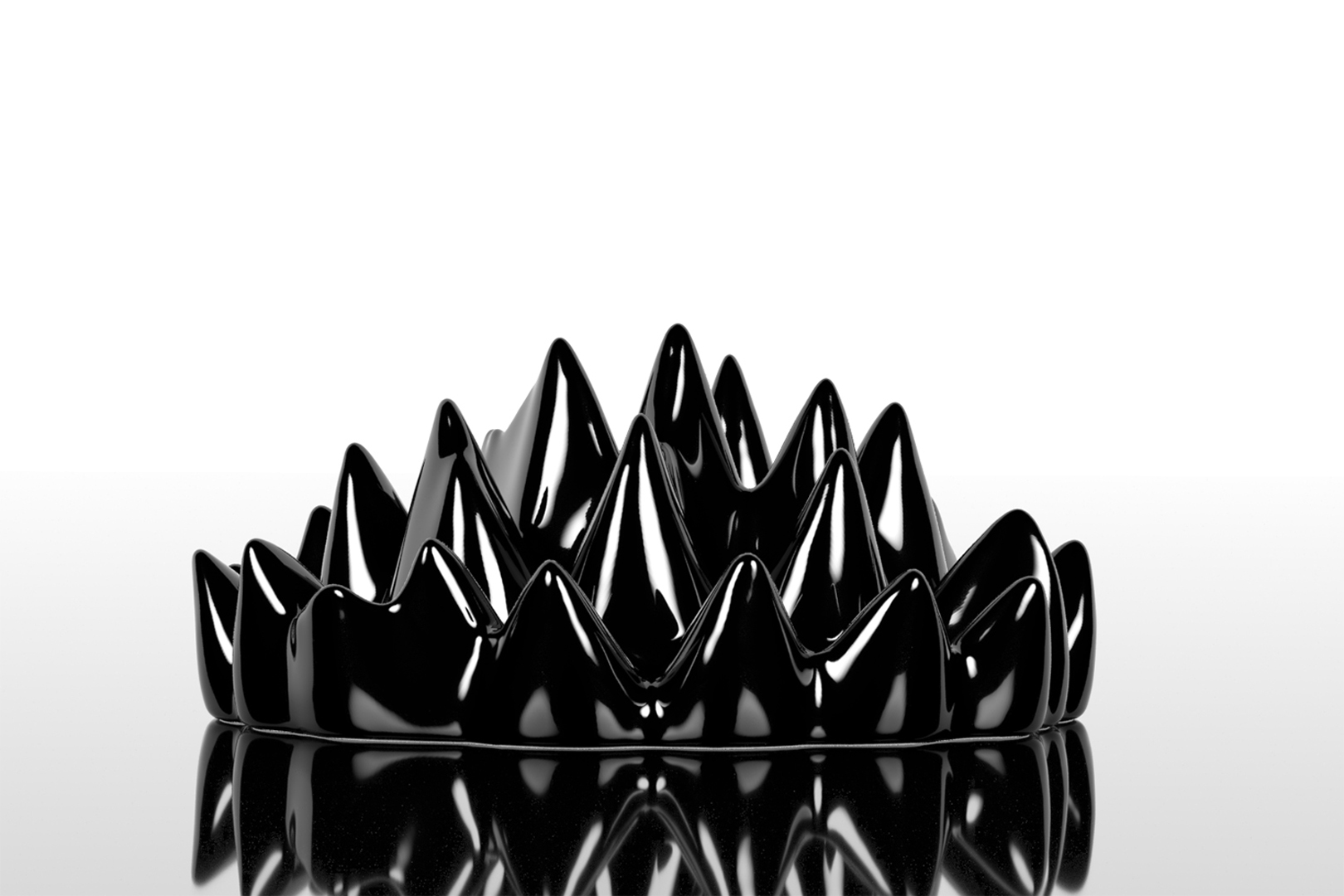
We devise a novel surface-only approach for simulating the three dimensional free-surface flow of incompressible, inviscid, and linearly magnetizable ferrofluids. A Lagrangian velocity field is stored on a triangle mesh capturing the fluid’s surface. The two key problems associated with the dynamic simulation of the fluid’s interesting geometry are the magnetization process transitioning the fluid from a non-magnetic into a magnetic material, and the evaluation of magnetic forces. In this regard, our key observation is that for linearly incompressible ferrofluids, their magnetization and application of magnetic forces only require knowledge about the position of the fluids’ boundary. Consequently, our approach employs a boundary element method solving the magnetization problem and evaluating the so-called magnetic pressure required for the force evaluation. The magnetic pressure is added to the Dirichlet boundary condition of a surface-only liquids solver carrying out the dynamical simulation. By only considering the fluid’s surface in contrast to its whole volume, we end up with an efficient approach enabling more complex and realistic ferrofluids to be explored in the digital domain without compromising efficiency. Our approach allows for the use of physical parameters leading to accurate simulations as demonstrated in qualitative and quantitative evaluations.
References:
1. Mark Ainsworth, William Mclean, and Thanh Tran. 1999. The Conditioning of Boundary Element Equations on Locally Refined Meshes and Preconditioning by Diagonal Scaling. SIAM J. Numer. Anal. 36, 6 (1999), 1901–1932.Google ScholarDigital Library
2. Nadir Akinci, Gizem Akinci, and Matthias Teschner. 2013. Versatile surface tension and adhesion for SPH fluids. ACM Trans. Graph. 32, 6, Article 182 (Nov. 2013), 8 pages.Google ScholarDigital Library
3. Saad Alazemi, A. Bibo, and M.F. Daqaq. 2015. A ferrofluid-based energy harvester: An experimental investigation involving internally-resonant sloshing modes. The European Physical Journal Special Topics 224 (11 2015), 2993–3004. Google ScholarCross Ref
4. Zoran Andjelic, Günther Of, Olaf Steinbach, and Peter Urthaler. 2011. Boundary element methods for magnetostatic field problems: a critical view. Computing and visualization in science 14, 3 (2011), 117–130.Google Scholar
5. Ryoichi Ando, Nils Thürey, and Chris Wojtan. 2013. Highly Adaptive Liquid Simulations on Tetrahedral Meshes. ACM Trans. Graph. (Proc. SIGGRAPH 2013) (July 2013).Google Scholar
6. Rick Beatson and Leslie Greengard. 1997. A short course on fast multipole methods. In Wavelets, Multilevel Methods and Elliptic PDEs. Oxford University Press, 1–37.Google Scholar
7. Miklós Bergou, Basile Audoly, Etienne Vouga, Max Wardetzky, and Eitan Grinspun. 2010. Discrete viscous threads. ACM Transactions on Graphics (TOG) 29, 4 (2010), 1–10.Google ScholarDigital Library
8. Morten Bojsen-Hansen and Chris Wojtan. 2013. Liquid Surface Tracking with Error Compensation. ACM Trans. Graph. 32, 4, Article 68 (July 2013), 13 pages.Google ScholarDigital Library
9. Andreas G. Boudouvis, Jason L. Puchalla, Laurence E. Scriven, and Ronald E. Rosensweig. 1987. Normal field instability and patterns in pools of ferrofluid. Journal of Magnetism and Magnetic Materials 65, 2 (1987), 307 — 310.Google ScholarCross Ref
10. Robert Bridson and Matthias Müller-Fischer. 2007. Fluid simulation: SIGGRAPH 2007 course notes. (2007), 1–81.Google Scholar
11. Tyson Brochu and Robert Bridson. 2009. Robust Topological Operations for Dynamic Explicit Surfaces. SIAM Journal on Scientific Computing 31, 4 (2009), 2472–2493.Google ScholarDigital Library
12. Denis Brousseau, Ermanno F. Borra, and Simon Thibault. 2007. Wavefront correction with a 37-actuator ferrofluid deformable mirror. Opt. Express 15, 26 (Dec 2007), 18190–18199.Google ScholarCross Ref
13. James V. Byrne. 1977. Ferrofluid hydrostatics according to classical and recent theories of the stresses. Proceedings of the Institution of Electrical Engineers 124, 11 (November 1977), 1089–1097.Google ScholarCross Ref
14. Yuan Cao and Ze J. Ding. 2014. Formation of hexagonal pattern of ferrofluid in magnetic field. Journal of Magnetism and Magnetic Materials 355 (2014), 93–99.Google ScholarCross Ref
15. Nuttapong Chentanez, Bryan E. Feldman, François Labelle, James F. O’Brien, and Jonathan R. Shewchuk. 2007. Liquid Simulation on Lattice-Based Tetrahedral Meshes. In ACM SIGGRAPH/Eurographics Symposium on Computer Animation 2007. 219–228.Google Scholar
16. Nuttapong Chentanez, Matthias Müller, Miles Macklin, and Tae-Yong Kim. 2015. Fast Grid-Free Surface Tracking. ACM Trans. Graph. 34, 4, Article 148 (July 2015), 11 pages.Google ScholarDigital Library
17. Albert Chern, Felix Knöppel, Ulrich Pinkall, Peter Schröder, and Steffen Weißmann. 2016. Schrödinger’s Smoke. ACM Trans. Graph. 35, 4, Article 77 (July 2016), 13 pages.Google ScholarDigital Library
18. Pascal Clausen, Martin Wicke, Jonathan R. Shewchuk, and James F. O’Brien. 2013. Simulating Liquids and Solid-Liquid Interactions with Lagrangian Meshes. ACM Transactions on Graphics 32, 2 (April 2013), 17:1–15. Presented at SIGGRAPH 2013.Google ScholarDigital Library
19. David Cohen-Steiner and Jean-Marie Morvan. 2003. Restricted delaunay triangulations and normal cycle. In Proceedings of the nineteenth annual symposium on Computational geometry. 312–321.Google ScholarDigital Library
20. Fang Da, Christopher Batty, and Eitan Grinspun. 2014. Multimaterial Mesh-Based Surface Tracking. ACM Trans. Graph. 33, 4, Article 112 (July 2014), 11 pages.Google ScholarDigital Library
21. Fang Da, Christopher Batty, Chris Wojtan, and Eitan Grinspun. 2015. Double Bubbles sans Toil and Trouble: Discrete Circulation-Preserving Vortex Sheets for Soap Films and Foams. ACM Trans. Graph. 34, 4, Article 149 (July 2015), 9 pages.Google ScholarDigital Library
22. Fang Da, David Hahn, Christopher Batty, Chris Wojtan, and Eitan Grinspun. 2016. Surface-Only Liquids. ACM Trans. Graph. 35, 4, Article 78 (July 2016), 12 pages.Google ScholarDigital Library
23. Akiva J. Dickstein, Shyamsunder Erramilli, Raymond E. Goldstein, David P. Jackson, and Stephen A. Langer. 1993. Labyrinthine Pattern Formation in Magnetic Fluids. Science 261, 5124 (1993), 1012–1015.Google Scholar
24. Michael G. Duffy. 1982. Quadrature Over a Pyramid or Cube of Integrands with a Singularity at a Vertex. SIAM J. Numer. Anal. 19, 6 (1982), 1260–1262.Google ScholarDigital Library
25. Thomas F. Eibert and Volkert Hansen. 1995. On the calculation of potential integrals for linear source distributions on triangular domains. IEEE transactions on antennas and propagation 43, 12 (1995), 1499–1502.Google Scholar
26. Douglas Enright, Ronald Fedkiw, Joel Ferziger, and Ian Mitchell. 2002. A hybrid particle level set method for improved interface capturing. Journal of Computational physics 183, 1 (2002), 83–116.Google ScholarDigital Library
27. Yu Fang, Minchen Li, Ming Gao, and Chenfanfu Jiang. 2019. Silly rubber: an implicit material point method for simulating non-equilibrated viscoelastic and elastoplastic solids. ACM Transactions on Graphics (TOG) 38, 4 (2019), 1–13.Google ScholarDigital Library
28. Yun (Raymond) Fei, Henrique Teles Maia, Christopher Batty, Changxi Zheng, and Eitan Grinspun. 2017. A Multi-Scale Model for Simulating Liquid-Hair Interactions. ACM Trans. Graph. 36, 4, Article 56 (July 2017), 17 pages.Google ScholarDigital Library
29. Nick Foster and Ronald Fedkiw. 2001. Practical animation of liquids. In Proceedings of the 28th annual conference on Computer graphics and interactive techniques. 23–30.Google ScholarDigital Library
30. Ryan Goldade, Yipeng Wang, Mridul Aanjaneya, and Christopher Batty. 2019. An Adaptive Variational Finite Difference Framework for Efficient Symmetric Octree Viscosity. ACM Trans. Graph. 38, 4, Article 94 (July 2019), 14 pages.Google ScholarDigital Library
31. Christian Gollwitzer, Gunar Matthies, Reinhard Richter, Ingo Rehberg, and Lutz Tobiska. 2007. The surface topography of a magnetic fluid: a quantitative comparison between experiment and numerical simulation. Journal of Fluid Mechanics 571 (2007), 455–474.Google ScholarCross Ref
32. Roberto D. Graglia. 1993. On the numerical integration of the linear shape functions times the 3-D Green’s function or its gradient on a plane triangle. IEEE transactions on antennas and propagation 41, 10 (1993), 1448–1455.Google Scholar
33. Ivan G. Graham and William McLean. 2006. Anisotropic Mesh Refinement: The Conditioning of Galerkin Boundary Element Matrices and Simple Preconditioners. SIAM J. Numer. Anal. 44, 4 (2006), 1487–1513.Google ScholarDigital Library
34. David Hahn and Chris Wojtan. 2015. High-Resolution Brittle Fracture Simulation with Boundary Elements. ACM Transactions on Graphics 34 (07 2015), 151:1–151:12.Google Scholar
35. David Hahn and Chris Wojtan. 2016. Fast Approximations for Boundary Element Based Brittle Fracture Simulation. ACM Trans. Graph. 35, 4, Article 104 (July 2016), 11 pages.Google ScholarDigital Library
36. Francis H. Harlow and J. Eddie Welch. 1965. Numerical calculation of time-dependent viscous incompressible flow of fluid with free surface. The physics of fluids 8, 12 (1965), 2182–2189.Google Scholar
37. Libo Huang, Torsten Hädrich, and Dominik L. Michels. 2019. On the Accurate Large-Scale Simulation of Ferrofluids. ACM Trans. Graph. 38, 4, Article 93 (July 2019), 15 pages.Google ScholarDigital Library
38. Tomokazu Ishikawa, Yonghao Yue, Kei Iwasaki, Yoshinori Dobashi, and Tomoyuki Nishita. 2012. Visual simulation of magnetic fluid taking into account dynamic deformation in spikes. In Image Electronics and Visual Computing Workshop.Google Scholar
39. Tomokazu Ishikawa, Yonghao Yue, Kei Iwasaki, Yoshinori Dobashi, and Tomoyuki Nishita. 2013. Visual simulation of magnetic fluid using a procedural approach for spikes shape. In Computer Vision, Imaging and Computer Graphics. Theory and Application, Gabriela Csurka, Martin Kraus, Robert S. Laramee, Paul Richard, and José Braz (Eds.). Springer Berlin Heidelberg, Berlin, Heidelberg, 112–126.Google Scholar
40. Doug L. James and Dinesh K. Pai. 1999. ArtDefo: Accurate Real Time Deformable Objects. In Proceedings of the 26th Annual Conference on Computer Graphics and Interactive Techniques (SIGGRAPH ’99). ACM Press/Addison-Wesley Publishing Co., USA, 65–72.Google Scholar
41. Lina Kafrouni and Oumarou Savadogo. 2016. Recent progress on magnetic nanoparticles for magnetic hyperthermia. Progress in Biomaterials 5 (09 2016). Google ScholarCross Ref
42. Todd Keeler and Robert Bridson. 2014. Ocean Waves Animation Using Boundary Integral Equations and Explicit Mesh Tracking. In ACM SIGGRAPH 2014 Posters (SIGGRAPH ’14). Association for Computing Machinery, New York, NY, USA, Article 11, 1 pages.Google Scholar
43. Byungsoo Kim, Vinicius C. Azevedo, Markus Gross, and Barbara Solenthaler. 2020. Lagrangian Neural Style Transfer for Fluids. ACM Transaction on Graphics (SIGGRAPH) (2020).Google Scholar
44. Seung-Wook Kim, Sun Young Park, and Junghyun Han. 2018. Magnetization dynamics for magnetic object interactions. ACM Trans. Graph. 37, 4, Article 121 (July 2018), 13 pages.Google ScholarDigital Library
45. Sachiko Kodama. 2008. Dynamic ferrofluid sculpture: organic shape-changing art forms. Commun. ACM 51, 6 (June 2008), 79–81.Google ScholarDigital Library
46. Dan Koschier, Jan Bender, Barbara Solenthaler, and Matthias Teschner. 2019. EUROGRAPHICS Tutorial on Smoothed Particle Hydrodynamics Techniques for the Physics Based Simulation of Fluids and Solids. (2019).Google Scholar
47. Egor Larionov, Christopher Batty, and Robert Bridson. 2017. Variational Stokes: A Unified Pressure-Viscosity Solver for Accurate Viscous Liquids. ACM Trans. Graph. 36, 4, Article 101 (July 2017), 11 pages.Google ScholarDigital Library
48. Olga Lavrova, Gunar Matthies, Teodora Mitkova, Viktor Polevikov, and Lutz Tobiska. 2006. Numerical treatment of free surface problems in ferrohydrodynamics. Journal of Physics: Condensed Matter 18, 38 (2006), S2657.Google ScholarCross Ref
49. Olga Lavrova, Gunar Matthies, and Lutz Tobiska. 2008. Numerical study of solitonlike surface configurations on a magnetic fluid layer in the Rosensweig instability. Communications in Nonlinear Science and Numerical Simulation 13, 7 (2008), 1302–1310.Google ScholarCross Ref
50. Xiaosheng Li, Xiaowei He, Xuehui Liu, Baoquan Liu, and Enhua Wu. 2016. Multiphase Interface Tracking with Fast Semi-Lagrangian Contouring. IEEE Transactions on Visualization and Computer Graphics 22, 8 (2016), 1973–1986.Google ScholarDigital Library
51. Jing Liu, Yit Fatt Yap, and Nam-Trung Nguyen. 2011. Numerical study of the formation process of ferrofluid droplets. Physics of Fluids 23, 7 (2011), 072008.Google ScholarCross Ref
52. Matthias Müller. 2009. Fast and Robust Tracking of Fluid Surfaces. In Proceedings of the 2009 ACM SIGGRAPH/Eurographics Symposium on Computer Animation (SCA ’09). Association for Computing Machinery, New York, NY, USA, 237–245.Google ScholarDigital Library
53. Kentaro Nagasawa, Takayuki Suzuki, Ryohei Seto, Masato Okada, and Yonghao Yue. 2019. Mixing sauces: a viscosity blending model for shear thinning fluids. ACM Transactions on Graphics (TOG) 38, 4 (2019), 1–17.Google ScholarDigital Library
54. Xingyu Ni, Bo Zhu, Bin Wang, and Baoquan Chen. 2020. A Level-Set Method for Magnetic Substance Simulation. ACM Trans. Graph. 39, 4 (2020).Google ScholarDigital Library
55. Ricardo H. Nochetto, Abner J. Salgado, and Ignacio Tomas. 2016a. A diffuse interface model for two-phase ferrofluid flows. Computer Methods in Applied Mechanics and Engineering 309 (2016), 497–531.Google ScholarCross Ref
56. Ricardo H. Nochetto, Abner J. Salgado, and Ignacio Tomas. 2016b. The equations of ferrohydrodynamics: modeling and numerical methods. Mathematical Models and Methods in Applied Sciences 26, 13 (2016), 2393–2449.Google ScholarCross Ref
57. Marcel Padilla, Albert Chern, Felix Knöppel, Ulrich Pinkall, and Peter Schröder. 2019. On Bubble Rings and Ink Chandeliers. ACM Trans. Graph. 38, 4, Article 129 (July 2019), 14 pages.Google ScholarDigital Library
58. Tobias Pfaff, Nils Thürey, and Markus Gross. 2012. Lagrangian Vortex Sheets for Animating Fluids. ACM Trans. Graph. 31, 4, Article 112 (July 2012), 8 pages.Google ScholarDigital Library
59. Sergej Rjasanow and Olaf Steinbach. 2007. The fast solution of boundary integral equations. Springer Science & Business Media.Google Scholar
60. Ronald E. Rosensweig. 1987. Magnetic Fluids. Annu. Rev. Fluid Mech. 19 (Jan 1987), 437–463.Google ScholarCross Ref
61. Ronald E. Rosensweig. 1988. An Introduction To Ferrohydrodynamics. Chemical Engineering Communications 67, 1 (1988), 1–18.Google ScholarCross Ref
62. Ronald E. Rosensweig. 1997. Ferrohydrodynamics. Dover Publications.Google Scholar
63. Ronald E. Rosensweig, Yuki Hirota, Sayaka Tsuda, and K. Russel Raj. 2008. Study of audio speakers containing ferrofluid. Journal of physics. Condensed matter : an Institute of Physics journal 20 (05 2008), 204147. Google ScholarCross Ref
64. Ronald E. Rosensweig, Markus Zahn, and Raymond Shumovich. 1983. Labyrinthine instability in magnetic and dielectric fluids. Journal of Magnetism and Magnetic Materials 39, 1–2 (1983), 127–132.Google ScholarCross Ref
65. Yousef Saad and Martin H Schultz. 1986. GMRES: A Generalized Minimal Residual Algorithm for Solving Nonsymmetric Linear Systems. SIAM J. Sci. Stat. Comput. 7, 3 (July 1986), 856–869.Google ScholarCross Ref
66. Philip G. Saffman. 1986. Viscous fingering in Hele-Shaw cells. Journal of Fluid Mechanics 173 (1986), 73–94.Google ScholarCross Ref
67. Stefan A. Sauter and Christoph Schwab. 2010. Boundary element methods. In Boundary Element Methods. Springer, 183–287.Google Scholar
68. Craig Schroeder, Wen Zheng, and Ronald Fedkiw. 2012. Semi-implicit surface tension formulation with a Lagrangian surface mesh on an Eulerian simulation grid. J. Comput. Phys. 231, 4 (2012), 2092–2115.Google ScholarDigital Library
69. Denis Sievers, Thomas F Eibert, and Volkert Hansen. 2005. Correction to “On the calculation of potential integrals for linear source distributions on triangular domains”. IEEE Transactions on Antennas and Propagation 53, 9 (2005), 3113–3113.Google ScholarCross Ref
70. Justin Solomon, Amir Vaxman, and David Bommes. 2017. Boundary Element Octahedral Fields in Volumes. ACM Trans. Graph. 36, 4, Article 114b (May 2017), 16 pages.Google ScholarDigital Library
71. Jos Stam. 1999. Stable Fluids. Proc. of ACM SIGGRAPH (1999), 121–128.Google Scholar
72. Olaf Steinbach. 2007. Numerical approximation methods for elliptic boundary value problems: finite and boundary elements. Springer Science & Business Media.Google Scholar
73. Alexey Stomakhin, Craig Schroeder, Chenfanfu Jiang, Lawrence Chai, Joseph Teran, and Andrew Selle. 2014. Augmented MPM for phase-change and varied materials. ACM Transactions on Graphics (TOG) 33, 4 (2014), 1–11.Google ScholarDigital Library
74. Bernhard Thomaszewski, Andreas Gumann, Simon Pabst, and Wolfgang Straßer. 2008. Magnets in motion. ACM Trans. Graph. 27, 5, Article 162 (Dec. 2008), 9 pages.Google ScholarDigital Library
75. Nils Thürey, Chris Wojtan, Markus Gross, and Greg Turk. 2010. A Multiscale Approach to Mesh-Based Surface Tension Flows. In ACM SIGGRAPH 2010 Papers (SIGGRAPH ’10). Association for Computing Machinery, New York, NY, USA, Article 48, 10 pages.Google ScholarDigital Library
76. Kiwon Um, Xiangyu Hu, and N. Thürey. 2018. Liquid Splash Modeling with Neural Networks. CGF 37, 8 (2018), 171–182.Google ScholarCross Ref
77. Benjamin Ummenhofer, Lukas Prantl, Nils Thürey, and Vladlen Koltun. 2020. Lagrangian Fluid Simulation with Continuous Convolutions. In ICLR.Google Scholar
78. He Wang, Kirill A. Sidorov, Peter Sandilands, and Taku Komura. 2013. Harmonic Parameterization by Electrostatics. ACM Trans. Graph. 32, 5, Article 155 (Oct. 2013), 12 pages.Google ScholarDigital Library
79. Steffen Weißmann and Ulrich Pinkall. 2010. Filament-Based Smoke with Vortex Shedding and Variational Reconnection. ACM Trans. Graph. 29, 4, Article 115 (July 2010), 12 pages.Google ScholarDigital Library
80. Chris Wojtan, Matthias Müller-Fischer, and Tyson Brochu. 2011. Liquid Simulation with Mesh-Based Surface Tracking. In ACM SIGGRAPH 2011 Courses (SIGGRAPH ’11). Association for Computing Machinery, New York, NY, USA, Article 8, 84 pages.Google Scholar
81. Chris Wojtan, Nils Thürey, Markus Gross, and Greg Turk. 2009. Deforming Meshes That Split and Merge. In ACM SIGGRAPH 2009 Papers (SIGGRAPH ’09). Association for Computing Machinery, New York, NY, USA, Article 76, 10 pages.Google Scholar
82. You Xie, Erik Franz, Mengyu Chu, and Nils Thürey. 2018. TempoGAN: A Temporally Coherent, Volumetric GAN for Super-Resolution Fluid Flow. ACM Trans. Graph. 37, 4, Article 95 (2018), 15 pages.Google ScholarDigital Library
83. Gaku Yoshikawa, Katsuhiro Hirata, Fumikazu Miyasaka, and Yu Okaue. 2010. Numerical analysis of transitional behavior of ferrofluid employing MPS method and FEM. In Digests of the 2010 14th Biennial IEEE Conference on Electromagnetic Field Computation. 1–1.Google ScholarCross Ref
84. Linbo Zhang, Tao Cui, and Hui Liu. 2009. A set of symmetric quadrature rules on triangles and tetrahedra. Journal of Computational Mathematics (2009), 89–96.Google Scholar
85. Xinxin Zhang and Robert Bridson. 2014. A PPPM fast summation method for fluids and beyond. ACM Transactions on Graphics (TOG) 33, 6 (2014), 1–11.Google ScholarDigital Library
86. Yizhong Zhang, Huamin Wang, Shuai Wang, Yiying Tong, and Kun Zhou. 2012. A Deformable Surface Model for Real-Time Water Drop Animation. IEEE Transactions on Visualization and Computer Graphics 18, 8 (Aug. 2012), 1281–1289.Google Scholar
87. Wen Zheng, Bo Zhu, Byungmoon Kim, and Ronald Fedkiw. 2015. A new incompressibility discretization for a hybrid particle MAC grid representation with surface tension. J. Comput. Phys. 280, C (Jan. 2015), 96–142.Google Scholar
88. Bo Zhu, Minjae Lee, Ed Quigley, and Ronald Fedkiw. 2015b. Codimensional non-Newtonian fluids. ACM Transactions on Graphics (TOG) 34, 4 (2015), 1–9.Google ScholarDigital Library
89. Bo Zhu, Ed Quigley, Matthew Cong, Justin Solomon, and Ronald Fedkiw. 2014. Codimensional surface tension flow on simplicial complexes. ACM Transactions on Graphics (TOG) 33, 4 (2014), 1–11.Google ScholarDigital Library
90. Gui-Ping Zhu, Nam-Trung Nguyen, R. V. Ramanujan, and Xiao-Yang Huang. 2011. Nonlinear Deformation of a Ferrofluid Droplet in a Uniform Magnetic Field. Langmuir 27, 24 (2011), 14834–14841.Google ScholarCross Ref
91. Yufeng Zhu, Robert Bridson, and Chen Greif. 2015a. Simulating Rigid Body Fracture with Surface Meshes. ACM Trans. Graph. 34, 4, Article 150 (July 2015), 11 pages.Google ScholarDigital Library



