
“Real2Sim: visco-elastic parameter estimation from dynamic motion” by Hahn, Banzet, Bern and Coros
Conference:
Type(s):
Title:
- Real2Sim: visco-elastic parameter estimation from dynamic motion
Session/Category Title:
- Data-Driven Dynamics
Presenter(s)/Author(s):
Moderator(s):
Abstract:
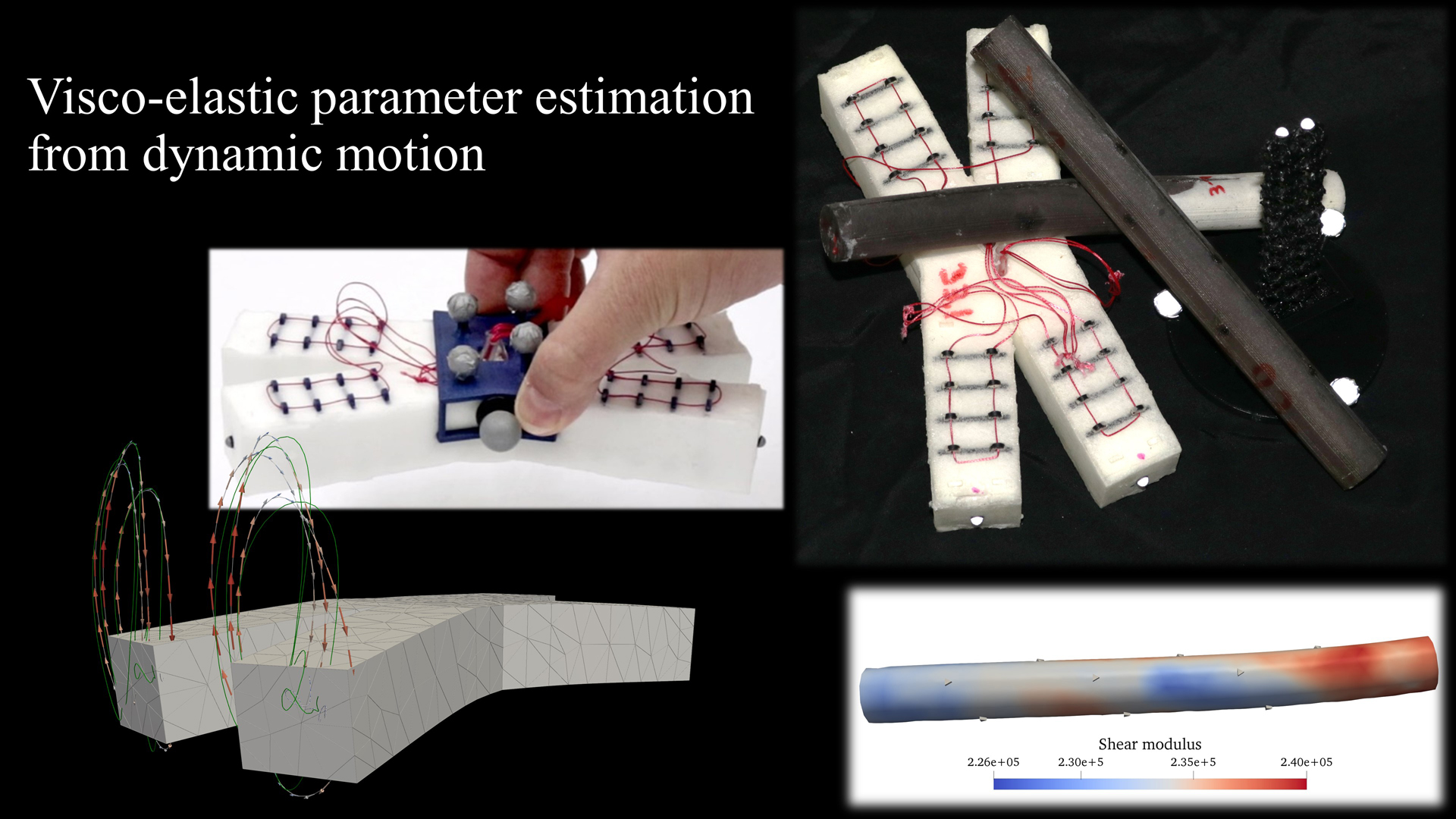
This paper presents a method for optimizing visco-elastic material parameters of a finite element simulation to best approximate the dynamic motion of real-world soft objects. We compute the gradient with respect to the material parameters of a least-squares error objective function using either direct sensitivity analysis or an adjoint state method. We then optimize the material parameters such that the simulated motion matches real-world observations as closely as possible. In this way, we can directly build a useful simulation model that captures the visco-elastic behaviour of the specimen of interest. We demonstrate the effectiveness of our method on various examples such as numerical coarsening, custom-designed objective functions, and of course real-world flexible elastic objects made of foam or 3D printed lattice structures, including a demo application in soft robotics.
References:
1. Thomas Auzinger, Wolfgang Heidrich, and Bernd Bickel. 2018. Computational design of nanostructural color for additive manufacturing. ACM Transactions on Graphics 37, 4 (2018), 1–16. Google ScholarDigital Library
2. Jernej Barbič and Doug L. James. 2005. Real-Time subspace integration for St. Venant-Kirchhoff deformable models. ACM Transactions on Graphics 24, 3 (2005), 982. Google ScholarDigital Library
3. James M. Bern, Pol Banzet, Roi Poranne, and Stelian Coros. 2019. Trajectory optimization for cable-driven soft robot locomotion. Robotics: Science and Systems (2019).Google ScholarCross Ref
4. B. Bickel, M. Bächer, M. A. Otaduy, W. Matusik, H. Pfister, and M. Gross. 2009. Capture and modeling of non-linear heterogeneous soft tissue. ACM Transactions on Graphics 28, 3 (2009), 1. Google ScholarDigital Library
5. Javier Bonet and Richard D. Wood. 2008. Nonlinear Continuum Mechanics for Finite Element Analysis. Cambridge University Press. Google ScholarCross Ref
6. A. F. Bower, N. A. Fleck, A. Needleman, and N. Ogbonna. 1993. Indentation of a Power Law Creeping Solid. Proceedings of the Royal Society A: Mathematical, Physical and Engineering Sciences 441, 1911 (1993), 97–124. Google ScholarCross Ref
7. Andrew M. Bradley. 2013. PDE-constrained optimization and the adjoint method. Technical Report. Stanford University. https://cs.stanford.edu/~ambrad/adjoint_tutorial.pdfGoogle Scholar
8. Desai Chen, David I. W. Levin, Wojciech Matusik, and Danny M. Kaufman. 2017. Dynamics-aware numerical coarsening for fabrication design. ACM Transactions on Graphics 36, 4 (2017), 1–15. Google ScholarDigital Library
9. Desai Chen, David I. W. Levin, Shinjiro Sueda, and Wojciech Matusik. 2015. Data-driven finite elements for geometry and material design. ACM Transactions on Graphics 34, 4 (2015), 74:1–74:10. Google ScholarDigital Library
10. C.A. Felippa and B. Haugen. 2005. A unified formulation of small-strain corotational finite elements: I. Theory. Computer Methods in Applied Mechanics and Engineering 194, 21–24 (2005), 2285–2335. Google ScholarCross Ref
11. Joachim Georgii and Rüdiger Westermann. 2008. Corotated Finite Elements Made Fast and Stable. Google ScholarCross Ref
12. Gaël Guennebaud, Benoît Jacob, et al. 2010. Eigen v3. http://eigen.tuxfamily.org.Google Scholar
13. G. Irving, J. Teran, and R. Fedkiw. 2004. Invertible Finite Elements for Robust Simulation of Large Deformation. ACM SIGGRAPH/Eurographics Symposium on Computer Animation (2004), 131–140. Google ScholarDigital Library
14. Arieh Iserles. 1996. A First Course in the Numerical Analysis of Differential Equations (Cambridge Texts in Applied Mathematics). Cambridge University Press.Google Scholar
15. Doris H. U. Kochanek and Richard H. Bartels. 1984. Interpolating splines with local tension, continuity, and bias control. ACM SIGGRAPH Computer Graphics 18, 3 (1984), 33–41. Google ScholarDigital Library
16. R. Mahnken. 2017. Identification of Material Parameters for Constitutive Equations. Encyclopedia of Computational Mechanics, Second Edition (eds E. Stein, R. Borst and T. J. Hughes) (2017). Google ScholarCross Ref
17. Antoine McNamara, Adrien Treuille, Zoran Popović, and Jos Stam. 2004. Fluid control using the adjoint method. ACM Transactions on Graphics 23, 3 (2004), 449. Google ScholarDigital Library
18. E. Miguel, D. Bradley, B. Thomaszewski, B. Bickel, W. Matusik, M. A. Otaduy, and S. Marschner. 2012. Data-Driven Estimation of Cloth Simulation Models. Computer Graphics Forum 31 (2012). Google ScholarCross Ref
19. Eder Miguel, David Miraut, and Miguel A. Otaduy. 2016. Modeling and Estimation of Energy-Based Hyperelastic Objects. Computer Graphics Forum 35, 2 (2016), 385–396. Google ScholarDigital Library
20. E. Miguel, R. Tamstorf, D. Bradley, S. C. Schvartzman, B. Thomaszewski, B. Bickel, W. Matusik, S. Marschner, and M. A. Otaduy. 2013. Modeling and estimation of internal friction in cloth. ACM Transactions on Graphics 32 (2013).Google Scholar
21. Matthias Müller and Markus Gross. 2004. Interactive Virtual Materials. In Proceedings of Graphics Interface 2004. 239–246.Google Scholar
22. A.H.W. Ngan, H.T. Wang, B. Tang, and K.Y. Sze. 2005. Correcting power-law viscoelastic effects in elastic modulus measurement using depth-sensing indentation. International Journal of Solids and Structures 42, 5–6 (2005), 1831–1846. Google ScholarCross Ref
23. Jorge Nocedal. 1980. Updating quasi-Newton matrices with limited storage. Math. Comp. 35, 151 (1980), 773–773. Google ScholarCross Ref
24. James F. O’Brien and Jessica K. Hodgins. 1999. Graphical modeling and animation of brittle fracture. In Proceedings of the 26th annual conference on Computer graphics and interactive techniques – SIGGRAPH’99. ACM Press.Google Scholar
25. R. W. Ogden. 1997. Non-Linear Elastic Deformations. Dover Publications Inc.Google Scholar
26. W. C. Oliver and G. M. Pharr. 1992. An improved technique for determining hardness and elastic modulus using load and displacement sensing indentation experiments. Journal of Materials Research 7, 06 (1992), 1564–1583.Google ScholarCross Ref
27. Dinesh K. Pai, Jochen Lang, John Lloyd, and Robert J. Woodham. 1999. ACME, a telerobotic active measurement facility. In Experimental Robotics VI. Springer London, 391–400. Google ScholarCross Ref
28. Dinesh K. Pai, Kees van den Doel, Doug L. James, Jochen Lang, John E. Lloyd, Joshua L. Richmond, and Som H. Yau. 2001. Scanning physical interaction behavior of 3D objects. In Proceedings of the 28th annual conference on Computer graphics and interactive techniques – SIGGRAPH ’01. ACM Press.Google Scholar
29. Yixuan Qiu. 2019. LBFGS++. http://yixuan.cos.name/LBFGSpp. 2019-03-12.Google Scholar
30. Eftychios Sifakis and Jernej Barbic. 2012. FEM simulation of 3D deformable solids. In ACM SIGGRAPH 2012 Courses. ACM Press. Google ScholarDigital Library
31. Breannan Smith, Fernando De Goes, and Theodore Kim. 2018. Stable Neo-Hookean Flesh Simulation. ACM Transactions on Graphics 37, 2 (2018), 1–15. Google ScholarDigital Library
32. Breannan Smith, Fernando De Goes, and Theodore Kim. 2019. Analytic Eigensystems for Isotropic Distortion Energies. ACM Transactions on Graphics 38, 1 (2019), 1–15. Google ScholarDigital Library
33. Smooth-On, Inc. 2018. FlexFoam-iT!™ Series, Technical Overview. http://www.smooth-on.com/tb/files/FLEXFOAM-IT_SERIES.pdf.Google Scholar
34. Luca Somm, David Hahn, Nitish Kumar, and Stelian Coros. 2019. Expanding Foam as the Material for Fabrication, Prototyping and Experimental Assessment of Low-Cost Soft Robots With Embedded Sensing. IEEE Robotics and Automation Letters 4, 2 (2019), 761–768. Google ScholarCross Ref
35. SpectroPlast. 2019. https://spectroplast.com/.Google Scholar
36. Alexey Stomakhin, Russell Howes, Craig Schroeder, and Joseph M. Teran. 2012. Energetically Consistent Invertible Elasticity. In ACM SIGGRAPH/Eurographics Symposium on Computer Animation (SCA ’12). 25–32.Google Scholar
37. Stratasys, Ltd. 2018. The Stratasys F123 Series. http://www.stratasys.com/-/media/files/printer-spec-sheets/pss_fdm_f123series_1017a.pdfGoogle Scholar
38. Joseph Teran, Eftychios Sifakis, Geoffrey Irving, and Ronald Fedkiw. 2005. Robust quasistatic finite elements and flesh simulation. In ACM SIGGRAPH/Eurographics Symposium on Computer Animation. ACM Press. Google ScholarDigital Library
39. Rosell Torres, Alejandro Rodríiguez, José M. Espadero, and Miguel A. Otaduy. 2016. High-resolution interaction with corotational coarsening models. ACM Transactions on Graphics 35, 6 (2016), 1–11. Google ScholarDigital Library
40. Bin Wang, Longhua Wu, KangKang Yin, Uri Ascher, Libin Liu, and Hui Huang. 2015. Deformation capture and modeling of soft objects. ACM Transactions on Graphics 34, 4 (2015), 94:1–94:12. Google ScholarDigital Library
41. Chris Wojtan, Peter J. Mucha, and Greg Turk. 2006. Keyframe Control of Complex Particle Systems Using the Adjoint Method. In ACM SIGGRAPH/Eurographics Symposium on Computer Animation (SCA ’06). Eurographics Association, 15–23. http://dl.acm.org/citation.cfm?id=1218064.1218067Google Scholar
42. Hongyi Xu and Jernej Barbič. 2017. Example-based damping design. ACM Transactions on Graphics 36, 4 (2017), 1–14. Google ScholarDigital Library
43. Hongyi Xu, Funshing Sin, Yufeng Zhu, and Jernej Barbič. 2015. Nonlinear material design using principal stretches. ACM Transactions on Graphics 34, 4 (2015), 75:1–75:11. Google ScholarDigital Library



