
“DiCE: dichoptic contrast enhancement for VR and stereo displays” by Zhong, Koulieris, Drettakis, Banks, Chambe, et al. …
Conference:
Type(s):
Title:
- DiCE: dichoptic contrast enhancement for VR and stereo displays
Session/Category Title:
- Thoughts on Display
Presenter(s)/Author(s):
- Fangcheng Zhong
- George Alex Koulieris
- George Drettakis
- Martin (Marty) S. Banks
- Mathieu Chambe
- Frédo Durand
- Rafał K. Mantiuk
Moderator(s):
Abstract:
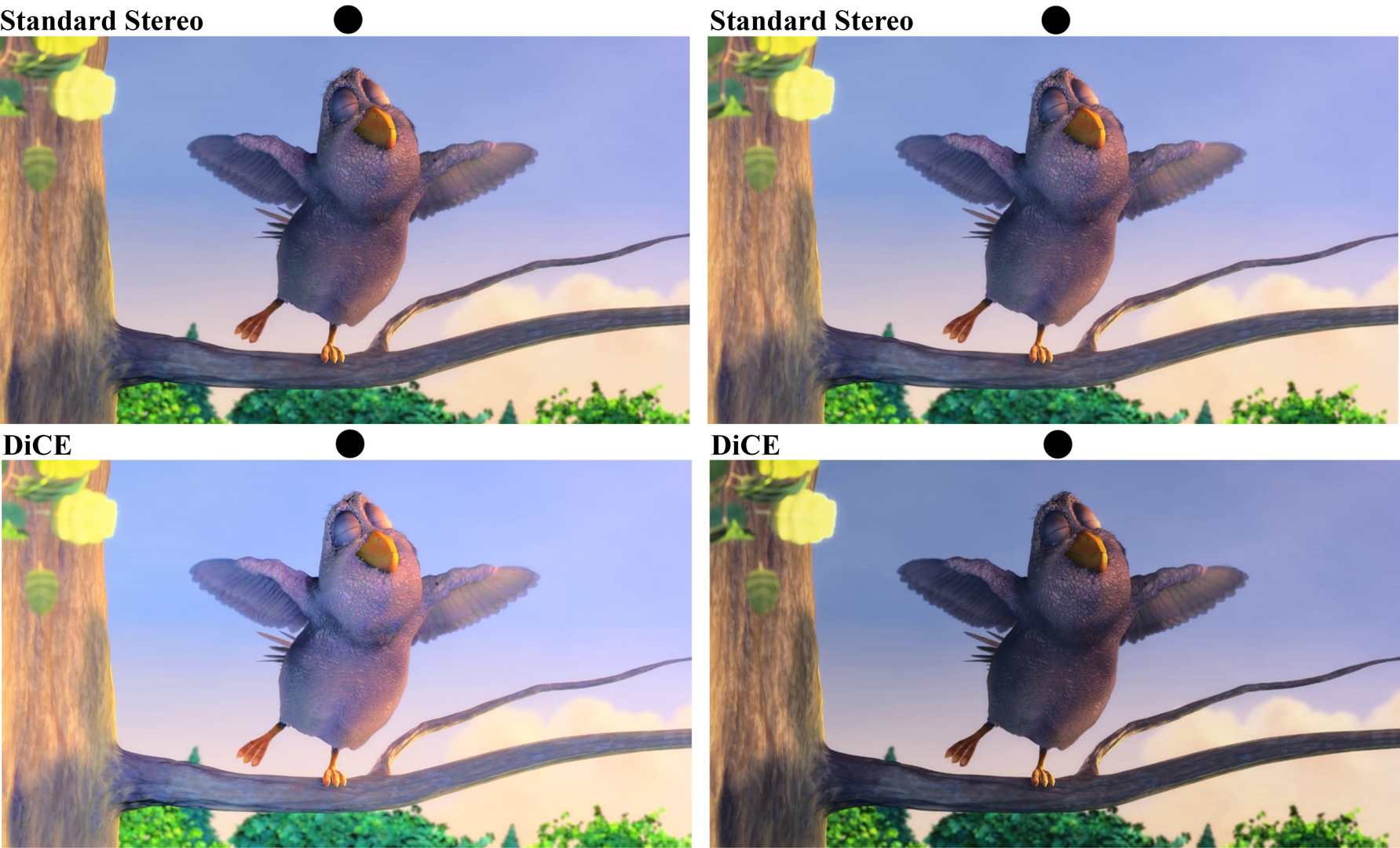
In stereoscopic displays, such as those used in VR/AR headsets, our eyes are presented with two different views. The disparity between the views is typically used to convey depth cues, but it could be also used to enhance image appearance. We devise a novel technique that takes advantage of binocular fusion to boost perceived local contrast and visual quality of images. Since the technique is based on fixed tone curves, it has negligible computational cost and it is well suited for real-time applications, such as VR rendering. To control the trade-off between contrast gain and binocular rivalry, we conduct a series of experiments to explain the factors that dominate rivalry perception in a dichoptic presentation where two images of different contrasts are displayed. With this new finding, we can effectively enhance contrast and control rivalry in mono- and stereoscopic images, and in VR rendering, as confirmed in validation experiments.
References:
1. Randolph Blake. 1989. A neural theory of binocular rivalry. Psychological review 96, 1 (1989), 145.Google Scholar
2. M. W. Cannon. 1985. Perceived contrast in the fovea and periphery. Journal of the Optical Society of America. A, Optics and image science 2, 10 (oct 1985), 1760–8. http://www.ncbi.nlm.nih.gov/pubmed/4056950Google ScholarCross Ref
3. Felice A Dunn and Fred Rieke. 2008. Single-photon absorptions evoke synaptic depression in the retina to extend the operational range of rod vision. Neuron 57, 6 (mar 2008), 894–904. Google ScholarCross Ref
4. Frédo Durand and Julie Dorsey. 2002. Fast bilateral filtering for the display of high-dynamic-range images. ACM Transactions on Graphics 21, 3 (jul 2002), 257–266. Google ScholarDigital Library
5. Gabriel Eilertsen, Rafał K. Mantiuk, and Jonas Unger. 2015. Real-time noise-aware tone mapping. ACM Transactions on Graphics 34, 6 (oct 2015), 1–15. Google ScholarDigital Library
6. G. Eilertsen, R. K. Mantiuk, and J. Unger. 2017. A comparative review of tone-mapping algorithms for high dynamic range video. Computer Graphics Forum 36, 2 (may 2017), 565–592. Google ScholarDigital Library
7. Gabriel Eilertsen, Robert Wanat, Rafał K Mantiuk, and Jonas Unger. 2013. Evaluation of Tone Mapping Operators for HDR-Video. Computer Graphics Forum 32, 7 (oct 2013), 275–284. Google ScholarCross Ref
8. Z. Farbman, R. Fattal, D. Lischinski, and R. Szeliski. 2008. Edge-preserving decompositions for multi-scale tone and detail manipulation. In ACM SIGGRAPH 2008. ACM, 1–10. http://portal.acm.org/citation.cfm?id=1399504.1360666Google Scholar
9. Philippe Fuchs. 2017. Virtual reality headsets-a theoretical and pragmatic approach. CRC Press.Google Scholar
10. M A Georgeson and G D Sullivan. 1975. Contrast constancy: deblurring in human vision by spatial frequency channels. J. Physiol. 252, 3 (nov 1975), 627–656.Google ScholarCross Ref
11. Shigeru Ichihara, Norimichi Kitagawa, and Hiromi Akutsu. 2007. Contrast and Depth Perception: Effects of Texture Contrast and Area Contrast. Perception 36, 5 (2007), 686–695. arXiv:https://doi.org/10.1068/p5696 PMID:17624115. Google ScholarCross Ref
12. Fred Kingdom and Bernard Moulden. 1988. Border effects on brightness: A review of findings, models and issues. Spatial Vision 3, 4 (jan 1988), 225–262. Google ScholarCross Ref
13. Frederick A. A. Kingdom and Lauren Libenson. 2015. Dichoptic color saturation mixture: Binocular luminance contrast promotes perceptual averaging. Journal of Vision 15, 5 (apr 2015), 2. Google ScholarCross Ref
14. Victor Klymenko, Robert W Verona, Howard H Beasley, and John S Martin. 1994. Convergent and divergent viewing affect luning, visual thresholds, and field-of-view fragmentation in partial binocular overlap helmet-mounted displays. In Helmet-and Head-Mounted Displays and Symbology Design Requirements, Vol. 2218. International Society for Optics and Photonics, 82–97.Google ScholarCross Ref
15. J.J. Kulikowski. 1976. Effective contrast constancy and linearity of contrast sensation. Vision Research 16, 12 (jan 1976), 1419–1431. Google ScholarCross Ref
16. G E Legge and J M Foley. 1980. Contrast masking in human vision. Journal of the Optical Society of America 70, 12 (dec 1980), 1458–71.Google ScholarCross Ref
17. Gordon E Legge and Gary S Rubin. 1981. Binocular interactions in suprathreshold contrast perception. Attention, Perception, & Psychophysics 30, 1 (1981), 49–61.Google ScholarCross Ref
18. Willem JM Levelt. 1965. Binocular brightness averaging and contour information. British journal of psychology 56, 1 (1965), 1–13.Google Scholar
19. R. Mantiuk, S. Daly, and L. Kerofsky. 2008. Display adaptive tone mapping. ACM Transactions on Graphics 27, 3 (2008), 68. Google ScholarDigital Library
20. Rafał K. Mantiuk, Karol Myszkowski, and Hans-peter Seidel. 2015. High Dynamic Range Imaging. In Wiley Encyclopedia of Electrical and Electronics Engineering. John Wiley & Sons, Inc., Hoboken, NJ, USA, 1–42. Google ScholarCross Ref
21. Stephen E Palmer. 1999. Vision science: Photons to phenomenology. MIT press.Google Scholar
22. Sylvain Paris, Samuel W. Hasinoff, and Jan Kautz. 2011. Local Laplacian filters. ACM Transactions on Graphics 30, 4 (jul 2011), 1. Google ScholarDigital Library
23. Robert Patterson, Marc Winterbottom, Byron Pierce, and Robert Fox. 2007. Binocular rivalry and head-worn displays. Human factors 49, 6 (2007), 1083–1096.Google Scholar
24. Maria Perez-Ortiz and Rafal K. Mantiuk. 2017. A practical guide and software for analysing pairwise comparison experiments. arXiv preprint (dec 2017). arXiv:1712.03686 http://arxiv.org/abs/1712.03686Google Scholar
25. Erik Reinhard, Michael Stark, Peter Shirley, and James Ferwerda. 2002. Photographic tone reproduction for digital images. ACM Transactions on Graphics 21, 3 (jul 2002), 267. Google ScholarDigital Library
26. Peter Vangorp, Rafat K Mantiuk, Bartosz Bazyluk, Karol Myszkowski, Radosław Mantiuk, Simon J Watt, and Hans-Peter Seidel. 2014. Depth from HDR: depth induction or increased realism?. In ACM Symposium on Applied Perception – SAP ’14. ACM Press, New York, New York, USA, 71–78. Google ScholarDigital Library
27. Gregory Ward-Larson, Holly Rushmeier, and Christine Piatko. 1997. A Visibility Matching Tone Reproduction Operator for High Dynamic Range Scenes. IEEE Transactions on Visualization and Computer Graphics 3, 4 (1997), 291–306. Google ScholarDigital Library
28. Jeremy M Wolfe. 1986. Stereopsis and binocular rivalry. Psychological review 93, 3 (1986), 269.Google Scholar
29. Jeremy M. Wolfe and Susan L. Franzel. 1988. Binocularity and visual search. Perception & Psychophysics 44, 1 (01 Jan 1988), 81–93. Google ScholarCross Ref
30. Xuan Yang, Linling Zhang, Tien-Tsin Wong, and Pheng-Ann Heng. 2012. Binocular tone mapping. ACM Transactions on Graphics (TOG) 31, 4 (2012), 93.Google ScholarDigital Library
31. Zhuming Zhang, Chu Han, Shengfeng He, Xueting Liu, Haichao Zhu, Xinghong Hu, and Tien-Tsin Wong. 2019. Deep binocular tone mapping. The Visual Computer 35, 6 (01 Jun 2019), 997–1011. Google ScholarDigital Library
32. Zhuming Zhang, Xinghong Hu, Xueting Liu, and Tien-Tsin Wong. 2018. Binocular Tone Mapping with Improved Overall Contrast and Local Details. Comput. Graph. Forum 37, 7 (2018), 433–442. Google ScholarCross Ref



