
“Cubic stylization” by Liu and Jacobson
Conference:
Type(s):
Title:
- Cubic stylization
Session/Category Title:
- Geometry with Style
Presenter(s)/Author(s):
Moderator(s):
Abstract:
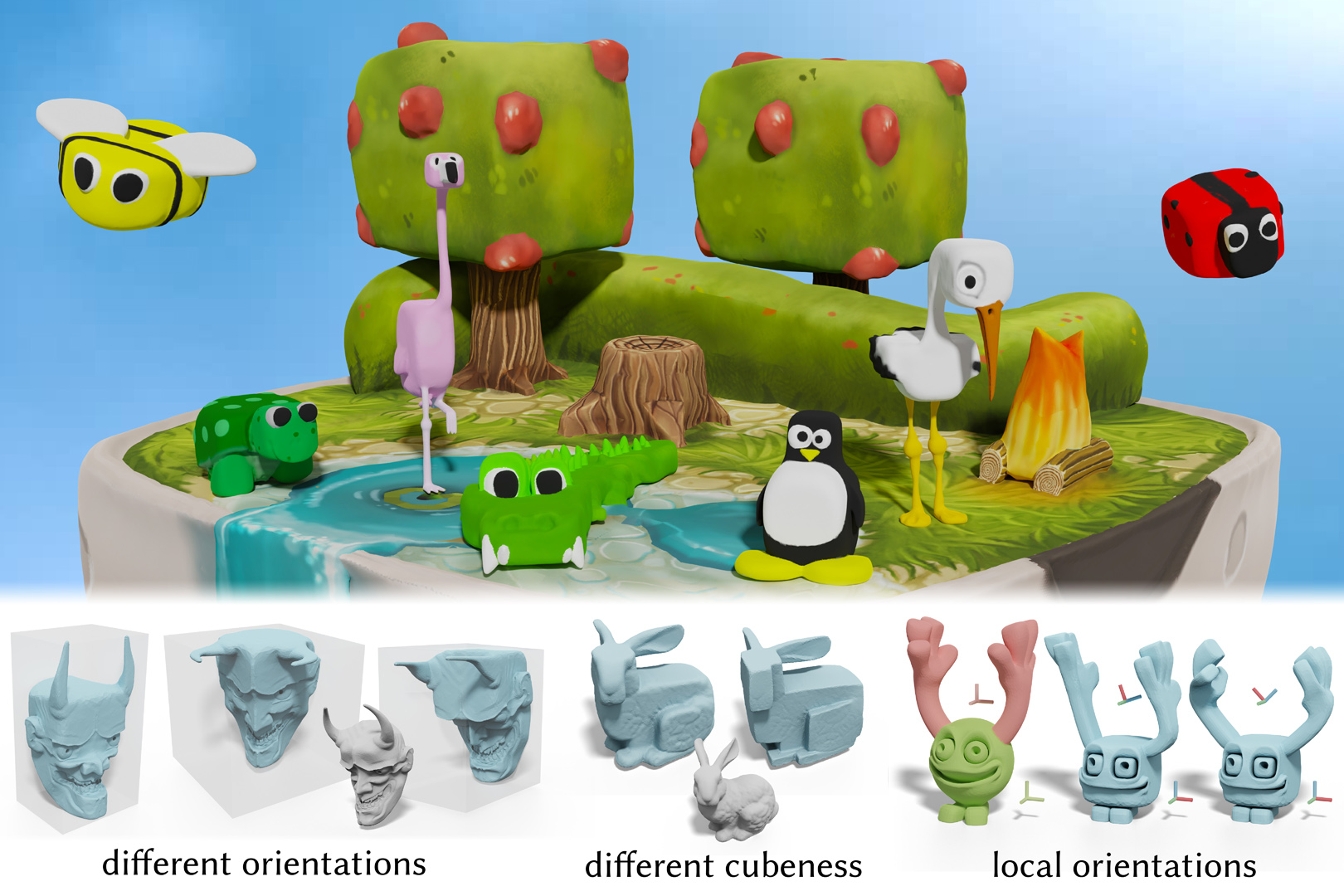
We present a 3D stylization algorithm that can turn an input shape into the style of a cube while maintaining the content of the original shape. The key insight is that cubic style sculptures can be captured by the as-rigid-as-possible energy with an ℓ1-regularization on rotated surface normals. Minimizing this energy naturally leads to a detail-preserving, cubic geometry. Our optimization can be solved efficiently without any mesh surgery. Our method serves as a non-realistic modeling tool where one can incorporate many artistic controls to create stylized geometries.
References:
1. Sema Berkiten, Maciej Halber, Justin Solomon, Chongyang Ma, Hao Li, and Szymon Rusinkiewicz. 2017. Learning detail transfer based on geometric features. In Computer Graphics Forum, Vol. 36. Wiley Online Library, 361–373.Google Scholar
2. Zhe Bian and Shi-Min Hu. 2011. Preserving detailed features in digital bas-relief making. Computer Aided Geometric Design 28, 4 (2011), 245–256.Google ScholarDigital Library
3. Sofien Bouaziz, Mario Deuss, Yuliy Schwartzburg, Thibaut Weise, and Mark Pauly. 2012. Shape-up: Shaping discrete geometry with projections. In Computer Graphics Forum, Vol. 31. Wiley Online Library, 1657–1667.Google Scholar
4. Stephen Boyd, Neal Parikh, Eric Chu, Borja Peleato, Jonathan Eckstein, et al. 2011. Distributed optimization and statistical learning via the alternating direction method of multipliers. Foundations and Trends® in Machine learning 3, 1 (2011), 1–122.Google Scholar
5. Isaac Chao, Ulrich Pinkall, Patrick Sanan, and Peter Schröder. 2010. A simple geometric model for elastic deformations. ACM transactions on graphics (TOG) 29, 4 (2010), 38.Google Scholar
6. Gianmarco Cherchi, Marco Livesu, and Riccardo Scateni. 2016. Polycube simplification for coarse layouts of surfaces and volumes. In Computer Graphics Forum, Vol. 35. Wiley Online Library, 11–20.Google Scholar
7. Quentin Corker-Marin, Alexander Pasko, and Valery Adzhiev. 2018. 4D Cubism: Modeling, Animation, and Fabrication of Artistic Shapes. IEEE computer graphics and applications 38, 3 (2018), 131–139.Google Scholar
8. Xianzhong Fang, Weiwei Xu, Hujun Bao, and Jin Huang. 2016. All-hex meshing using closed-form induced polycube. ACM Transactions on Graphics (TOG) 35, 4 (2016), 124.Google ScholarDigital Library
9. Xiao-Ming Fu, Chong-Yang Bai, and Yang Liu. 2016. Efficient volumetric polycube-map construction. In Computer Graphics Forum, Vol. 35. Wiley Online Library, 97–106.Google Scholar
10. Ran Gal, Olga Sorkine, Tiberiu Popa, Alla Sheffer, and Daniel Cohen-Or. 2007. 3D collage: expressive non-realistic modeling. In Proceedings of the 5th international symposium on Non-photorealistic animation and rendering. ACM, 7–14.Google ScholarDigital Library
11. Ismael García Fernández, Jiazhi Xia, Ying He, Shi-Qing Xin, and Gustavo Patow. 2013. Interactive Applications for Sketch-Based Editable Polycube Map. © IEEE Transactions on Visualization and Computer Graphics, 2013, vol. 19, núm. 7, p. 1158–1171 (2013).Google Scholar
12. Michael Garland. 1999. Multiresolution modeling: Survey & future opportunities. State of the art report (1999), 111–131.Google Scholar
13. Bruce Gooch and Amy Gooch. 2001. Non-photorealistic rendering. AK Peters/CRC Press.Google Scholar
14. John C Gower, Garmt B Dijksterhuis, et al. 2004. Procrustes problems. Vol. 30. Oxford University Press on Demand.Google Scholar
15. James Gregson, Alla Sheffer, and Eugene Zhang. 2011. All-hex mesh generation via volumetric polycube deformation. In Computer graphics forum, Vol. 30. Wiley Online Library, 1407–1416.Google Scholar
16. Lei He and Scott Schaefer. 2013. Mesh denoising via L 0 minimization. ACM Transactions on Graphics (TOG) 32, 4 (2013), 64.Google ScholarDigital Library
17. Ying He, Hongyu Wang, Chi-Wing Fu, and Hong Qin. 2009. A divide-and-conquer approach for automatic polycube map construction. Computers & Graphics 33, 3 (2009), 369–380.Google ScholarDigital Library
18. Linda Dalrymple Henderson. 1983. The Fourth Dimension and Non-Euclidean Geometry. Princeton, Princeton University Press.Google Scholar
19. Aaron Hertzmann, Carol O’Sullivan, and Ken Perlin. 2009. Realistic human body movement for emotional expressiveness. In ACM SIGGRAPH 2009 Courses. ACM, 20.Google ScholarDigital Library
20. Hugues Hoppe. 1996. Progressive meshes. In Proceedings of the 23rd annual conference on Computer graphics and interactive techniques. ACM, 99–108.Google ScholarDigital Library
21. Ruizhen Hu, Wenchao Li, Oliver Van Kaick, Hui Huang, Melinos Averkiou, Daniel Cohen-Or, and Hao Zhang. 2017. Co-locating style-defining elements on 3d shapes. ACM Transactions on Graphics (TOG) 36, 3 (2017), 33.Google ScholarDigital Library
22. Jin Huang, Tengfei Jiang, Zeyun Shi, Yiying Tong, Hujun Bao, and Mathieu Desbrun. 2014. l1-Based Construction of Polycube Maps from Complex Shapes. ACM Transactions on Graphics (TOG) 33, 3 (2014), 25.Google ScholarDigital Library
23. Takeo Igarashi, Tomer Moscovich, and John F Hughes. 2005. As-rigid-as-possible shape manipulation. In ACM transactions on Graphics (TOG), Vol. 24. ACM, 1134–1141.Google Scholar
24. Alec Jacobson, Daniele Panozzo, et al. 2018. libigl: A simple C++ geometry processing library. http://libigl.github.io/libigl/.Google Scholar
25. Jens Kerber, Art Tevs, Alexander Belyaev, Rhaleb Zayer, and Hans-Peter Seidel. 2009. Feature sensitive bas relief generation. In 2009 IEEE International Conference on Shape Modeling and Applications. IEEE, 148–154.Google ScholarCross Ref
26. Shahar Z Kovalsky, Meirav Galun, and Yaron Lipman. 2016. Accelerated quadratic proxy for geometric optimization. ACM Transactions on Graphics (TOG) 35, 4 (2016), 134.Google ScholarDigital Library
27. Julian Kratt, Ferdinand Eisenkeil, Sören Pirk, Andrei Sharf, and Oliver Deussen. 2014. Non-realistic 3D Object Stylization. In Proceedings of the Workshop on Computational Aesthetics (CAe ’14). ACM, New York, NY, USA, 67–75. Google ScholarDigital Library
28. Jan Eric Kyprianidis, John Collomosse, Tinghuai Wang, and Tobias Isenberg. 2013. State of the “Art”: A Taxonomy of Artistic Stylization Techniques for Images and Video. IEEE transactions on visualization and computer graphics 19, 5 (2013), 866–885.Google Scholar
29. Honghua Li, Hao Zhang, Yanzhen Wang, Junjie Cao, Ariel Shamir, and Daniel Cohen-Or. 2013. Curve style analysis in a set of shapes. In Computer Graphics Forum, Vol. 32. Wiley Online Library, 77–88.Google Scholar
30. Isaak Lim, Anne Gehre, and Leif Kobbelt. 2016. Identifying style of 3D shapes using deep metric learning. In Computer Graphics Forum, Vol. 35. Wiley Online Library, 207–215.Google Scholar
31. Juncong Lin, Xiaogang Jin, Zhengwen Fan, and Charlie CL Wang. 2008. Automatic polycube-maps. In International Conference on Geometric Modeling and Processing. Springer, 3–16.Google ScholarCross Ref
32. Hsueh-Ti Derek Liu, Michael Tao, and Alec Jacobson. 2018. Paparazzi: Surface Editing by way of Multi-View Image Processing. In SIGGRAPH Asia 2018 Technical Papers. ACM, 221.Google Scholar
33. Ligang Liu, Lei Zhang, Yin Xu, Craig Gotsman, and Steven J Gortler. 2008. A local/global approach to mesh parameterization. In Computer Graphics Forum, Vol. 27. Wiley Online Library, 1495–1504.Google ScholarDigital Library
34. Tiantian Liu, Adam W Bargteil, James F O’Brien, and Ladislav Kavan. 2013. Fast simulation of mass-spring systems. ACM Transactions on Graphics (TOG) 32, 6 (2013), 214.Google ScholarDigital Library
35. Tianqiang Liu, Aaron Hertzmann, Wilmot Li, and Thomas Funkhouser. 2015. Style compatibility for 3D furniture models. ACM Transactions on Graphics (TOG) 34, 4 (2015), 85.Google ScholarDigital Library
36. Marco Livesu, Nicholas Vining, Alla Sheffer, James Gregson, and Riccardo Scateni. 2013. PolyCut: monotone graph-cuts for PolyCube base-complex construction. ACM Transactions on Graphics (TOG) 32, 6 (2013), 171.Google ScholarDigital Library
37. Zhaoliang Lun, Evangelos Kalogerakis, and Alla Sheffer. 2015. Elements of style: learning perceptual shape style similarity. ACM Transactions on Graphics (TOG) 34, 4 (2015), 84.Google ScholarDigital Library
38. Zhaoliang Lun, Evangelos Kalogerakis, Rui Wang, and Alla Sheffer. 2016. Functionality preserving shape style transfer. ACM Transactions on Graphics (TOG) 35, 6 (2016), 209.Google ScholarDigital Library
39. Sheng-Jie Luo, Yonghao Yue, Chun-Kai Huang, Yu-Huan Chung, Sei Imai, Tomoyuki Nishita, and Bing-Yu Chen. 2015. Legolization: optimizing LEGO designs. ACM Transactions on Graphics (TOG) 34, 6 (2015), 222.Google ScholarDigital Library
40. Chongyang Ma, Haibin Huang, Alla Sheffer, Evangelos Kalogerakis, and Rui Wang. 2014. Analogy-driven 3D style transfer. In Computer Graphics Forum, Vol. 33. Wiley Online Library, 175–184.Google Scholar
41. Josiah Manson and Scott Schaefer. 2011. Hierarchical deformation of locally rigid meshes. In Computer Graphics Forum, Vol. 30. Wiley Online Library, 2387–2396.Google Scholar
42. Jacob Mattingley and Stephen Boyd. 2012. CVXGEN: A code generator for embedded convex optimization. Optimization and Engineering 13, 1 (2012), 1–27.Google ScholarCross Ref
43. Ravish Mehra, Qingnan Zhou, Jeremy Long, Alla Sheffer, Amy Gooch, and Niloy J Mitra. 2009. Abstraction of man-made shapes. In ACM transactions on graphics (TOG), Vol. 28. ACM, 137.Google Scholar
44. Alessandro Muntoni, Marco Livesu, Riccardo Scateni, Alla Sheffer, and Daniele Panozzo. 2018. Axis-aligned height-field block decomposition of 3d shapes. ACM Transactions on Graphics (TOG) 37, 5 (2018), 169.Google ScholarDigital Library
45. Yue Peng, Bailin Deng, Juyong Zhang, Fanyu Geng, Wenjie Qin, and Ligang Liu. 2018. Anderson acceleration for geometry optimization and physics simulation. ACM Transactions on Graphics (TOG) 37, 4 (2018), 42.Google ScholarDigital Library
46. Ulrich Pinkall and Konrad Polthier. 1993. Computing discrete minimal surfaces and their conjugates. Experimental mathematics 2, 1 (1993), 15–36.Google Scholar
47. Michael Rabinovich, Roi Poranne, Daniele Panozzo, and Olga Sorkine-Hornung. 2017. Scalable locally injective mappings. ACM Transactions on Graphics (TOG) 36, 2 (2017), 16.Google ScholarDigital Library
48. Bernhard Reinert, Tobias Ritschel, and Hans-Peter Seidel. 2012. Homunculus Warping: Conveying importance using self-intersection-free non-homogeneous mesh deformation. In Computer Graphics Forum, Vol. 31. Wiley Online Library, 2165–2171.Google Scholar
49. Christian Schüller, Daniele Panozzo, and Olga Sorkine-Hornung. 2014. Appearance-mimicking surfaces. ACM Transactions on Graphics (TOG) 33, 6 (2014), 216.Google ScholarDigital Library
50. Liang-Tsen Shen, Sheng-Jie Luo, Chun-Kai Huang, and Bing-Yu Chen. 2012. SD Models: Super-Deformed Character Models. In Computer Graphics Forum, Vol. 31. Wiley Online Library, 2067–2075.Google Scholar
51. Anna Shtengel, Roi Poranne, Olga Sorkine-Hornung, Shahar Z Kovalsky, and Yaron Lipman. 2017. Geometric optimization via composite majorization. ACM Trans. Graph. 36, 4 (2017), 38–1.Google ScholarDigital Library
52. Wenhao Song, Alexander Belyaev, and Hans-Peter Seidel. 2007. Automatic generation of bas-reliefs from 3d shapes. In IEEE International Conference on Shape Modeling and Applications 2007 (SMI’07). IEEE, 211–214.Google ScholarDigital Library
53. Olga Sorkine and Marc Alexa. 2007. As-rigid-as-possible surface modeling. In Symposium on Geometry processing, Vol. 4. 109–116.Google ScholarDigital Library
54. Oded Stein, Eitan Grinspun, and Keenan Crane. 2018a. Developability of Triangle Meshes. ACM Trans. Graph. 37, 4 (2018).Google ScholarDigital Library
55. Oded Stein, Eitan Grinspun, Max Wardetzky, and Alec Jacobson. 2018b. Natural Boundary Conditions for Smoothing in Geometry Processing. ACM Trans. Graph. 37, 2, Article 23 (May 2018), 13 pages. Google ScholarDigital Library
56. Oded Stein, Alec Jacobson, and Eitan Grinspun. 2019. Interactive design of castable shapes using two-piece rigid molds. Computers & Graphics (2019).Google Scholar
57. Marco Tarini, Kai Hormann, Paolo Cignoni, and Claudio Montani. 2004. Polycube-maps. In ACM transactions on graphics (TOG), Vol. 23. ACM, 853–860.Google Scholar
58. Romain Testuz, Yuliy Schwartzburg, and Mark Pauly. 2013. Automatic Generation of Constructable Brick Sculptures. In Eurographics 2013 – Short Papers. The Eurographics Association. Google ScholarCross Ref
59. Christian Theobalt, Christian Roessl, Edilson de Aguiar, and Hans-Peter Seidel. 2007. Animation Collage. In Eurographics/SIGGRAPH Symposium on Computer Animation, Dimitris Metaxas and Jovan Popovic (Eds.). The Eurographics Association. Google ScholarCross Ref
60. Robert Tibshirani. 1996. Regression shrinkage and selection via the lasso. Journal of the Royal Statistical Society: Series B (Methodological) 58, 1 (1996), 267–288.Google ScholarCross Ref
61. Andreï Nikolaevitch Tikhonov, AV Goncharsky, VV Stepanov, and Anatoly G Yagola. 2013. Numerical methods for the solution of ill-posed problems. Vol. 328. Springer Science & Business Media.Google Scholar
62. Hongyu Wang, Ying He, Xin Li, Xianfeng Gu, and Hong Qin. 2007. Polycube splines. In Proceedings of the 2007 ACM symposium on Solid and physical modeling. ACM, 241–251.Google ScholarDigital Library
63. Hongyu Wang, Miao Jin, Ying He, Xianfeng Gu, and Hong Qin. 2008. User-controllable polycube map for manifold spline construction. In Proceedings of the 2008 ACM symposium on Solid and physical modeling. ACM, 397–404.Google ScholarDigital Library
64. Yu-Shuen Wang, Min-Wen Chao, Chin-Chueng Yi, and Chao-Hung Lin. 2011. Cubist Style Rendering for 3D Polygonal Models. Journal of Information Science and Engineering 27, 6 (2011), 1885–1899.Google Scholar
65. Tim Weyrich, Jia Deng, Connelly Barnes, Szymon Rusinkiewicz, and Adam Finkelstein. 2007. Digital bas-relief from 3D scenes. In ACM transactions on graphics (TOG), Vol. 26. ACM, 32.Google Scholar
66. Kai Xu, Honghua Li, Hao Zhang, Daniel Cohen-Or, Yueshan Xiong, and Zhi-Quan Cheng. 2010. Style-content separation by anisotropic part scales. In ACM Transactions on Graphics (TOG), Vol. 29. ACM, 184.Google ScholarCross Ref
67. Fenggen Yu, Kai Xu, Ali Mahdavi-Amiri, Hao Zhang, et al. 2018. Semi-Supervised Co-Analysis of 3D Shape Styles from Projected Lines. ACM Transactions on Graphics (TOG) 37, 2 (2018), 21.Google ScholarDigital Library
68. Wuyi Yu, Kang Zhang, Shenghua Wan, and Xin Li. 2014. Optimizing polycube domain construction for hexahedral remeshing. Computer-Aided Design 46 (2014), 58–68.Google ScholarDigital Library
69. Mehmet Ersin Yumer and Levent Burak Kara. 2012. Co-abstraction of shape collections. ACM Transactions on Graphics (TOG) 31, 6 (2012), 166.Google ScholarDigital Library
70. Juyong Zhang, Bailin Deng, Yang Hong, Yue Peng, Wenjie Qin, and Ligang Liu. 2018. Static/dynamic filtering for mesh geometry. IEEE transactions on visualization and computer graphics (2018).Google Scholar
71. Hui Zhao, Na Lei, Xuan Li, Peng Zeng, Ke Xu, and Xianfeng Gu. 2018. Robust edge-preserving surface mesh polycube deformation. Computational Visual Media 4, 1 (01 Mar 2018), 33–42. Google ScholarCross Ref
72. Qingnan Zhou and Alec Jacobson. 2016. Thingi10K: A Dataset of 10,000 3D-Printing Models. arXiv preprint arXiv:1605.04797 (2016).Google Scholar
73. Yufeng Zhu, Robert Bridson, and Danny M Kaufman. 2018. Blended cured quasi-newton for distortion optimization. ACM Transactions on Graphics (TOG) 37, 4 (2018), 40.Google ScholarDigital Library
74. Denis Zorin. 2006. Modeling with multiresolution subdivision surfaces. In ACM SIGGRAPH 2006 Courses. ACM, 30–50.Google ScholarDigital Library



