
“Discrete geodesic parallel coordinates” by Wang, Pellis, Rist, Pottmann and Müller
Conference:
Type(s):
Title:
- Discrete geodesic parallel coordinates
Session/Category Title:
- Network
Presenter(s)/Author(s):
Moderator(s):
Abstract:
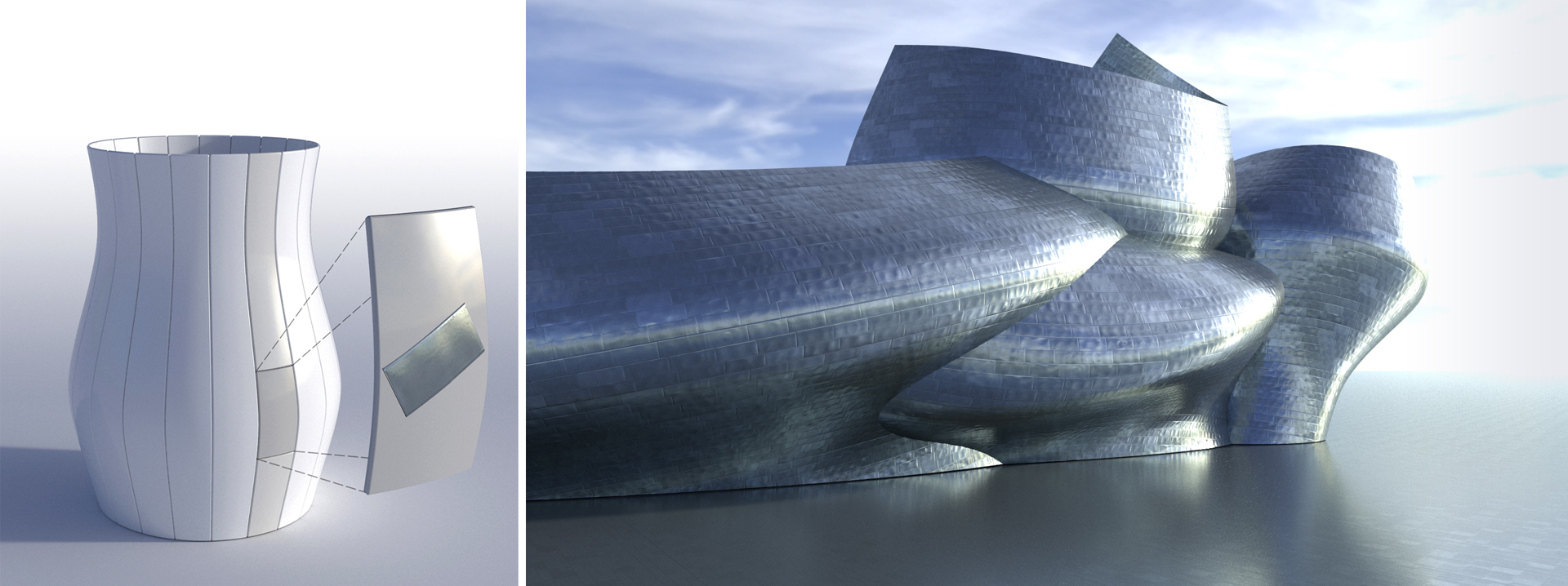
Geodesic parallel coordinates are orthogonal nets on surfaces where one of the two families of parameter lines are geodesic curves. We describe a discrete version of these special surface parameterizations and show that they are very useful for specific applications, most of which are related to the design and fabrication of surfaces in architecture. With the new discrete surface model, it is easy to control strip widths between neighboring geodesics. This facilitates tasks such as cladding a surface with strips of originally straight flat material or designing geodesic gridshells and timber rib shells. It is also possible to model nearly developable surfaces. These are characterized by geodesic strips with almost constant strip widths and are used for generating shapes that can be manufactured from materials which allow for some stretching or shrinking like felt, leather, or thin wooden boards. Most importantly, we show how to constrain the strip width parameters to model a class of intrinsically symmetric surfaces. These surfaces are isometric to surfaces of revolution and can be covered with doubly-curved panels that are produced with only a few molds when working with flexible materials like metal sheets.
References:
1. Mirela Ben-Chen, Adrian Butscher, Justin Solomon, and Leonidas J. Guibas. 2010. On Discrete Killing Vector Fields and Patterns on Surfaces. Comput. Graph. Forum 29, 5 (2010), 1701–1711.Google ScholarCross Ref
2. Fabio Bianconi and Marco Filippucci. 2019. Digital wood design. Lecture notes in Civil Engineering, Vol. 24. Springer.Google Scholar
3. Sebastien Callens and Amir Zadpoor. 2018. From flat sheets to curved geometries: Origami and kirigami approaches. Materials Today 21, 3 (2018), 241–264.Google ScholarCross Ref
4. Wolfgang Carl. 2017. On semidiscrete constant mean curvature surfaces and their associated families. Monatsh. Math. 182, 3 (2017), 537–563.Google ScholarCross Ref
5. Keenan Crane, Clarisse Weischedel, and Max Wardetzky. 2017. The Heat Method for Distance Computation. Commun. ACM 60, 11 (2017), 90–99.Google ScholarDigital Library
6. Erik Demain and Joseph O’Rourke. 2007. Geometric Folding Algorithms. Cambridge University Press.Google Scholar
7. Levi H Dudte, Etienne Vouga, Tomohiro Tachi, and L Mahadevan. 2016. Programming curvature using origami tessellations. Nature materials 15, 5 (2016), 583.Google Scholar
8. Michael Eigensatz, Martin Kilian, Alexander Schiftner, Niloy Mitra, Helmut Pottmann, and Mark Pauly. 2010. Paneling Architectural Freeform Surfaces. ACM Trans. Graphics 29, 4 (2010), #45,1–10.Google ScholarDigital Library
9. Sebastian Finsterwalder. 1899. Mechanische Beziehungen bei der Flächendeformation. Jahresber. d. Deutschen Math.-Vereinigung 6 (1899), 43–90.Google Scholar
10. Konstantinos Gavriil, Alexander Schiftner, and Helmut Pottmann. 2018. Optimizing B-spline surfaces for developability and paneling architectural freeform surfaces. CoRR abs/1808.07560 (2018). arXiv:1808.07560 http://arxiv.org/abs/1808.07560Google Scholar
11. Elisa Lafuente Hernandez. 2015. Design and optimisation of elastic gridshells. Ph.D. Dissertation. Univ. of Arts, Berlin.Google Scholar
12. Joe Kahlert, Matt Olson, and Hao Zhang. 2011. Width-Bounded Geodesic Strips for Surface Tiling. The Visual Computer 27, 1 (2011), 45–56.Google ScholarDigital Library
13. Mina Konaković, Keenan Crane, Bailin Deng, Sofien Bouaziz, Daniel Piker, and Mark Pauly. 2016. Beyond Developable: Computational Design and Fabrication with Auxetic Materials. ACM Trans. Graph. 35, 4, Article 89 (2016), 11 pages.Google ScholarDigital Library
14. Mina Konaković, Julian Panetta, Keenan Crane, and Mark Pauly. 2018. Rapid Deployment of Curved Surfaces via Programmable Auxetics. ACM Trans. Graph. 37, 4, Article 106 (2018), 13 pages.Google Scholar
15. Wolfgang Kühnel. 2003. Differentialgeometrie (second ed.). Friedr. Vieweg & Sohn, Braunschweig. viii+256 pages. Kurven—Flächen—Mannigfaltigkeiten.Google Scholar
16. Yang Liu, Helmut Pottmann, Johannes Wallner, Yong-Liang Yang, and Wenping Wang. 2006. Geometric modeling with conical meshes and developable surfaces. ACM Trans. Graphics 25, 3 (2006), 681–689. Proc. SIGGRAPH.Google ScholarDigital Library
17. Neil Meredith and James Kotronis. 2012. Self-detailing and self-documenting systems for wood fabrication: The Burj Khalifa. In Advances in Architectural Geometry 2012, L. Hesselgren et al. (Eds.). Springer, 185–198.Google Scholar
18. Ferdinand Minding. 1838. Ueber die Biegung krummer Flächen. J. Reine Angew. Math. 18 (1838), 365–368.Google Scholar
19. Jun Mitani and Hiromasa Suzuki. 2004. Making Papercraft Toys from Meshes Using Strip-based Approximate Unfolding. In ACM SIGGRAPH 2004 Papers (SIGGRAPH ’04). ACM, New York, NY, USA, 259–263. Google ScholarDigital Library
20. Christian Müller and Johannes Wallner. 2013. Semi-discrete isothermic surfaces. Results Math. 63, 3–4 (2013), 1395–1407.Google ScholarCross Ref
21. Maks Ovsjanikov, Jian Sun, and Leonidas J. Guibas. 2008. Global Intrinsic Symmetries of Shapes. Comput. Graph. Forum 27, 5 (2008), 1341–1348.Google ScholarCross Ref
22. Jesus Perez, Miguel A. Otaduy, and Bernhard Thomaszewski. 2017. Computational Design and Automated Fabrication of Kirchhoff-Plateau Surfaces. ACM Trans. on Graphics 36, 4 (2017), 62.1–62.12. Proc. SIGGRAPH.Google ScholarDigital Library
23. Claudio Pirazzi and Yves Weinand. 2006. Geodesic lines on free-form surfaces: optimized grids for timber rib shells. In 9th World Conference on Timber Engineering. 72–79.Google Scholar
24. Konrad Polthier and Markus Schmies. 1998. Straightest Geodesics on Polyhedral Surfaces. Springer Berlin Heidelberg, Berlin, Heidelberg, 135–150.Google Scholar
25. Helmut Pottmann, Michael Eigensatz, Amir Vaxman, and Johannes Wallner. 2015. Architectural Geometry. Computers and Graphics 47 (2015), 145–164.Google ScholarDigital Library
26. Helmut Pottmann, Qixing Huang, Bailin Deng, Alexander Schiftner, Martin Kilian, Leonidas Guibas, and Johannes Wallner. 2010. Geodesic Patterns. ACM Trans. Graphics 29, 4 (2010), #43,1–10. Proc. SIGGRAPH.Google ScholarDigital Library
27. Helmut Pottmann, Alexander Schiftner, Pengbo Bo, Heinz Schmiedhofer, Wenping Wang, Niccolo Baldassini, and Johannes Wallner. 2008. Freeform surfaces from single curved panels. ACM Trans. Graph. 27, 3 (2008), #76,1–10. Proc. SIGGRAPH.Google ScholarDigital Library
28. Michael Rabinovich, Tim Hoffmann, and Olga Sorkine-Hornung. 2018a. Discrete Geodesic Nets for Modeling Developable Surfaces. ACM Trans. Graph. 37, 2, Article 16 (2018), 17 pages.Google ScholarDigital Library
29. Michael Rabinovich, Tim Hoffmann, and Olga Sorkine-Hornung. 2018b. The Shape Space of Discrete Orthogonal Geodesic Nets. ACM Trans. Graph. 37, 6, Article 228 (2018), 17 pages.Google ScholarDigital Library
30. Dan Raviv, Alexander M. Bronstein, Michael M. Bronstein, and Ron Kimmel. 2010. Full and Partial Symmetries of Non-rigid Shapes. International Journal of Computer Vision 89, 1 (01 Aug 2010), 18–39.Google ScholarDigital Library
31. Martin H Sadd. 2009. Elasticity: theory, applications, and numerics. Academic Press, Oxford.Google Scholar
32. Robert Sauer. 1970. Differenzengeometrie. Springer.Google Scholar
33. Eike Schling. 2018. Repetitive Structures – Design and construction of curved support structures with repetitive parameters. Ph.D. Dissertation. TU Munich.Google Scholar
34. Eike Schling, Martin Kilian, Hui Wang, Denis Schikore, and Helmut Pottmann. 2018. Design and construction of curved support structures with repetitive parameters. In Adv. in Architectural Geometry, L.Hesselgren et al. (Ed.). Klein Publ. Ltd, 140–165.Google Scholar
35. Markus Schneider and Peter Mehrtens. 2012. Cladding freeform surfaces with curved metal panels – a complete digital production chain. In Advances in Architectural Geometry 2012, L. Hesselgren et al. (Eds.). Springer, 237–242.Google Scholar
36. J.A. Sethian. 1999. Level Set Methods and Fast Marching Methods: Evolving Interfaces in Computational Geometry, Fluid Mechanics, Computer Vision, and Materials Science. Cambridge University Press.Google Scholar
37. Dennis Shelden. 2002. Digital surface representation and the constructibility of Gehry’s architecture. Ph.D. Dissertation. M.I.T.Google Scholar
38. Justin Solomon, Mirela Ben-Chen, Adrian Butscher, and Leonidas J. Guibas. 2011. Discovery of Intrinsic Primitives on Triangle Meshes. Comput. Graph. Forum 30, 2 (2011), 365–374.Google ScholarCross Ref
39. Michael Spivak. 1979. A comprehensive introduction to differential geometry. Vol. II (second ed.). Publish or Perish, Inc., Wilmington, Del. xv+423 pages.Google Scholar
40. Oded Stein, Eitan Grinspun, and Keenan Crane. 2018. Developability of Triangle Meshes. ACM Trans. Graph. 37, 4, Article 77 (2018), 14 pages.Google ScholarDigital Library
41. Chengcheng Tang, Pengbo Bo, Johannes Wallner, and Helmut Pottmann. 2016. Interactive Design of Developable Surfaces. ACM Trans. Graph. 35, 2, Article 12 (Jan. 2016), 12 pages.Google ScholarDigital Library
42. Chengcheng Tang, Xiang Sun, Alexandra Gomes, Johannes Wallner, and Helmut Pottmann. 2014. Form-finding with Polyhedral Meshes Made Simple. ACM Trans. Graph. 33, 4, Article 70 (2014), 9 pages.Google ScholarDigital Library
43. Julius Weingarten. 1861. Über eine Klasse aufeinander abwickelbarer Flächen. J. reine u. angewandte Mathematik 59 (1861), 382–393.Google Scholar
44. Walter Wunderlich. 1951. Zur Differenzengeometrie der Flächen konstanter negativer Krümmung. Österreich. Akad. Wiss. Math.-Nat. Kl. S.-B. IIa. 160 (1951), 39–77.Google Scholar



