
“MIS compensation: optimizing sampling techniques in multiple importance sampling” by Karlík, Šik, Vévoda, Skřivan and Křivánek
Conference:
Type(s):
Title:
- MIS compensation: optimizing sampling techniques in multiple importance sampling
Session/Category Title:
- Light Transport
Presenter(s)/Author(s):
Moderator(s):
Abstract:
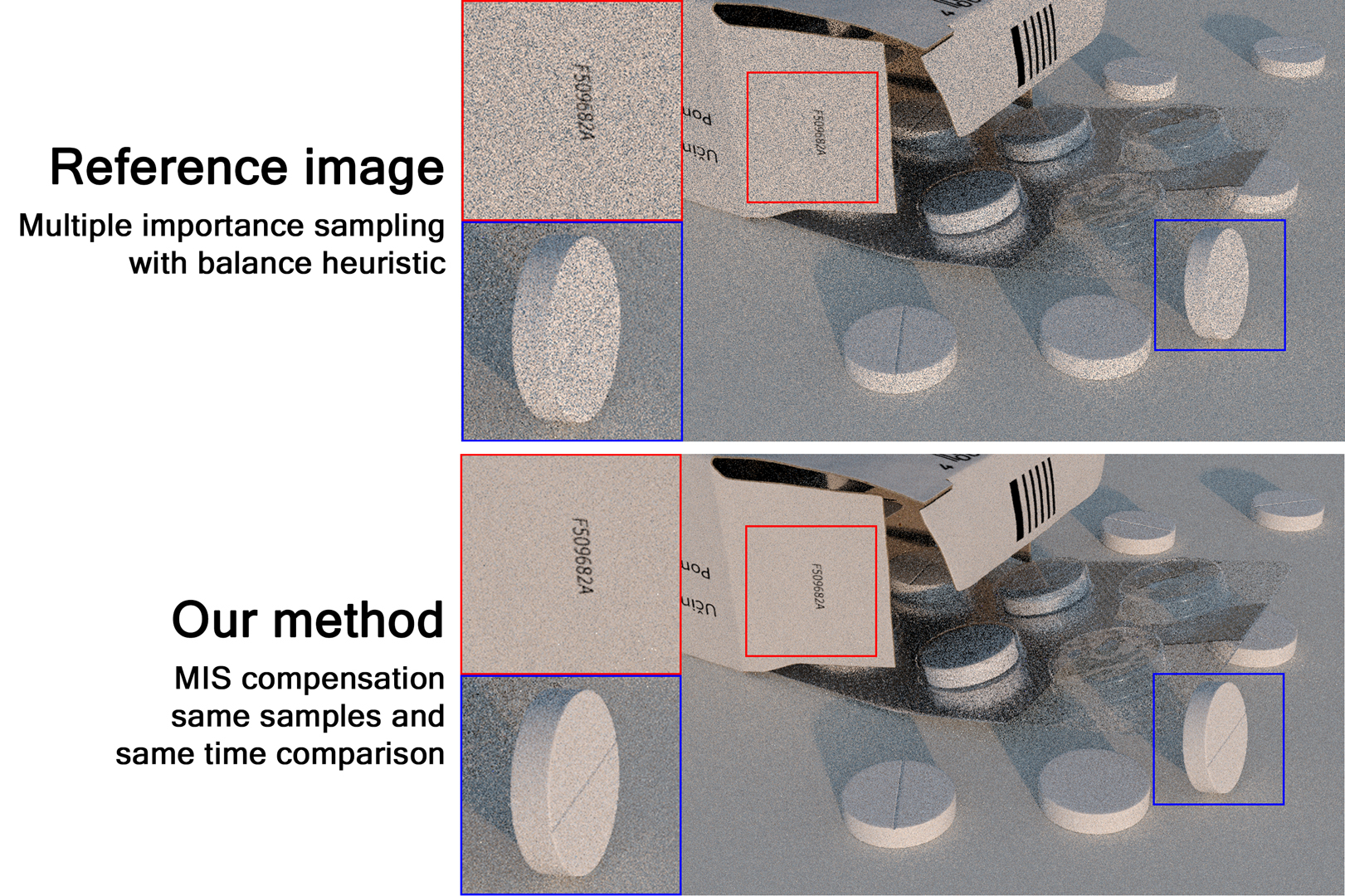
Multiple importance sampling (MIS) has become an indispensable tool in Monte Carlo rendering, widely accepted as a near-optimal solution for combining different sampling techniques. But an MIS combination, using the common balance or power heuristics, often results in an overly defensive estimator, leading to high variance. We show that by generalizing the MIS framework, variance can be substantially reduced. Specifically, we optimize one of the combined sampling techniques so as to decrease the overall variance of the resulting MIS estimator. We apply the approach to the computation of direct illumination due to an HDR environment map and to the computation of global illumination using a path guiding algorithm. The implementation can be as simple as subtracting a constant value from the tabulated sampling density done entirely in a preprocessing step. This produces a consistent noise reduction in all our tests with no negative influence on run time, no artifacts or bias, and no failure cases.
References:
1. Sameer Agarwal, Ravi Ramamoorthi, Serge Belongie, and Henrik Wann Jensen. 2003. Structured importance sampling of environment maps. ACM Trans. Graph. 22, 3 (July 2003), 605–612.Google ScholarDigital Library
2. Laurent Belcour, Guofu Xie, Christophe Hery, Mark Meyer, Wojciech Jarosz, and Derek Nowrouzezahrai. 2018. Integrating Clipped Spherical Harmonics Expansions. ACM Trans. Graph. 37, 2, Article 19 (July 2018).Google ScholarDigital Library
3. David Burke, Abhijeet Ghosh, and Wolfgang Heidrich. 2005. Bidirectional Importance Sampling for Direct Illumination. In Proceedings of the Sixteenth Eurographics Conference on Rendering Techniques (EGSR ’05). 147–156.Google ScholarDigital Library
4. Olivier Cappé, Randal Douc, Arnaud Guillin, Jean-Michel Marin, and Christian P. Robert. 2008. Adaptive importance sampling in general mixture classes. Statistics and Computing 18, 4 (December 2008), 447–459.Google ScholarDigital Library
5. Petrik Clarberg and Tomas Akenine-Möller. 2008a. Exploiting Visibility Correlation in Direct Illumination. In Eurographics Symposium on Rendering (EGSR ’08).Google Scholar
6. Petrik Clarberg and Tomas Akenine-Möller. 2008b. Practical Product Importance Sampling for Direct Illumination. Comput. Graph. Forum 27, 2 (April 2008).Google ScholarCross Ref
7. Petrik Clarberg, Wojciech Jarosz, Tomas Akenine-Möller, and Henrik Wann Jensen. 2005. Wavelet Importance Sampling: Efficiently Evaluating Products of Complex Functions. ACM Trans. Graph. 24, 3 (July 2005), 1166–1175.Google ScholarDigital Library
8. Jean-Marie Cornuet, Jean-Michel Marin, Antonietta Mira, and Christian P. Robert. 2012. Adaptive multiple importance sampling. Scandinavian Journal of Stats. 39, 4 (2012).Google Scholar
9. Víctor Elvira, Luca Martino, David Luengo, and Mónica F. Bugallo. 2015. Generalized multiple importance sampling. arXiv:1511.03095.Google Scholar
10. Víctor Elvira, Luca Martino, David Luengo, and Mónica F. Bugallo. 2016. Heretical multiple importance sampling. IEEE Signal Processing Letters 23, 10 (October 2016).Google ScholarCross Ref
11. Shaohua Fan, Stephen Chenney, Bo Hu, Kam Wah Tsui, and Yu Chi Lai. 2006. Optimizing control variate estimators for rendering. Comput. Graph. Forum (EUROGRAPHICS ’06) 25, 3 (2006), 351–357.Google Scholar
12. Iliyan Georgiev, Jaroslav Křivánek, Stefan Popov, and Philipp Slusallek. 2012a. Importance caching for complex illumination. Comput. Graph. Forum (EUROGRAPHICS ’12) 31, 2 (May 2012), 701–710.Google ScholarDigital Library
13. Iliyan Georgiev, Jaroslav Křivánek, Tomáš Davidovič, and Philipp Slusallek. 2012b. Light transport simulation with vertex connection and merging. ACM Trans. Graph. (SIGGRAPH Asia ’12) 31, 6 (November 2012).Google ScholarDigital Library
14. Toshiya Hachisuka, Jacopo Pantaleoni, and Henrik Wann Jensen. 2012. A path space extension for robust light transport simulation. ACM Trans. Graph. (SIGGRAPH Asia ’12) 31, 6 (November 2012).Google ScholarDigital Library
15. Vlastimil Havran and Mateu Sbert. 2014. Optimal Combination of Techniques in Multiple Importance Sampling. In Proceedings of the 13th ACM SIGGRAPH International Conference on Virtual-Reality Continuum and Its Applications in Industry. 141–150.Google ScholarDigital Library
16. Hera Y. He and Art B. Owen. 2014. Optimal mixture weights in multiple importance sampling. arXiv:1411.3954.Google Scholar
17. Sebastian Herholz, Oskar Elek, Jiří Vorba, Hendrik Lensch, and Jaroslav Křivánek. 2016. Product importance sampling for light transport path guiding. Comput. Graph. Forum 35, 4 (July 2016), 67–77.Google ScholarCross Ref
18. Sebastian Herholz, Yangyang Zhao, Oskar Elek, Derek Nowrouzezahrai, Hendrik P. A. Lensch, and Jaroslav Křivánek. 2019. Volume Path Guiding Based on Zero-Variance Random Walk Theory. ACM Trans. Graph. 38, 3 (2019).Google ScholarDigital Library
19. Tim Hesterberg. 1995. Weighted average importance sampling and defensive mixture distributions. Technometrics 37, 2 (May 1995), 185–194.Google ScholarCross Ref
20. Stephen Hill, Stephen McAuley, Cyril Jover, Sébastien Lachambre, Angelo Pesce, and Xian-Chun Wu. 2016. Physically based shading in theory and practice. In ACM SIGGRAPH 2016 Courses (SIGGRAPH ’16). Article 21.Google ScholarDigital Library
21. Wojciech Jarosz, Nathan A. Carr, and Henrik Wann Jensen. 2009. Importance sampling spherical harmonics. Comput. Graph. Forum 28, 2 (April 2009), 577–586.Google ScholarCross Ref
22. Henrik Wann Jensen. 1995. Importance driven path tracing using the photon map. In Rendering Techniques. 326–335.Google Scholar
23. Alexander Keller, Luca Fascione, Marcos Fajardo, Iliyan Georgiev, Per Christensen, Johannes Hanika, Christian Eisenacher, and Gregory Nichols. 2015. The path tracing revolution in the movie industry. In ACM SIGGRAPH 2015 Courses. Article 24.Google ScholarDigital Library
24. Alan King, Christopher Kulla, Alejandro Conty, and Marcos Fajardo. 2013. BSSRDF importance sampling. In ACM SIGGRAPH 2013 Talks (SIGGRAPH ’13). Article 48.Google ScholarDigital Library
25. Ivo Kondapaneni, Petr Vévoda, Pascal Grittmann, Tomáš Skřivan, Philipp Slusallek, and Jaroslav Křivánek. 2019. Optimal Multiple Importance Sampling. ACM Trans. Graph. (SIGGRAPH 2019) 38, 4 (July 2019).Google Scholar
26. Jaroslav Křivánek, Iliyan Georgiev, Toshiya Hachisuka, Petr Vévoda, Martin Šik, Derek Nowrouzezahrai, and Wojciech Jarosz. 2014. Unifying points, beams, and paths in volumetric light transport simulation. ACM Trans. Graph. 33, 4 (August 2014).Google ScholarDigital Library
27. Jaroslav Křivánek, Ondřej Karlík, Vladimir Koylazov, Henrik Wann Jensen, Thomas Ludwig, and Christophe Chevallier. 2018. Realistic Rendering in Architecture and Product Visualization. In ACM SIGGRAPH 2018 Courses (SIGGRAPH ’18). Article 10.Google Scholar
28. Christopher Kulla and Marcos Fajardo. 2012. Importance sampling techniques for path tracing in participating media. Comput. Graph. Forum 31, 4 (June 2012), 1519–1528.Google ScholarDigital Library
29. Eric P. Lafortune and Yves D. Willems. 1995. A 5D Tree to Reduce the Variance of Monte Carlo Ray Tracing. In Proceedings of the 6th Eurographics Workshop on Rendering.Google Scholar
30. Yu-Chi Lai, Hsuan-Ting Chou, Kuo-Wei Chen, and Shaohua Fan. 2015. Robust and efficient adaptive direct lighting estimation. The Visual Computer 31, 1 (2015).Google Scholar
31. Heqi Lu, Romain Pacanowski, and Xavier Granier. 2013. Second-order approximation for variance reduction in multiple importance sampling. Comput. Graph. Forum 32, 7 (October 2013).Google ScholarCross Ref
32. Thomas Müller, Markus Gross, and Jan Novák. 2017. Practical path guiding for efficient light-transport simulation. Comput. Graph. Forum (EGSR ’17) 36, 4 (June 2017).Google ScholarDigital Library
33. Art Owen and Yi Zhou. 2000. Safe and effective importance sampling. J. Amer. Statist. Assoc. 95, 449 (March 2000), 135–143.Google ScholarCross Ref
34. Anthony Pajot, Loic Barthe, Mathias Paulin, and Pierre Poulin. 2011. Representativity for robust and adaptive multiple importance sampling. IEEE Transactions on Visualization and Computer Graphics 17, 8 (August 2011), 1108–1121.Google ScholarDigital Library
35. Matt Pharr, Wenzel Jakob, and Greg Humphreys. 2016. Physically Based Rendering, Third Edition: From Theory to Implementation (3rd ed.). Morgan Kaufmann Publishers Inc., San Francisco, CA, USA.Google ScholarDigital Library
36. Bui Tuong Phong. 1975. Illumination for computer generated pictures. Commun. ACM 18, 6 (June 1975), 311–317.Google ScholarDigital Library
37. Stefan Popov, Ravi Ramamoorthi, Frédo Durand, and George Drettakis. 2015. Probabilistic connections for bidirectional path tracing. Comput. Graph. Forum 34, 4 (2015).Google Scholar
38. Fabrice Rousselle, Petrik Clarberg, Luc Leblanc, Victor Ostromoukhov, and Pierre Poulin. 2008. Efficient product sampling using hierarchical thresholding. The Visual Computer 24, 7 (July 2008), 465–474.Google ScholarDigital Library
39. Andrzej Ruszczynski. 2006. Nonlinear Optimization. Princeton University Press.Google Scholar
40. Mateu Sbert and Vlastimil Havran. 2017. Adaptive multiple importance sampling for general functions. The Visual Computer 33, 6 (June 2017), 845–855.Google ScholarDigital Library
41. Mateu Sbert, Vlastimil Havran, and Laszlo Szirmay-Kalos. 2016. Variance Analysis of Multi-sample and One-sample Multiple Importance Sampling. Comput. Graph. Forum 35, 7 (October 2016), 451–460.Google Scholar
42. Mateu Sbert, Vlastimil Havran, and László Szirmay-Kalos. 2018. Multiple importance sampling revisited: breaking the bounds. EURASIP Journal on Advances in Signal Processing 2018, 1 (February 2018).Google ScholarCross Ref
43. Mateu Sbert, Vlastimil Havran, and László Szirmay-Kalos. 2019. Optimal Deterministic Mixture Sampling. In Eurographics 2019, Short Papers.Google Scholar
44. Justin Talbot, David Cline, and Parris K. Egbert. 2005. Importance resampling for global illumination. In Eurographics Symposium on Rendering. 139–146.Google Scholar
45. Glenn Torrie and John Valleau. 1977. Nonphysical sampling distributions in Monte Carlo free-energy estimation: Umbrella sampling. J. Comput. Phys. 23, 2 (1977).Google ScholarCross Ref
46. Eric Veach and Leonidas J. Guibas. 1995. Optimally combining sampling techniques for Monte Carlo rendering. In SIGGRAPH ’95. 419–428.Google Scholar
47. Jiří Vorba, Johannes Hanika, Sebastian Herholz, Thomas Müller, Jaroslav Křivánek, and Alexander Keller. 2019. Path Guiding in Production. In ACM SIGGRAPH 2019 Courses. Google ScholarDigital Library
48. Jiří Vorba, Ondřej Karlík, Martin Šik, Tobias Ritschel, and Jaroslav Křivánek. 2014. On-line Learning of Parametric Mixture Models for Light Transport Simulation. ACM Trans. Graph. (SIGGRAPH ’14) 33, 4 (July 2014).Google Scholar



