
“Sketch-based implicit blending”
Conference:
Type(s):
Title:
- Sketch-based implicit blending
Session/Category Title:
- Geometry and Shape
Presenter(s)/Author(s):
Abstract:
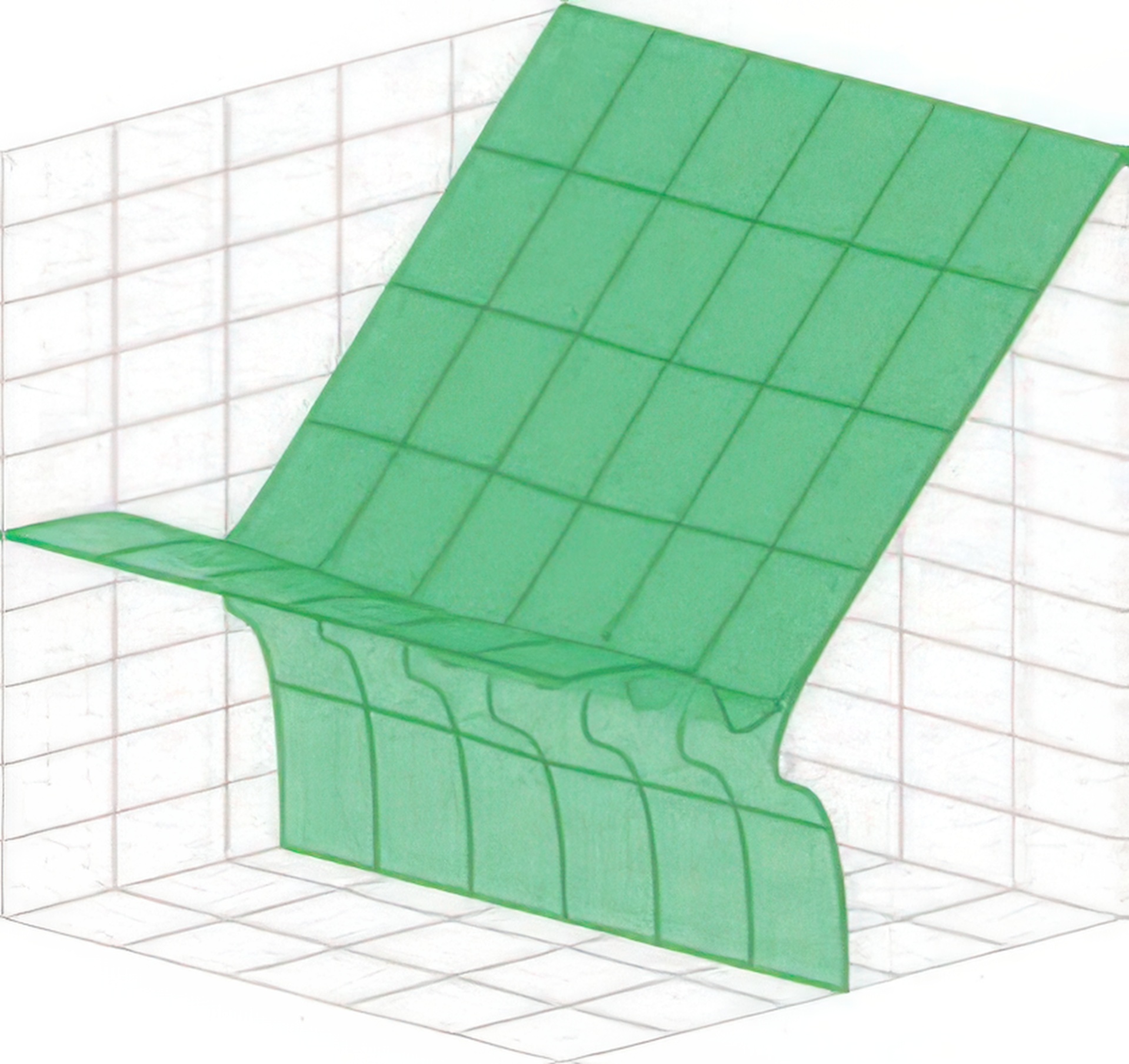
Implicit models can be combined by using composition operators; functions that determine the resulting shape. Recently, gradient-based composition operators have been used to express a variety of behaviours including smooth transitions, sharp edges, contact surfaces, bulging, or any combinations. The problem for designers is that building new operators is a complex task that requires specialized technical knowledge. In this work, we introduce an automatic method for deriving a gradient-based implicit operator from 2D drawings that prototype the intended visual behaviour. To solve this inverse problem, in which a shape defines a function, we introduce a general template for implicit operators. A user’s sketch is interpreted as samples in the 3D operator’s domain. We fit the template to the samples with a non-rigid registration approach. The process works at interactive rates and can accommodate successive refinements by the user. The final result can be applied to 3D surfaces as well as to 2D shapes. Our method is able to replicate the effect of any blending operator presented in the literature, as well as generating new ones such as non-commutative operators. We demonstrate the usability of our method with examples in font-design, collision-response modeling, implicit skinning, and complex shape design.
References:
1. A. Alexe, L. Barthe, M.P. Cani, and V. Gaildrat. 2005. Shape modelling by sketching using convolution surfaces. In Pacific Graphics (Short Papers).
2. L. Barthe, N. A. Dodgson, M. A. Sabin, B. Wyvill, and V. Gaildrat. 2003. Two-dimensional Potential Fields for Advanced Implicit Modeling Operators. Computer Graphics Forum 22, 1 (2003), 23–33. Cross Ref
3. Loïc Barthe, Brian Wyvill, and Erwin De Groot. 2004. Controllable binary csg operators for soft objects. International Journal of Shape Modeling (2004).
4. Adrien Bernhardt, Loic Barthe, Marie-Paule Cani, and Brian Wyvill. 2010. Implicit blending revisited. Proc. of Eurographics, Computer Graphics Forum 29, 2, 367–376. Cross Ref
5. A. Bernhardt, A. Pihuit, M. P. Cani, and L. Barthe. 2008. Matisse: Painting 2D Regions for Modeling Free-form Shapes. In Proc. of the Fifth Eurographics Conference on Sketch-Based Interfaces and Modeling (SBM’08). Eurographics Association, 57–64.
6. James F Blinn. 1982. A generalization of algebraic surface drawing. ACM transactions on graphics (TOG) 1, 3 (1982), 235–256.
7. Jules Bloomenthal. 1995. Skeletal Design of Natural Forms. Ph.D. Dissertation. University of Calgary.
8. Jules Bloomenthal and Brian Wyvill (Eds.). 1997. Introduction to Implicit Surfaces. Morgan Kaufmann Publishers Inc.
9. Mario Botsch and Leif Kobbelt. 2004. A remeshing approach to multiresolution modeling. In Proc. of the Eurographics/ACM SIGGRAPH symposium on Geometry processing.
10. Sofien Bouaziz, Andrea Tagliasacchi, Hao Li, and Mark Pauly. 2016. Modern Techniques and Applications for Real-Time Non-rigid Registration. Proc. SIGGRAPH Asia (Technical Course Notes) (2016).
11. Neill D. F. Campbell and Jan Kautz. 2014. Learning a Manifold of Fonts. ACM Trans. on Graphics (TOG) (2014).
12. Marie-Paule Cani. 1993. An Implicit Formulation for Precise Contact Modeling Between Flexible Solids. In ACM Trans. on Graphics (Proc. of SIGGRAPH).
13. Bruno de Araújo and Joaquim Jorge. 2003. BlobMaker: Free-Form Modelling with Variational Implicit Surfaces. In 12th Encontro Português de Computação Gráfica.
14. Callum Galbraith, Lars Muendermann, and Brian Wyvill. 2004. Implicit Visualization and Inverse Modeling of Growing Trees. (2004).
15. Olivier Gourmel, Loic Barthe, Marie-Paule Cani, Brian Wyvill, Adrien Bernhardt, Mathias Paulin, and Herbert Grasberger. 2013. A Gradient-based Implicit Blend. ACM Trans. on Graphics (TOG) (2013).
16. John C Hart and Brent Baker. 1996. Implicit modeling of tree surfaces. In Proc. EG workshop on implicit surfaces.
17. Christoph Hoffmann and John Hopcroft. 1985. Automatic surface generation in computer aided design. The Visual Computer 1, 2 (1985), 92–100. Cross Ref
18. P. C. Hsu and C. Lee. 2003. Field Functions for Blending Range Controls on Soft Objects. Proc. of Eurographics, Computer Graphics Forum 22, 3 (2003), 233–242. Cross Ref
19. Takeo Igarashi, Satoshi Matsuoka, and Hidehiko Tanaka. 1999. Teddy: A Sketching Interface for 3D Freeform Design. In Proc. of the 26th Annual Conference on Computer Graphics and Interactive Techniques.
20. Markus Ihmsen, Jens Orthmann, Barbara Solenthaler, Andreas Kolb, and Matthias Teschner. 2014. SPH Fluids in Computer Graphics. In Eurographics 2014 – State of the Art Reports.
21. Alec Jacobson, Zhigang Deng, Ladislav Kavan, and JP Lewis. 2014. Skinning: Real-time Shape Deformation. In ACM SIGGRAPH 2014 Courses.
22. Olga Karpenko, John F Hughes, and Ramesh Raskar. 2002. Free-form sketching with variational implicit surfaces. In Computer Graphics Forum.
23. Hao Li, Robert W Sumner, and Mark Pauly. 2008. Global Correspondence Optimization for Non-Rigid Registration of Depth Scans. In Computer graphics forum, Vol. 27. Wiley Online Library, 1421–1430.
24. S. Lienhard, C. Lau, P. Müller, P. Wonka, and M. Pauly. 2017. In Design Transformations for Rule-based Procedural Modeling. Computer Graphics Forum (Proc. of Eurographics).
25. Ives Macedo, Joao Paulo Gois, and Luiz Velho. 2011. Hermite radial basis functions implicits. In Computer Graphics Forum, Vol. 30. Wiley Online Library, 27–42. Cross Ref
26. Steve Marschner and Peter Shirley. 2015. Fundamentals of computer graphics (4th ed.) Chapter 22 Implicit Modeling. A. K. Peters/CRC Press, Ltd.
27. Alexander Pasko and Valery Adzhiev. 2004. Function-based shape modeling: mathematical framework and specialized language. In Automated Deduction in Geometry, Lecture Notes in Artificial Intelligence 2930.
28. Alexander Pasko, Valery Adzhiev, Alexei Sourin, and Vladimir Savchenko. 1995. Function representation in geometric modeling: concepts, implementation and applications. The Visual Computer (1995).
29. Alexander A Pasko and Vladimir V Savchenko. 1994. Blending Operations for the Functionally Based Constructive Geometry, In Set-theoretic Solid Modeling: Techniques and Applications. CSG 94 Conference Proc..
30. Galina I. Pasko, Alexander A. Pasko, and Tosiyasu L. Kunii. 2005. Bounded Blending for Function-Based Shape Modeling. IEEE Comput. Graph. Appl. 25, 2 (2005), 36–45.
31. A.A.G. Requicha and H.B. Voelcker. 1977. Constructive Solid Geometry. Production Automation Project, University of Rochester.
32. A Ricci. 1973. A constructive geometry for computer graphics. Comput. J. 16, 2 (1973), 157–160. Cross Ref
33. A. P. Rockwood. 1989. The Displacement Method for Implicit Blending Surfaces in Solid Models. ACM Trans. on Graphics (TOG) (1989).
34. M.-A. Sabin. 1968. The use of potential surfaces for numerical geometry. British Aircraft Corporation, Weybridge, UK, Technical Report No. VTO/MS/153 (1968).
35. Ryan Schmidt, Brian Wyvill, Mario Costa-Sousa, and Joaquim A. Jorge. 2005. ShapeShop: Sketch-Based Solid Modeling with the BlobTree. In Proc. 2nd Eurographics Workshop on Sketch-based Interfaces and Modeling. Eurographics.
36. Xiaohan Shi, Kun Zhou, Yiying Tong, Mathieu Desbrun, Hujun Bao, and Baining Guo. 2008. Example-based dynamic skinning in real time. In ACM Trans. on Graphics (TOG).
37. Karan Singh and Eugene Fiume. 1998. Wires: A Geometric Deformation Technique. In Proc. of SIGGRAPH’98. ACM, New York, NY, USA, 405–414.
38. Rapee Suveeranont and Takeo Igarashi. 2010. Example-based Automatic Font Generation. In Proceedings of the 10th International Conference on Smart Graphics (SG’10). Springer-Verlag, Berlin, Heidelberg, 127–138. http://dl.acm.org/citation.cfm?id=1894345.1894361
39. C. Tai, H. Zhang, and J. Fong. 2004. Prototype modeling from sketched silhouettes based on convolution surfaces. In Computer Graphics Forum, Vol. 23. 71–83. Cross Ref
40. Nils Thürey, Chris Wojtan, Markus Gross, and Greg Turk. 2010. A multiscale approach to mesh-based surface tension flows. In ACM Trans. on Graphics (Proc. of SIGGRAPH).
41. Anastasia Tkach, Mark Pauly, and Andrea Tagliasacchi. 2016. Sphere-meshes for real-time hand modeling and tracking. ACM Trans. on Graphics (Proc. of SIGGRAPH Asia) (2016).
42. Rodolphe Vaillant, Loïc Barthe, Gaël Guennebaud, Marie-Paule Cani, Damien Rohmer, Brian Wyvill, Olivier Gourmel, and Mathias Paulin. 2013. Implicit Skinning: Real-time Skin Deformation with Contact Modeling. ACM Trans. on Graphics (Proc. of SIGGRAPH) (2013).
43. Rodolphe Vaillant, Gäel Guennebaud, Loïc Barthe, Brian Wyvill, and Marie-Paule Cani. 2014. Robust Iso-surface Tracking for Interactive Character Skinning. ACM Trans. on Graphics (Proc. of SIGGRAPH Asia) (2014).
44. Huamin Wang, Peter J Mucha, and Greg Turk. 2005. Water drops on surfaces. In ACM Transactions on Graphics (TOG), Vol. 24. ACM, 921–929.
45. Brian Wyvill, Andrew Guy, and Eric Galin. 1999. Extending the csg tree. warping, blending and boolean operations in an implicit surface modeling system. In Computer Graphics Forum, Vol. 18. Wiley Online Library, 149–158.



