“Efficient rendering of heterogeneous polydisperse granular media” by Müller, Papas, Gross, Jarosz and Novák
Conference:
Type(s):
Title:
- Efficient rendering of heterogeneous polydisperse granular media
Session/Category Title:
- Complex Rendering
Presenter(s)/Author(s):
Abstract:
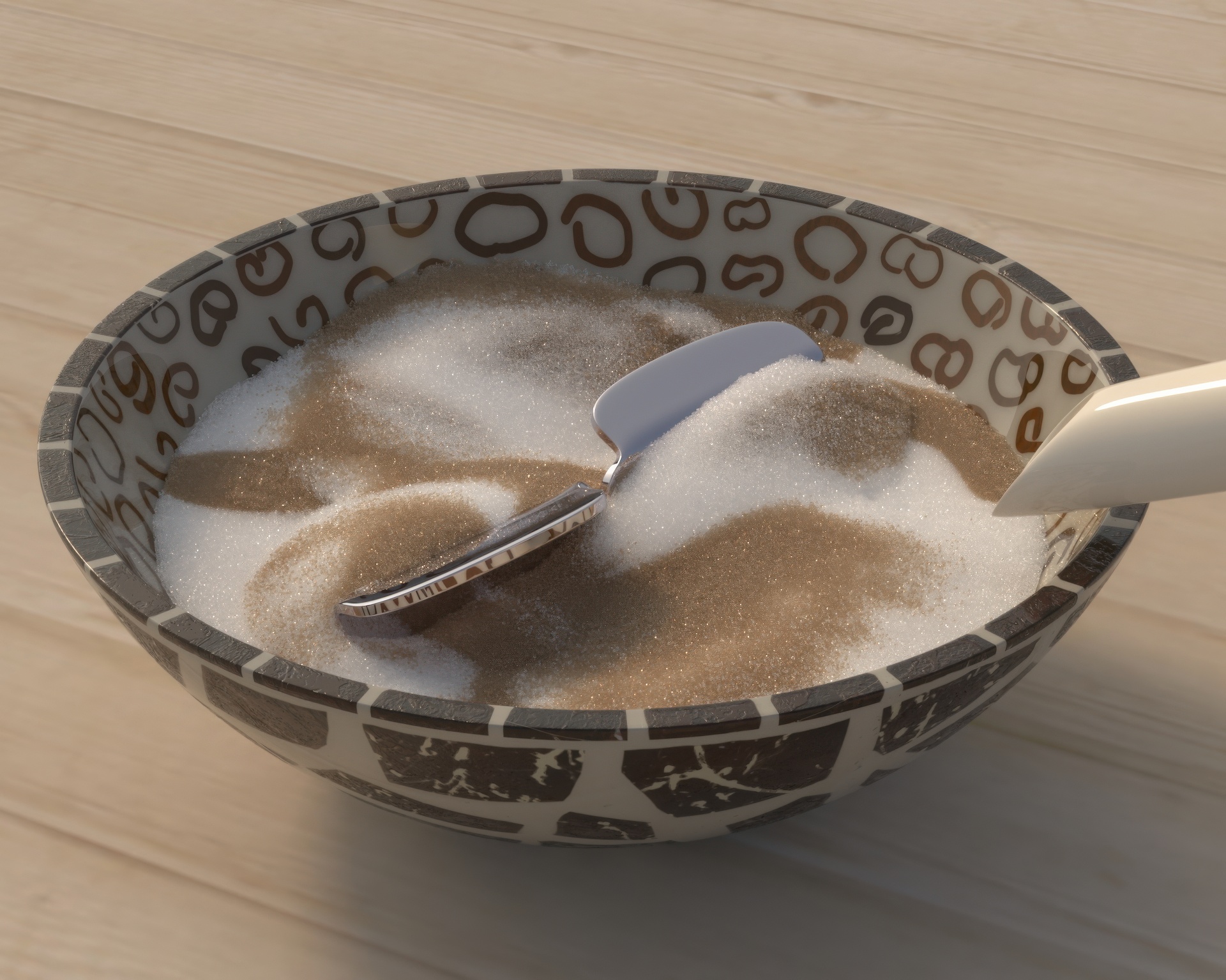
We address the challenge of efficiently rendering massive assemblies of grains within a forward path-tracing framework. Previous approaches exist for accelerating high-order scattering for a limited, and static, set of granular materials, often requiring scene-dependent precomputation. We significantly expand the admissible regime of granular materials by considering heterogeneous and dynamic granular mixtures with spatially varying grain concentrations, pack rates, and sizes. Our method supports both procedurally generated grain assemblies and dynamic assemblies authored in off-the-shelf particle simulation tools. The key to our speedup lies in two complementary aggregate scattering approximations which we introduced to jointly accelerate construction of short and long light paths. For low-order scattering, we accelerate path construction using novel grain scattering distribution functions (GSDF) which aggregate intra-grain light transport while retaining important grain-level structure. For high-order scattering, we extend prior work on shell transport functions (STF) to support dynamic, heterogeneous mixtures of grains with varying sizes. We do this without a scene-dependent precomputation and show how this can also be used to accelerate light transport in arbitrary continuous heterogeneous media. Our multi-scale rendering automatically minimizes the usage of explicit path tracing to only the first grain along a light path, or can avoid it completely, when appropriate, by switching to our aggregate transport approximations. We demonstrate our technique on animated scenes containing heterogeneous mixtures of various types of grains that could not previously be rendered efficiently. We also compare to previous work on a simpler class of granular assemblies, reporting significant computation savings, often yielding higher accuracy results.
References:
1. Ashikhmin, M., Premoze, S., and Shirley, P. S. 2000. A microfacet-based BRDF generator. In Proc. SIGGRAPH, 65–74.
2. Chandrasekar, S. 1960. Radiative Transfer. Dover Publications.
3. Debevec, P., Hawkins, T., Tchou, C., Duiker, H.-P., Sarokin, W., and Sagar, M. 2000. Acquiring the reflectance field of a human face. In Proc. SIGGRAPH, 145–156.
4. d’Eon, E., and Irving, G. 2011. A quantized-diffusion model for rendering translucent materials. ACM TOG 30, 4 (July), 56:1–56:14.
5. d’Eon, E., Francois, G., Hill, M., Letteri, J., and Aubry, J.-M. 2011. An energy-conserving hair reflectance model. In Proc. EGSR, Eurographics Association, 1181–1187.
6. d’Eon, E., Marschner, S., and Hanika, J. 2013. Importance sampling for physically-based hair fiber models. In SIGGRAPH Asia 2013 Technical Briefs, SA ’13, 25:1–25:4.
7. Dixmier, M. 1978. Une nouvelle description des empilements aléatoires et des fluides denses. Le Journal de Physique 39, 873–895. Cross Ref
8. Dullien, F. A. L. 1991. Porous Media: Fluid Transport and Pore Structure, 2nd ed. Academic Press Inc.
9. Habel, R., Christensen, P. H., and Jarosz, W. 2013. Photon beam diffusion: A hybrid monte carlo method for subsurface scattering. Computer Graphics Forum 32, 4 (June).
10. Henyey, L. G., and Greenstein, J. L. 1941. Diffuse radiation in the galaxy. The Astrophysical Journal 93, 70–83. Cross Ref
11. Hery, C., and Ramamoorthi, R. 2012. Importance sampling of reflection from hair fibers. Journal of Computer Graphics Techniques.
12. Jakob, W., Moon, J. T., and Marschner, S. 2009. Capturing hair assemblies fiber by fiber. ACM TOG 28, 5 (Dec.), 164:1–164:9.
13. Jakob, W., d’Eon, E., Jakob, O., and Marschner, S. 2014. A comprehensive framework for rendering layered materials. ACM TOG 33, 4 (July), 118:1–118:14.
14. Jakob, W., Hašan, M., Yan, L.-Q., Lawrence, J., Ramamoorthi, R., and Marschner, S. 2014. Discrete stochastic microfacet models. ACM TOG 33, 4 (July), 115:1–115:10.
15. Jakob, W., 2010. Mitsuba renderer. http://mitsuba-renderer.org.
16. Jensen, H. W., Marschner, S. R., Levoy, M., and Hanrahan, P. 2001. A practical model for subsurface light transport. In Proc. SIGGRAPH, 511–518.
17. Kajiya, J. T., and Kay, T. L. 1989. Rendering fur with three dimensional textures. In Computer Graphics, 271–280.
18. Kajiya, J. T. 1986. The rendering equation. Computer Graphics 20, 143–150.
19. Kimmel, B. W., and Baranoski, G. V. G. 2007. A novel approach for simulating light interaction with particulate materials: application to the modeling of sand spectral properties. Optics Express 15, 15 (July), 9755–9777. Cross Ref
20. Lafortune, E. P., and Willems, Y. D. 1996. Rendering participating media with bidirectional path tracing. In Proc. EGWR, 91–100.
21. Lee, R., and O’Sullivan, C. 2007. Accelerated light propagation through participating media. In Proc. Eurographics / Ieee VGTC Conference on Volume Graphics, 17–23.
22. Levoy, M., and Hanrahan, P. M. 1996. Light field rendering. In Proc. SIGGRAPH, 31–42.
23. Li, H., Pellacini, F., and Torrance, K. E. 2005. A hybrid Monte Carlo method for accurate and efficient subsurface scattering. In Proc. EGSR, 283–290.
24. Loos, B. J., Antani, L., Mitchell, K., Nowrouzezahrai, D., Jarosz, W., and Sloan, P.-P. 2011. Modular radiance transfer. ACM TOG 30, 6 (Dec.).
25. Marschner, S. R., Jensen, H. W., Cammarano, M., Worley, S., and Hanrahan, P. 2003. Light scattering from human hair fibers. ACM TOG 22, 3 (July), 780–791.
26. Matusik, W., Pfister, H., Brand, M., and McMillan, L. 2003. A data-driven reflectance model. ACM TOG 22, 3 (July), 759–769.
27. Meng, J., Papas, M., Habel, R., Dachsbacher, C., Marschner, S., Gross, M., and Jarosz, W. 2015. Multi-scale modeling and rendering of granular materials. ACM TOG 34, 4 (July), 49:1–49:13.
28. Moon, J. T., Walter, B., and Marschner, S. R. 2007. Rendering discrete random media using precomputed scattering solutions. In Proc. EGSR, 231–242.
29. Neyret, F. 1998. Modeling, animating, and rendering complex scenes using volumetric textures. IEEE Trans. on Visualization and Computer Graphics 4, 1 (Jan./Mar.), 55–70.
30. Nicodemus, F. E., Richmond, J. C., Hsia, J. J., Ginsberg, I. W., and Limperis, T. 1992. Geometrical considerations and nomenclature for reflectance. In Radiometry. 94–145.
31. Ou, J., Xie, F., Krishnamachari, P., and Pellacini, F. 2012. ISHair: Importance Sampling for Hair Scattering. Computer Graphics Forum 31, 4, 1537–1545.
32. Peers, P., vom Berge, K., Matusik, W., Ramamoorthi, R., Lawrence, J., Rusinkiewicz, S., and Dutré, P. 2006. A compact factored representation of heterogeneous subsurface scattering. ACM TOG 25, 3 (July), 746–753.
33. Pharr, M., and Hanrahan, P. M. 2000. Monte carlo evaluation of non-linear scattering equations for subsurface reflection. In Proc. SIGGRAPH, 75–84.
34. Ramamoorthi, R. 2009. Precomputation-based rendering. Found. Trends. Comput. Graph. Vis. 3, 4 (Apr.), 281–369.
35. Sadeghi, I., Muñoz, A., Laven, P., Jarosz, W., Seron, F., Gutierrez, D., and Jensen, H. W. 2012. Physically-based simulation of rainbows. ACM TOG 31, 1 (Feb.), 3:1–3:12.
36. Sadeghi, I., Bisker, O., De Deken, J., and Jensen, H. W. 2013. A practical microcylinder appearance model for cloth rendering. ACM TOG 32, 2 (Apr.), 14:1–14:12.
37. Schröder, K., Klein, R., and Zinke, A. 2011. A volumetric approach to predictive rendering of fabrics. Computer Graphics Forum 30, 4 (July), 1277–1286.
38. Skoge, M., Donev, A., Stillinger, F. H., and Torquato, S. 2006. Packing hyperspheres in high-dimensional Euclidean spaces. Physical Review E 74, 4, 041127. Cross Ref
39. Song, C., Wang, P., and Makse, H. A. 2008. A phase diagram for jammed matter. Nature, 7195, 629–632. Cross Ref
40. Stam, J. 1995. Multiple scattering as a diffusion process. Proc. EGWR, 41–50. Cross Ref
41. Torquato, S., and Lu, B. 1993. Chord-length distribution function for two-phase random media. Physical Review E 47 (Apr.), 2950–2953. Cross Ref
42. Torrance, K. E., and Sparrow, E. M. 1967. Theory for off-specular reflection from roughened surfaces. Journal of the Optical Society of America 57, 9 (Sept.), 1105–1112. Cross Ref
43. Veach, E., and Guibas, L. J. 1995. Optimally combining sampling techniques for monte carlo rendering. In Proc. SIGGRAPH, 419–428.
44. Wei, Y., Ofek, E., Quan, L., and Shum, H.-Y. 2005. Modeling hair from multiple views. ACM TOG 24, 3 (July), 816–820.
45. Westin, S. H., Arvo, J. R., and Torrance, K. E. 1992. Predicting reflectance functions from complex surfaces. In Computer Graphics, 255–264.
46. Xu, Y.-Q., Chen, Y., Lin, S., Zhong, H., Wu, E., Guo, B., and Shum, H.-Y. 2001. Photorealistic rendering of knitwear using the lumislice. In Proc. SIGGRAPH, 391–398.
47. Yan, L.-Q., Hašan, M., Jakob, W., Lawrence, J., Marschner, S., and Ramamoorthi, R. 2014. Rendering glints on high-resolution normal-mapped specular surfaces. ACM TOG 33, 4 (July), 116:1–116:9.
48. Yan, L.-Q., Tseng, C.-W., Jensen, H. W., and Ramamoorthi, R. 2015. Physically-accurate fur reflectance: Modeling, measurement and rendering. ACM TOG 34, 6 (Oct.), 185:1–185:13.
49. Zhao, S., Hašan, M., Ramamoorthi, R., and Bala, K. 2013. Modular flux transfer: efficient rendering of high-resolution volumes with repeated structures. ACM TOG 32, 4 (July), 131:1–131:12.
50. Zhao, S., Ramamoorthi, R., and Bala, K. 2014. High-order similarity relations in radiative transfer. ACM TOG 33, 4 (July), 104:1–104:12.
51. Zinke, A., and Weber, A. 2007. Light scattering from filaments. IEEE Transactions on Visualization and Computer Graphics 13, 2, 342–356.