“Anisotropic Gaussian mutations for metropolis light transport through Hessian-Hamiltonian dynamics” by Li, Lehtinen, Ramamoorthi, Jakob and Durand
Conference:
Type(s):
Title:
- Anisotropic Gaussian mutations for metropolis light transport through Hessian-Hamiltonian dynamics
Session/Category Title: Sampling and Light Transport
Presenter(s)/Author(s):
Abstract:
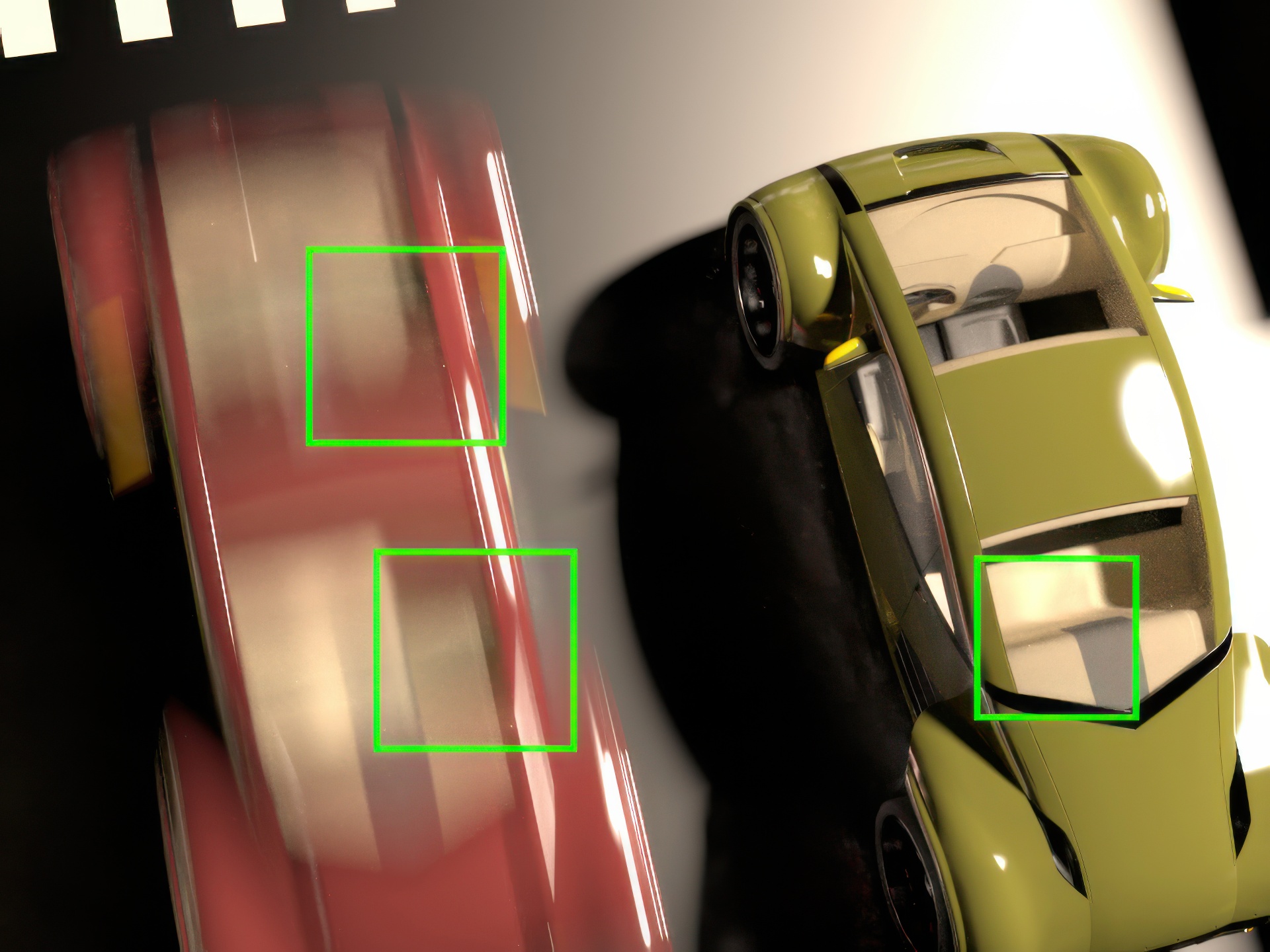
The simulation of light transport in the presence of multi-bounce glossy effects and motion is challenging because the integrand is high dimensional and areas of high-contribution tend to be narrow and hard to sample. We present a Markov Chain Monte Carlo (MCMC) rendering algorithm that extends Metropolis Light Transport by automatically and explicitly adapting to the local shape of the integrand, thereby increasing the acceptance rate. Our algorithm characterizes the local behavior of throughput in path space using its gradient as well as its Hessian. In particular, the Hessian is able to capture the strong anisotropy of the integrand. We obtain the derivatives using automatic differentiation, which makes our solution general and easy to extend to additional sampling dimensions such as time.However, the resulting second order Taylor expansion is not a proper distribution and cannot be used directly for importance sampling. Instead, we use ideas from Hamiltonian Monte-Carlo and simulate the Hamiltonian dynamics in a flipped version of the Taylor expansion where gravity pulls particles towards the high-contribution region. Whereas such methods usually require numerical integration, we show that our quadratic landscape leads to a closed-form anisotropic Gaussian distribution for the final particle positions, and it results in a standard Metropolis-Hastings algorithm. Our method excels at rendering glossy-to-glossy reflections on small and highly curved surfaces. Furthermore, unlike previous work that derives sampling anisotropy with pen and paper and only considers specific effects such as specular BSDFs, we characterize the local shape of throughput through automatic differentiation. This makes our approach very general. In particular, our method is the first MCMC rendering algorithm that is able to resolve the anisotropy in the time dimension and render difficult moving caustics.
References:
1. Andrieu, C., and Thoms, J. 2008. A tutorial on adaptive MCMC. Statistics and Computing 18, 4, 343–373.
2. Belcour, L., Soler, C., Subr, K., Holzschuch, N., and Durand, F. 2013. 5d covariance tracing for efficient defocus and motion blur. ACM Trans. Graph. 32, 3, 31.
3. Bell, B., 2003–2015. CppAD: A package for differentiation of C++ algorithms. http://www.coin-or.org/CppAD/.
4. Betancourt, M. 2013. A general metric for riemannian manifold hamiltonian monte carlo. In GSI 2013, 327–334.
5. Chen, M., and Arvo, J. 2000. Theory and application of specular path perturbation. ACM Trans. Graph. 19, 4, 246–278.
6. Cline, D., Talbot, J., and Egbert, P. 2005. Energy redistribution path tracing. ACM Trans. Graph. (Proc. SIGGRAPH) 24, 3 (July), 1186–1195.
7. Duane, S., Kennedy, A. D., Pendleton, B. J., and Roweth, D. 1987. Hybrid monte carlo. Physics Letters B 195, 2, 216–222.
8. Girolami, M., and Calderhead, B. 2011. Riemann manifold langevin and hamiltonian monte carlo methods. Journal of the Royal Statistical Society: Series B (Statistical Methodology) (With Discussion) 73, 123–214.
9. Griewank, A., and Walther, A. 2008. Evaluating Derivatives: Principles and Techniques of Algorithmic Differentiation, second ed. Society for Industrial and Applied Mathematics, Philadelphia, PA, USA.
10. Grinspun, E., Hirani, A. N., Desbrun, M., and Schröder, P. 2003. Discrete shells. In SCA 2003.
11. Gritz, L., Stein, C., Kulla, C., and Conty, A. 2010. Open shading language. In SIGGRAPH 2010 Talks, 33:1–33:1.
12. Guenter, B. K. 2007. Efficient symbolic differentiation for graphics applications. ACM Trans. Graph. (Proc. SIGGRAPH) 26, 3, 108.
13. Hachisuka, T., Kaplanyan, A. S., and Dachsbacher, C. 2014. Multiplexed metropolis light transport. ACM Trans. Graph. (Proc. SIGGRAPH) 33, 4, 100.
14. Hanika, J., Kaplanyan, A., and Dachsbacher, C. 2015. Improved half vector space light transport. Computer Graphics Forum (Proc. EGSR) 34, 4, 65–74.
15. Hastings, W. K. 1970. Monte carlo sampling methods using markov chains and their applications. Biometrika 57, 1, 97–109.
16. Holzschuch, N., and Sillion, F. X. 1998. An exhaustive error-bounding algorithm for hierarchical radiosity. Computer Graphics Forum 17, 4, 197–218.
17. Igehy, H. 1999. Tracing ray differentials. SIGGRAPH 1999, 179–186.
18. Jakob, W., and Marschner, S. 2012. Manifold exploration: a markov chain monte carlo technique for rendering scenes with difficult specular transport. ACM Trans. Graph. (Proc. SIGGRAPH) 31, 4, 58.
19. Jakob, W., 2010. Mitsuba renderer. http://www.mitsubarenderer.org.
20. Kaplanyan, A. S., Hanika, J., and Dachsbacher, C. 2014. The natural-constraint representation of the path space for efficient light transport simulation. ACM Trans. Graph. (Proc. SIGGRAPH) 33, 4, 102.
21. Kelemen, C., Szirmay-Kalos, L., Antal, G., and Csonka, F. 2002. A simple and robust mutation strategy for the metropolis light transport algorithm. Comput. Graph. Forum (Proc. Eurographics) 21, 3, 531–540.
22. Kettunen, M., Manzi, M., Aittala, M., Lehtinen, J., Durand, F., and Zwicker, M. 2015. Gradient-domain path tracing. ACM Trans. Graph. (Proc. SIGGRAPH) 34, 4 (July), 123.
23. Kitaoka, S., Kitamura, Y., and Kishino, F. 2009. Replica exchange light transport. Computer Graphics Forum 28, 8 (Dec.), 2330–2342.
24. Lai, Y., Fan, S., Chenney, S., and Dyer, C. 2007. Photorealistic image rendering with population monte carlo energy redistribution. Rendering Techniques (Proc. EGSR), 287–295.
25. Lai, Y.-C.,, Liu, F., and Dyer, C. 2009. Physically-based animation rendering with markov chain monte carlo. University of Wisconsin – Madison Computer Sciences Department, UW-CS-TR-1653.
26. Leal, J. R., 2011–2015. CppADCodeGen. https://github.com/joaoleal/CppADCodeGen/.
27. Lehtinen, J., Karras, T., Laine, S., Aittala, M., Durand, F., and Aila, T. 2013. Gradient-domain metropolis light transport. ACM Trans. Graph. (Proc. SIGGRAPH) 32, 4, 95.
28. Metropolis, N., Rosenbluth, A. W., Rosenbluth, M. N., Teller, A. H., and Teller, E. 1953. Equation of state calculations by fast computing machines. J. Chem. Phys. 21, 6, 1087–1092.
29. Neal, R. M. 2010. MCMC using Hamiltonian dynamics. Handbook of Markov Chain Monte Carlo 54, 113–162.
30. Piponi, D. 2004. Automatic differentiation, C++ templates, and photogrammetry. Journal of graphics, GPU, and game tools 9, 4, 41–55.
31. Ramamoorthi, R., Mahajan, D., and Belhumeur, P. 2007. A first-order analysis of lighting, shading, and shadows. ACM Trans. Graph. 26, 1, 2.
32. Ritchie, D., Lin, S., Goodman, N. D., and Hanrahan, P. 2015. Generating design suggestions under tight co.traint.ith gradient-based probabilistic programming. Comput. Graph. Forum (Proc. Eurographics) 34, 2, 515–526.
33. Roberts, G. O., and Tweedie, R. L. 1996. Exponential convergence of langevin distributions and their discrete approximations. Bernoulli 2, 4, 341–363.
34. Schwarzhaupt, J., Jensen, H. W., and Jarosz, W. 2012. Practical hessian-based error control for irradiance caching. ACM Trans. Graph. (Proc. SIGGRAPH Asia) 31, 6, 193.
35. Shinya, M., Takahashi, T., and Naito, S. 1987. Principles and applications of pencil tracing. Comput. Graph. 21, 4, 45–54.
36. Suykens, F., and Willems, Y. D. 2001. Path differentials and applications. In Eurographics Workshop on Rendering Techniques, 257–268.
37. Veach, E., and Guibas, L. J. 1995. Optimally combining sampling techniques for monte carlo rendering. SIGGRAPH 1995, 419–428.
38. Veach, E., and Guibas, L. J. 1997. Metropolis light transport. SIGGRAPH 1997, 65–76.
39. Veach, E. 1998. Robust Monte Carlo Methods for Light Transport Simulation. PhD thesis, Stanford, CA, USA.
40. Wald, I., Woop, S., Benthin, C., Johnson, G. S., and Ernst, M. 2014. Embree: A kernel framework for efficient cpu ray tracing. ACM Trans. Graph. 33, 4, 143.
41. Walter, B., Marschner, S. R., Li, H., and Torrance, K. E. 2007. Microfacet models for refraction through rough surfaces. In Rendering Techniques (Proc. EGSR), 195–206.
42. Ward, G., and Heckbert, P. 1992. Irradiance gradients. In Eurographics Rendering Workshop, 85–98.
43. Ward, G. J., Rubinstein, F. M., and Clear, R. D. 1988. A ray tracing solution for diffuse interreflection. SIGGRAPH 1988, 85–92.