“DressUp!: outfit synthesis through automatic optimization” by Yu, Yeung, Terzopoulos and Chan
Conference:
Type(s):
Title:
- DressUp!: outfit synthesis through automatic optimization
Session/Category Title:
- Operating on Images
Presenter(s)/Author(s):
Abstract:
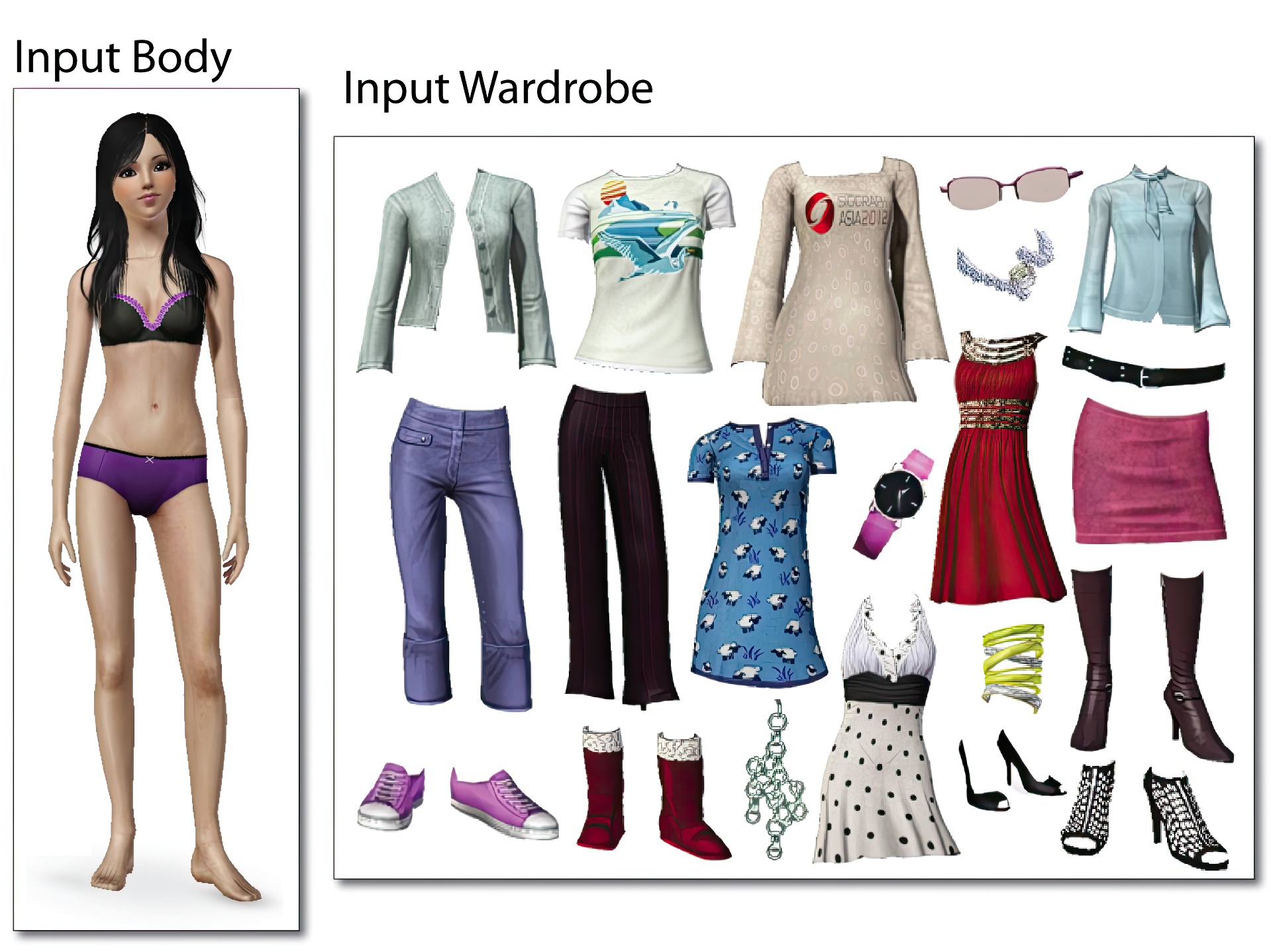
We present an automatic optimization approach to outfit synthesis. Given the hair color, eye color, and skin color of the input body, plus a wardrobe of clothing items, our outfit synthesis system suggests a set of outfits subject to a particular dress code. We introduce a probabilistic framework for modeling and applying dress codes that exploits a Bayesian network trained on example images of real-world outfits. Suitable outfits are then obtained by optimizing a cost function that guides the selection of clothing items to maximize the color compatibility and dress code suitability. We demonstrate our approach on the four most common dress codes: Casual, Sportswear, Business-Casual, and Business. A perceptual study validated on multiple resultant outfits demonstrates the efficacy of our framework.
References:
1. Andrieu, C., De Freitas, N., Doucet, A., and Jordan, M. I. 2003. An introduction to mcmc for machine learning. Science 50, 1, 5–43.
2. Baraff, D., and Witkin, A. 1998. Large steps in cloth simulation. In SIGGRAPH ’98: Proceedings of the 25th annual conference on Computer graphics and interactive techniques, ACM Press, New York, NY, USA, 43–54.
3. Chaudhuri, S., Kalogerakis, E., Guibas, L., and Koltun, V. 2011. Probabilistic reasoning for assembly-based 3D modeling. ACM Transactions on Graphics 30, 4.
4. Cohen-Or, D., Sorkine, O., Gal, R., Leyvand, T., and Xu, Y.-Q. 2006. Color harmonization. ACM Transactions on Graphics (Proceedings of ACM SIGGRAPH) 25, 3, 624–630.
5. Cristianini, N., and Shawe-Taylor, J. 2000. An Introduction to Support Vector Machines and Other Kernel-based Learning Methods. Cambridge University Press.
6. de Aguiar, E., Sigal, L., Treuille, A., and Hodgins, J. K. 2010. Stable spaces for real-time clothing. ACM Trans. Graph. 29, 4.
7. Dobbyn, S., McDonnell, R., Kavan, L., Collins, S., and O’Sullivan, C. 2006. Clothing the Masses: Real-Time Clothed Crowds With Variation. In Eurographics Short Papers (EG’06), 103–106.
8. Feng, W.-W., Yu, Y., and Kim, B.-U. 2010. A deformation transformer for real-time cloth animation. ACM Trans. Graph. 29, 4.
9. Fischer-Mirkin, T. 1995. Dress Code: Understanding the Hidden Meanings of Women’s Clothes. Clarkson Potter, New York, NY.
10. Flusser, A. J. 2002. Dressing the Man: Mastering the Art of Permanent Fashion. HarperCollins.
11. Friedman, N., Geiger, D., and Goldszmidt, M. 1997. Bayesian network classifiers. Mach. Learn. 29, 2–3 (Nov.), 131–163.
12. Gilchrist, R. A. 2011. The Encyclopedia of Men’s Clothes.
13. Godsill, S. J. 2001. On the relationship between markov chain monte carlo methods for model uncertainty. Journal Of Computational And Graphical Statistics 10, 2, 1–19.
14. Green, P. J. 1995. Reversible jump markov chain monte carlo computation and bayesian model determination. Biometrika 82, 711–732.
15. Green, P. J. 2003. Highly structured stochastics systems. Oxford University Press, Oxford, UK, ch. Trans-dimensional Markov Chain Monte Carlo, 179–196.
16. Guan, P., Reiss, L., Hirshberg, D. A., Weiss, A., and Black, M. J. 2012. Drape: Dressing any person. ACM Trans. Graph. 31, 4, 35.
17. Hastings, W. 1970. Monte Carlo samping methods using Markov chains and their applications. Biometrika, 97–109.
18. Henderson, V., and Henshaw, P. 2008. Color Me Confident: Change Your Look – Change Your Life!. Hamlyn, London, UK.
19. Jackson, C., and Lulow, K. 1984. Color for Men. Ballantine Books, New York, NY.
20. Jackson, C. 1987. Color Me Beautiful. Ballantine Books, New York, NY.
21. Jagnow, R., Dorsey, J., and Rushmeier, H. 2008. Evaluation of methods for approximating shapes used to synthesize 3D solid textures. ACM Trans. Appl. Percept. 4, 4, 1–27.
22. Jimenez, J., Sundstedt, V., and Gutierrez, D. 2009. Screen-space perceptual rendering of human skin. ACM Trans. Appl. Percept. 6, 4, 1–15.
23. Kaldor, J. M., James, D. L., and Marschner, S. 2008. Simulating knitted cloth at the yarn level. ACM Trans. Graph. 27, 3.
24. Kaldor, J. M., James, D. L., and Marschner, S. 2010. Efficient yarn-based cloth with adaptive contact linearization. ACM Trans. Graph. 29, 4.
25. Kavan, L., Gerszewski, D., Bargteil, A. W., and Sloan, P.-P. 2011. Physics-inspired upsampling for cloth simulation in games. ACM Trans. Graph. 30, 4, 93.
26. Koller, D., and Friedman, N. 2009. Probabilistic Graphical Models: Principles and Techniques. MIT Press.
27. McDonnell, R., Dobbyn, S., and O’Sullivan, C. 2006. Crowd Creation Pipeline for Games. In International Conference on Computer Games (CGames’06), 183–190.
28. McDonnell, R., Larkin, M., Dobbyn, S., Collins, S., and O’Sullivan, C. 2008. Clone attack! perception of crowd variety. ACM Trans. Graph. 27, 3.
29. McDonnell, R., Larkin, M., Hernández, B., Rudomín, I., and O’Sullivan, C. 2009. Eye-catching crowds: saliency based selective variation. ACM Trans. Graph. 28, 3.
30. Merrell, P., Schkufza, E., and Koltun, V. 2010. Computer-generated residential building layouts. ACM Trans. Graph. 29, 181:1–181:12.
31. Metropolis, N., Rosenbluth, A. W., Rosenbluth, M. N., Teller, A. H., and Teller, E. 1953. Equation of state calculations by fast computing machines. Journal of Chemical Physics 21, 1087–1092.
32. Nicholson, J. 2003. Dressing smart for women: 101 mistakes you can’t afford to make and how to avoid them. Impact Publications, Manassas, VA.
33. O’Donovan, P., Agarwala, A., and Hertzmann, A. 2011. Color compatibility from large datasets. ACM Trans. Graph. 30, 4, 63.
34. O’Sullivan, C. 2009. Variety is the spice of (virtual) life. In MIG, 84–93.
35. Pearl, J. 1988. Probabilistic reasoning in intelligent systems: networks of plausible inference. Morgan Kaufmann Publishers Inc., San Francisco, CA, USA.
36. Provot, X. 1995. Deformation constraints in a mass–spring model to describe rigid cloth behavior. In Graphics Interface ’95, 147–154.
37. Schneider, J. J., and Kirkpatrick, S. 2006. Stochastic Optimization (Scientific Computation). Springer-Verlag, Berlin.
38. Schoeffler, O. E., and Gale, W. 1973. Esquire’s encyclopedia of 20th century men’s fashions. McGraw-Hill, New York, NY.
39. Sondag, G. R. 2011. Anything Other Than Naked – A guide for men on how to dress properly for every occassion. Two Harbors Press.
40. Talton, J. O., Lou, Y., Lesser, S., Duke, J., Mech, R., and Koltun, V. 2011. Metropolis procedural modeling. ACM Trans. Graph. 30, 2, 11.
41. Tecchia, F., Loscos, C., and Chrysanthou, Y. 2002. Image-based crowd rendering. IEEE Computer Graphics and Applications 22, 36–43.
42. Terzopoulos, D., and Fleischer, K. W. 1988. Deformable models. The Visual Computer 4, 6, 306–331.
43. Terzopoulos, D., Platt, J. C., Barr, A. H., and Fleischer, K. W. 1987. Elastically deformable models. In SIGGRAPH, 205–214.
44. Thalmann, D., O’Sullivan, C., Yersin, B., Mam, J., and McDonnell, R. 2007. EG 2007 Course on Populating Virtual Environments with Crowds. 23–123.
45. Tsujita, H., Tsukada, K., Kambara, K., and Siio, I. 2010. Complete fashion coordinator: a support system for capturing and selecting daily clothes with social networks. In Proceedings of the International Conference on Advanced Visual Interfaces, ACM, New York, NY, USA, AVI ’10, 127–132.
46. Tu, Z., and Zhu, S.-C. 2002. Image segmentation by data-driven markov chain monte carlo. IEEE Trans. Pattern Anal. Mach. Intell. 24 (May), 657–673.
47. Ulicny, B., Ciechomski, P. d. H., and Thalmann, D. 2004. Crowdbrush: Interactive authoring of real-time crowd scenes. In Proceedings of the 2004 ACM SIGGRAPH/Eurographics symposium on Computer animation, Eurographics Association, Aire-la-Ville, Switzerland, Switzerland, SCA ’04, 243–252.
48. Umetani, N., Kaufman, D. M., Igarashi, T., and Grinspun, E. 2011. Sensitive couture for interactive garment modeling and editing. ACM Trans. Graph. 30 (Aug.), 90:1–90:12.
49. Volino, P., Magnenat-Thalmann, N., and Faure, F. 2009. A simple approach to nonlinear tensile stiffness for accurate cloth simulation. ACM Trans. Graph. 28, 4.
50. Wang, H., Hecht, F., Ramamoorthi, R., and O’Brien, J. F. 2010. Example-based wrinkle synthesis for clothing animation. ACM Trans. Graph. 29, 4.
51. Wang, H., O’Brien, J. F., and Ramamoorthi, R. 2011. Data-driven elastic models for cloth: modeling and measurement. ACM Trans. Graph. 30, 4, 71.
52. Yeung, S. K., Tang, C.-K., Brown, M. S., and Kang, S. B. 2011. Matting and compositing of transparent and refractive objects. ACM Transactions on Graphics 30, 1, 2.
53. Yu, L.-F., Yeung, S. K., Tang, C.-K., Terzopoulos, D., Chan, T. F., and Osher, S. 2011. Make it home: automatic optimization of furniture arrangement. ACM Transactions on Graphics 30, 4, 86.
54. Zyla, D. 2010. The Color of Style. Dutton Adult, New York, NY.