“Position-free monte carlo simulation for arbitrary layered BSDFs” by Guo, Hasan and Zhao
Conference:
Type(s):
Title:
- Position-free monte carlo simulation for arbitrary layered BSDFs
Session/Category Title:
- Rendering & reflectance
Presenter(s)/Author(s):
Moderator(s):
Abstract:
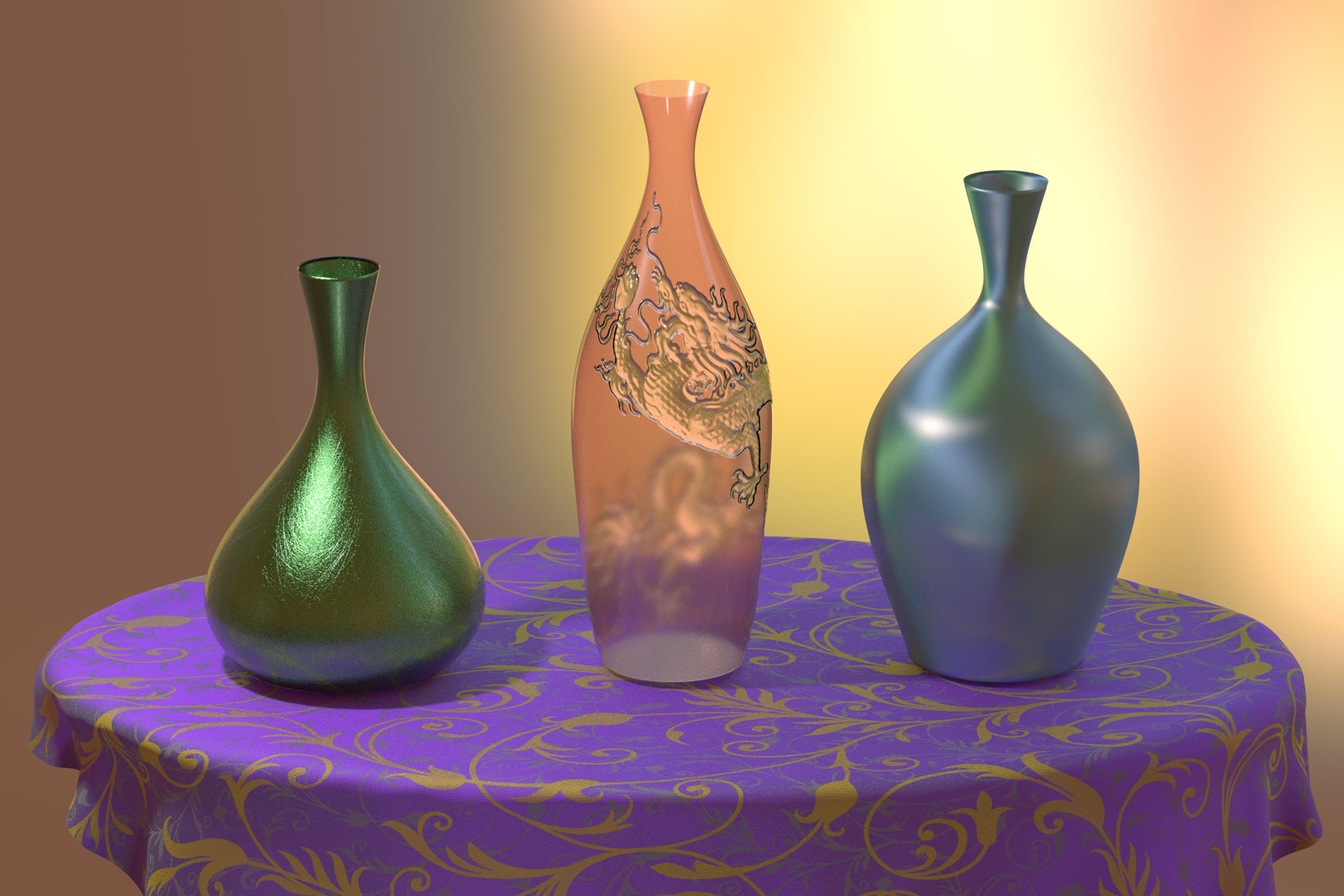
Real-world materials are often layered: metallic paints, biological tissues, and many more. Variation in the interface and volumetric scattering properties of the layers leads to a rich diversity of material appearances from anisotropic highlights to complex textures and relief patterns. However, simulating light-layer interactions is a challenging problem. Past analytical or numerical solutions either introduce several approximations and limitations, or rely on expensive operations on discretized BSDFs, preventing the ability to freely vary the layer properties spatially. We introduce a new unbiased layered BSDF model based on Monte Carlo simulation, whose only assumption is the layer assumption itself. Our novel position-free path formulation is fundamentally more powerful at constructing light transport paths than generic light transport algorithms applied to the special case of flat layers, since it is based on a product of solid angle instead of area measures, so does not contain the high-variance geometry terms needed in the standard formulation. We introduce two techniques for sampling the position-free path integral, a forward path tracer with next-event estimation and a full bidirectional estimator. We show a number of examples, featuring multiple layers with surface and volumetric scattering, surface and phase function anisotropy, and spatial variation in all parameters.
References:
1. Laurent Belcour. 2018. Efficient Rendering of Layered Materials using an Atomic Decomposition with Statistical Operators. ACM Trans. Graph. (2018). Google ScholarDigital Library
2. Antoine Bouthors, Fabrice Neyret, and Sylvain Lefebvre. 2006. Real-time realistic illumination and shading of stratiform clouds. In Eurographics Workshop on Natural Phenomena. Google ScholarDigital Library
3. R. L. Cook and K. E. Torrance. 1982. A Reflectance Model for Computer Graphics. ACM Trans. Graph. 1, 1 (1982), 7–24. Google ScholarDigital Library
4. Craig Donner, Tim Weyrich, Eugene d’Eon, Ravi Ramamoorthi, and Szymon Rusinkiewicz. 2008. A Layered, Heterogeneous Reflectance Model for Acquiring and Rendering Human Skin. ACM Trans. Graph. 27, 5 (2008), 140:1–140:12. Google ScholarDigital Library
5. Jeppe Revall Frisvad, Toshiya Hachisuka, and Thomas Kim Kjeldsen. 2014. Directional Dipole Model for Subsurface Scattering. ACM Trans. Graph. 34, 1 (2014), 5:1–5:12. Google ScholarDigital Library
6. Jie Guo, Jinghui Qian, Yanwen Guo, and Jingui Pan. 2017. Rendering Thin Transparent Layers with Extended Normal Distribution Functions. IEEE transactions on visualization and computer graphics 23, 9 (2017), 2108–2119.Google ScholarDigital Library
7. Pat Hanrahan and Wolfgang Krueger. 1993. Reflection from Layered Surfaces Due to Subsurface Scattering. In Proceedings of the 20th Annual Conference on Computer Graphics and Interactive Techniques (SIGGRAPH ’93). ACM, New York, NY, USA, 165–174. Google ScholarDigital Library
8. Eric Heitz, Jonathan Dupuy, Cyril Crassin, and Carsten Dachsbacher. 2015. The SGGX Microflake Distribution. ACM Trans. Graph. 34, 4 (2015), 48:1–48:11. Google ScholarDigital Library
9. Eric Heitz, Johannes Hanika, Eugene d’Eon, and Carsten Dachsbacher. 2016. Multiple-scattering Microfacet BSDFs with the Smith Model. ACM Trans. Graph. 35, 4 (2016), 58:1–58:14. Google ScholarDigital Library
10. Wenzel Jakob. 2010. Mitsuba renderer. (2010). http://www.mitsuba-renderer.org.Google Scholar
11. Wenzel Jakob, Adam Arbree, Jonathan T. Moon, Kavita Bala, and Steve Marschner. 2010. A Radiative Transfer Framework for Rendering Materials with Anisotropic Structure. ACM Trans. Graph. 29, 4 (2010), 53:1–53:13. Google ScholarDigital Library
12. Wenzel Jakob, Eugene d’Eon, Otto Jakob, and Steve Marschner. 2014. A Comprehensive Framework for Rendering Layered Materials. ACM Trans. Graph. 33, 4 (2014), 118:1–118:14. Google ScholarDigital Library
13. Henrik Wann Jensen, Stephen R. Marschner, Marc Levoy, and Pat Hanrahan. 2001. A Practical Model for Subsurface Light Transport. In Proceedings of the 28th Annual Conference on Computer Graphics and Interactive Techniques. 511–518. Google ScholarDigital Library
14. David Koerner, Jan Novák, Peter Kutz, Ralf Habel, and Wojciech Jarosz. 2016. Subdivision Next-event Estimation for Path-traced Subsurface Scattering. In Proceedings of the Eurographics Symposium on Rendering: Experimental Ideas & Implementations (EGSR ’16). 91–96. Google ScholarDigital Library
15. Vincent Schüssler, Eric Heitz, Johannes Hanika, and Carsten Dachsbacher. 2017. Microfacet-based Normal Mapping for Robust Monte Carlo Path Tracing. ACM Trans. Graph. 36, 6 (Nov. 2017), 205:1–205:12. Google ScholarDigital Library
16. Yoshifumi Sekiguchi and Hiroki Kaneko. 2017. Simple ray-tracing model for a rough surface including multiple scattering effects. Applied Optics 56, 1 (2017), 35–45.Google ScholarCross Ref
17. Jos Stam. 2001. An Illumination Model for a Skin Layer Bounded by Rough Surfaces. In Proceedings of the 12th Eurographics Workshop on Rendering Techniques. Springer-Verlag, London, UK, UK, 39–52. http://dl.acm.org/citation.cfm?id=647653.732287 Google ScholarDigital Library
18. Eric Veach. 1997. Robust Monte Carlo Methods for Light Transport Simulation. Ph.D. Dissertation. Stanford University. Google ScholarDigital Library
19. Bruce Walter, Stephen R. Marschner, Hongsong Li, and Kenneth E. Torrance. 2007. Microfacet Models for Refraction Through Rough Surfaces. In Proceedings of the 18th Eurographics Conference on Rendering Techniques. 195–206. Google ScholarDigital Library
20. Bruce Walter, Shuang Zhao, Nicolas Holzschuch, and Kavita Bala. 2009. Single Scattering in Refractive Media with Triangle Mesh Boundaries. ACM Trans. Graph. 28, 3 (2009), 92:1–92:8. Google ScholarDigital Library
21. Andrea Weidlich and Alexander Wilkie. 2007. Arbitrarily Layered Micro-facet Surfaces. In Proc. 5th Int. Conf. Comput. Graph. Interactive Techn. 171–178. Google ScholarDigital Library
22. Tizian Zeltner and Wenzel Jakob. 2018. The Layer Laboratory: A Calculus for Additive and Subtractive Composition of Anisotropic Surface Reflectance. ACM Trans. Graph. (2018). Google ScholarDigital Library
23. Shuang Zhao, Wenzel Jakob, Steve Marschner, and Kavita Bala. 2011. Building Volumetric Appearance Models of Fabric Using Micro CT Imaging. ACM Trans. Graph. 30, 4 (2011), 44:1–44:10. Google ScholarDigital Library